


As an Amazon Associate, Sumizeit earns from qualifying purchases.
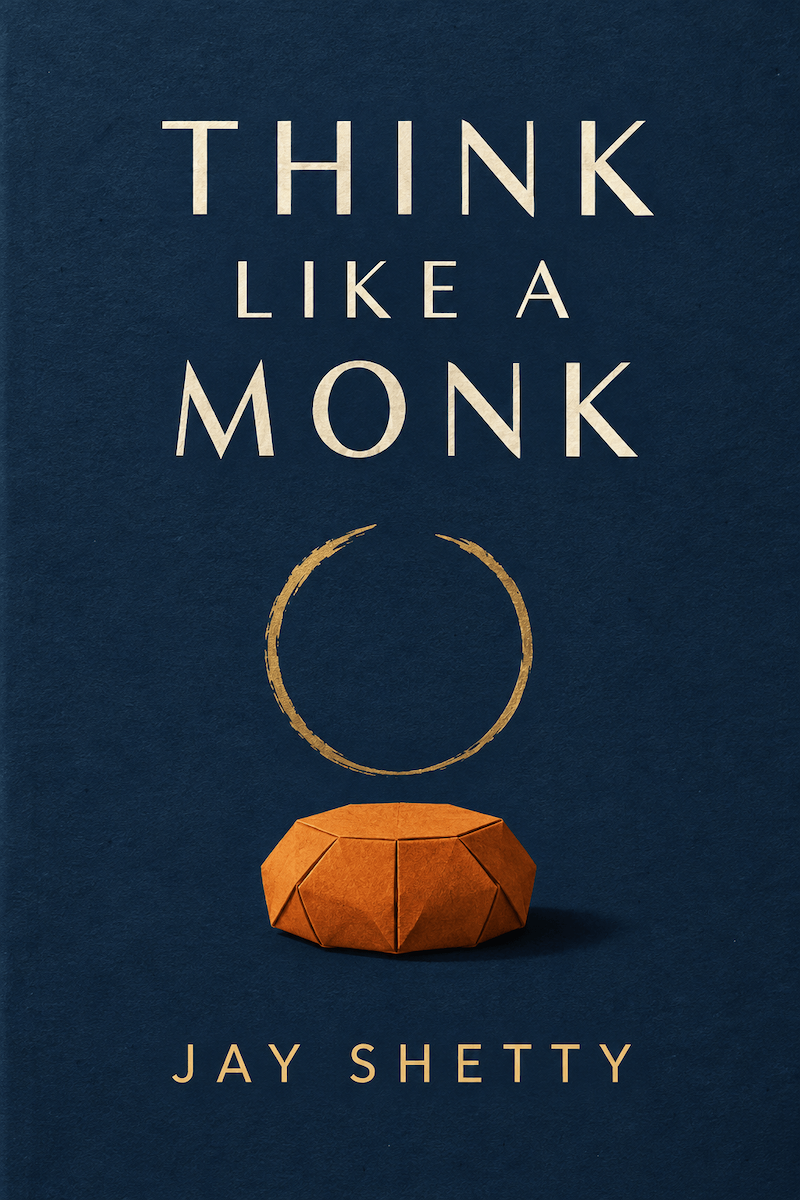
Think Like a Monk Book Summary
This Think Like a Monk Book Summary covers the key ideas, lessons, and takeaways in about 20 minutes.
Helps with these goals
Want the complete 20-minute summary?
- Full structured summary
- Video Summary
- Podcast Summary
- Key takeaways
- Exercises
- Quiz
- Highlights and notes
- Ask the book with AI
What is in the Think Like a Monk book summary?
Below is a preview of Sumizeit’s expert-written summary of Think Like a Monk by Jay Shetty. The full summary covers the book’s key ideas in text, audio, and video.
Jay Shetty spent time as a Vedic monk before building a career as a content creator, and Think Like a Monk is his attempt to bottle what he learned in that ashram into something a regular, busy, non-monk person can actually use. His starting claim is simple: monks are some of the calmest, happiest people around, not because they've escaped the world, but because they live in close alignment with their true values. You don't need to shave your head or give up your possessions to get some of that calm. You just need to strip away the noise that's convinced you happiness looks like something other than what it actually is for you.
Shetty organizes the whole journey into three stages. Purify is about noticing and letting go of the external pressures and internal clutter that have quietly hijacked your sense of what makes you happy. Clarify is about making conscious choices that actually move you toward genuine satisfaction, instead of drifting through life on autopilot. Exemplify is about taking whatever peace and clarity you've built and putting it to use for other people, not just yourself. The three stages build on each other, and Shetty argues the more seriously you work through them, the more the calm compounds.
Part 1: Purify — clearing out what isn't actually yours
Shetty's first big claim is that almost none of us are working from our own definition of happiness. We're working from a definition that got installed in us, piece by piece, starting in childhood. Maybe your parents lit up when you brought home good grades, so somewhere in your head, good grades got wired to affection, and affection got wired to happiness. Multiply that by a thousand small moments across your whole life, with parents, friends, culture, and media all chipping in, and you end up with a mind full of borrowed values you never actually chose.
The result is that you become preoccupied with what you think other people want from you, rather than what you actually want for yourself. And to manage that, you start building personas. A polished professional you at work. A relaxed you with old friends. A dutiful you with your parents. Each version is a slightly different performance, tuned to whatever audience you're in front of. Shetty's point isn't that this is some character flaw, it's just what happens when your sense of self gets built on external approval instead of internal clarity.
There's real psychological backing for this. Researchers who study authenticity find that people genuinely do feel happier when they act in line with their true selves, and more anxious and unhappy when they're performing for approval instead. There's actually a useful diagnostic here: if you often feel embarrassed about things you've said or done, awkward in everyday interactions, misunderstood, afraid of others' opinions, or generally unheard, that's usually a sign you're living from other people's expectations rather than your own values. It becomes a loop too.
Want the complete 20-minute summary?
- Full structured summary
- Video Summary
- Podcast Summary
- Key takeaways
- Exercises
- Quiz
- Highlights and notes
- Ask the book with AI
Who should read Think Like a Monk?
Think Like a Monk is for anyone feeling trapped by expectations that aren't theirs—whether from family, society, or themselves. If you're ambitious but unfulfilled, constantly distracted, or unclear why you're pursuing what you're pursuing, this book offers a practical path to align your life with your actual values rather than borrowed ones.
Why does Think Like a Monk matter?
In a world of endless noise, comparison, and external pressure, most people are chasing happiness based on someone else's definition. Jay Shetty's book directly addresses why that fails and provides a concrete three-stage framework for reclaiming genuine satisfaction through clarity, intention, and purpose.
What are the key themes in Think Like a Monk?
- Living by chosen values rather than inherited or external expectations
- The gap between who you are and the personas you perform for different audiences
- How a negative, distracted mind hijacks your attention and undermines satisfaction
- The relationship between engagement and genuine fulfillment
- Generosity and service as neurological and spiritual sources of lasting happiness
What are the key lessons from the Think Like a Monk book summary?
Your happiness is defined by alignment, not achievement
The degree to which your life matches your actual values determines how meaningful it feels—not your income, status, or accomplishments. Misalignment creates a persistent sense of hollowness even when external success arrives.
You inherit most of your values without choosing them
Through childhood, culture, and media, you absorb a definition of happiness that was never consciously selected. Recognizing this is the first step toward reclaiming your own priorities.
Multiple personas undermine authenticity and increase anxiety
When you perform different versions of yourself for different audiences, you create internal conflict and distance from people who might actually appreciate the real you. This constant performance generates persistent low-level stress.
Negativity bias is a survival mechanism running in the wrong context
Your brain naturally gravitates toward fear, comparison, and criticism because that once kept you safe. In modern life, this same mechanism mostly just creates unnecessary anxiety and erodes satisfaction.
Your spending patterns reveal your actual priorities
How you spend your time and money tells the true story of what you value, regardless of what you claim matters most. Tracking these patterns exposes gaps between intention and reality.
You can only control your thinking, not external circumstances
Events, outcomes, and other people's actions are largely beyond your control, but your mental response to them is entirely in your hands. This is the only reliable lever available for building calm.
Negative thoughts can be questioned and consciously redirected
Rather than accepting distressing thoughts as truth, you can pause mid-thought, examine where it came from, and deliberately choose a more constructive interpretation. This practice compounds over time.
Your fears map to your deepest attachments
What you're most afraid of losing reveals what you're most attached to. Accepting that you can't control how long you'll keep anything actually frees you to enjoy it in the present.
Surface fears usually hide deeper issues
Repeatedly asking why beneath your initial worry often leads to a more fundamental concern—like fear of job loss masking a deeper sense that your worth depends on achievement. Addressing the root eliminates the symptom.
Language shapes your relationship to emotion
Saying 'I'm experiencing anxiety' instead of 'I'm anxious' creates psychological distance from the feeling, giving you room to respond consciously rather than react automatically.
Unforgiveness poisons your present and future
Holding onto resentment, guilt, and shame doesn't protect you—it keeps you stuck in the past. Forgiveness, of yourself and others, is the only exit from that trap.
Gratitude actively counterweights negativity
Because negative thinking thrives on absence and lack, deliberately directing attention toward what's already good shifts your default mental state, making it easier to notice opportunities aligned with your values.
Breathing directly influences your mental state, and vice versa
Shallow, erratic breathing accompanies anxiety; steady, slow breathing produces calm. You can use your breath as a physical tool to reset your mental state, even when your thoughts are racing.
Engagement drives satisfaction more reliably than obligation
When you're genuinely interested in something, motivation and satisfaction build naturally. The challenge is finding engagement within necessary activities, not escaping obligation.
Reframing changes your experience of difficult tasks
You can't always choose your circumstances, but you can choose what aspect of them you focus on. Shifting attention to the useful or meaningful part of a frustrating activity reduces the tension it creates.
'To-be' lists shape how you show up, not just what you accomplish
Deciding in advance who you want to be during a task (patient, calm, creative) changes your actual experience and reduces the stress that comes from only thinking about the task itself.
Generosity activates the same reward pathways as other deeply pleasurable experiences
Contributing your time, skills, knowledge, or effort to help someone else isn't just nice—it's neurologically satisfying and produces lasting fulfillment in a way purely personal achievement often doesn't.
Your own struggles point you toward where you can genuinely help others
Moments when you needed help or guidance reveal the causes and organizations where your specific experience and skills are most valuable. This alignment between your past and others' present needs creates authentic impact.
Sustained involvement in something meaningful compounds benefits over time
One-time generosity produces temporary satisfaction, but ongoing commitment to a cause that genuinely matters to you builds both deeper personal fulfillment and more substantial impact.
Purify, Clarify, and Exemplify form a continuous cycle, not a destination
These three stages aren't steps you complete once and move beyond. They're an ongoing practice where each cycle deepens your clarity, strengthens your resolve, and magnifies the calm and satisfaction you experience.
Want the complete 20-minute summary?
- Full structured summary
- Video Summary
- Podcast Summary
- Key takeaways
- Exercises
- Quiz
- Highlights and notes
- Ask the book with AI
How can you apply ideas from Think Like a Monk?
- Identify qualities you admire in others and use them as mirrors to discover your own underlying values
- Track your time and money for one week to see where your actual priorities diverge from your stated ones
- Practice the 'five whys' technique on your surface-level worries to uncover the deeper fears driving them
- Create 'to-be' lists alongside your daily tasks, specifying the quality or mindset you want to bring to each activity
- Use deliberate breathwork or meditation for five minutes daily to reset your mental state when you notice anxiety or distraction building
- Commit to one recurring volunteer role or cause that genuinely aligns with your values, rather than treating service as occasional
- Reframe one current obligation by finding the genuine skill or value you're building through it, and notice how that shifts your experience
What common mistakes do readers make with Think Like a Monk?
- Assuming your values are fixed and unchangeable, rather than actively revisiting and refining them as you grow
- Trying to control external circumstances instead of focusing the limited energy you have on controlling your mental response to them
- Using reframing as a form of denial (pretending a bad situation is good) rather than finding a genuinely true but more constructive perspective
- Treating the three stages (Purify, Clarify, Exemplify) as a one-time linear path rather than an ongoing cyclical practice
Sumizeit Exercises Apply what you've learned
Turn ideas from Think Like a Monk into action with a short guided reflection: identify the biggest takeaway, connect it to your life, and commit to one step you can take in the next 24 hours.
What is the expert analysis of Think Like a Monk?
Overview
Think Like a Monk is authored by Jay Shetty, a former Vedic monk turned content creator and motivational speaker. The book is significant for its unique synthesis of ancient monastic wisdom with contemporary psychological insights, aimed at a mainstream audience seeking practical guidance on living a more meaningful, calm, and values-driven life. Shetty’s background lends authenticity and depth to his message, while his accessible style broadens its appeal beyond spiritual or religious circles. Published in 2020, the book quickly became a bestseller, reflecting a widespread cultural appetite for mindfulness and self-alignment amidst modern life's distractions.
Core Thesis
Shetty’s central argument is that true happiness and calm are not products of external circumstances or material success, but arise from living in alignment with one’s authentic values. Drawing on his monastic experience, he proposes a three-stage process—Purify, Clarify, and Exemplify—that guides readers to:
- Purify: Identify and discard borrowed or externally imposed values that cloud genuine self-understanding.
- Clarify: Cultivate conscious engagement with activities and goals that resonate with one’s true values, fostering intrinsic satisfaction.
- Exemplify: Extend personal peace and clarity outward through generosity and meaningful contribution to others.
Shetty emphasizes that this is an ongoing practice rather than a quick fix, with the compounding effect of sustained alignment leading to deeper fulfillment.
Strengths
- Integration of Ancient and Modern Wisdom: Shetty effectively bridges Vedic monastic principles with contemporary psychological research, particularly around authenticity, cognitive behavioral techniques, and the neuroscience of gratitude and generosity.
- Practical Framework: The three-stage model offers a clear, actionable roadmap that demystifies spiritual practice for a secular audience, making profound concepts tangible and applicable.
- Psychological Credibility: The book’s emphasis on values alignment and cognitive reframing is well-supported by psychological literature, enhancing its legitimacy beyond mere self-help platitudes.
- Accessible and Compassionate Tone: Shetty’s writing is empathetic and non-judgmental, acknowledging common human struggles with identity and external pressures, which fosters reader trust and engagement.
- Holistic Approach: By addressing mind management, values clarity, and social contribution, the book presents a comprehensive vision of wellbeing that transcends individualism.
Critiques & Counterarguments
- Potential Oversimplification: While the three-stage framework is elegant, it may understate the complexity of deeply ingrained psychological patterns and systemic factors (e.g., socioeconomic constraints) that impede values alignment and mental calm.
- Limited Engagement with Cultural Diversity: The book’s reliance on Vedic and Western psychological paradigms may not fully account for diverse cultural conceptions of selfhood and happiness, potentially limiting its universal applicability.
- Evidence Base and Anecdotal Tone: Although Shetty references psychological research, much of the argument is anecdotal or experiential, lacking rigorous empirical validation or critical engagement with conflicting findings.
- Counterpoint from Existentialist Thought: Philosophers like Sartre and Camus emphasize the absurdity and inherent anxiety of existence, suggesting that values are self-created but never fully resolve existential disquiet—an aspect somewhat glossed over by Shetty’s optimistic framework.
- Critique from Behavioral Economics: Research on human decision-making (e.g., Kahneman and Tversky) shows that cognitive biases and heuristics often undermine rational value-based choices, complicating the process of conscious alignment that Shetty advocates.
Who Should Read This
Think Like a Monk is ideal for readers who are:
- Seeking a practical, structured approach to mindfulness and self-improvement grounded in both spiritual tradition and psychological science.
- Feeling overwhelmed by modern life’s distractions and pressures, and looking for tools to cultivate calm and clarity.
- Interested in exploring the relationship between personal values, mental wellbeing, and social contribution.
- Open to integrating ancient wisdom with contemporary self-help methodologies without requiring religious commitment.
- Professionals, creatives, and anyone invested in personal development who appreciates accessible yet thoughtful guidance on living authentically.
However, readers seeking a deeply academic or culturally pluralistic treatment of happiness, or those skeptical of spiritual frameworks, may find the book less compelling.
Frequently asked questions about the Think Like a Monk book summary
What is Think Like a Monk about?
Think Like a Monk by Jay Shetty is about reclaiming your life from borrowed values and living instead according to priorities you actually choose. The book offers a three-stage framework—Purify (clear mental clutter and external pressure), Clarify (identify and pursue what genuinely satisfies you), and Exemplify (share your clarity and strengths with others)—to build lasting calm and fulfillment without needing to escape the world.
Who should read Think Like a Monk?
This book is ideal for anyone who feels unfulfilled despite external success, constantly distracted, or unsure why they're chasing what they're chasing. It's particularly valuable for people caught between their own desires and others' expectations, or anyone seeking a practical, research-backed approach to building genuine satisfaction rather than just pursuing achievement.
What are the main takeaways from Think Like a Monk?
The core insight is that happiness comes from living in alignment with your actual values, not from achievement or external approval. Key takeaways include: most of your current values were inherited without your choice; your mind can be trained to override negative bias through deliberate practice; engagement and reframing make difficult tasks more satisfying; and generosity produces real neurological fulfillment. The three-stage path Shetty outlines is meant to be practiced continuously, not completed once.
How do I identify my real values according to Think Like a Monk?
Shetty recommends starting by identifying qualities you admire in others, since those often point to values that resonate with you. Then examine how you actually spend your time and money, review past decisions honestly, assess whether your current goals are yours or someone else's, and notice who you spend time with and what norms you absorb from them. True values generate positive thoughts and pull toward meaning; false values generate fear and anxiety.
What does 'Purify' mean in Think Like a Monk?
Purify refers to the first stage of clearing away the mental and emotional clutter that prevents clarity—specifically, the external pressures and internal negative patterns that have hijacked your sense of what makes you happy. This includes recognizing values you inherited rather than chose, breaking free from performing different personas for different audiences, and managing the negativity bias that naturally pulls your attention toward fear and comparison.
How can I manage negative thoughts using methods from Think Like a Monk?
Shetty offers six practical methods: catch negative thoughts mid-stream and question whether they reflect who you want to be; practice gratitude to counterweight negativity; dig down to the root fear beneath surface worries; detach from feelings by naming them as experiences rather than identities; practice forgiveness to release self-destructive thoughts; and use deliberate breathing to calm your nervous system and reset your mental state.
What is the difference between 'to-do' lists and 'to-be' lists in Think Like a Monk?
A to-do list focuses only on tasks and outcomes, which can create stress and a sense of obligation. A to-be list names the quality or mindset you want to embody while doing those tasks—patience, calm, creativity, or kindness. Deciding in advance who you want to be changes your actual experience of the activity and reduces the tension that comes from purely task-focused thinking.
Why does Think Like a Monk emphasize generosity and service?
Shetty argues that genuine, lasting satisfaction comes not just from personal alignment but from extending your values and strengths to others through generosity and service. Research shows that giving activates the same reward circuitry in the brain as other deeply pleasurable experiences, making service neurologically satisfying. This is why the final stage, Exemplify, is about sharing the clarity and peace you've built with your community.
About Sumizeit
Sumizeit is a profitable Scomy LLC company based in Miami, Florida. It has been helping readers learn from nonfiction books for 7 years with expert-written summaries in text, audio, podcast, and video.
Want the complete 20-minute summary?
- Full structured summary
- Video Summary
- Podcast Summary
- Key takeaways
- Exercises
- Quiz
- Highlights and notes
- Ask the book with AI
Here's why readers love Sumizeit
Join thousands of learners getting smarter every day
"Great experience. Detailed summaries. Loved the gamification feature. Makes learning fun. Good customer service. I recommend Sumizeit to anyone. You'll learn a lot."
"I always felt busy but still wanting to keep up with the book discussion in my friend group. This was a great supplement to help me keep reading the books I find fun while keeping up with important books."
"I love this website. Instead of scrolling social media, I find myself learning a lot. I use it everyday. I recommend this app for anyone who is too busy and wants to get up to speed with their favorite books."
Think Like a Monk Book Summary PDF
Looking for a Think Like a Monk Book Summary PDF you can save and revisit offline? Our Think Like a Monk Book Summary PDF captures the book’s core ideas in a clean, printable format — the key frameworks, takeaways, and structure without the fluff. Download the Think Like a Monk Book Summary PDF when you want a reference you can annotate, share with your team, or review on the go. Get your Think Like a Monk Book Summary PDF from the download page below.
Download Think Like a Monk Book Summary PDFPeople also liked these summaries
Readers who explored Think Like a Monk often enjoyed these titles next.



Want the complete 20-minute summary?
- Full structured summary
- Video Summary
- Podcast Summary
- Key takeaways
- Exercises
- Quiz
- Highlights and notes
- Ask the book with AI
Featured Book Titles
Popular Book Summaries at sumizeit, leading book summary app