


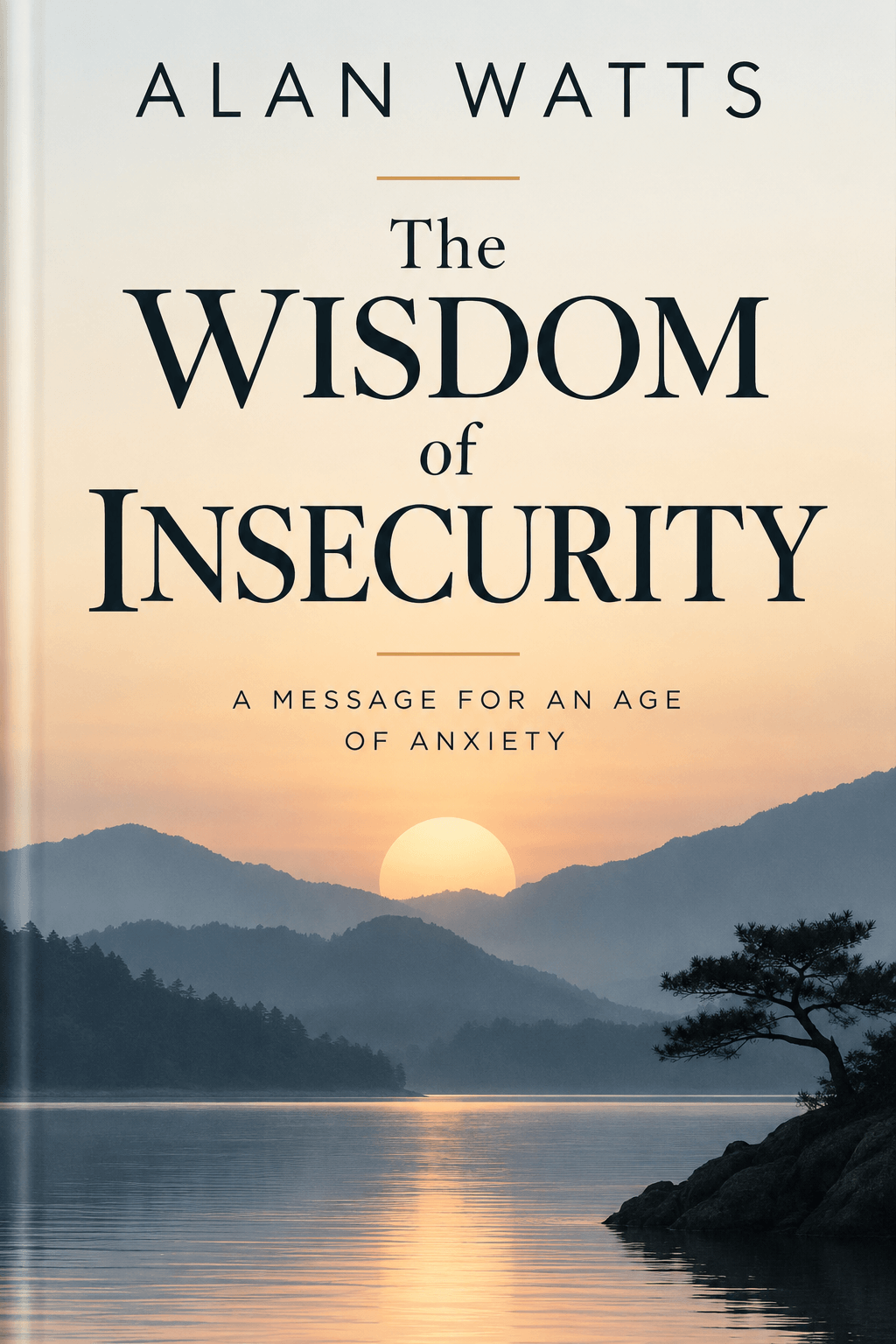
Prefer the print book? Buy on Amazon
As an Amazon Associate, Sumizeit earns from qualifying purchases.
The Wisdom of Insecurity Book Summary
This The Wisdom of Insecurity Book Summary covers the key ideas, lessons, and takeaways in about 20 minutes.
Short Description:
Watts argues anxiety comes from resisting change, and peace comes from accepting insecurity as life itself.
Helps with these goals
Preview the The Wisdom of Insecurity book summary
Below is a preview of Sumizeit’s comprehensive human-written summary of The Wisdom of Insecurity by Alan Watts. The full summary is 15-20 minutes long and covers the book’s key ideas in text, audio, visual, and video formats. Unlock the full 20 Minute Summary
Alan Watts wrote The Wisdom of Insecurity in 1951, and it reads less like a self help manual and more like someone grabbing you by the shoulders and saying "stop trying to fix the wrong problem." His central claim is simple to state and hard to live. You feel anxious because you're trying to make life stable, and life was never built to hold still. Watts wasn't a therapist or a scientist. He was a philosopher and religious scholar who spent his career translating Buddhist and Taoist ideas into language Westerners could actually use, and this book is probably the clearest distillation of that project he ever wrote. The book's argument builds in three moves. First, Watts explains where anxiety actually comes from, and it's not what most people assume. Second, he walks through why the usual fixes, religion, science, buying stuff, don't work and sometimes make things worse. Third, he lays out what he thinks does work, which boils down to giving up the fight against change and learning to live inside the present moment the way an animal does. None of this is abstract for Watts. He wants you to feel it in your body, not just agree with it as an idea.
Why insecurity isn't a glitch, it's the operating system
Watts opens with a claim that sounds obvious once you hear it but that most of us spend our whole lives resisting. Insecurity, meaning the fact that you and everything around you is temporary and always changing, isn't a problem to be solved. It's just what existing is. Every moment replaces the one before it. Nothing gets frozen in place. Every living thing ages, shifts, and eventually dies. Trying to achieve security, in Watts's view, is like trying to hold a river still with your hands. You can dam it up for a while, but the water keeps moving underneath. This matters because so much of modern life is organized around the opposite belief, that if you just plan well enough, save enough, insure yourself enough, you can lock in some kind of permanent safety. Watts says that project is doomed from the start, and worse, chasing it is what actually generates most of your anxiety. You're not anxious despite trying to secure your life. You're anxious because you're trying.
The two selves you're carrying around
To explain why we keep making this mistake, Watts splits the human experience into two parts, which he calls the animal self and the thinking self. Your animal self is the part of you that runs on instinct. It gets hungry, gets tired, feels pleasure, feels pain, and it does all of this without narrating any of it. It has no interest in yesterday or tomorrow. It just responds to whatever is happening right now, the way a cat stretches when it wants to stretch and sleeps when it wants to sleep. Watts says this self is actually quite sophisticated. It's not dumb or primitive. It's just not verbal.
Want the complete 20-minute summary?
- Full structured summary
- Video Summary
- Podcast Summary
- Audio summary
- Key takeaways
- Exercises
- Quiz
- Highlights and notes
- Ask the book with AI
Who should read The Wisdom of Insecurity?
The Wisdom of Insecurity is for anyone struggling with anxiety, restlessness, or the feeling that they're constantly chasing the next goal without ever arriving at peace. It speaks especially to people caught in cycles of acquiring, achieving, or planning their way to happiness, as well as those questioning whether modern religion, science, or consumer culture can truly deliver lasting security.
Why does The Wisdom of Insecurity matter?
In an age of unprecedented planning, controlling, and accumulating, Alan Watts's core insight—that anxiety stems not from life's unpredictability but from our refusal to accept it—cuts straight to why modern life feels so exhausting. The book offers a counterintuitive path to peace that doesn't require self-improvement or more discipline, but rather a fundamental shift in how you relate to time, change, and the present moment.
What are the key themes in The Wisdom of Insecurity?
- The futility of seeking permanent security in an inherently changing world
- The split between the thinking self and the animal self
- How fear of death and pain drives consumerism and anxiety
- The inadequacy of religion and science as solutions to insecurity
- The possibility of wisdom in accepting rather than resisting change
- Integration of body and mind as a path to peace
How can you apply ideas from The Wisdom of Insecurity?
- Eat when your body signals hunger rather than by the clock, and honor other bodily signals (fatigue, tension, ease) as guides for daily decisions
- When pain arises, stay present with it rather than mentally escaping into memories or fantasies about relief, allowing it to pass through you more quickly
- Notice moments of ordinary pleasure—the feel of dirt, the taste of food, conversation—and bring full attention to them instead of mentally jumping to the next experience
- Question purchasing impulses by asking whether the acquisition addresses a real present need or a future-anxiety fantasy, then observe how often the latter is true
- Identify areas where you override your body's wisdom with rigid schedules or beliefs, and experiment with listening to your body's signals instead
- When anxiety peaks, pause and ask: 'Am I actually in danger right now, or am I mentally living in a feared future?' and deliberately redirect attention to the present moment
- Read religious or spiritual texts you resonate with as metaphors for present-moment truth rather than as literal historical or doctrinal claims
What common mistakes do readers make with The Wisdom of Insecurity?
- Treating this book as another self-help system to master rather than a pointer toward letting go of self-improvement projects altogether
- Assuming Watts dismisses the thinking self or advocates abandoning rational thought, when his actual argument is for integration and balance
- Reading his acceptance of insecurity as fatalism or passivity, rather than as the foundation for more authentic action and ethics
- Expecting a single breakthrough experience to settle the insight permanently, when Watts frames this as an ongoing practice of returning to presence
Sumizeit Exercises Apply what you've learned
Turn ideas from The Wisdom of Insecurity into action with a short guided reflection: identify the biggest takeaway, connect it to your life, and commit to one step you can take in the next 24 hours.
What is the expert analysis of The Wisdom of Insecurity?
Overview
The Wisdom of Insecurity, authored by Alan Watts in 1951, stands as a seminal work that bridges Eastern philosophical traditions with Western existential concerns. Watts, a British-born philosopher and religious scholar, is renowned for his eloquent translations of Buddhist and Taoist thought into accessible language for Western audiences. This book is significant not only for its clear articulation of complex ideas about impermanence and anxiety but also for its enduring relevance in contemporary discussions about mental well-being, spirituality, and the human condition. Unlike conventional self-help manuals, Watts’s work challenges readers to fundamentally reconsider their relationship with insecurity, making it a profound philosophical treatise as much as a guide to living.
Core Thesis
At the heart of The Wisdom of Insecurity lies a compelling argument: anxiety arises not from insecurity itself, but from the futile human attempt to impose permanence on an inherently impermanent existence. Watts posits that life’s instability is not a problem to be fixed but the essential operating system of reality. He distinguishes between the “animal self,” which lives fully in the present moment, and the “thinking self,” which clings to a constructed sense of continuity and permanence. This attachment to permanence fuels anxiety, as it inevitably clashes with the transient nature of life. The solution Watts offers is radical yet simple—embrace insecurity by living fully in the present moment, surrendering the illusion of control, and integrating the instinctual and reflective aspects of the self. This shift, he argues, dissolves anxiety and opens the door to a deeper experience of freedom, love, and ethical living.
Strengths
- Philosophical Synthesis: Watts masterfully synthesizes Eastern philosophies—particularly Buddhism and Taoism—with Western existential thought, creating a cross-cultural dialogue that enriches both traditions.
- Clarity and Accessibility: The book distills complex metaphysical and psychological concepts into clear, relatable language without sacrificing depth, making profound insights accessible to a broad audience.
- Embodied Wisdom: Watts emphasizes experiential understanding over intellectual assent, encouraging readers to feel the truth of impermanence in their bodies rather than merely conceptualize it.
- Timeless Relevance: The exploration of anxiety, consumerism, and the search for meaning remains strikingly pertinent in today’s fast-paced, materialistic society.
- Integration of Self: The nuanced distinction and eventual integration of the “animal” and “thinking” selves provide a psychologically rich framework that resonates with both philosophy and emerging psychological research.
Critiques & Counterarguments
- Overgeneralization of the Self: Watts’s binary division of the self into “animal” and “thinking” components, while evocative, oversimplifies the complexity of human consciousness. Contemporary neuroscience and psychology reveal a far more intricate interplay of cognitive, emotional, and unconscious processes that resist such neat categorization.
- Romanticizing the Present Moment: The valorization of living fully in the present risks underestimating the importance of future-oriented planning and memory in human survival and flourishing. Critics argue that a balance between present awareness and future anticipation is necessary rather than an exclusive focus on “now.”
- Limited Engagement with Scientific Evidence: Although Watts critiques science as insufficient for addressing existential insecurity, his dismissal overlooks advances in psychology—such as mindfulness-based therapies—that empirically validate the benefits of present-moment awareness.
- Potential for Passivity: Some may interpret Watts’s call to surrender control as encouraging passivity or resignation, though he explicitly rejects this. Nevertheless, the tension between acceptance and agency remains a challenging dialectic in both philosophy and practice.
- Competing Philosophical Views: Existentialist thinkers like Jean-Paul Sartre emphasize radical freedom and the creation of meaning through choice, which contrasts with Watts’s emphasis on acceptance and unity. Similarly, Stoicism advocates for control over one’s judgments rather than surrender to impermanence, presenting alternative frameworks for coping with insecurity.
Who Should Read This
The Wisdom of Insecurity is ideally suited for readers who are intellectually curious about the intersection of philosophy, spirituality, and psychology, especially those grappling with anxiety, existential uncertainty, or dissatisfaction with conventional self-help approaches. It appeals to individuals seeking a deeper, more embodied understanding of impermanence and presence, as well as practitioners of mindfulness, meditation, or contemplative traditions. Additionally, scholars and students of comparative religion and philosophy will find Watts’s synthesis a valuable entry point into Eastern thought. Finally, anyone interested in reexamining the cultural narratives around consumerism, control, and happiness will benefit from Watts’s incisive critique and hopeful vision.
Frequently asked questions about the The Wisdom of Insecurity book summary
What is The Wisdom of Insecurity about?
The Wisdom of Insecurity by Alan Watts argues that anxiety stems not from life's inherent instability but from our futile resistance to it. Watts contends that real peace comes not through building better security systems—religion, science, consumer goods—but through accepting insecurity and learning to fully inhabit the present moment the way animals naturally do.
Who should read The Wisdom of Insecurity?
This book is essential for anyone trapped in cycles of anxiety, endless acquiring, or the feeling that happiness always lies just beyond the next achievement or purchase. It's also valuable for those questioning whether modern belief systems—whether religious, scientific, or consumer-based—can truly deliver lasting peace.
What are the main takeaways from The Wisdom of Insecurity?
The core insights are: anxiety comes from fighting an unchangeable reality rather than from the reality itself; your thinking mind and animal body are in conflict, and integration rather than domination heals this split; you only ever experience the present moment, so living mentally in the future costs you the only life you have; and peace emerges not from more control but from acceptance and presence. Watts also argues that religion, science, and consumerism all fail as lasting solutions because they're ultimately forms of denying change rather than embracing it.
How does Alan Watts explain anxiety?
Watts traces anxiety to the thinking self's refusal to accept insecurity—the fact that everything is temporary and always changing. Your thinking mind creates a sense of continuous identity and wants to preserve that identity forever, but life doesn't cooperate. This gap between the mind's desire for permanence and reality's impermanence is the source of anxiety. It's not that life is broken; it's that you're fighting a battle you can't win.
What does Watts mean by the animal self and thinking self?
The animal self is the instinctive part of you that responds to the present moment without narration—it gets hungry, rests when tired, feels pleasure and pain directly, like a cat stretching when it wants to stretch. The thinking self is the reflective, remembering part that creates identity through time and worries about permanence. Watts argues the thinking self's dominance in modern life, especially at the expense of the animal self's wisdom, is a major source of anxiety.
Why does Watts reject religion and science as solutions to insecurity?
While religion and science both offer comfort through systems that name, order, and control reality, Watts argues they ultimately fail because they're elaborate forms of resisting change rather than accepting it. Religion promises eternal permanence, science promises mastery through progress, but both miss the fundamental point: you can't truly live off a belief system or representation of reality. You can only live through direct, present-moment experience.
How does consumerism connect to fear of death in Watts's framework?
Watts argues that consumerism springs from the thinking self's panic about mortality and its desire to cram in as much pleasure as possible before time runs out. But this strategy backfires because each purchase raises your baseline of satisfaction, creating an endless cycle where the next acquisition never quite delivers the peace the last one promised. The consumer treadmill is structurally incapable of producing satisfaction because it depends on your never feeling satisfied in the present.
What does Watts say about death and pain as meaningful?
Watts argues that pain and death aren't malfunctions but necessary features of a life worth living. Pleasure only registers as good because of the contrast with pain; without low points, highs have no meaning. Similarly, the fact that life is finite—that we will die—gives experiences urgency and value. An endless life would become its own prison. Accepting this doesn't mean pain feels good in the moment, but that it's not evidence something has gone wrong with existence.
About Sumizeit
Sumizeit is a profitable Scomy LLC company based in Miami, Florida. Our founders, Clemens Raemy and Weina Scott, are successful entrepreneurs with several exits. Sumizeit is a popular book summary app / micro learning app used by busy professionals and entrepreneurs with over 2,500 non-fiction book summaries and 10,000 podcast summaries in text, audio, visual, podcast, and video format. We also have stellar retention tools to make ideas stick - such as flashcards with spaced repetition, quizzes, streaks, highlighting and notes, daily challenges, riddles, mini-courses, meditation, and more. You won't only learn the idea, but also remember it. Over 90% of our users change their habits with Sumizeit.
Upgrade Now
Here's why readers love Sumizeit
Join thousands of learners getting smarter every day
"Great experience. Detailed summaries. Loved the gamification feature. Makes learning fun. Good customer service. I recommend Sumizeit to anyone. You'll learn a lot."
"I always felt busy but still wanting to keep up with the book discussion in my friend group. This was a great supplement to help me keep reading the books I find fun while keeping up with important books."
"I love this website. Instead of scrolling social media, I find myself learning a lot. I use it everyday. I recommend this app for anyone who is too busy and wants to get up to speed with their favorite books."
The Wisdom of Insecurity Book Summary PDF
Looking for a The Wisdom of Insecurity Book Summary PDF you can save and revisit offline? Our The Wisdom of Insecurity Book Summary PDF captures the book’s core ideas in a clean, printable format — the key frameworks, takeaways, and structure without the fluff. Download the The Wisdom of Insecurity Book Summary PDF when you want a reference you can annotate, share with your team, or review on the go. Get your The Wisdom of Insecurity Book Summary PDF from the download page below.
Download The Wisdom of Insecurity Book Summary PDFPeople also liked these summaries
Readers who explored The Wisdom of Insecurity often enjoyed these titles next.


Ready to read the whole thing?
- Full structured summary
- Video Summary
- Podcast Summary
- Audio summary
- Key takeaways
- Exercises
- Quiz
- Highlights and notes
- Ask the book with AI
Featured Book Titles
Popular Book Summaries at sumizeit, leading book summary app