


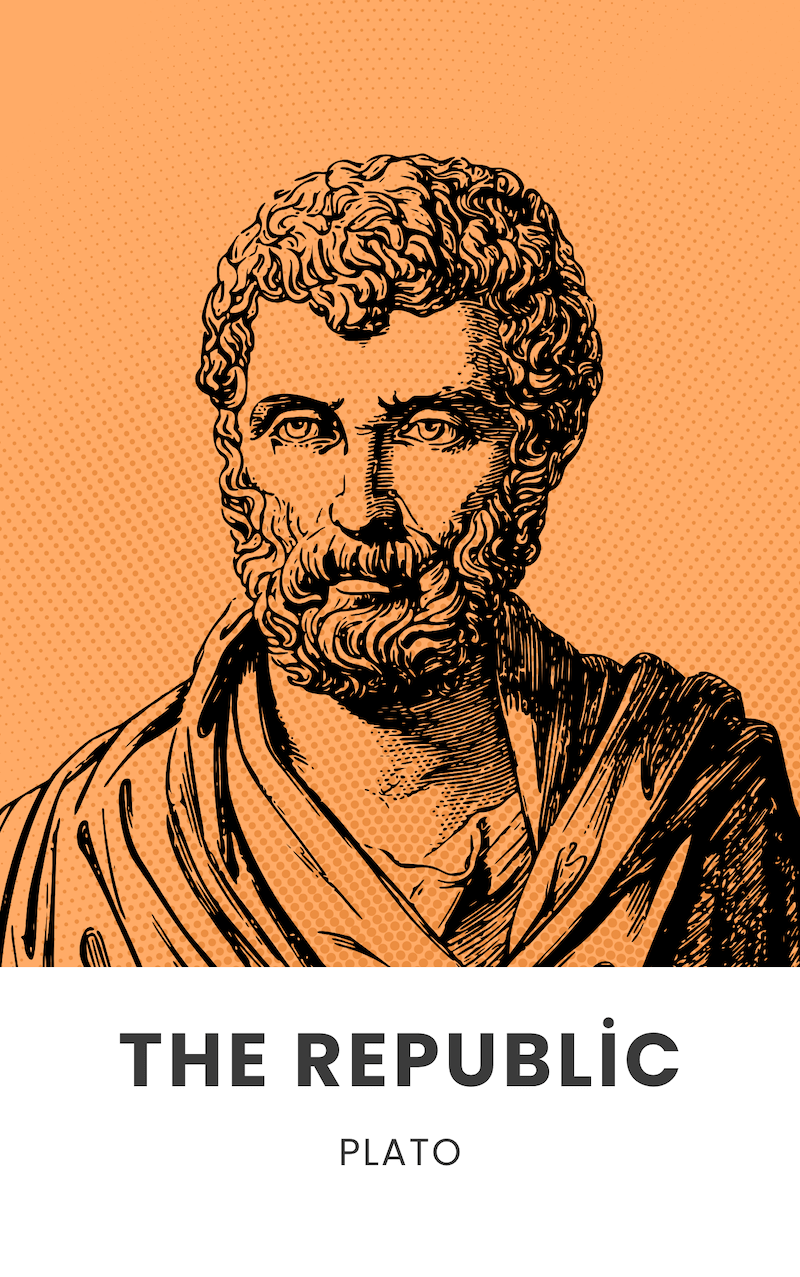
Prefer the print book? Buy on Amazon
As an Amazon Associate, Sumizeit earns from qualifying purchases.
The Republic Book Summary
This The Republic Book Summary covers the key ideas, lessons, and takeaways in about 20 minutes.
Short Description:
The Republic argues justice brings harmony and is the highest good.
Helps with these goals
Want a Free Weekly Read?
Get a free summary every week straight to your mailbox.
Preview the The Republic book summary
Below is a preview of Sumizeit’s comprehensive human-written summary of The Republic by Plato. The full summary is 15-20 minutes long and covers the book’s key ideas in text, audio, visual, and video formats. Unlock the full 20 Minute Summary
Plato’s The Republic opens with Socrates and his companions embarking on what initially appears to be a casual visit to a religious festival in the port district of Piraeus. Instead, they are drawn into a debate that becomes one of the most influential philosophical investigations in history. The conversation begins in the home of the wealthy and aging Cephalus, who reflects on how wealth brings peace in old age by allowing one to avoid dishonesty and repay debts. From this starting point, the group begins searching for a precise definition of justice.
Cephalus’s son Polemarchus proposes a traditional moral idea: justice means helping friends and harming enemies. Socrates challenges this by pointing out that humans often misjudge others—someone believed to be a friend may actually be deceitful, and an apparent enemy may be innocent. If justice depended on such mistaken judgments, it would lead to harming good people and helping bad people, which cannot be just. Socrates uses a striking analogy from medicine: doctors do not harm the sick but heal them; similarly, justice should improve people rather than damage them. This reframes justice as something constructive rather than punitive.
At this point, Thrasymachus bursts angrily into the debate. He asserts that justice is merely the will of the stronger—that rulers define justice in ways that benefit themselves, and ordinary people obey out of weakness or ignorance. He points to real political examples: tyrants who confiscate property, rewrite laws, eliminate rivals, and are celebrated as heroes or saviors rather than condemned as criminals. To Thrasymachus, injustice is more powerful and rewarding than justice.
Socrates responds with examples showing that true professions aim at the good of others: the pilot navigates a ship for the passengers’ safety, the shepherd tends his flock for their health, and the physician works for patients rather than profit. Thus, a true ruler is one who governs for the benefit of the governed, not for personal gain. Yet even after this rebuttal, Glaucon and Adeimantus insist that most people behave morally only because they fear punishment, shame, or the law, not because they value justice itself.
The Ring of Gyges: Would Anyone Resist Corruption?
To sharpen the challenge, Glaucon recounts the myth of Gyges. A shepherd discovers a ring that makes him invisible. Free from consequences, he seduces the queen, murders the king, and seizes the throne. Glaucon argues that anyone—whether saint or criminal—would act unjustly if guaranteed secrecy and impunity. The story demonstrates that fear maintains morality, not virtue. This forces Socrates to prove that justice benefits the person who practices it regardless of external rewards.
Constructing the Ideal City to Understand Justice
Instead of defining justice directly, Socrates suggests magnifying it by examining how it functions within a city. The ideal city begins with people cooperating to satisfy basic needs such as food, shelter, and clothing. As complexity grows, specialization becomes necessary: farmers produce food, builders construct houses, weavers make clothing, traders distribute goods, and teachers cultivate knowledge.
Want the complete 20-minute summary?
- Full structured summary
- Video Summary
- Podcast Summary
- Audio summary
- Key takeaways
- Exercises
- Quiz
- Highlights and notes
- Ask the book with AI
Who should read The Republic?
The Republic is essential for anyone seeking to understand the foundations of Western philosophy, ethics, and political theory. Students of philosophy, aspiring leaders, and those grappling with questions about justice, the ideal society, and the purpose of human life will find profound insights. Anyone interested in how societies function, decline, and reform—from policymakers to thoughtful citizens—benefits from Plato's timeless analysis.
Why does The Republic matter?
The Republic remains remarkably relevant because it addresses enduring questions about justice, power, and human flourishing that societies face today. Plato's warnings about democratic decay, the dangers of unchecked appetite, and the corruption that comes from prioritizing wealth over wisdom speak directly to contemporary challenges. By proposing that reason and virtue—not fear or wealth—should guide both individuals and societies, Plato offers a counterweight to purely materialistic or power-driven worldviews.
What are the key themes in The Republic?
- Justice as inner harmony and social order
- The tripartite soul and the rule of reason
- The nature of knowledge and enlightenment
- The ideal state and the role of philosopher-rulers
- The decay of societies through moral decline
- The relationship between appearance and reality
- The purpose of education in shaping virtue
How can you apply ideas from The Republic?
- Evaluate your own decisions by asking whether reason guides them or appetites control you, then work to strengthen rational self-governance
- Assess organizations and leaders by their service to others rather than personal gain, identifying corruption before it spreads
- Design educational systems that balance emotional development, physical discipline, and intellectual rigor rather than specializing too early
- Build social cohesion in groups by emphasizing shared purpose and common values rather than relying on fear of punishment alone
- Recognize the early warning signs of societal decline—the shift from honor to wealth, then to unchecked freedom, then to authoritarian rule—in your own community
- Cultivate wisdom through philosophy and dialogue rather than accumulating possessions or status as measures of success
- Structure teams and organizations so that the most capable and wise lead, rather than those with wealth or ambition for power
What common mistakes do readers make with The Republic?
- Assuming that justice simply means following rules or that morality is purely external rather than an internal state of the soul
- Believing that injustice benefits the perpetrator; Plato argues that the unjust person is deeply unhappy despite outward success
- Thinking that enlightenment comes easily or without effort; Plato emphasizes the painful, decades-long process of intellectual and moral development
- Underestimating how societies decline gradually through moral compromise; citizens often don't recognize decay until tyranny arrives
- Confusing democracy with freedom; unlimited liberty leads to chaos and makes populations vulnerable to authoritarian 'protectors'
- Overestimating the role of punishment in maintaining morality; true justice requires citizens who understand virtue's inherent value
Sumizeit Exercises Apply what you've learned
Turn ideas from The Republic into action with a short guided reflection: identify the biggest takeaway, connect it to your life, and commit to one step you can take in the next 24 hours.
What is the expert analysis of The Republic?
Overview
The Republic by Plato stands as a cornerstone of Western philosophy and political theory. Written by Plato, a towering figure of ancient Greece and a student of Socrates, this dialogue explores the nature of justice, the ideal society, and the human soul. Its significance lies not only in its profound philosophical insights but also in its enduring influence on ethics, political science, psychology, and education. Plato’s method of dialectical inquiry and his visionary construction of the ideal city-state continue to provoke thought and debate among scholars and practitioners alike.
Core Thesis
At its heart, The Republic argues that justice is the highest good, essential for both societal harmony and individual well-being. Justice is conceived not as mere obedience to laws or social conventions but as a structural harmony where each part of society and the soul performs its proper role under the guidance of reason. The philosopher-king, embodying wisdom and virtue, is the ideal ruler who governs for the common good. Plato further asserts that true happiness and fulfillment arise from this ordered life, while injustice leads inevitably to chaos and misery.
Strengths
- Philosophical Depth: Plato’s dialectical method rigorously examines competing definitions of justice, exposing their limitations and refining the concept through reasoned argument.
- Systematic Vision: The construction of the ideal city-state with its tripartite class structure and corresponding tripartite soul offers a compelling metaphor for social and psychological order.
- Enduring Allegories: The Allegory of the Cave and the Myth of Gyges powerfully illustrate epistemological and ethical challenges that resonate across cultures and epochs.
- Educational Insight: The detailed account of guardian education anticipates modern ideas about moral formation, the role of culture, and the importance of intellectual development in leadership.
- Integration of Ethics and Politics: Plato’s work bridges personal virtue and political justice, emphasizing their interdependence in creating a just society.
Critiques & Counterarguments
- Idealism vs. Practicality: Plato’s ideal city and philosopher-king model, while inspiring, often appear utopian and detached from the complexities of real political life, where power dynamics and human self-interest are more resistant to rational control.
- Authoritarian Tendencies: The communal living of guardians, censorship of art, and the “noble lie” raise ethical concerns about individual freedom and the potential for manipulation under the guise of social harmony.
- Psychological Reductionism: The tripartite soul, though influential, simplifies human motivation and neglects the nuances revealed by contemporary psychology, such as unconscious drives and social conditioning.
- Opposing Philosophical Views: Schools like Aristotelianism emphasize empirical observation and political realism, critiquing Plato’s reliance on abstract Forms and ideal types as insufficient for practical governance.
- Modern Political Evidence: Historical attempts to realize Plato’s vision have often resulted in rigid hierarchies or technocracies that suppress dissent, suggesting that the balance between wisdom and power is more precarious than Plato envisaged.
Who Should Read This
The Republic is essential reading for philosophers, political theorists, psychologists, and anyone interested in the foundations of justice, governance, and human nature. It challenges readers to reconsider the meaning of justice beyond legalistic or utilitarian frameworks and invites reflection on the ethical responsibilities of leadership and citizenship. Students of literature and history will find its allegories and myths invaluable for understanding Western intellectual heritage. Those seeking to engage deeply with questions of morality, societal organization, and personal virtue will find Plato’s work both demanding and rewarding.
Frequently asked questions about the The Republic book summary
What is The Republic about?
The Republic by Plato is a philosophical dialogue exploring the nature of justice, the ideal state, and the virtuous life. Through conversations between Socrates and others, Plato constructs an ideal city with three social classes, proposes that justice is the highest good and source of human happiness, describes the famous Allegory of the Cave as a metaphor for enlightenment, and traces how societies decline morally through predictable stages.
Who should read The Republic?
The Republic is essential for anyone interested in philosophy, ethics, politics, or human nature—including students, educators, leaders, and thoughtful citizens. Those grappling with questions about justice, the purpose of society, what makes a good leader, or how to live a meaningful life will find timeless wisdom. It remains foundational to Western intellectual tradition across law, psychology, art, and political theory.
What are the main takeaways from The Republic?
The main takeaways include that justice brings harmony to both the individual soul and society through the rule of reason, that injustice causes internal fragmentation and misery regardless of external wealth or power, that legitimate rulers serve the governed rather than exploiting them, and that education in virtue and wisdom is more important than accumulating possessions. Plato also warns that democracies can decay into tyranny and that societies require shared values and capable leaders to maintain stability.
What does the Allegory of the Cave represent?
The Allegory of the Cave depicts prisoners chained in darkness viewing shadows on a wall, representing ordinary people mistaking appearances for reality. When one prisoner ascends toward light and sees the sun, he experiences the painful journey from ignorance to enlightenment. The allegory illustrates that most people live in illusion, that truth-seeking involves struggle, and that philosophers who achieve wisdom are uniquely suited to lead because they understand genuine benefit rather than mere appearances.
What is Plato's ideal form of government?
Plato's ideal government is ruled by philosopher-kings—wise leaders educated for decades in mathematics, philosophy, music, and gymnastics, who have no private property and govern for the common good rather than personal gain. They possess reason refined by decades of study and are motivated by wisdom and justice. Plato argues that most actual governments fall short because they lack such enlightened, selfless leaders and wisdom-based leadership.
What is the tripartite soul in Plato's philosophy?
Plato divides the human soul into three parts: reason (which judges and governs), spirit (seat of courage and ambition), and appetite (desire for pleasure and material gain). A just, happy soul maintains reason in control, spirit as its ally, and appetite obedient. Injustice occurs when appetite or spirit rebels against reason, creating inner turmoil. This framework explains both personal psychology and political stability.
How does Plato describe the decline of societies?
Plato traces a predictable cycle of governmental decay: the ideal republic declines into timocracy (ruled by honor and military values), then oligarchy (ruled by the wealthy), then democracy (where freedom becomes excessive and disorder reigns), and finally tyranny (where a strong leader seizes control amid chaos). Each stage reflects moral decline in both leaders and citizens, with each form containing the seeds of its successor until tyranny emerges as the worst option.
Is The Republic still relevant today?
Yes, The Republic remains profoundly relevant because it addresses timeless questions about justice, leadership, and societal decay that persist in modern democracies. Plato's warnings about how unlimited freedom can lead to authoritarian rule, how greed corrupts leadership, and how societies need wisdom-based guidance rather than power-based control speak directly to contemporary challenges. His vision of education developing virtue and character remains a counterweight to purely materialistic worldviews.
About Sumizeit
Sumizeit is a profitable Scomy LLC company based in Miami, Florida. Our founders, Clemens Raemy and Weina Scott, are successful entrepreneurs with several exits. Sumizeit is a popular book summary app / micro learning app used by busy professionals and entrepreneurs with over 2,500 non-fiction book summaries and 10,000 podcast summaries in text, audio, visual, podcast, and video format. We also have stellar retention tools to make ideas stick - such as flashcards with spaced repetition, quizzes, streaks, highlighting and notes, daily challenges, riddles, mini-courses, meditation, and more. You won't only learn the idea, but also remember it. Over 90% of our users change their habits with Sumizeit.
Upgrade Now
Here's why readers love Sumizeit
Join thousands of learners getting smarter every day
"Great experience. Detailed summaries. Loved the gamification feature. Makes learning fun. Good customer service. I recommend Sumizeit to anyone. You'll learn a lot."
"I always felt busy but still wanting to keep up with the book discussion in my friend group. This was a great supplement to help me keep reading the books I find fun while keeping up with important books."
"I love this website. Instead of scrolling social media, I find myself learning a lot. I use it everyday. I recommend this app for anyone who is too busy and wants to get up to speed with their favorite books."
The Republic Book Summary PDF
Looking for a The Republic Book Summary PDF you can save and revisit offline? Our The Republic Book Summary PDF captures the book’s core ideas in a clean, printable format — the key frameworks, takeaways, and structure without the fluff. Download the The Republic Book Summary PDF when you want a reference you can annotate, share with your team, or review on the go. Get your The Republic Book Summary PDF from the download page below.
Download The Republic Book Summary PDFPeople also liked these summaries
Readers who explored The Republic often enjoyed these titles next.



Ready to read the whole thing?
- Full structured summary
- Video Summary
- Podcast Summary
- Audio summary
- Key takeaways
- Exercises
- Quiz
- Highlights and notes
- Ask the book with AI
Featured Book Titles
Popular Book Summaries at sumizeit, leading book summary app