


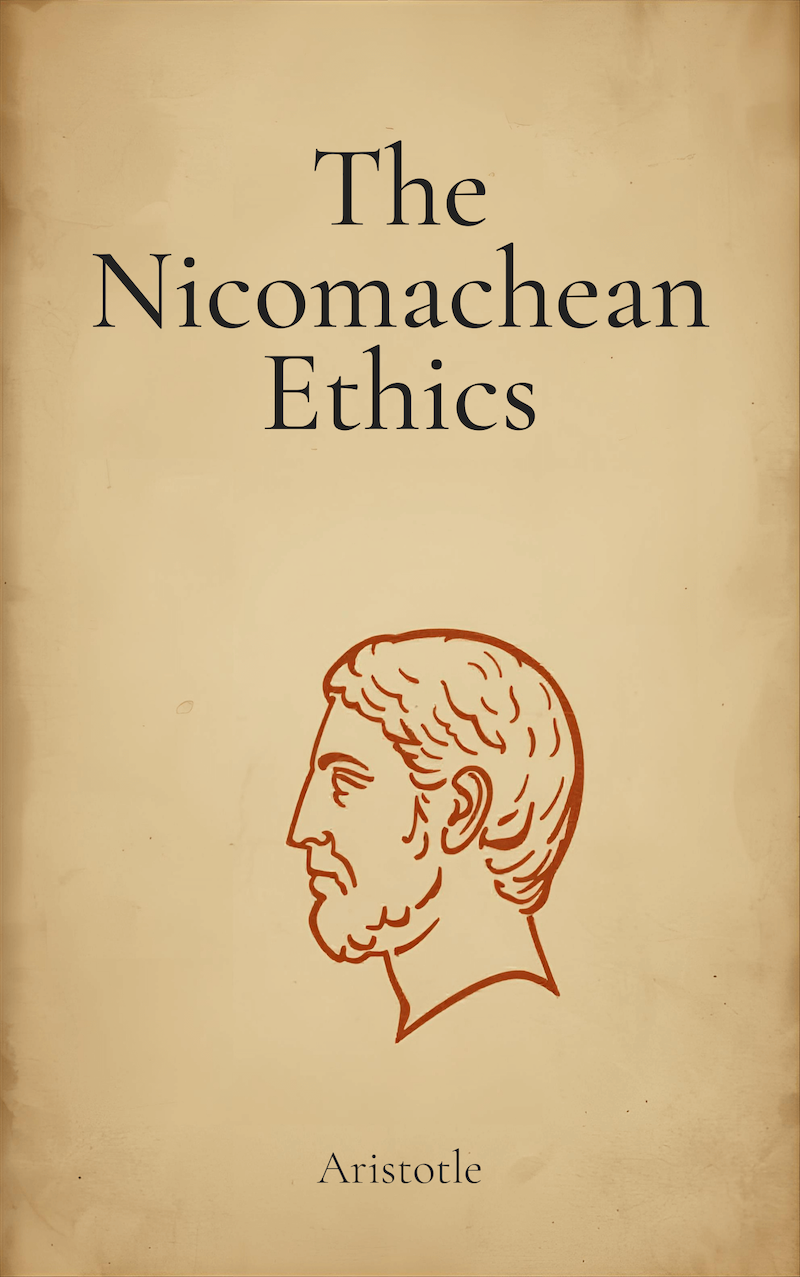
Prefer the print book? Buy on Amazon
As an Amazon Associate, Sumizeit earns from qualifying purchases.
The Nicomachean Ethics Book Summary
This The Nicomachean Ethics Book Summary covers the key ideas, lessons, and takeaways in about 20 minutes.
Short Description:
The Nicomachean Ethics teaches happiness through virtue and balanced character.
Helps with these goals
Preview the The Nicomachean Ethics book summary
Below is a preview of Sumizeit’s comprehensive human-written summary of The Nicomachean Ethics by Aristotle. The full summary is 15-20 minutes long and covers the book’s key ideas in text, audio, visual, and video formats. Unlock the full 20 Minute Summary
Aristotle’s The Nicomachean Ethics stands as one of the most influential works in moral philosophy and human psychology. Rather than offering commandments or rigid rules, Aristotle delivers a roadmap for how human beings can cultivate a fulfilling life by developing excellence in thought and action. He begins not by telling readers what to do but by investigating what people ultimately seek—happiness—and then works backward to explore how this state is achieved. To Aristotle, happiness is not pleasure, wealth, honor, or luck. It is a lifelong pattern of choices, a continual exercise of virtue, and a rational engagement with one’s abilities and responsibilities. A good life is not stumbled into; it must be built through character, wisdom, and moderation. Aristotle wants us to understand that morality is not just theory—it is practice, shaped by repetition and choices that mold who we become.
The Goal of Human Life: Happiness as Flourishing
Aristotle opens with a question: What is the highest aim of human life? His answer is not comfort or indulgence but eudaimonia, often translated as flourishing or deep fulfillment. It is the state of living in a way that expresses the best of what humans are capable of. Happiness, he insists, is not a fleeting emotion but a stable condition grounded in virtuous living. If someone experiences temporary pleasures yet lives without discipline or purpose, they are not truly happy—they are merely entertained. True fulfillment must be self-sustaining and complete within itself. It cannot depend solely on luck, approval, material success, or physical pleasure. Happiness is something we do, not something we receive. It is an activity of the soul that engages reason, character, and long-term purpose. Happiness is therefore a way of being, cultivated by consistent action and built gradually over a lifetime.
Virtue as the Foundation of a Good Life
If happiness is the aim, virtue is the method. Aristotle sees virtue not as an abstract label but as a living habit that shapes decision-making. Virtue is the excellence of character that allows people to act rightly without constant internal conflict. A person becomes brave by repeatedly facing fear with discipline, becomes generous through acts of giving, and becomes honest by practicing truthfulness. Just as musicians improve through rehearsal, individuals refine their moral character through repetition. Virtue does not arise naturally; humans are born capable of it but not possessing it. Nature gives us raw potential, but we must train ourselves into goodness. Habits shape the soul, and the repeated choice to act well gradually transforms tendencies into character.
The Golden Mean: Avoiding Excess and Deficiency
Central to Aristotle’s ethics is his doctrine of the mean. Virtue, he argues, lies between extremes. Courage sits between cowardice and recklessness, generosity between miserliness and waste. A virtuous person is not one who suppresses emotion but one who manages feelings and actions in proportion to the situation at hand. Virtue is not a midpoint by arithmetic calculation—it is the action appropriate to the context.
Want the complete 20-minute summary?
- Full structured summary
- Video Summary
- Podcast Summary
- Audio summary
- Key takeaways
- Exercises
- Quiz
- Highlights and notes
- Ask the book with AI
Who should read The Nicomachean Ethics?
The Nicomachean Ethics is essential reading for anyone seeking to understand what a fulfilling life looks like and how to actively build it. This book appeals to philosophers, students of ethics, leaders who want to make better decisions, and individuals who believe personal growth requires both self-discipline and wisdom. Whether you're struggling with life direction or want to deepen your moral reasoning, Aristotle's framework offers timeless guidance grounded in human nature rather than rigid rules.
Why does The Nicomachean Ethics matter?
In a world of instant gratification and conflicting advice on happiness, Aristotle's vision remains radically practical and profound. The Nicomachean Ethics teaches that true fulfillment comes not from chasing pleasure, wealth, or status but from developing character through repeated ethical choices. This ancient work directly challenges modern assumptions about success and contentment, offering a philosophy that emphasizes habit, judgment, and community as the real foundations of a meaningful life.
What are the key themes in The Nicomachean Ethics?
- Happiness as flourishing through virtuous living, not pleasure or external fortune
- Virtue as a habit developed through repeated ethical choices and practice
- The golden mean—finding balance between extremes rather than seeking absolutes
- Practical wisdom as the bridge between moral knowledge and real-world action
- The essential role of friendship and community in human flourishing
- Character development as an ongoing, intentional process shaped by education and discipline
How can you apply ideas from The Nicomachean Ethics?
- Build habits intentionally: identify one virtue you want to develop (courage, generosity, honesty) and practice it consistently in small ways until it becomes your natural response
- Use the golden mean as a decision-making framework: when facing a choice, identify the extremes and seek the contextually appropriate middle path rather than looking for universal rules
- Develop practical wisdom by reflecting on your decisions: after important choices, analyze what worked, what didn't, and what you learned to sharpen your judgment for future situations
- Cultivate virtuous friendships: invest time in relationships where you and others genuinely care about each other's character and growth rather than utility or entertainment
- Let reason govern your emotions: when angry, ask if your anger serves justice; when tempted, assess whether the pleasure aligns with your values and long-term flourishing
- Align external goods with your values: use wealth, status, and health as tools for virtue rather than measuring your success by them alone
- Create conditions for moral development: seek education, role models, and communities that reinforce good habits and make virtue the easy path, not the hard one
What common mistakes do readers make with The Nicomachean Ethics?
- Confusing momentary happiness with true fulfillment: pursuing pleasure, wealth, or approval as if they were the final goal rather than recognizing happiness requires sustained virtuous action
- Treating virtue as knowledge rather than practice: thinking that understanding ethics intellectually is enough, when real moral development requires repeated action and habit formation
- Seeking absolute rules instead of developing judgment: expecting a formula for every ethical situation rather than cultivating practical wisdom to navigate real-world complexity
- Isolating self-improvement from community: pursuing personal excellence without recognizing that friendship, justice, and social contribution are essential to flourishing
- Viewing temperance as deprivation instead of balance: thinking virtue requires suppressing all pleasure rather than understanding that proper moderation allows genuine enjoyment aligned with goodness
Sumizeit Exercises Apply what you've learned
Turn ideas from The Nicomachean Ethics into action with a short guided reflection: identify the biggest takeaway, connect it to your life, and commit to one step you can take in the next 24 hours.
What is the expert analysis of The Nicomachean Ethics?
Overview
The Nicomachean Ethics by Aristotle stands as a cornerstone of Western philosophical thought, particularly in the domains of ethics, psychology, and political philosophy. Written by Aristotle, a towering figure in ancient Greek philosophy and a student of Plato, this work has profoundly influenced the conceptualization of virtue, happiness, and the good life for over two millennia. Its significance lies not only in its historical impact but in its enduring relevance to contemporary discussions on moral character, practical wisdom, and human flourishing. Aristotle’s methodical approach—grounding ethics in human nature and rational inquiry—offers a systematic framework that transcends cultural and temporal boundaries, making it essential reading for anyone interested in the foundations of ethical theory and the art of living well.
Core Thesis
At the heart of The Nicomachean Ethics is the thesis that the highest human good is eudaimonia, often translated as flourishing or true happiness, which is achieved through the cultivation of virtue and rational activity over a complete life. Aristotle argues that happiness is not a transient feeling or external acquisition but a stable condition realized by living in accordance with reason and moral excellence. Virtue is understood as a habitual disposition to act rightly, situated between extremes of excess and deficiency—the doctrine of the Golden Mean. Practical wisdom (phronesis) is crucial, enabling one to discern the appropriate action in varying contexts. The ethical life is thus an active, ongoing process of choice and habituation, deeply embedded in social relationships and communal life.
Strengths
- Systematic Ethical Framework: Aristotle provides a comprehensive and coherent account of ethics that integrates character, reason, emotion, and social context, avoiding reductionism.
- Emphasis on Practical Wisdom: The focus on phronesis as the bridge between intellectual insight and moral action highlights the complexity of ethical decision-making beyond mere rule-following.
- Nuanced View of Virtue: The doctrine of the mean offers a sophisticated understanding of moral virtues as context-dependent, avoiding simplistic binary moral judgments.
- Integration of Individual and Community: Aristotle’s recognition that flourishing is both personal and social anticipates modern communitarian ethics and underscores the role of political structures in moral development.
- Enduring Influence: The work’s insights into habit formation, character development, and the role of emotions continue to resonate in contemporary psychology and virtue ethics.
Critiques & Counterarguments
- Historical and Cultural Context: Aristotle’s ethics presuppose a particular social order—namely, the polis of classical Greece—which includes hierarchical and exclusionary assumptions (e.g., regarding women, slaves, and non-citizens) that limit its universal applicability.
- Ambiguity in the Golden Mean: The concept of the mean can be criticized for its vagueness and reliance on subjective judgment, which may lead to relativism or inconsistency in moral evaluation.
- Underestimation of Emotions’ Complexity: While Aristotle acknowledges emotions, modern affective science suggests emotions are more deeply intertwined with cognition and behavior than the reason-emotion dichotomy Aristotle proposes.
- Competing Ethical Theories: Deontological ethics (e.g., Kantianism) and consequentialism challenge Aristotle’s virtue ethics by emphasizing duties or outcomes rather than character traits, arguing that virtue alone does not guarantee moral correctness.
- Empirical Challenges: Contemporary psychology and behavioral economics reveal that habitual behavior and moral decision-making are often influenced by unconscious biases and social pressures, complicating Aristotle’s ideal of rational, deliberate choice.
Who Should Read This
The Nicomachean Ethics is indispensable for scholars and students of philosophy, ethics, political theory, and psychology who seek a foundational understanding of virtue ethics and the classical conception of the good life. It is equally valuable for practitioners in leadership, education, and counseling who wish to ground their approaches in a rich tradition of character formation and practical wisdom. Readers interested in the intersection of moral theory and everyday living will find Aristotle’s insights both challenging and enriching, offering a timeless guide to cultivating excellence and meaning in a complex world.
Frequently asked questions about the The Nicomachean Ethics book summary
What is The Nicomachean Ethics about?
The Nicomachean Ethics by Aristotle is a foundational work on moral philosophy that explores how to live well and achieve true happiness (eudaimonia) through the development of virtue. Rather than offering rigid rules, Aristotle investigates what humans ultimately seek and argues that happiness comes through cultivating excellence of character via repeated ethical choices, guided by practical wisdom, and grounded in reason and moderation. The work covers virtues like courage, temperance, and justice; the role of habit and education; the importance of friendship; and how individual flourishing contributes to and depends upon community.
Who should read The Nicomachean Ethics?
The Nicomachean Ethics is valuable for anyone interested in building a meaningful life, developing stronger character, or understanding what true fulfillment requires. This includes philosophers, students, leaders and decision-makers seeking wiser judgment, people in personal transition questioning their direction, and anyone frustrated with modern definitions of success centered on wealth or status. The book appeals both to those wanting rigorous ethical reasoning and to practical people seeking guidance on how to actually live better every day.
What are the main takeaways from The Nicomachean Ethics?
The central insights are that happiness is achieved through virtuous living as a long-term state of flourishing, not through pleasure or external fortune; virtue is built through repeated practice and habit rather than intellectual understanding alone; practical wisdom allows you to apply ethics skillfully to real situations; and character development requires supportive communities, good education, and intentional discipline. Aristotle teaches that you become excellent by repeatedly choosing excellence, that proper self-love means caring for your moral health, and that a fulfilling life balances individual virtue with friendship, justice, and social contribution.
How does Aristotle define happiness?
Aristotle defines happiness (eudaimonia) as flourishing through the excellent activity of the soul guided by reason. It is not a feeling or passing pleasure but a stable condition achieved through virtuous living over a lifetime. True happiness requires self-sustaining fulfillment grounded in character development, cannot depend solely on luck or external goods, and must be evaluated by the quality of your choices across your complete life rather than in isolated moments.
What is the golden mean in Aristotle's ethics?
The golden mean is Aristotle's principle that virtue lies between extremes—courage between cowardice and recklessness, generosity between miserliness and waste. However, the mean is not a mathematical midpoint but a contextually appropriate action requiring practical judgment. What counts as courage for a soldier may differ from courage in another situation; the virtuous person uses wisdom to determine the right action in each unique circumstance rather than following a universal formula.
Why does Aristotle emphasize habit and practice in moral development?
Aristotle believes we become virtuous the same way musicians become skilled—through repeated practice and exercise. Moral character is not innate but developed gradually through habitual action; becoming brave requires repeatedly facing fear, becoming generous requires acts of giving, and becoming honest requires practicing truthfulness. Once habits are ingrained, they shape perception and decision-making for life, making proper upbringing and deliberate practice essential to ethical development.
What role does friendship play in The Nicomachean Ethics?
Aristotle considers friendship essential to human flourishing, arguing that no one would willingly live without friends. The highest friendships are grounded in mutual virtue and character, where each person values the other's growth and integrity. Such friendships endure unlike utility-based or pleasure-based friendships, cultivate moral development through mutual encouragement and accountability, and create the social conditions necessary for individuals to thrive and pursue excellence together.
How does Aristotle view the relationship between reason and emotion?
Aristotle does not advocate suppressing emotion but rather governing it through reason. A virtuous person is not emotionless but self-governed, using rational judgment to regulate feelings appropriately to each situation. Anger can be justified when used for justice rather than vengeance, and pleasure can accompany noble activities—the key is proportion and purpose. Reason acts as a navigator steering between dangerous extremes of excess and deficiency.
About Sumizeit
Sumizeit is a profitable Scomy LLC company based in Miami, Florida. Our founders, Clemens Raemy and Weina Scott, are successful entrepreneurs with several exits. Sumizeit is a popular book summary app / micro learning app used by busy professionals and entrepreneurs with over 2,500 non-fiction book summaries and 10,000 podcast summaries in text, audio, visual, podcast, and video format. We also have stellar retention tools to make ideas stick - such as flashcards with spaced repetition, quizzes, streaks, highlighting and notes, daily challenges, riddles, mini-courses, meditation, and more. You won't only learn the idea, but also remember it. Over 90% of our users change their habits with Sumizeit.
Upgrade Now
Here's why readers love Sumizeit
Join thousands of learners getting smarter every day
"Great experience. Detailed summaries. Loved the gamification feature. Makes learning fun. Good customer service. I recommend Sumizeit to anyone. You'll learn a lot."
"I always felt busy but still wanting to keep up with the book discussion in my friend group. This was a great supplement to help me keep reading the books I find fun while keeping up with important books."
"I love this website. Instead of scrolling social media, I find myself learning a lot. I use it everyday. I recommend this app for anyone who is too busy and wants to get up to speed with their favorite books."
The Nicomachean Ethics Book Summary PDF
Looking for a The Nicomachean Ethics Book Summary PDF you can save and revisit offline? Our The Nicomachean Ethics Book Summary PDF captures the book’s core ideas in a clean, printable format — the key frameworks, takeaways, and structure without the fluff. Download the The Nicomachean Ethics Book Summary PDF when you want a reference you can annotate, share with your team, or review on the go. Get your The Nicomachean Ethics Book Summary PDF from the download page below.
Download The Nicomachean Ethics Book Summary PDFPeople also liked these summaries
Readers who explored The Nicomachean Ethics often enjoyed these titles next.



Ready to read the whole thing?
- Full structured summary
- Video Summary
- Podcast Summary
- Audio summary
- Key takeaways
- Exercises
- Quiz
- Highlights and notes
- Ask the book with AI
Featured Book Titles
Popular Book Summaries at sumizeit, leading book summary app