


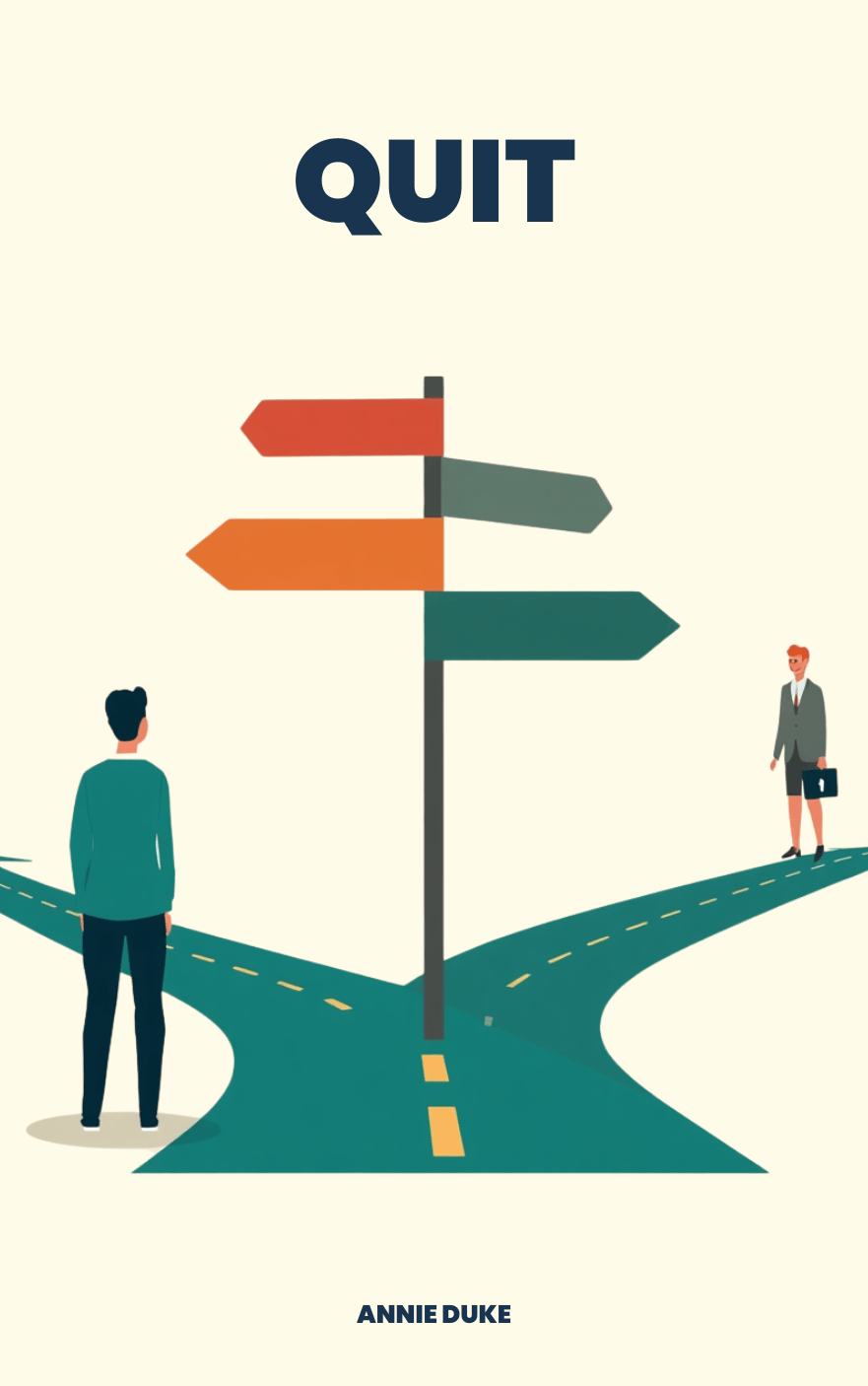
Prefer the print book? Buy on Amazon
As an Amazon Associate, Sumizeit earns from qualifying purchases.
Quit Book Summary
This Quit Book Summary covers the key ideas, lessons, and takeaways in about 20 minutes.
Short Description:
When to quit wisely and make better decisions under uncertainty
Rather than fearing quitting, you should see it as a strategic tool. By setting clear exit criteria, recognizing cognitive biases, and maintaining alternative options, you can make more rational choices. The most successful people are not those who never quit—they are the ones who quit the right things at the right time, allowing them to focus their energy where it matters most.
Helps with these goals
Preview the Quit book summary
Below is a preview of Sumizeit’s comprehensive human-written summary of Quit by Annie Duke. The full summary is 15-20 minutes long and covers the book’s key ideas in text, audio, visual, and video formats. Unlock the full 20 Minute Summary
In Quit, Annie Duke challenges one of the most deeply ingrained beliefs in modern culture: that persistence is always virtuous and quitting is inherently a failure. Instead, she reframes quitting as a powerful decision-making tool—one that, when used wisely, leads to better outcomes, faster progress, and more meaningful success.
At the heart of the book is a simple but often overlooked truth: life is uncertain, and the decisions we make are based on incomplete information. Because of this, many of our initial choices will inevitably be flawed. The real advantage doesn’t come from stubbornly sticking to those choices, but from being willing—and able—to change course when reality proves them wrong.
Duke argues that the ability to disengage is not a weakness but a form of intelligence. It allows individuals and organizations to adapt to changing conditions, reallocate resources more effectively, and pursue better opportunities. Without this skill, people risk becoming trapped in failing paths, wasting time, money, and energy on pursuits that no longer serve them.
The Role of Uncertainty in Decision-Making
One of the central ideas in the book is that every decision is made under uncertainty. We never have complete knowledge about how things will turn out. Even the most well-researched plans are ultimately educated guesses.
Because of this, Duke emphasizes that decisions should not be judged solely by their outcomes. A good decision can lead to a bad result due to randomness, and a bad decision can sometimes appear successful. What matters is how well the decision process accounts for uncertainty and adapts over time.
This perspective shifts the focus from being “right” to being flexible. Instead of committing rigidly to a path, successful decision-makers continually reassess whether their current course still makes sense given new information. Quitting becomes a natural part of this process—an adjustment, not a failure.
For example, imagine someone climbing a dangerous mountain. Even if they’ve trained for years and invested significant resources, worsening weather conditions may make continuing too risky. Turning back isn’t a defeat—it’s a smart response to updated information.
Why Quitting Unlocks Better Opportunities
Continuing with a failing pursuit doesn’t just waste resources—it actively prevents you from pursuing better alternatives. Every decision to persist comes with an opportunity cost: the loss of what you could have done instead.
Duke highlights that quitting frees up valuable resources such as time, money, and mental energy. These can then be redirected toward more promising opportunities.
A compelling example is the story of a company that shut down a struggling product while still financially stable, allowing it to pivot toward a new idea that ultimately became highly successful. If the company had continued investing in the failing project, it might never have discovered the better opportunity.
This principle applies to individuals as well. Staying in an unfulfilling job, relationship, or project doesn’t just prolong dissatisfaction—it blocks the possibility of finding something better.
Quitting, in this sense, is not about giving up. It’s about reallocating effort toward higher-value pursuits.
The Cultural Bias Against Quitting
Despite…
Want the complete 20-minute summary?
- Full structured summary
- Video Summary
- Podcast Summary
- Audio summary
- Key takeaways
- Exercises
- Quiz
- Highlights and notes
- Ask the book with AI
Who should read Quit?
Quit is for anyone stuck in a job, relationship, project, or pursuit that isn't working but feels too difficult to leave. It's especially valuable for entrepreneurs, professionals, and leaders who struggle with the fear of quitting and need permission to change course strategically.
Why does Quit matter?
In a world that celebrates relentless persistence, Quit reframes quitting as an intelligent decision-making tool rather than a failure. As uncertainty and rapid change become constants in work and life, the ability to recognize when to stop—and actually do it—has become a crucial competitive advantage.
What are the key themes in Quit?
- Quitting as intelligent decision-making, not failure
- The role of uncertainty in evaluating choices
- Cognitive biases that trap us in failing paths
- Opportunity cost and resource allocation
- The cultural stigma against quitting
- Strategic flexibility over rigid persistence
How can you apply ideas from Quit?
- Write down exit criteria for your current projects or roles before starting them, so you can assess progress objectively without bias
- When starting something new, identify the hardest unsolved problem and tackle it first to test whether the venture is truly viable
- Seek feedback from someone with no emotional investment in your decision—a mentor, coach, or trusted advisor who will challenge your assumptions
- Regularly audit your time and resources: are they flowing toward your best opportunities or trapped in habits and sunk costs?
- Build skills and relationships in multiple areas so you have alternatives when it's time to move on from a failing path
What common mistakes do readers make with Quit?
- Assuming a good decision should always lead to a good outcome, causing you to second-guess smart choices when randomness produces bad results
- Continuing to invest in something because of what you've already spent, rather than evaluating whether the future payoff justifies the current cost
- Working on visible, easy tasks while avoiding harder core problems, creating an illusion of progress that masks fundamental flaws
- Letting fear of others' judgment override your better judgment, staying in situations that aren't working because you worry about looking like a quitter
Sumizeit Exercises Apply what you've learned
Turn ideas from Quit into action with a short guided reflection: identify the biggest takeaway, connect it to your life, and commit to one step you can take in the next 24 hours.
What is the expert analysis of Quit?
Overview
Quit by Annie Duke is a significant contribution to contemporary discourse on decision-making, challenging the conventional valorization of persistence. Duke, a former professional poker player and decision scientist, leverages her expertise in uncertainty and cognitive biases to reframe quitting not as failure, but as a strategic, intelligent choice. The book intersects domains of psychology, behavioral economics, and practical self-improvement, offering a nuanced perspective that is both timely and countercultural in a society that often equates quitting with weakness.
Core Thesis
Duke’s central argument is that the ability to quit—disengage from unproductive pursuits—is a critical decision-making skill that enables better allocation of resources, enhances adaptability, and ultimately leads to more successful outcomes. She posits that because all decisions are made under uncertainty and incomplete information, rigid persistence can trap individuals and organizations in failing paths. Instead, quitting, when guided by rational criteria and awareness of cognitive biases, is an act of intelligence and flexibility rather than defeat.
Strengths
Innovative Reframing: Duke effectively dismantles the cultural stigma around quitting, transforming it into a positive, strategic tool for growth and innovation.
Integration of Cognitive Science: The book’s detailed exploration of biases such as the sunk cost fallacy, loss aversion, and status quo bias provides a robust psychological foundation for understanding why quitting is difficult and how to overcome these barriers.
Practical Frameworks: Duke offers actionable strategies like setting exit criteria in advance, tackling hardest problems first, and maintaining optionality, which empower readers to apply the concepts in real-world contexts.
Balanced Perspective: The nuanced discussion of when to persist versus when to quit avoids simplistic prescriptions, acknowledging the complexity of decision-making under uncertainty.
Authorial Credibility: Duke’s background in high-stakes poker and decision science lends authenticity and depth to her insights, bridging theory and practice.
Critiques & Counterarguments
Evidence Scope: While Duke draws on compelling examples and psychological research, some readers may find the empirical foundation somewhat anecdotal or reliant on illustrative cases rather than large-scale longitudinal studies, which could limit generalizability.
Potential Oversimplification: The binary framing of quitting versus persisting risks oversimplifying complex motivational and contextual factors, such as resilience, grit, and the nonlinear nature of many success trajectories.
Cultural Variability: The book’s critique of cultural biases against quitting is largely Western-centric; in other cultural contexts, the social meaning and consequences of quitting may differ significantly, which the book does not fully explore.
Competing Research: Psychological research on grit (Angela Duckworth) and growth mindset (Carol Dweck) emphasizes perseverance as a key predictor of success, suggesting that quitting may sometimes undermine long-term achievement if not carefully contextualized.
Real-World Complexities: In organizational settings, quitting projects can be complicated by political, structural, and emotional factors that are not easily resolved by rational exit criteria, indicating a gap between theory and practice.
Who Should Read This
Quit is ideally suited for professionals, entrepreneurs, and leaders who grapple with high-stakes decisions under uncertainty and seek frameworks to optimize their choices. It also appeals to individuals interested in cognitive psychology and behavioral economics, as well as readers in self-improvement who wish to challenge conventional wisdom about persistence. Those facing career transitions, innovation challenges, or strategic pivots will find Duke’s insights particularly valuable for cultivating adaptive thinking and emotional resilience in the face of change.
About Sumizeit
Sumizeit is a profitable Scomy LLC company based in Miami, Florida. Our founders, Clemens Raemy and Weina Scott, are successful entrepreneurs with several exits. Sumizeit is a popular book summary app / micro learning app used by busy professionals and entrepreneurs with over 2,500 non-fiction book summaries and 10,000 podcast summaries in text, audio, visual, podcast, and video format. We also have stellar retention tools to make ideas stick - such as flashcards with spaced repetition, quizzes, streaks, highlighting and notes, daily challenges, riddles, mini-courses, meditation, and more. You won't only learn the idea, but also remember it. Over 90% of our users change their habits with Sumizeit.
Upgrade Now
Here's why readers love Sumizeit
Join thousands of learners getting smarter every day
"Great experience. Detailed summaries. Loved the gamification feature. Makes learning fun. Good customer service. I recommend Sumizeit to anyone. You'll learn a lot."
"I always felt busy but still wanting to keep up with the book discussion in my friend group. This was a great supplement to help me keep reading the books I find fun while keeping up with important books."
"I love this website. Instead of scrolling social media, I find myself learning a lot. I use it everyday. I recommend this app for anyone who is too busy and wants to get up to speed with their favorite books."
Quit Book Summary PDF
Looking for a Quit Book Summary PDF you can save and revisit offline? Our Quit Book Summary PDF captures the book’s core ideas in a clean, printable format — the key frameworks, takeaways, and structure without the fluff. Download the Quit Book Summary PDF when you want a reference you can annotate, share with your team, or review on the go. Get your Quit Book Summary PDF from the download page below.
Download Quit Book Summary PDFPeople also liked these summaries
Readers who explored Quit often enjoyed these titles next.


Ready to read the whole thing?
- Full structured summary
- Video Summary
- Podcast Summary
- Audio summary
- Key takeaways
- Exercises
- Quiz
- Highlights and notes
- Ask the book with AI
Featured Book Titles
Popular Book Summaries at sumizeit, leading book summary app