
Question 1 of 10


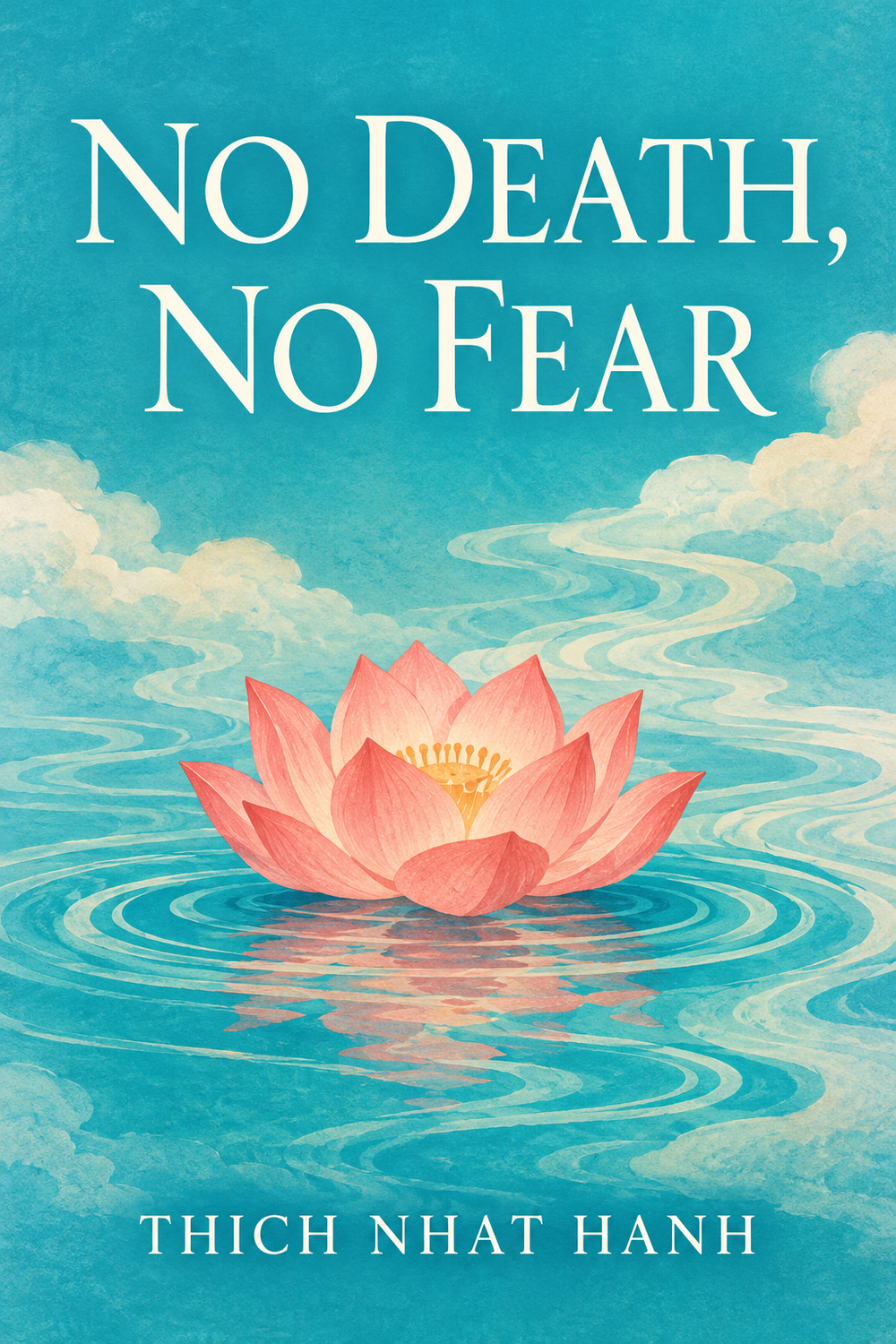
Prefer the print book? Buy on Amazon
As an Amazon Associate, Sumizeit earns from qualifying purchases.
Book Summary
No Death, No Fear Book Summary
This No Death, No Fear Book Summary covers the key ideas, lessons, and takeaways in about 20 minutes.
Short Description:
Nhat Hanh’s case that birth and death are changes, plus practices to lose fear
You are not a separate thing headed toward a final ending. You are a temporary form of something much bigger, as a wave is a form of the ocean, and nothing that makes you up is ever created from zero or destroyed into zero. Fear of death comes from believing otherwise and clinging to a self that was never fixed in the first place. When you look closely, through your breath, your ancestors, the seasons, and the moment you are in right now, you can see for yourself that life continues in other forms. That sight doesn't make this life matter less. It frees you to love it fully, grieve honestly, comfort others calmly, and meet your own death without panic.
Helps with these goals
Preview the No Death, No Fear book summary
Below is a preview of Sumizeit’s comprehensive human-written summary of No Death, No Fear by Thich Nhat Hanh. The full summary is 15-20 minutes long and covers the book’s key ideas in text, audio, visual, and video formats. Unlock the full 20 Minute Summary
Most of us carry a quiet dread about dying. Thich Nhat Hanh wrote this book (2002) to take that dread apart. He is a Zen master, and his central claim is simple to state and hard to feel. Nothing is ever truly born, and nothing ever truly dies. What we call birth and death are just changes of form in a flow that never stops. If you see this clearly, he says, you can live with less fear, more peace, and more joy, even though everything around you keeps changing.
The book is short and written for anyone. You don't need to be Buddhist. He uses clouds, candles, leaves, and breathing to make his points, and he asks you to check them against your own experience instead of taking them on faith. The book moves through three steps. First, why birth and death are illusions. Second, why our wrong view of ourselves causes so much suffering. Third, what you can actually do about it, day by day.
Why birth and death are illusions
Start with a cloud. It turns into rain, the rain feeds a river, the river runs to the ocean, and the ocean sends water back up to become a cloud. At no point did anything start from nothing or vanish into nothing. Nhat Hanh says human life works the same way. Birth and death are two stops along a continuous path, not a door that opens out of nowhere and a door that slams shut at the end.
He uses a candle to show this. You might say a flame is born when the match touches the wick. But the flame needed wax, a wick, oxygen, and the match itself before it could exist. When you blow it out, the heat and light spread into the room. The flame changed. It did not go from something to nothing.
Your own body is a good test. Your cells keep dying and being replaced. You take in food, air, and water and give them back. Your thoughts and moods rise and fade all day. Nothing in you stays fixed, so you are less like a solid object and more like a process, something still happening. The line between you and the world around you is drawn by the mind. It is not drawn in nature. A wave rises from the ocean and falls back into it, and it was never apart from the ocean at any moment. You are like that wave.
Not a separate self, but interbeing
Buddhism calls this idea "no self." Nhat Hanh is careful to say it does not mean you don't exist. It means you exist in a different way than you assume. Try to find your "self" and see what turns up. You find a body that trades material with its surroundings, feelings and perceptions that depend on countless causes, and a personality that shifts over the years. There is no permanent core hiding underneath.
Want the complete 20-minute summary?
- Full structured summary
- Video Summary
- Podcast Summary
- Audio summary
- Key takeaways
- Exercises
- Quiz
- Highlights and notes
- Ask the book with AI
Who should read No Death, No Fear?
No Death, No Fear is for anyone struggling with mortality anxiety, grief, or existential dread—whether you're Buddhist or not. It's ideal for people seeking practical ways to live more fully in the present moment and for those caring for the dying or grieving a loss.
Why does No Death, No Fear matter?
In a culture that often denies death and clings to permanence, this book offers a radically different framework: that birth and death are illusions of perspective, and understanding this can free you from fear while deepening your capacity to love and act. As we face global crises and personal mortality, Thich Nhat Hanh's teachings provide both philosophical clarity and accessible practices for living with peace rather than panic.
What are the key themes in No Death, No Fear?
- Interdependence and interbeing
- The illusion of a separate, permanent self
- Presence in the present moment as liberation
- Continuity through transformation
- Compassion born from understanding impermanence
- The role of mindfulness in facing death and grief
How can you apply ideas from No Death, No Fear?
- Use mindful breathing as an anchor when anxiety or grief arises, returning attention to the simple fact that you are alive right now
- Practice walking meditation to stay present in each step, noticing how fear often exists only in your head and dissolves when you are fully here
- Observe natural cycles—fallen leaves feeding soil, seeds sprouting, plants returning to earth—to internalize the principle of transformation rather than erasure
- Reflect on your ancestors by noticing their features, mannerisms, and values in yourself, and recognize that you are also continuing them for the next generation
- When facing grief, look deeply at how the person who died continues through their influence on you, in the qualities you carry, in causes they believed in, or in people they loved
- Prepare for your own death or serious illness by practicing mindfulness and acceptance of change now, so that steadiness is already woven into your nervous system
- Support someone who is dying by maintaining your own calm presence, using gentle mindfulness guidance, and reminding them of how they will continue in others and the world
What common mistakes do readers make with No Death, No Fear?
- Thinking that accepting impermanence means your life or relationships don't matter—the opposite is true; seeing the temporary nature of life makes it more precious
- Trying to believe the concepts intellectually without checking them against direct experience through observation, breathing, and meditation
- Assuming mindfulness is only a stress-management trick rather than a gateway to fundamental shifts in how you see yourself and death
- Avoiding grief by prematurely jumping to the idea of continuation, instead of honoring both the sadness and the larger context in which the loss sits
Sumizeit Exercises Apply what you've learned
Turn ideas from No Death, No Fear into action with a short guided reflection: identify the biggest takeaway, connect it to your life, and commit to one step you can take in the next 24 hours.
What is the expert analysis of No Death, No Fear?
Overview
No Death, No Fear is a profound meditation on mortality and existence by the revered Zen master Thich Nhat Hanh. Published in 2002, this concise work distills complex Buddhist teachings into accessible reflections on life, death, and the nature of self. Thich Nhat Hanh, a Vietnamese monk and peace activist, is renowned for bridging Eastern contemplative traditions with Western audiences, making his insights both spiritually rich and pragmatically relevant. His legacy as a prolific author and mindfulness pioneer lends this book significant weight in contemporary discussions on death anxiety and the search for meaning.
Core Thesis
The central argument of No Death, No Fear is that the conventional understanding of birth and death as absolute beginnings and endings is an illusion. Instead, Thich Nhat Hanh posits that all phenomena, including human life, are continuous transformations within an interconnected flow he terms "interbeing." This perspective dissolves the notion of a fixed, separate self, replacing it with a dynamic process embedded in the whole of existence. Recognizing this truth, the author argues, liberates individuals from the fear of death and suffering, allowing them to embrace life with greater peace, presence, and compassion.
Strengths
- Clarity and Accessibility: Despite its deep philosophical roots, the book is remarkably approachable, using everyday metaphors—clouds, candles, breath—to elucidate abstract concepts without esoteric jargon.
- Integration of Tradition and Modernity: Thich Nhat Hanh skillfully synthesizes Pure Land and Zen Buddhist traditions, offering a balanced "middle path" that avoids extremes of eternalism and nihilism.
- Practical Application: The text is not merely theoretical; it provides concrete mindfulness practices such as breathing, walking meditation, and reflective exercises on ancestry and nature that ground the philosophy in lived experience.
- Emotional Resonance: The compassionate tone and emphasis on embracing grief and love with open hands resonate deeply, validating human vulnerability while offering a transformative outlook on loss.
- Interdisciplinary Corroboration: The book thoughtfully references scientific findings—such as the stellar origin of elements and quantum entanglement—to bridge spiritual insight with empirical knowledge, enhancing its credibility for a modern readership.
Critiques & Counterarguments
- Philosophical Oversimplification: While the metaphor of continuous transformation is compelling, it risks glossing over complex metaphysical debates about identity, consciousness, and personal persistence that have occupied philosophers for centuries.
- Empirical Ambiguity: The scientific references, though evocative, are often metaphorical rather than rigorously substantiated parallels; quantum entanglement and stellar nucleosynthesis do not straightforwardly validate Buddhist ontology.
- Cultural and Religious Specificity: The book’s Buddhist framework may not fully resonate with readers from other spiritual or secular traditions who might find the notion of “no-self” counterintuitive or unsettling.
- Potential for Passive Acceptance: Critics from existentialist or humanist perspectives might argue that emphasizing impermanence and interconnectedness could inadvertently encourage resignation rather than active engagement with life's challenges.
- Contrasting Views on Death: Other philosophical traditions, such as certain strands of Western dualism or materialism, maintain that death is a definitive cessation of personal experience, challenging the continuity thesis presented here.
Who Should Read This
No Death, No Fear is ideally suited for readers seeking a compassionate, contemplative approach to mortality that transcends doctrinal Buddhism. It appeals to those grappling with death anxiety, loss, or existential uncertainty, as well as practitioners of mindfulness and meditation looking to deepen their understanding of impermanence and selfhood. Additionally, scholars and thoughtful lay readers interested in the intersection of spirituality, psychology, and science will find the book’s synthesis both enlightening and inspiring. Its gentle, poetic style makes it accessible to a broad audience, yet its philosophical depth rewards careful reflection.
Discussion questions for No Death, No Fear Short questions you can actually use in a conversation
Frequently asked questions about the No Death, No Fear book summary
What is No Death, No Fear about?
No Death, No Fear by Thich Nhat Hanh is about understanding that birth and death are illusions born from a mistaken sense of having a separate, permanent self. The book teaches that everything continuously transforms—like a cloud becoming rain—and that seeing this clearly frees you from fear while helping you live more fully, grieve honestly, and face your own death with peace.
Who should read No Death, No Fear?
Anyone struggling with fear of death, grief over loss, or a sense of disconnection should read this book. It speaks to parents caring for dying children, people facing terminal illness, those grieving loved ones, and anyone curious about living more peacefully in a world of constant change. You don't need to be Buddhist or have any spiritual background to benefit from it.
What are the main takeaways from No Death, No Fear?
The core insight is that you are not a separate thing with an absolute beginning and end, but a temporary form of something much larger—like a wave that is also the ocean. The book teaches that mindfulness practice, reflection on your interdependence with all things, and acceptance of impermanence are the practical paths to freedom from death anxiety. Finally, it shows how this understanding can deepen your compassion for others and transform how you grieve and support those facing death.
Does No Death, No Fear require religious belief?
No. Thich Nhat Hanh invites readers to check his teachings against direct experience rather than accept them on faith. He uses everyday observations—clouds, candles, your own body—and practices like mindful breathing to show the principles of impermanence and interdependence. The book is accessible to secular readers and works alongside any worldview or spiritual tradition.
What is interbeing?
Interbeing is Thich Nhat Hanh's term for the idea that everything exists only because everything else exists. A tree cannot exist without soil, rain, sun, insects, and fungi; similarly, you exist because of your ancestors, culture, food, and countless other causes. The boundary between self and world is drawn by the mind; in nature, all things are interconnected in one continuous web of life.
How does No Death, No Fear address grief?
Rather than denying grief or rushing past it, the book teaches a practice of looking deeply to see how the person who died continues through their influence on others, the qualities they instilled in you, causes they cared about, and the natural return of their elements to the earth. This doesn't erase sadness but places it in a larger context of continuation, which changes the feel of the loss over time.
What practices does Thich Nhat Hanh recommend?
Key practices include mindful breathing to anchor you in the present moment; walking meditation to stay with each step; observing nature's cycles to see transformation in action; reflecting on your ancestors to recognize how you carry them forward; and the Touching the Earth practice, where you bow while thinking of ancestors, descendants, teachers, and all beings. These practices make the teachings about impermanence and interdependence clear from lived experience.
Can this book help me support someone who is dying?
Yes. The book explains how your own calm presence and lack of fear create space for someone facing death to die peacefully, since people sense the emotions of those around them. It offers practical guidance on staying centered with mindful breathing, creating a peaceful environment, offering gentle mindfulness support, and helping the person see how they will continue through their influence on others and the world.
About Sumizeit
Sumizeit is a profitable Scomy LLC company based in Miami, Florida. Our founders, Clemens Raemy and Weina Scott, are successful entrepreneurs with several exits. Sumizeit is a popular book summary app / micro learning app used by busy professionals and entrepreneurs with over 2,500 non-fiction book summaries and 10,000 podcast summaries in text, audio, visual, podcast, and video format. We also have stellar retention tools to make ideas stick - such as flashcards with spaced repetition, quizzes, streaks, highlighting and notes, daily challenges, riddles, mini-courses, meditation, and more. You won't only learn the idea, but also remember it. Over 90% of our users change their habits with Sumizeit.
Upgrade Now
Here's why readers love Sumizeit
Join thousands of learners getting smarter every day
"Great experience. Detailed summaries. Loved the gamification feature. Makes learning fun. Good customer service. I recommend Sumizeit to anyone. You'll learn a lot."
"I always felt busy but still wanting to keep up with the book discussion in my friend group. This was a great supplement to help me keep reading the books I find fun while keeping up with important books."
"I love this website. Instead of scrolling social media, I find myself learning a lot. I use it everyday. I recommend this app for anyone who is too busy and wants to get up to speed with their favorite books."
No Death, No Fear Book Summary PDF
Looking for a No Death, No Fear Book Summary PDF you can save and revisit offline? Our No Death, No Fear Book Summary PDF captures the book’s core ideas in a clean, printable format — the key frameworks, takeaways, and structure without the fluff. Download the No Death, No Fear Book Summary PDF when you want a reference you can annotate, share with your team, or review on the go. Get your No Death, No Fear Book Summary PDF from the download page below.
Download No Death, No Fear Book Summary PDFPeople also liked these summaries
Readers who explored No Death, No Fear often enjoyed these titles next.




Ready to read the whole thing?
- Full structured summary
- Video Summary
- Podcast Summary
- Audio summary
- Key takeaways
- Exercises
- Quiz
- Highlights and notes
- Ask the book with AI
Featured Book Titles
Popular Book Summaries at sumizeit, leading book summary app
Atomic Habits Book Summary Rich Dad Poor Dad Book Summary The Four Agreements Book Summary The 48 Laws of Power Book Summary When Breath Becomes Air Book Summary Think and Grow Rich Book Summary