


As an Amazon Associate, Sumizeit earns from qualifying purchases.
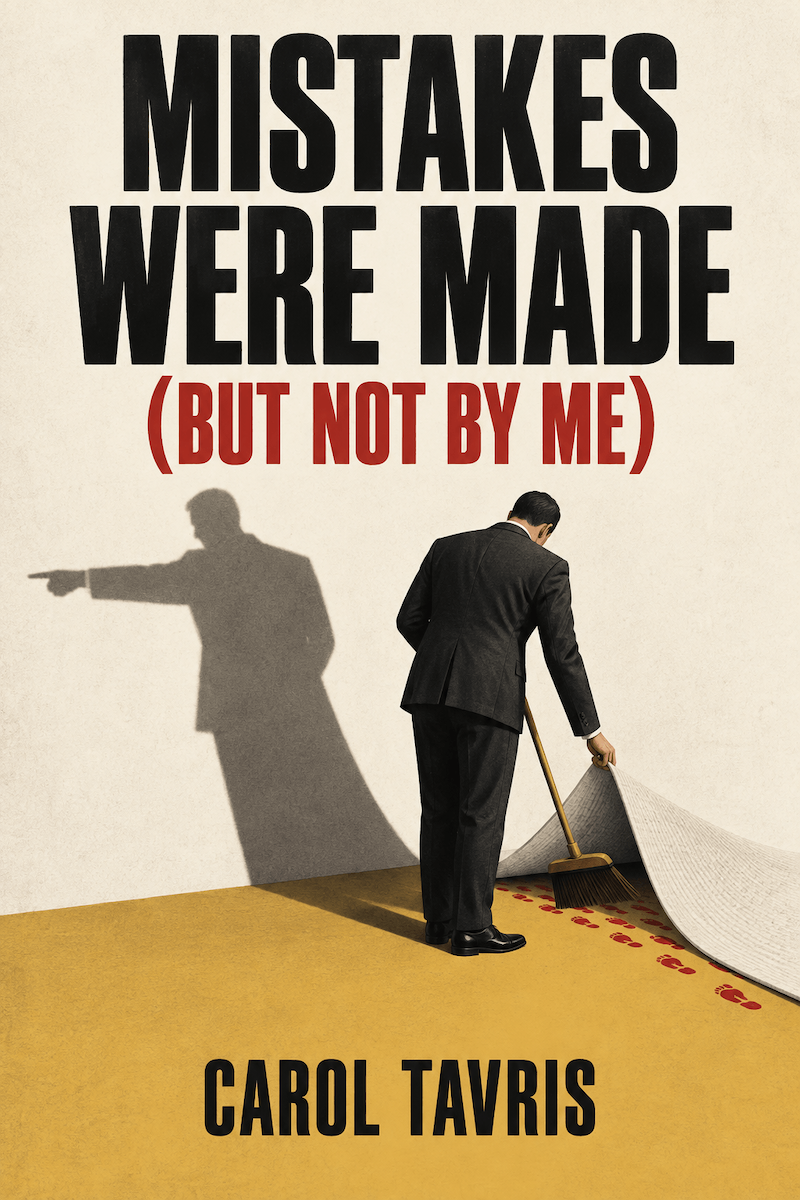
Mistakes Were Made (But Not by Me) Book Summary
This Mistakes Were Made (But Not by Me) Book Summary covers the key ideas, lessons, and takeaways in about 20 minutes.
Helps with these goals
Want the complete 20-minute summary?
- Full structured summary
- Video Summary
- Podcast Summary
- Audio summary
- Key takeaways
- Exercises
- Quiz
- Highlights and notes
- Ask the book with AI
What is in the Mistakes Were Made (But Not by Me) book summary?
Below is a preview of Sumizeit’s expert-written summary of Mistakes Were Made (But Not by Me) by Carol Tavris. The full summary covers the book’s key ideas in text, audio, and video.
Think about the last time you watched someone dig in on a bad call instead of just owning it. A politician who denies a scandal everyone can see. A friend who insists the fight was your fault, not theirs. A doctor who won't revisit a diagnosis even after the treatment fails. You've probably done a version of this yourself. Carol Tavris and Elliot Aronson, two social psychologists, spent this book trying to answer a simple question: why is admitting a mistake so hard, even for smart, decent people who genuinely want to do the right thing?
Their answer comes down to a concept called cognitive dissonance. That's the uncomfortable feeling you get when two things you believe, or a belief and an action, don't line up. Say you think of yourself as an honest person, but you just fudged a number on your taxes. Those two facts clash, and the friction between them is dissonance. It's not a huge crisis most of the time, but it's genuinely uncomfortable, because it threatens something we all want to believe: that we're consistent, sensible people living in a world that makes sense.
Faced with that discomfort, most of us don't sit with it and change our behavior. We get rid of it the easy way. We twist the story until the contradiction disappears. Tavris and Aronson spend the book walking through exactly how we do that, why it happens without us noticing, and what it costs us when we let it run unchecked.
The discomfort of not matching up
Dissonance shows up whenever your actions and your self image don't match. If you believe factory farming is cruel but you still eat meat three times a day, you'll feel some version of that tension. If you think of yourself as someone who works hard but you spent the afternoon scrolling instead of finishing a project, same thing.
The reason this bothers us so much isn't vanity. It's that our sense of self depends on believing we're rational and consistent. The moment we admit we did something that contradicts our values, we lose that claim. So the mind looks for a way to close the gap between what we did and who we think we are. Usually it does this by changing the story rather than changing the behavior.
Tavris and Aronson argue that most of us treat dissonance as something to escape as fast as possible, whatever the cost to the truth. And they identify three separate mental habits that do the escaping for us, usually so quietly we never catch them in the act.
Habit one, telling ourselves a better story
The first and most central of these habits is what the authors call self justification. It's worth being precise about what this is, because it's easy to confuse with lying. Lying requires you to know you're doing something wrong and cover it up on purpose. Self justification is different. It happens below the surface.
Want the complete 20-minute summary?
- Full structured summary
- Video Summary
- Podcast Summary
- Audio summary
- Key takeaways
- Exercises
- Quiz
- Highlights and notes
- Ask the book with AI
Who should read Mistakes Were Made (But Not by Me)?
This book is for anyone who has ever struggled to admit a mistake or found themselves defending a poor decision long after knowing better. It's essential reading for leaders, professionals, parents, and anyone interested in understanding why intelligent, well-intentioned people often can't see their own role in conflicts, failures, or harmful behavior.
Why does Mistakes Were Made (But Not by Me) matter?
In an era of polarization, workplace dysfunction, and personal conflict, understanding how our minds protect us through self-deception has never been more relevant. Mistakes Were Made (But Not by Me) reveals the psychological mechanisms behind everything from political gridlock to relationship breakdown, helping readers recognize these patterns in themselves before they cause lasting damage.
What are the key themes in Mistakes Were Made (But Not by Me)?
- Cognitive dissonance and how we resolve uncomfortable contradictions
- Self-justification as an automatic defense mechanism
- Confirmation bias and selective information processing
- How memory distortion protects our self-image
- The role of prejudice in maintaining false beliefs
- How small justified choices accumulate into fundamental differences
- The gap between how wrongdoers and victims remember harm
- Breaking cycles of defensive thinking through awareness
What are the key lessons from the Mistakes Were Made (But Not by Me) book summary?
Cognitive dissonance is unavoidable but manageable
The discomfort of contradicting your self-image is not a sign of failure but a natural human experience. Learning to sit with this discomfort rather than escaping it through justification is the key to genuine growth.
Self-justification feels like truth from the inside
When your mind rewrites your actions to protect your self-image, you genuinely believe the revised story. This isn't lying; it's a subconscious process that makes admitting mistakes feel impossible.
Confirmation bias filters reality without your awareness
Your brain automatically accepts evidence that supports what you already believe while dismissing contradictory information as unreliable. This creates a sealed belief system resistant to change.
Memories are rebuilt to serve your self-image
Every time you recall something, your brain reconstructs it in ways that make you look better. The more a memory threatens your identity, the more likely it is to be distorted over time.
We protect three core beliefs about ourselves
Most self-justification defends the beliefs that we're rational, competent, and good. Understanding which belief is under threat in any situation helps explain defensive reactions.
Sunk costs make it harder to admit mistakes
The more time, money, or effort you've invested in a decision, the more your mind will work to convince you it was right. Backing down feels like admitting irrationality.
Small mistakes are easier to own than large ones
Low-stakes errors barely threaten your sense of competence, so you can admit them easily. High-stakes failures trigger intense justification because they threaten your core identity.
Harmdoers and victims live in different emotional realities
People who caused harm usually rewrite the story quickly and move on, while those who were harmed carry the pain much longer. This creates a fundamental mismatch in how both sides remember conflict.
Victimhood can justify cruelty
Feeling wronged creates moral cover to act badly yourself, letting people hurt others while still believing they're good. This dynamic escalates conflicts as both sides feel righteously defensive.
Early childhood shapes our relationship with mistakes
Fear of disappointing parents or getting punished for errors becomes a lifelong pattern of defensive thinking. Talking openly about mistakes teaches children that errors are normal and fixable.
Stereotypes protect bias while feeling rational
Our brains use stereotypes to make quick judgments, but they also flatten differences and justify unfair treatment. Naive realism makes us feel our biased views are simply factual observations.
Prejudice persists because of cognitive dissonance, not ignorance
Most people know prejudice is wrong, which creates dissonance with holding prejudiced views. Instead of questioning the prejudice, they double down on the stereotype to resolve the discomfort.
Small choices accumulate into opposite worldviews
When two people make different choices in a similar situation, each justifies their decision, which shifts how they see the whole issue. Over time, these small shifts create people with completely opposite beliefs who can't remember ever thinking alike.
Conflict widens through the pyramid of choice
Political, moral, and relational divides don't usually stem from one dramatic disagreement but from a series of small justified choices that gradually push people further apart.
Admitting mistakes actually lightens their weight
Contrary to intuition, owning an error reduces its burden more than hiding or justifying it. Honesty also builds trust and respect far more effectively than defensive explanations.
Awareness of bias gives you power to control it
Automatic self-justification works because it's invisible. Catching your own justifications in the moment, before they harden into beliefs, gives you real control over them.
Discomfort is information, not a problem to escape
The moment you feel defensive about a decision or claim, that discomfort is signaling that something doesn't align. Pausing to examine it rather than justify it opens the door to learning.
Organizations fail when people can't admit fault
Teams and companies where self-justification runs unchecked never solve real problems because nobody will acknowledge what went wrong. People prioritize protecting their image over the group's success.
Righteousness can mask self-interest
When you frame a self-serving choice as the moral high ground, self-justification lets you feel good about decisions that primarily benefit you. Examining whether you'd make the same choice if it hurt instead of helped is a useful test.
Understanding the mechanism is the first step to change
Simply knowing that your mind automatically justifies mistakes doesn't eliminate the habit, but it creates enough distance for you to notice it happening and choose differently.
Want the complete 20-minute summary?
- Full structured summary
- Video Summary
- Podcast Summary
- Audio summary
- Key takeaways
- Exercises
- Quiz
- Highlights and notes
- Ask the book with AI
How can you apply ideas from Mistakes Were Made (But Not by Me)?
- When you feel defensive about a decision or claim, pause and ask what belief about yourself you're protecting—are you defending being rational, competent, or good?
- Before accepting evidence that confirms what you already believe, actively seek out credible counterarguments and examine them seriously rather than dismissing them
- In workplace conflicts, ask the other person to describe their experience first without interruption, then share your own, to surface the gap between how each person remembers events
- When teaching children about their own mistakes, focus on what they can learn and fix rather than what they did wrong, to build a healthy relationship with error
- Before making a major decision, write down your real reasons for choosing one path instead of another, then check that reasoning a month later to see if you're rewriting the story
- In relationships, establish a practice of saying 'I got that wrong' early and often for small things, building the muscle to admit bigger mistakes without the same defensive escalation
- When you catch yourself justifying why something wasn't your fault, flip the perspective and ask what someone you trust would say about your role in it
What common mistakes do readers make with Mistakes Were Made (But Not by Me)?
- Assuming that smart, educated people are immune to self-justification—intelligence actually makes the rationalizations more sophisticated, not less likely
- Believing that pointing out someone's bias or mistake will change their mind—defensive reactions to evidence usually deepen the original position
- Waiting until you feel ready or calm to admit a mistake—the discomfort never fully disappears, and delaying only gives justification more time to harden
- Confusing self-justification with malice—most people aren't deliberately lying; they've genuinely convinced themselves, which makes the pattern far more persistent
Sumizeit Exercises Apply what you've learned
Turn ideas from Mistakes Were Made (But Not by Me) into action with a short guided reflection: identify the biggest takeaway, connect it to your life, and commit to one step you can take in the next 24 hours.
What is the expert analysis of Mistakes Were Made (But Not by Me)?
Overview
Mistakes Were Made (But Not by Me) is a seminal work co-authored by Carol Tavris and Elliot Aronson, two distinguished social psychologists whose combined expertise lends considerable weight to the exploration of human self-deception and cognitive dissonance. The book stands out in the landscape of psychology and self-improvement literature by dissecting the subtle psychological mechanisms that prevent individuals from admitting mistakes, even when confronted with clear evidence. Its significance lies not only in elucidating these pervasive mental habits but also in connecting them to broader social phenomena such as prejudice, conflict escalation, and organizational dysfunction.
Core Thesis
The central insight of the book is that the human mind employs three unconscious habits—self-justification, confirmation bias, and memory distortion—to protect core self-beliefs: that we are rational, competent, and good. These cognitive defenses generate a persistent resistance to admitting errors, as doing so threatens our self-image and emotional equilibrium. Tavris and Aronson argue that this self-deception is not a matter of deliberate lying but an automatic psychological process that shapes how we interpret our actions, memories, and incoming information. The authors extend this framework to explain how these mechanisms fuel interpersonal conflicts, prejudice, and entrenched divisions, and they advocate for conscious awareness and acceptance of discomfort as a path toward greater honesty and reconciliation.
Strengths
- Integration of Psychological Research and Real-World Examples: The authors skillfully translate complex psychological concepts into accessible narratives, using relatable scenarios—from parking lot scratches to political scandals—that vividly illustrate cognitive dissonance in action.
- Nuanced Distinction Between Self-Justification and Lying: By clarifying that self-justification is an unconscious process distinct from intentional deceit, the book deepens our understanding of human fallibility without moralizing.
- Insightful Analysis of Social and Interpersonal Dynamics: The exploration of how self-justification contributes to organizational failures, prolonged conflicts, and societal prejudice offers a compelling framework for understanding entrenched divisions.
- Constructive Solutions Rooted in Psychological Awareness: Rather than leaving readers with a bleak diagnosis, the book offers practical guidance on embracing discomfort and recognizing biases to break the cycle of denial and defensiveness.
- Authoritative Authorship: Tavris and Aronson’s extensive backgrounds and prior influential works lend credibility and depth to their arguments, enriching the book’s intellectual rigor.
Critiques & Counterarguments
- Potential Oversimplification of Complex Behaviors: While the triad of self-justification, confirmation bias, and memory distortion captures key mechanisms, human cognition and social behavior are multifaceted, and some critics might argue that the book underrepresents other psychological factors such as motivated reasoning or emotional regulation nuances.
- Limited Attention to Cultural and Contextual Variability: The book primarily draws on Western psychological paradigms and examples; cross-cultural research suggests that concepts of self and error admission vary significantly, which could complicate the universality of the authors’ claims.
- Evidence Base and Empirical Nuance: Although grounded in well-established psychological theory, some of the book’s anecdotes and generalizations might benefit from more recent empirical studies, particularly in neuropsychology and behavioral economics, which have expanded understanding of decision-making biases.
- Opposing Schools of Thought: Some cognitive scientists emphasize the adaptive functions of self-deception, suggesting it can enhance social cohesion or personal resilience, a perspective that complicates the primarily negative framing of self-justification in this book.
- Real-World Contradictions: In certain high-stakes environments such as scientific research or crisis management, admitting mistakes is often institutionalized and rewarded, indicating that social structures can mitigate the cognitive tendencies described, a nuance the book touches on but could explore further.
Who Should Read This
This book is essential reading for psychologists, organizational leaders, educators, and anyone interested in the interplay between cognition, behavior, and social dynamics. It offers valuable insights for professionals seeking to foster accountability and constructive conflict resolution within teams or communities. Additionally, individuals invested in personal growth and self-awareness will find its practical advice on recognizing and overcoming mental biases profoundly empowering. Finally, those engaged in social justice or political discourse may gain a deeper understanding of the psychological roots of polarization and prejudice, equipping them with tools to bridge divides.
Frequently asked questions about the Mistakes Were Made (But Not by Me) book summary
What is Mistakes Were Made (But Not by Me) about?
Mistakes Were Made (But Not by Me) by Carol Tavris and Elliot Aronson is about how and why intelligent, well-meaning people convince themselves they haven't done anything wrong. The book explains three mental habits—self-justification, confirmation bias, and memory distortion—that protect our self-image by rewriting our mistakes into acceptable stories. These mechanisms help us defend the beliefs that we're rational, competent, and good, but they also prevent us from learning and create spiraling conflicts.
Who should read Mistakes Were Made (But Not by Me)?
Anyone interested in human behavior, decision-making, or why conflicts persist should read this book. It's particularly valuable for leaders and managers dealing with organizational dysfunction, parents concerned about their children's relationship with failure, professionals navigating workplace conflicts, and people struggling to understand why close relationships break down. Anyone who has ever felt frustrated by someone's inability to admit they were wrong will gain insight from this book.
What are the main takeaways from Mistakes Were Made (But Not by Me)?
The main takeaways are that cognitive dissonance—the discomfort of contradicting your self-image—drives us to rewrite our mistakes rather than fix them. Through self-justification, confirmation bias, and memory distortion, we protect three core beliefs: that we're rational, competent, and good. Small justified choices accumulate over time, pushing people into opposite worldviews. The solution involves learning to sit with discomfort rather than escape it through justification, and catching your own biases in the moment before they harden into beliefs.
How does cognitive dissonance relate to admitting mistakes?
Cognitive dissonance is the uncomfortable feeling when your actions contradict your self-image. When you make a mistake, admitting it creates dissonance because it threatens the belief that you're rational, competent, and good. Rather than sit with this discomfort and change, most people escape it by rewriting the story—telling themselves it wasn't really a mistake, someone else was to blame, or it wasn't important. This automatic defense mechanism makes genuine admission feel almost impossible.
What are the three mental habits that prevent us from admitting mistakes?
The three habits are self-justification (rewriting your actions in your own mind to look better), confirmation bias (accepting evidence that supports your beliefs while dismissing contradictory information), and memory distortion (rebuilding memories in ways that make you look good). These three work together to seal off your beliefs from contradiction, letting you maintain your self-image even when evidence suggests you were wrong. They operate mostly unconsciously, which is what makes them so powerful.
Why do political disagreements and social conflicts become so difficult to resolve?
According to Tavris and Aronson, conflicts deepen through what they call the pyramid of choice. When two people make different choices about the same issue, each justifies their decision, which shifts how they see the whole problem. Over months or years, these accumulated small justified choices push people further apart until they hold opposite beliefs and can't even imagine choosing the other path. This explains why political and moral divides widen over time rather than narrowing—it's not one big disagreement but a series of small, mutually reinforcing justifications.
How does this book explain the gap between harmdoers and victims?
Tavris and Aronson explain that people who caused harm usually use self-justification to smooth over what happened and move on quickly, while people who were harmed hold onto the pain much longer. The harmdoer remembers a smaller, less significant version of events, while the victim remembers real and lasting effects. This creates two genuinely different emotional realities, which is why apologies often feel inadequate—the person apologizing has already rewritten the harm as minor, while the person harmed hasn't.
Can we ever truly overcome our biases and stop justifying our mistakes?
According to the authors, you can't eliminate bias or self-justification, but you can gain real control over them through awareness. Research cited in the book shows that people who can identify their own biases in the moment have noticeably more control over them. The key is catching the justification forming before it hardens into belief, which requires active attention rather than running on autopilot. This is not about willpower alone but about learning to notice your mind's defensive moves as they happen.
About Sumizeit
Sumizeit is a profitable Scomy LLC company based in Miami, Florida. It has been helping readers learn from nonfiction books for 7 years with expert-written summaries in text, audio, podcast, and video.
Want the complete 20-minute summary?
- Full structured summary
- Video Summary
- Podcast Summary
- Audio summary
- Key takeaways
- Exercises
- Quiz
- Highlights and notes
- Ask the book with AI
Here's why readers love Sumizeit
Join thousands of learners getting smarter every day
"Great experience. Detailed summaries. Loved the gamification feature. Makes learning fun. Good customer service. I recommend Sumizeit to anyone. You'll learn a lot."
"I always felt busy but still wanting to keep up with the book discussion in my friend group. This was a great supplement to help me keep reading the books I find fun while keeping up with important books."
"I love this website. Instead of scrolling social media, I find myself learning a lot. I use it everyday. I recommend this app for anyone who is too busy and wants to get up to speed with their favorite books."
Mistakes Were Made (But Not by Me) Book Summary PDF
Looking for a Mistakes Were Made (But Not by Me) Book Summary PDF you can save and revisit offline? Our Mistakes Were Made (But Not by Me) Book Summary PDF captures the book’s core ideas in a clean, printable format — the key frameworks, takeaways, and structure without the fluff. Download the Mistakes Were Made (But Not by Me) Book Summary PDF when you want a reference you can annotate, share with your team, or review on the go. Get your Mistakes Were Made (But Not by Me) Book Summary PDF from the download page below.
Download Mistakes Were Made (But Not by Me) Book Summary PDFPeople also liked these summaries
Readers who explored Mistakes Were Made (But Not by Me) often enjoyed these titles next.


Want the complete 20-minute summary?
- Full structured summary
- Video Summary
- Podcast Summary
- Audio summary
- Key takeaways
- Exercises
- Quiz
- Highlights and notes
- Ask the book with AI
Featured Book Titles
Popular Book Summaries at sumizeit, leading book summary app