


Prefer the print book? Buy on Amazon
As an Amazon Associate, Sumizeit earns from qualifying purchases.
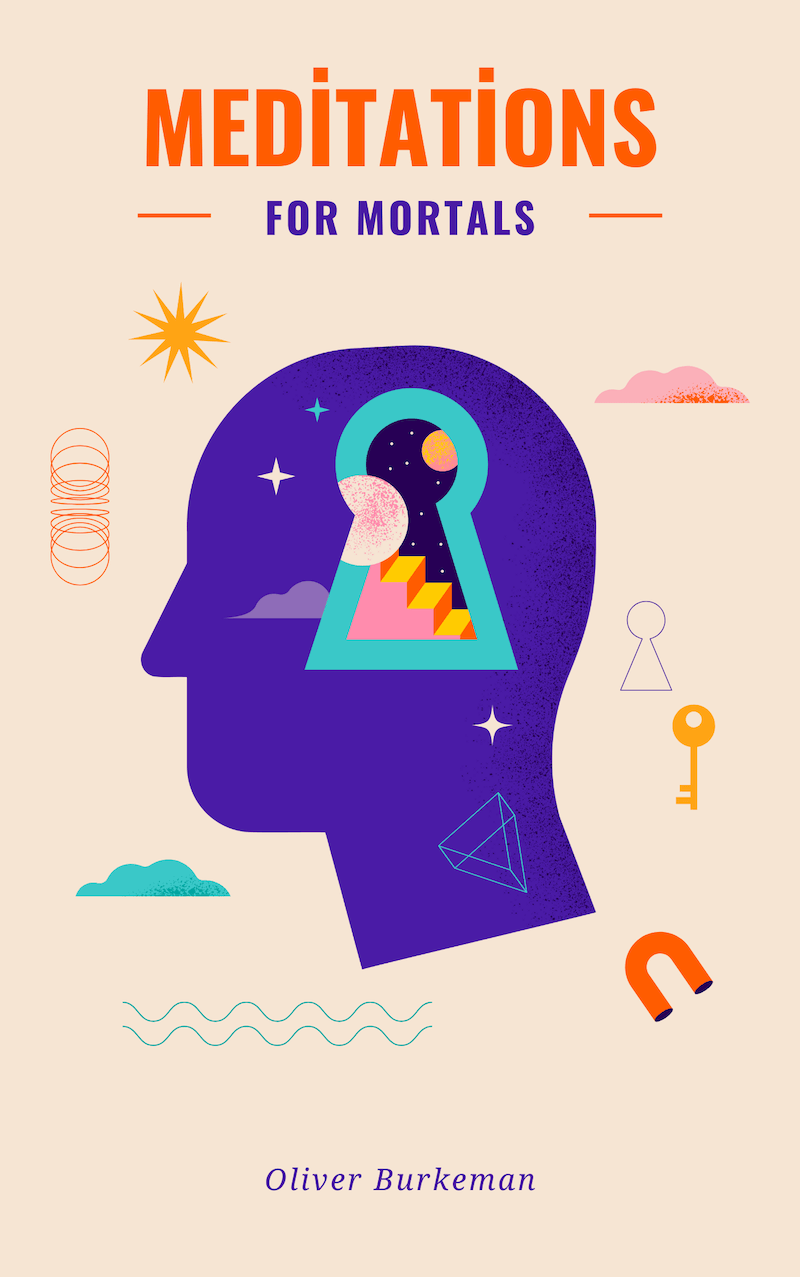
Meditations for Mortals Book Summary
This Meditations for Mortals Book Summary covers the key ideas, lessons, and takeaways in about 20 minutes.
Short Description:
Meditations for Mortals embraces life’s limits to find fulfillment.
The book’s message is both sobering and uplifting: life is short—and that is precisely why it is beautiful. We can either spend our days preparing for life to start or step into the reality that it has already begun.
Helps with these goals
Want the complete 20-minute summary?
- Full structured summary
- Video Summary
- Podcast Summary
- Audio summary
- Key takeaways
- Exercises
- Quiz
- Highlights and notes
- Ask the book with AI
Want a Free Weekly Read?
Get a free summary every week straight to your mailbox.
Preview the Meditations for Mortals book summary
Below is a preview of Sumizeit’s comprehensive human-written summary of Meditations for Mortals by Oliver Burkeman. The full summary is 15-20 minutes long and covers the book’s key ideas in text, audio, visual, and video formats. Unlock the full 20 Minute Summary
In Meditations for Mortals, Oliver Burkeman invites readers to rethink their relationship with time, productivity, and ambition by confronting a truth most people spend their lives trying to avoid: we are finite. Our days are limited in number, our attention and energy are scarce, and our control over the future is far more fragile than we imagine. Yet instead of accepting these boundaries, modern culture encourages constant striving—doing more, improving endlessly, and orchestrating life so perfectly that discomfort and unpredictability are removed. Burkeman argues that this relentless pursuit leaves people exhausted, overwhelmed, and perpetually unsatisfied.
Many people treat life as if they were preparing for something greater that hasn’t yet begun—saving enjoyment, delaying rest, and postponing meaningful decisions until some imagined “right moment.” Someone might say, for example, “I’ll start painting again when work settles down,” or “I’ll prioritize family time once we pay off the mortgage.” But as Burkeman notes, life never presents the perfect window. Instead, years pass, routines deepen, and possibilities evaporate unnoticed. The tragedy isn’t failure; it’s the realization, often late in life, that real living was endlessly deferred.
The core question the book asks is: If this moment is your actual life—not preparation for later—how would you show up differently?
Accepting Limitations as the Path to Freedom
Burkeman maintains that confronting limits is not defeatist, but liberating. Pretending we can do everything leads to burnout and disconnection. When we accept that our capacity is small, we gain the freedom to choose wisely.
Imagine someone who says yes to everything at work—volunteering for extra assignments, attending every meeting, answering emails late into the night. They believe productivity proves worth. Yet instead of succeeding, they end up depleted, rushed, and resentful, while doing none of the projects well. By contrast, a colleague who gracefully declines nonessential tasks and focuses on a few meaningful efforts may produce better results, feel less stressed, and build a deeper sense of satisfaction. Accepting limits lets us commit fully, rather than dabbling endlessly.
Burkeman encourages choosing priorities based not on pressure or comparison but on personal meaning. For instance, someone who dreams of learning the piano but keeps postponing it for more “serious” goals may eventually realize that practicing 15 minutes a day—even imperfectly—provides more fulfillment than chasing external validation. Saying no to lesser obligations makes room for what matters.
Another example he offers is the way people overload their schedules believing they can accomplish every opportunity offered to them. They sign up for online courses, join committees, start side projects, and try to maintain an active social calendar. But spreading themselves across dozens of commitments means they are truly present for none. When they narrow their focus—perhaps choosing one course to finish and letting go of the others—they experience progress instead of frustration.
Limitations help sharpen meaning. When we cannot do everything, we must decide what is worth doing.
Imperfect Action Over Ideal Conditions
Perfectionism is one of the central obstacles Burkeman identifies.
Want the complete 20-minute summary?
- Full structured summary
- Video Summary
- Podcast Summary
- Audio summary
- Key takeaways
- Exercises
- Quiz
- Highlights and notes
- Ask the book with AI
Who should read Meditations for Mortals?
Meditations for Mortals is for anyone feeling overwhelmed by the pressure to optimize every moment, achieve perfection, and control their future. It speaks to those caught between ambition and exhaustion, and to readers ready to question whether postponing life until conditions are perfect is worth the cost.
Why does Meditations for Mortals matter?
In an era of endless self-improvement and relentless productivity demands, Oliver Burkeman's book offers a countercultural perspective: accepting our limitations and finitude is not defeat, but the path to genuine fulfillment. As anxiety, burnout, and chronic busyness become epidemic, this book addresses the root cause—our refusal to accept the reality that time is finite—and shows how embracing this truth liberates us to live more fully.
What are the key themes in Meditations for Mortals?
- Mortality and finitude as liberating rather than limiting
- The trap of perfectionism and endless optimization
- Accepting constraints to enable meaningful choice
- The danger of perpetual deferral and deathbed regrets
- Imperfect action as superior to waiting for ideal conditions
- Releasing the illusion of control over outcomes
- Vulnerability and authenticity as paths to connection
- Redefining success beyond worldly achievement
Want the complete 20-minute summary?
- Full structured summary
- Video Summary
- Podcast Summary
- Audio summary
- Key takeaways
- Exercises
- Quiz
- Highlights and notes
- Ask the book with AI
How can you apply ideas from Meditations for Mortals?
- Conduct a personal audit of commitments and deliberately decline nonessential obligations to free capacity for what genuinely matters
- Lower your entry threshold for a long-delayed project by committing to a tiny first step (ten minutes of writing, one sketch, a single email reconnecting with someone)
- Keep a reverse to-do list by jotting down daily accomplishments—no matter how small—to build evidence of progress and counter guilt-spiraling perfectionism
- When planning an important event or trip, intentionally leave gaps and embrace unplanned moments rather than scheduling every hour
- Practice 'scruffy hospitality' by inviting people over without perfecting your space or preparing elaborate meals, modeling authenticity and lowering barriers to gathering
- Before starting a task, ask yourself what imperfect version you could complete today instead of waiting for ideal conditions
- When faced with an interruption or deviation from plans, pause and ask with curiosity: 'What might this offer me that I didn't expect?'
What common mistakes do readers make with Meditations for Mortals?
- Waiting for the perfect moment to pursue meaningful goals, not recognizing that ideal conditions rarely materialize and years quietly pass
- Saying yes to every opportunity and commitment, mistaking busyness for productivity and ending up present for nothing
- Treating small imperfect steps as inadequate, waiting instead for grand gestures or complete readiness that paralyzes progress
- Approaching life as a test to pass or a problem to solve, creating anxiety through over-control and obsessive planning instead of embracing uncertainty
Sumizeit Exercises Apply what you've learned
Turn ideas from Meditations for Mortals into action with a short guided reflection: identify the biggest takeaway, connect it to your life, and commit to one step you can take in the next 24 hours.
What is the expert analysis of Meditations for Mortals?
Overview
Meditations for Mortals is a profound meditation on the human condition authored by Oliver Burkeman, a British journalist and thinker renowned for his incisive explorations of productivity, psychology, and the quest for meaning. Building on his previous works such as Four Thousand Weeks and The Antidote, Burkeman confronts the pervasive cultural denial of finitude and the relentless pursuit of optimization that characterizes contemporary life. This book stands out for its synthesis of philosophical reflection, psychological insight, and practical guidance, offering readers a compelling invitation to embrace life’s inherent limitations as a pathway to genuine freedom and fulfillment.
Core Thesis
At the heart of Meditations for Mortals lies the argument that modern culture’s obsession with control, productivity, and perfectionism is fundamentally at odds with the reality of human finitude. Burkeman contends that recognizing and accepting our limited time, energy, and influence is not an act of defeat but a liberating foundation for living more meaningfully. By relinquishing the illusion of infinite possibility and perfect conditions, individuals can focus on what truly matters, take imperfect action, and cultivate presence, vulnerability, and authenticity. Ultimately, the book asserts that peace and fulfillment emerge from partnering with life’s uncertainties rather than resisting them.
Strengths
- Clarity and Accessibility: Burkeman’s prose is lucid and engaging, making complex philosophical and psychological concepts approachable without sacrificing depth.
- Integration of Disciplines: The book skillfully weaves together insights from philosophy, psychology, and cultural critique, providing a holistic framework for understanding human limitations.
- Practical Wisdom: Rather than remaining abstract, the work offers concrete examples and actionable advice—such as embracing imperfect action and maintaining a reverse to-do list—that readers can readily apply.
- Countercultural Perspective: In an era dominated by self-optimization rhetoric, Burkeman’s call to accept constraints and embrace vulnerability is a refreshing and necessary corrective.
- Emphasis on Presence and Meaning: The focus on living fully in the present and redefining success in terms of local, sincere contributions resonates deeply with contemporary concerns about burnout and alienation.
Critiques & Counterarguments
- Potential Oversimplification of Productivity: While Burkeman critiques the culture of relentless striving, some may argue that the book underestimates the complexity of systemic pressures—economic, social, and technological—that compel overwork, thus placing too much responsibility on individual choice.
- Limited Engagement with Structural Inequalities: The emphasis on personal acceptance and prioritization may not fully account for how socioeconomic status, race, or disability constrain one’s capacity to say no or to choose meaningful commitments freely.
- Competing Research on Control and Well-being: Psychological studies on locus of control suggest that a moderate sense of agency and planning correlates with better mental health outcomes, complicating Burkeman’s argument that relinquishing control is broadly beneficial.
- Philosophical Alternatives: Existentialist thinkers like Sartre emphasize radical freedom and responsibility, which can be read as advocating for embracing the anxiety of choice rather than accepting limits as liberating; this presents a nuanced counterpoint to Burkeman’s framing.
- Risk of Passivity: The book’s advocacy for acceptance might be interpreted by some as encouraging complacency or resignation, potentially undermining motivation for social change or personal growth in contexts where action is necessary.
Who Should Read This
Meditations for Mortals is ideally suited for readers grappling with the pressures of modern life—professionals overwhelmed by productivity demands, individuals struggling with perfectionism, and seekers of deeper meaning amid cultural noise. It will appeal to those interested in philosophy applied to everyday living, fans of psychological self-help grounded in research, and anyone drawn to contemplative approaches to time and mortality. Moreover, it offers valuable perspectives for leaders, educators, and caregivers who must navigate complexity and uncertainty while fostering authentic connection. Ultimately, this book is a vital read for anyone ready to confront the reality of finitude and to live more intentionally within it.
Frequently asked questions about the Meditations for Mortals book summary
What is Meditations for Mortals about?
Meditations for Mortals by Oliver Burkeman is a philosophical guide that invites readers to confront human finitude and rethink their relationship with time, productivity, and ambition. The book argues that accepting our limitations—rather than endlessly striving to overcome them—is the key to genuine fulfillment and a life well-lived.
Who should read Meditations for Mortals?
This book is ideal for anyone caught in the cycle of endless self-improvement, those feeling overwhelmed by the pressure to optimize every moment, and readers ready to question whether perpetual striving and postponement are worth the cost. It speaks to anyone experiencing burnout, ambition-driven anxiety, or the suspicion that something is missing despite apparent success.
What are the main takeaways from Meditations for Mortals?
The key takeaways include: accepting finitude clarifies what truly matters; perfectionism and endless optimization paradoxically prevent fulfillment; imperfect action now beats waiting for ideal conditions; releasing control over outcomes reduces anxiety while opening possibilities; and genuine meaning emerges from ordinary, locally-focused contribution rather than grand achievement. Ultimately, recognizing that life is short makes it precious and worth living fully today.
How does Burkeman address perfectionism in Meditations for Mortals?
Burkeman identifies perfectionism as a central obstacle to living well. He argues that waiting for perfect circumstances, perfect knowledge, or perfect conditions is a trap that ensures perpetual deferral. Instead, he advocates for lowering the bar for beginning—taking small, imperfect steps that build momentum—and tracking completed work rather than accumulating guilt over unfinished ideals.
What does Meditations for Mortals say about control?
Burkeman argues that the desire to control outcomes and eliminate uncertainty fuels modern anxiety. He shows how rigid planning and attempts to prevent all discomfort actually create stress when reality inevitably deviates from the script. Instead, he recommends holding plans lightly, treating interruptions with curiosity, and accepting that meaningful moments often arise precisely when expected paths fall apart.
How does Meditations for Mortals connect mortality to living better?
Rather than treating mortality as something to fear, Burkeman positions finitude as liberating. When you genuinely accept that your time is limited, you stop wasting it on what doesn't matter, quit postponing joy and meaningful action, and make wiser choices about where to invest your finite attention and energy. Awareness of mortality becomes a tool for clarity and presence, not depression.
What practical advice does Meditations for Mortals offer?
Practical recommendations include: declining nonessential commitments to focus on what matters; taking imperfect first steps instead of waiting for ideal conditions; keeping a reverse to-do list to recognize progress; practicing 'scruffy hospitality' by showing up authentically rather than performing perfection; and regularly asking yourself how you would approach today if it were your last year. Each tool targets the gap between how we live and how we want to live.
About Sumizeit
Sumizeit is a profitable Scomy LLC company based in Miami, Florida. Our founders, Clemens Raemy and Weina Scott, are successful entrepreneurs with several exits. Sumizeit is a popular book summary app / micro learning app used by busy professionals and entrepreneurs with over 2,500 non-fiction book summaries and 10,000 podcast summaries in text, audio, visual, podcast, and video format. We also have stellar retention tools to make ideas stick - such as flashcards with spaced repetition, quizzes, streaks, highlighting and notes, daily challenges, riddles, mini-courses, meditation, and more. You won't only learn the idea, but also remember it. Over 90% of our users change their habits with Sumizeit.
Upgrade Now
Want the complete 20-minute summary?
- Full structured summary
- Video Summary
- Podcast Summary
- Audio summary
- Key takeaways
- Exercises
- Quiz
- Highlights and notes
- Ask the book with AI
Here's why readers love Sumizeit
Join thousands of learners getting smarter every day
"Great experience. Detailed summaries. Loved the gamification feature. Makes learning fun. Good customer service. I recommend Sumizeit to anyone. You'll learn a lot."
"I always felt busy but still wanting to keep up with the book discussion in my friend group. This was a great supplement to help me keep reading the books I find fun while keeping up with important books."
"I love this website. Instead of scrolling social media, I find myself learning a lot. I use it everyday. I recommend this app for anyone who is too busy and wants to get up to speed with their favorite books."
Meditations for Mortals Book Summary PDF
Looking for a Meditations for Mortals Book Summary PDF you can save and revisit offline? Our Meditations for Mortals Book Summary PDF captures the book’s core ideas in a clean, printable format — the key frameworks, takeaways, and structure without the fluff. Download the Meditations for Mortals Book Summary PDF when you want a reference you can annotate, share with your team, or review on the go. Get your Meditations for Mortals Book Summary PDF from the download page below.
Download Meditations for Mortals Book Summary PDFPeople also liked these summaries
Readers who explored Meditations for Mortals often enjoyed these titles next.


Want the complete 20-minute summary?
- Full structured summary
- Video Summary
- Podcast Summary
- Audio summary
- Key takeaways
- Exercises
- Quiz
- Highlights and notes
- Ask the book with AI
Featured Book Titles
Popular Book Summaries at sumizeit, leading book summary app