


Prefer the print book? Buy on Amazon
As an Amazon Associate, Sumizeit earns from qualifying purchases.
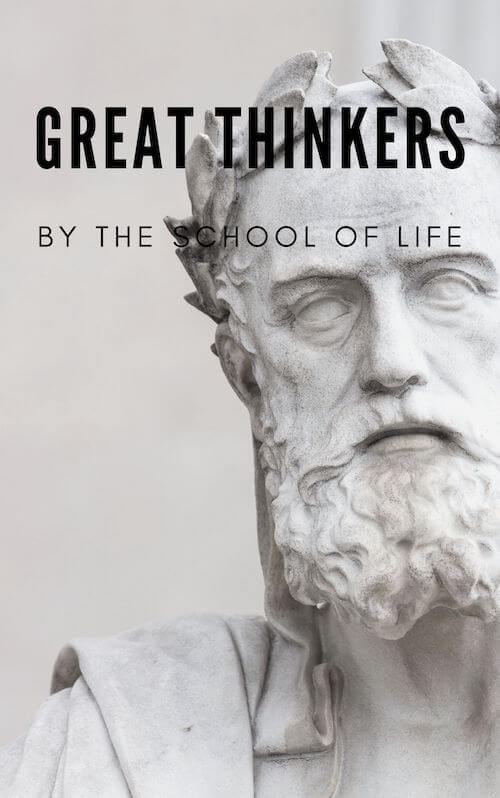
Great Thinkers Book Summary
This Great Thinkers Book Summary covers the key ideas, lessons, and takeaways in about 20 minutes.
Short Description:
Great Thinkers offer wisdom to live meaningful lives today.
Helps with these goals
Preview the Great Thinkers book summary
Below is a preview of Sumizeit’s comprehensive human-written summary of Great Thinkers by The School of Life. The full summary is 15-20 minutes long and covers the book’s key ideas in text, audio, visual, and video formats. Unlock the full 20 Minute Summary
Are the thinkers of today better than the thinkers of previous eras? Not necessarily. Many problems in modern society can be faced by relying on old wisdom.
Sure, society has made great progress in science and technology since the days of Plato, Adam Smith, and Jane Austen. But issues like anxiety can’t be fixed with an app or a quantum mechanics equation.
Great Thinkers distills the ideas of the most revered individuals from the fields of philosophy, political theory, eastern philosophy, sociology, psychotherapy, art and architecture, and literature.
While many things have changed about society since the times of each of these thinkers, their ideas still apply. Superficial changes don’t cancel out the validity and impact of their ideas.
From each field of Great Thinkers, there is something you can apply to your life or to society as a whole.
You can use the principles of stoicism to deal with anxiety.
Among the great thinkers in philosophy are the stoics. The movement of stoicism can be traced to ancient Greek and Roman societies in the third century BC.
The basic notion of stoicism is to not be shaken by all of the bad things in life. You act with virtue and you don’t let the day-to-day fluctuations affect you. No matter how much your circumstances may change, or the good or bad, you can’t get too emotional.
On the opposite end of the spectrum from a stoic personality is an anxious one. According to stoicism, anxiety comes from hoping for something good or fearing something bad. In either situation, you’re anxious about what will come.
Stoics believe in the goddess Fortuna. With Fortuna, it doesn’t matter whether or not you’ve been good or bad. It’s not like karma where there are consequences for how you’ve behaved. Instead, something good or bad could happen to anyone regardless of their character.
By understanding that your fortune isn’t in your control, you can let go of your anxiety and just let things happen as they may.
Confronting your worst fears can reduce their power over you.
Even if you know you have no control over what may or may not happen, the worst-case scenario may still make you anxious. The stoics offer sage advice for handling this issue.
Face your fears and they won’t seem as terrible. If you try to experience what it may be like if your worst fears come true, you won’t be as scared of them. You can think about how to handle losing your job or home. You can try handling the spider that scares you. Whatever the situation, jump into what scares you.
Meanwhile, don’t focus on your hopes and dreams. If it happens, it happens thanks to Fortuna. If the worst happens, you’re ready. Just center yourself and charge on with stoicism.
Faith and science are not mutually exclusive.
Thomas Aquinas was an Italian monk who lived during the thirteenth century. He also received sainthood.
Want the complete 20-minute summary?
- Full structured summary
- Video Summary
- Podcast Summary
- Audio summary
- Key takeaways
- Exercises
- Quiz
- Highlights and notes
- Ask the book with AI
Who should read Great Thinkers?
Great Thinkers is for anyone seeking practical wisdom to navigate modern life's challenges. Whether you're struggling with anxiety, questioning your career, or searching for deeper meaning, this book offers insights from history's greatest minds across philosophy, psychology, economics, and the arts. It's ideal for curious readers who believe that timeless ideas can solve contemporary problems.
Why does Great Thinkers matter?
In our technology-obsessed era, we often assume that newer solutions are better—but many of today's problems remain fundamentally human. Great Thinkers by The School of Life reminds us that ancient philosophers, economists, and thinkers understood anxiety, relationships, work fulfillment, and community in ways that still apply today. By drawing from sixty diverse thinkers, the book demonstrates that wisdom isn't outdated; it's a resource we've overlooked.
What are the key themes in Great Thinkers?
- Ancient wisdom remains applicable to modern problems
- Balance between multiple perspectives (faith and science, specialization and purpose)
- Human nature transcends cultural and historical boundaries
- Personal growth emerges from relationship and challenge
- Intentional living requires understanding natural rhythms and limits
- Community and social connection are essential to well-being
How can you apply ideas from Great Thinkers?
- Use stoic principles to reframe anxiety by distinguishing what you control from what you don't, then focusing energy accordingly
- Practice exposure to your specific fears in small, manageable ways to reduce their psychological grip over time
- Integrate scientific evidence with personal values and beliefs rather than treating them as mutually exclusive worldviews
- Communicate clearly with colleagues and direct reports about how their specialized work contributes to the organization's larger mission and impact
- Audit your neighborhood or workplace for balance: Do diverse needs and activities coexist, or are functions artificially separated?
- When meeting someone new or evaluating a relationship, consciously delay judgment and invest time in understanding their character rather than relying on first impressions
- Set aside regular time to quiet your mind through nature, meditation, or simple observation rather than constant planning and productivity
- Acknowledge repressed desires or impulses with yourself and find constructive outlets rather than expecting willpower alone to suppress them indefinitely
What common mistakes do readers make with Great Thinkers?
- Assuming that modern solutions (apps, technology, optimization) can solve fundamentally human problems like anxiety or loneliness
- Believing you must either embrace science or faith completely, missing the complementary wisdom each provides
- Judging people entirely on superficial qualities like wealth, appearance, or credentials without exploring their actual character and values
- Pushing aggressively toward goals through force and stress rather than creating conditions for natural readiness and opportunity
- Treating specialized job roles as purely transactional, forgetting to help workers understand their meaningful contribution to larger purpose
Sumizeit Exercises Apply what you've learned
Turn ideas from Great Thinkers into action with a short guided reflection: identify the biggest takeaway, connect it to your life, and commit to one step you can take in the next 24 hours.
What is the expert analysis of Great Thinkers?
Overview
Great Thinkers is a compendium of distilled wisdom from sixty influential figures across diverse disciplines, curated by The School of Life, an organization dedicated to practical philosophy and self-improvement. Founded by Alain de Botton, a philosopher with a rich academic background and a commitment to making philosophy accessible, the book embodies the School’s mission to bridge classical thought and contemporary life. Its significance lies in its interdisciplinary approach, drawing from philosophy, economics, psychology, literature, and anthropology to offer timeless insights that remain relevant in addressing modern existential and societal challenges.
Core Thesis
The central argument of Great Thinkers is that despite the technological and scientific advances of modern society, many of the fundamental human problems—such as anxiety, social disengagement, and ethical dilemmas—are perennial and can be effectively addressed by revisiting the wisdom of historical thinkers. The book posits that ancient and classical ideas are not relics but living tools that can be adapted to contemporary life, encouraging readers to adopt a pluralistic mindset that values both faith and reason, individual growth, and social cohesion.
Strengths
- Interdisciplinary breadth: The book’s inclusion of thinkers from philosophy, economics, psychology, literature, and anthropology provides a holistic perspective on human experience and societal organization.
- Accessibility and practical application: By translating complex ideas into simple, actionable principles—such as stoicism for anxiety management or Adam Smith’s insights on job specialization—the book makes profound concepts approachable for a broad audience.
- Balanced cultural representation: Incorporating Eastern philosophy alongside Western traditions enriches the narrative and underscores universal themes across cultures.
- Emphasis on timelessness: The work effectively argues for the enduring relevance of classical wisdom, challenging the notion that progress necessarily renders past ideas obsolete.
- Integration of social and personal dimensions: From individual psychological impulses to urban planning and economic systems, the book connects personal well-being with broader societal structures.
Critiques & Counterarguments
- Potential oversimplification: The condensation of complex philosophies into brief, practical lessons risks diluting nuances and the contextual subtleties that give these ideas their depth and complexity.
- Selective interpretation: The book tends to present the thinkers’ ideas in an uncritical, largely affirmative light, which may gloss over significant controversies, contradictions, or limitations inherent in their work.
- Historical and cultural context: Some examples, such as the portrayal of Samoan society by Margaret Mead, have been challenged by subsequent anthropological research questioning the accuracy and generalizability of her findings.
- Competing schools of thought: For instance, Freud’s theories on impulse repression have been contested by modern psychology, which emphasizes neurobiological and cognitive frameworks over psychoanalytic models.
- Contemporary relevance of capitalism: While Adam Smith’s nuanced view of capitalism is highlighted, the book does not fully engage with critical perspectives that emphasize systemic inequalities and environmental costs associated with capitalist economies.
Who Should Read This
Great Thinkers is ideally suited for intellectually curious readers who seek to enrich their understanding of life through the lens of classical wisdom without requiring specialized academic background. It appeals to those interested in philosophy, psychology, and social theory, as well as professionals in self-improvement, education, and leadership who desire a broad conceptual toolkit to navigate personal and societal challenges. Moreover, readers open to cross-cultural perspectives and interdisciplinary synthesis will find this volume particularly rewarding as a springboard for deeper exploration.
Frequently asked questions about the Great Thinkers book summary
What is Great Thinkers about?
Great Thinkers by The School of Life is a practical guide that distills insights from sixty influential thinkers across philosophy, psychology, economics, anthropology, literature, and architecture. The book demonstrates how ideas from ancient stoics, Thomas Aquinas, Adam Smith, Lao Tzu, Sigmund Freud, Jane Austen, and many others remain directly applicable to solving modern life challenges like anxiety, relationships, work fulfillment, and community building.
Who should read Great Thinkers?
Great Thinkers is ideal for anyone seeking practical wisdom beyond self-help trends and quick fixes. It appeals to curious readers who value depth, those struggling with contemporary issues who suspect that timeless ideas might help, and people interested in drawing connections across diverse fields of knowledge. You don't need academic background—just openness to learning from history's greatest minds.
What are the main takeaways from Great Thinkers?
The main takeaways include: stoicism and facing fears can combat anxiety; faith and science complement rather than contradict each other; meaningful work requires visible connection to larger purpose; cultural norms are learned, not universal; relationships grow through mutual evolution; and community thrives when diverse human needs are balanced in proximity. Ultimately, Great Thinkers shows that old ideas address enduring human challenges better than modern shortcuts.
How can stoicism help with modern anxiety?
Stoic philosophy teaches that anxiety arises from hoping for specific outcomes or fearing particular ones—both of which assume you control the future. By accepting that fortune is beyond your control and mentally preparing for worst-case scenarios, you strip anxiety of its power. This ancient framework proves highly relevant to today's uncertain world.
Does Great Thinkers suggest that science and faith are incompatible?
No—quite the opposite. Drawing on Thomas Aquinas's philosophy, Great Thinkers argues that natural law (science and reason) and eternal law (faith and values) are complementary ways of understanding the world. Rather than choosing one, an open mind integrates both perspectives for fuller wisdom.
What does Great Thinkers teach about relationships?
Using Jane Austen's novels, Great Thinkers emphasizes that relationships thrive when both partners help each other grow and improve over time. Rather than seeking perfect matches, the book shows that genuine love emerges through mutual challenge and evolution, and that true character matters far more than superficial qualities like appearance or wealth.
How can I apply Great Thinkers' lessons about work and purpose?
Drawing on Adam Smith's economic insights, Great Thinkers recommends that organizations help specialized workers see how their narrow role serves the larger mission. In your own career, seek or create visibility between your daily tasks and meaningful impact, and encourage leaders to communicate this connection clearly to maintain engagement.
What is the book's perspective on cities and neighborhoods?
Based on Jane Jacobs's architectural philosophy, Great Thinkers argues that thriving neighborhoods function like balanced ecosystems with diverse uses (work, food, entertainment), density that encourages casual social interaction, and a mix of people. This creates community and belonging better than purely functional urban design.
About Sumizeit
Sumizeit is a profitable Scomy LLC company based in Miami, Florida. Our founders, Clemens Raemy and Weina Scott, are successful entrepreneurs with several exits. Sumizeit is a popular book summary app / micro learning app used by busy professionals and entrepreneurs with over 2,500 non-fiction book summaries and 10,000 podcast summaries in text, audio, visual, podcast, and video format. We also have stellar retention tools to make ideas stick - such as flashcards with spaced repetition, quizzes, streaks, highlighting and notes, daily challenges, riddles, mini-courses, meditation, and more. You won't only learn the idea, but also remember it. Over 90% of our users change their habits with Sumizeit.
Upgrade Now
Here's why readers love Sumizeit
Join thousands of learners getting smarter every day
"Great experience. Detailed summaries. Loved the gamification feature. Makes learning fun. Good customer service. I recommend Sumizeit to anyone. You'll learn a lot."
"I always felt busy but still wanting to keep up with the book discussion in my friend group. This was a great supplement to help me keep reading the books I find fun while keeping up with important books."
"I love this website. Instead of scrolling social media, I find myself learning a lot. I use it everyday. I recommend this app for anyone who is too busy and wants to get up to speed with their favorite books."
Great Thinkers Book Summary PDF
Looking for a Great Thinkers Book Summary PDF you can save and revisit offline? Our Great Thinkers Book Summary PDF captures the book’s core ideas in a clean, printable format — the key frameworks, takeaways, and structure without the fluff. Download the Great Thinkers Book Summary PDF when you want a reference you can annotate, share with your team, or review on the go. Get your Great Thinkers Book Summary PDF from the download page below.
Download Great Thinkers Book Summary PDFPeople also liked these summaries
Readers who explored Great Thinkers often enjoyed these titles next.

Ready to read the whole thing?
- Full structured summary
- Video Summary
- Podcast Summary
- Audio summary
- Key takeaways
- Exercises
- Quiz
- Highlights and notes
- Ask the book with AI
Featured Book Titles
Popular Book Summaries at sumizeit, leading book summary app