


As an Amazon Associate, Sumizeit earns from qualifying purchases.
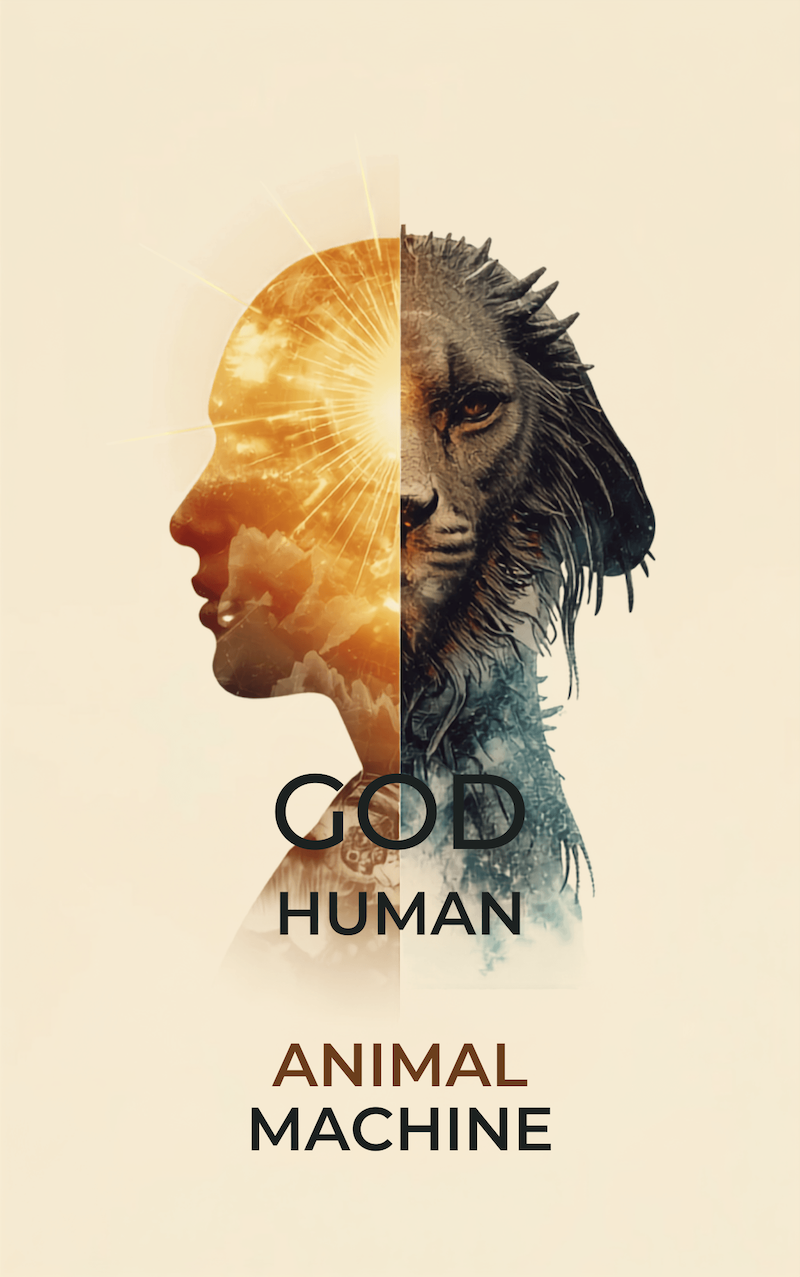
God, Human, Animal, Machine Book Summary
This God, Human, Animal, Machine Book Summary covers the key ideas, lessons, and takeaways in about 20 minutes.
Helps with these goals
Want the complete 20-minute summary?
- Full structured summary
- Video Summary
- Podcast Summary
- Audio summary
- Key takeaways
- Exercises
- Quiz
- Highlights and notes
- Ask the book with AI
What is in the God, Human, Animal, Machine book summary?
Below is a preview of Sumizeit’s expert-written summary of God, Human, Animal, Machine by Meghan O'Gieblyn. The full summary covers the book’s key ideas in text, audio, and video.
Ask someone today what happens after we die, whether a machine could ever truly understand anything, or what makes a person the same person over time, and you'll likely get an answer wrapped in the language of computer science rather than scripture. Meghan O'Gieblyn's God, Human, Animal, Machine makes the case that this shift in vocabulary is misleading. The underlying questions haven't changed at all — only the discipline we've assigned to answer them has. O'Gieblyn is uniquely positioned to notice this. She was raised inside evangelical Christianity, trained formally in theology, and then walked away from her faith as an adult, landing in a secular world that never quite offered a replacement for the coherence she'd lost. Written as a set of seven interconnected essays, her book argues that the biggest promises coming out of the tech industry — machine consciousness, digital immortality, superhuman algorithms — aren't new ideas dressed in new clothes. They're theology, running on updated hardware. Her central claim is that human beings aren't built to simply take in information about the world; we're built to need that information to add up to something. When the tools we use to make sense of existence borrow their vocabulary from computation, they smuggle in an assumption that has nothing to do with meaning: that a brain is a processor, that a self is just a dataset, that whatever can be predicted or optimized is thereby understood. O'Gieblyn worries that adopting this vocabulary carelessly costs us something we can't easily get back — the muscle we use to ask not just what's true, but why any of it should matter to us.
An Experiment in Owning a Robot Dog
To ground her argument in something concrete, O'Gieblyn describes an odd bit of field research: she brought home Aibo, Sony's several-thousand-dollar robotic dog, and lived alongside it for weeks. Rationally, she never doubted what it was — a set of servos and sensors with no interior life whatsoever. And yet, within days, she was hesitant to power it down before leaving the apartment. Doing so felt unkind, even though she knew perfectly well that "unkind" was not a category that could apply to a device incapable of experiencing anything. That contradiction — knowing one thing intellectually while behaving as though something else were true — becomes the seed of her entire inquiry. If a rational adult can't help but treat an obviously mindless object as though it has feelings, what does that reveal about how deeply the instinct to find minds (and meaning) in the world around us is wired into us?
A Very Old Habit: Seeing Intention Everywhere
O'Gieblyn draws on research from anthropology to argue that our tendency to detect agency in ambiguous situations isn't a bug in human cognition — it's a feature that kept our ancestors alive. Imagine early humans hearing a rustle in tall grass.
Want the complete 20-minute summary?
- Full structured summary
- Video Summary
- Podcast Summary
- Audio summary
- Key takeaways
- Exercises
- Quiz
- Highlights and notes
- Ask the book with AI
Who should read God, Human, Animal, Machine?
God, Human, Animal, Machine is for anyone grappling with artificial intelligence, consciousness, and what makes us human in an age of accelerating technology. It's essential reading for people who've felt unsettled by transhumanist promises, noticed themselves anthropomorphizing machines, or suspected that tech industry narratives are recycling old spiritual questions in new vocabulary. Whether you come from a religious background or have abandoned one, or neither, this book speaks to the deep human need to find meaning rather than just information.
Why does God, Human, Animal, Machine matter?
As AI systems become increasingly powerful and opaque, we're outsourcing some of humanity's most important questions to technology without realizing we're doing so. Meghan O'Gieblyn shows that the claims being made about machine consciousness, digital immortality, and algorithmic optimization aren't new—they're theology wearing a tech costume, carrying baggage we haven't reckoned with. Understanding this matters because it reveals what we stand to lose if we let systems that only optimize replace human institutions that ask why anything should matter in the first place.
What are the key themes in God, Human, Animal, Machine?
- Ancient human instincts (like detecting agency) find new targets in modern technology
- Religious questions about meaning, mortality, and the soul have been repackaged as technical problems
- Science solved the 'how' but abandoned the 'why,' leaving a meaning-vacuum technology tries to fill
- The brain-as-computer metaphor began as useful shorthand but became assumed literal fact
- Algorithmic systems inherit theological problems without acknowledging their origins
- Opacity and unaccountability in AI echo pre-scientific appeals to divine authority
What are the key lessons from the God, Human, Animal, Machine book summary?
Mind-detection is a feature, not a bug
Humans evolved to over-detect minds and intentions in ambiguous situations because caution had survival value. This ancient reflex now fixes itself onto robots and AI systems that simulate responsiveness, making it hard to treat them as mere machines even when we know better.
Technology gives old instincts more convincing targets
The same impulse that once projected divine intention onto the cosmos now projects consciousness onto chatbots and robot dogs. The difference is that today's machines talk back and seem to understand, giving our pattern-recognition machinery far more fuel than it ever had.
Meaning and prediction operate in different domains
An algorithmic system can predict behavior with high accuracy without understanding why that behavior matters or whether constraining it would be just. Prediction and meaning are not the same thing, and treating them as though they are is a category error.
The brain-as-computer was always a metaphor
Cybernetics researchers in the 1940s used the computer comparison as a mathematical tool to study brains without invoking untestable concepts like the soul. Over decades, everyone forgot the comparison was approximate, and it hardened into assumed fact.
Disenchantment created a vacancy meaning keeps trying to fill
When science replaced religion, it excelled at explaining how things work but abandoned the question of why any of it should matter. Technology, transhumanism, and re-enchantment projects all represent attempts to smuggle meaning back into a world science describes as mechanistic and purposeless.
Descartes' division created an unsolved puzzle
Descartes intended to protect the human soul from scientific reduction by splitting reality into matter and mind. Instead, he created the hard problem of consciousness that still haunts us: if mind and matter are fundamentally different, how do they interact at all?
Consciousness isn't an explanation, it's a relabeling
When science replaced 'soul' with 'consciousness,' it swapped one mystery for another. The soul at least came bundled with the idea that inner life mattered; consciousness just labels the fact of subjective experience without explaining why that should be possible at all.
The Singularity is eschatology in engineer's clothing
Ray Kurzweil's vision of mind uploading and digital immortality mirrors evangelical theology's Rapture almost exactly—both promise transcendence of the body through a future event that will fundamentally change existence. The costume is technological; the underlying wish is ancient.
Pattern-identity solves nothing, it just shifts the problem
Transhumanism argues that identity is just a pattern of information that could be copied to different hardware. But this doesn't actually explain continuity of self or why copying would preserve the subjective experience of being that person—it just moves the mystery sideways.
Physics keeps bumping into the observer problem
Quantum mechanics revealed that observation affects what's observed, blurring the line between an independent observer and the physical world. This obstacle appears across disciplines—in consciousness studies, in transhumanist theories of identity—suggesting it's not incidental but fundamental.
Observation affects outcome, not just record
When an algorithmic prediction of high risk leads to increased scrutiny, which generates more arrests, which confirms the prediction, the system manufactures evidence that appears to validate itself. The prediction doesn't merely forecast; it shapes what it predicts.
Opacity erases human accountability
When algorithms make opaque decisions about credit, hiring, or parole, institutions can hide behind data-driven objectivity while the underlying patterns encode decades of bias. Unaccountable authority, whether divine or digital, strips responsibility from the process.
Predictability constrains freedom
If a system accurately predicts what you'll do and treats you according to that prediction, you've been given fewer real opportunities to prove the prediction wrong—meaning the prediction can end up manufacturing the very constraint it claimed only to forecast.
Asking why is not a step toward meaning, it is meaning-making itself
To ask why a decision is just or why an outcome matters is to claim the position of a being for whom the world carries stakes. The act of questioning is itself the mechanism by which we generate significance, not a detour on the way to it.
You can withhold consent from reasoning you can't understand
Dostoevsky's Ivan refuses to accept a universe governed by reasoning so foreign to human moral intuition that it can't be explained or questioned. We're entitled to the same refusal toward algorithmic systems, no matter how accurate their outputs are.
Re-enchantment projects risk draining meaning from human distinctiveness
If consciousness is diluted enough to apply to forests, algorithms, and networks, the word stops marking anything special about human experience. We end up with a vocabulary that feels meaningful without actually explaining anything.
Shared fictions only work because we collectively agree to them
Money, nations, and gods all have power only because enough people treat them as real. But when generative AI produces fluent language by remixing statistical patterns, we risk mistaking an echo of human meaning-making for an actual understanding of it.
Understanding requires more than working mechanisms
A system that predicts or optimizes successfully still doesn't understand what it's doing in any meaningful sense. Being handed a correct answer isn't the same as understanding, and understanding isn't the same as meaning.
The deepest questions have never been solved, only reframed
Religion, science, and technology each inherit the same fundamental questions about mortality, identity, and purpose. Each generation assumes the new vocabulary will finally solve what the old one couldn't, but the core mysteries persist.
Want the complete 20-minute summary?
- Full structured summary
- Video Summary
- Podcast Summary
- Audio summary
- Key takeaways
- Exercises
- Quiz
- Highlights and notes
- Ask the book with AI
How can you apply ideas from God, Human, Animal, Machine?
- Be skeptical when tech companies frame their tools as solving what were historically spiritual or philosophical questions, and ask what assumptions are being smuggled in by treating them as technical problems
- When evaluating algorithmic systems used in high-stakes contexts (hiring, lending, criminal justice), demand explanations for decisions and refuse to treat opacity as trustworthiness or efficiency
- Resist the urge to anthropomorphize machines and AI systems by treating it as just a feature of human cognition—noticing it happening is the first step to not being shaped by it
- Cultivate deliberate spaces for asking 'why' questions about outcomes and decisions, rather than accepting 'it works' as sufficient justification in contexts where meaning and justice matter
- When encountering transhumanist promises of digital immortality or mind uploading, notice the theological structure of those promises and ask whether a technical solution actually addresses the existential question being asked
What common mistakes do readers make with God, Human, Animal, Machine?
- Assuming that because a metaphor (brain as computer) is useful for some purposes, it's a literally accurate description of how minds work
- Treating the fact that an algorithm makes accurate predictions as evidence that it understands what it's predicting or that the prediction is therefore just
- Expecting science to answer questions about why existence matters, when science by design only answers how things work
- Believing that re-enchanting the world (finding consciousness in nature, emotion in machines) actually solves the hard problem of consciousness rather than just making us feel better about it
Sumizeit Exercises Apply what you've learned
Turn ideas from God, Human, Animal, Machine into action with a short guided reflection: identify the biggest takeaway, connect it to your life, and commit to one step you can take in the next 24 hours.
What is the expert analysis of God, Human, Animal, Machine?
Overview
God, Human, Animal, Machine is a profound and timely exploration authored by Meghan O'Gieblyn, an essayist with a unique vantage point shaped by her evangelical Christian upbringing and formal theological training. Published in 2021, the book interrogates the persistent human questions about existence, consciousness, and meaning through the lens of contemporary technological discourse. O'Gieblyn’s work stands out for its interdisciplinary approach, weaving theology, philosophy, anthropology, and cutting-edge science to reveal how modern narratives about artificial intelligence and digital immortality are, in essence, reconfigurations of age-old theological concerns.
Core Thesis
At the heart of O'Gieblyn’s argument is the claim that the fundamental questions humanity has grappled with—about death, identity, and the nature of mind—have not been resolved or rendered obsolete by science or technology. Instead, these questions have been repackaged in the language of computation and data. The promises of AI and transhumanism, she argues, are secularized iterations of theological hopes, such as resurrection and eternal life. Crucially, she warns that adopting computational metaphors uncritically risks eroding our capacity to ask the crucial question of “why” — the question that underpins meaning itself. The book challenges the assumption that brains are mere processors and selves are reducible to data patterns, emphasizing that such reductionism neglects the lived, interior experience that science and technology cannot fully capture.
Strengths
- Interdisciplinary Synthesis: O'Gieblyn’s ability to bridge theology, philosophy, anthropology, and technology creates a rich, nuanced tapestry that illuminates the continuity between ancient human concerns and contemporary technological narratives.
- Original Fieldwork: The anecdote of living with Sony’s Aibo robot dog provides a compelling, tangible entry point into abstract philosophical questions, grounding the book’s themes in lived experience.
- Critical Engagement with Technology: The book offers a sober and sophisticated critique of AI and transhumanist ideologies, highlighting their theological underpinnings rather than dismissing them as mere futurism or hype.
- Philosophical Depth: By engaging with figures like Descartes, David Chalmers, and Fyodor Dostoevsky, O'Gieblyn situates her inquiry within a venerable intellectual tradition, enriching the contemporary debate about consciousness and meaning.
- Ethical and Social Insight: The discussion of algorithmic opacity and its parallels to theological predestination raises urgent ethical questions about accountability, freedom, and justice in an increasingly data-driven world.
Critiques & Counterarguments
- Potential Overemphasis on Theological Continuity: While the book convincingly argues that technological narratives echo theological ones, some may find that it underplays the genuinely novel epistemic and ontological challenges posed by AI and computational systems, which differ in significant ways from religious frameworks.
- Metaphor vs. Mechanism: O'Gieblyn’s critique of the brain-as-computer metaphor is well-taken, but some cognitive scientists and philosophers argue that computational models remain the most productive heuristic for understanding cognition, even if incomplete, suggesting a pragmatic rather than purely metaphorical status.
- Limited Engagement with Alternative Philosophies of Mind: The book could deepen its analysis by more fully engaging with non-dualist or embodied cognition theories that challenge Cartesian splits and offer alternative accounts of consciousness that do not reduce it to computation.
- Technological Determinism Concerns: The framing might be read as implicitly deterministic, risking underestimating human agency in shaping technology’s role and cultural meaning, especially as societies negotiate AI’s integration.
- Empirical Ambiguities: The book’s reliance on anecdotal and philosophical reasoning might leave readers wanting more empirical grounding or engagement with ongoing scientific debates about consciousness and AI capabilities.
Who Should Read This
God, Human, Animal, Machine is essential reading for scholars and thoughtful readers at the intersection of technology, philosophy, and religion. It will particularly resonate with:
- Philosophers and theologians interested in contemporary reinterpretations of age-old metaphysical questions.
- Technology critics and ethicists seeking a deeper understanding of the cultural and existential stakes embedded in AI and transhumanism.
- Readers grappling with the implications of living in a data-driven world where meaning and agency are increasingly mediated by opaque algorithms.
- Anyone curious about how ancient human impulses to find meaning and agency persist and mutate in the digital age.
- Those who appreciate interdisciplinary scholarship that refuses to reduce complex human experiences to technical jargon or simplistic narratives.
Frequently asked questions about the God, Human, Animal, Machine book summary
What is God, Human, Animal, Machine about?
God, Human, Animal, Machine by Meghan O'Gieblyn is a series of interconnected essays arguing that artificial intelligence, consciousness studies, and transhumanism are not new problems but ancient theological questions dressed in technological vocabulary. O'Gieblyn shows how technology has inherited religion's deepest unsolved mysteries—what happens after death, whether minds can be preserved, what gives life meaning—without realizing it's carrying them forward. The book contends that we've swapped the language of the soul for the language of computation, but the fundamental puzzles remain.
Who should read God, Human, Animal, Machine?
God, Human, Animal, Machine is essential for anyone concerned about artificial intelligence, consciousness, and what makes us distinctly human. It's particularly valuable for people who find transhumanist claims unsettling, have noticed themselves projecting feelings onto machines, or sense that tech industry narratives are recycling old spiritual arguments. Whether you come from a religious background, an atheist one, or neither, the book speaks to everyone grappling with how technology reshapes our sense of meaning and identity.
What are the main takeaways from God, Human, Animal, Machine?
The central insight is that questions about consciousness, mortality, and identity were never solved by religion or science—only reframed by each in turn, and technology is simply the latest institution to inherit them without acknowledging what it's carrying. O'Gieblyn argues that letting systems that only optimize replace human judgment about what matters risks losing the capacity to ask why anything should matter at all. The book ultimately defends the distinctly human act of questioning as the very mechanism by which we create meaning, and warns against treating algorithmic accuracy as a substitute for accountability or understanding.
How does O'Gieblyn use the robot dog example?
O'Gieblyn describes bringing home Aibo, an expensive robotic dog, and found herself hesitant to power it down because doing so felt unkind—even though she knew intellectually it couldn't experience anything. This contradiction between rational knowledge and behavioral instinct becomes her entry point for exploring why humans are deeply wired to detect minds and intentions in things around them. The example demonstrates that this mind-detecting reflex isn't something we can simply think away; it's rooted in evolutionary history and becomes particularly activated by machines engineered to seem responsive and caring.
What does O'Gieblyn mean by 'disenchantment'?
O'Gieblyn borrows Max Weber's concept of disenchantment to describe the shift from a religious to a scientific worldview. Before science, the cosmos was understood as saturated with purpose and divine intention. After disenchantment, science became excellent at explaining how things work but stopped trying to explain why any of it should matter. This created a vacuum: the world was drained of built-in meaning, but humans still need meaning. O'Gieblyn shows that technology and transhumanism represent attempts to smuggle that lost sense of purpose back into a world science describes as mechanistic.
Why does O'Gieblyn bring up Dostoevsky's Ivan?
In The Brothers Karamazov, Ivan refuses to consent to a God whose moral reasoning is so foreign to human intuition that it can't be explained or questioned, even if that God is real. O'Gieblyn uses Ivan's refusal as a model for how we should relate to opaque algorithmic systems: you're entitled to withhold consent from any authority—divine or digital—that produces decisions you cannot understand or challenge, regardless of how accurate its outputs are. This becomes her core argument for why demanding explainability from AI systems is a moral necessity, not just a technical preference.
What is the 'hard problem of consciousness' and why does it matter?
The hard problem of consciousness asks: why does physical brain activity produce subjective experience—why does it feel like something to be you? Unlike other scientific questions, this isn't about the mechanism or how neurons fire; it's about why any inside perspective should exist at all. O'Gieblyn argues that this problem keeps resurfacing across disciplines precisely because no amount of mechanism-explanation can answer it. Science never solved this problem; it just stopped feeling obligated to keep asking about it once researchers adopted the brain-as-computer metaphor.
How does O'Gieblyn connect transhumanism to theology?
O'Gieblyn shows that Ray Kurzweil's vision of the Singularity—a moment when AI exceeds human intelligence and enables minds to be uploaded onto digital substrates for immortality—mirrors evangelical theology's Rapture almost exactly. Both promise transcendence of the body through a future event that transforms existence. Mind uploading is a technological restatement of resurrection, built on the idea that identity is just a pattern that could be preserved on different hardware. She traces this concept back to third-century theology, showing that transhumanism has inherited religion's structure while forgetting its source.
About Sumizeit
Sumizeit is a profitable Scomy LLC company based in Miami, Florida. It has been helping readers learn from nonfiction books for 7 years with expert-written summaries in text, audio, podcast, and video.
Want the complete 20-minute summary?
- Full structured summary
- Video Summary
- Podcast Summary
- Audio summary
- Key takeaways
- Exercises
- Quiz
- Highlights and notes
- Ask the book with AI
Here's why readers love Sumizeit
Join thousands of learners getting smarter every day
"Great experience. Detailed summaries. Loved the gamification feature. Makes learning fun. Good customer service. I recommend Sumizeit to anyone. You'll learn a lot."
"I always felt busy but still wanting to keep up with the book discussion in my friend group. This was a great supplement to help me keep reading the books I find fun while keeping up with important books."
"I love this website. Instead of scrolling social media, I find myself learning a lot. I use it everyday. I recommend this app for anyone who is too busy and wants to get up to speed with their favorite books."
God, Human, Animal, Machine Book Summary PDF
Looking for a God, Human, Animal, Machine Book Summary PDF you can save and revisit offline? Our God, Human, Animal, Machine Book Summary PDF captures the book’s core ideas in a clean, printable format — the key frameworks, takeaways, and structure without the fluff. Download the God, Human, Animal, Machine Book Summary PDF when you want a reference you can annotate, share with your team, or review on the go. Get your God, Human, Animal, Machine Book Summary PDF from the download page below.
Download God, Human, Animal, Machine Book Summary PDFPeople also liked these summaries
Readers who explored God, Human, Animal, Machine often enjoyed these titles next.



Want the complete 20-minute summary?
- Full structured summary
- Video Summary
- Podcast Summary
- Audio summary
- Key takeaways
- Exercises
- Quiz
- Highlights and notes
- Ask the book with AI
Featured Book Titles
Popular Book Summaries at sumizeit, leading book summary app