
Question 1 of 10


Prefer the print book? Buy on Amazon
As an Amazon Associate, Sumizeit earns from qualifying purchases.
Book Summary
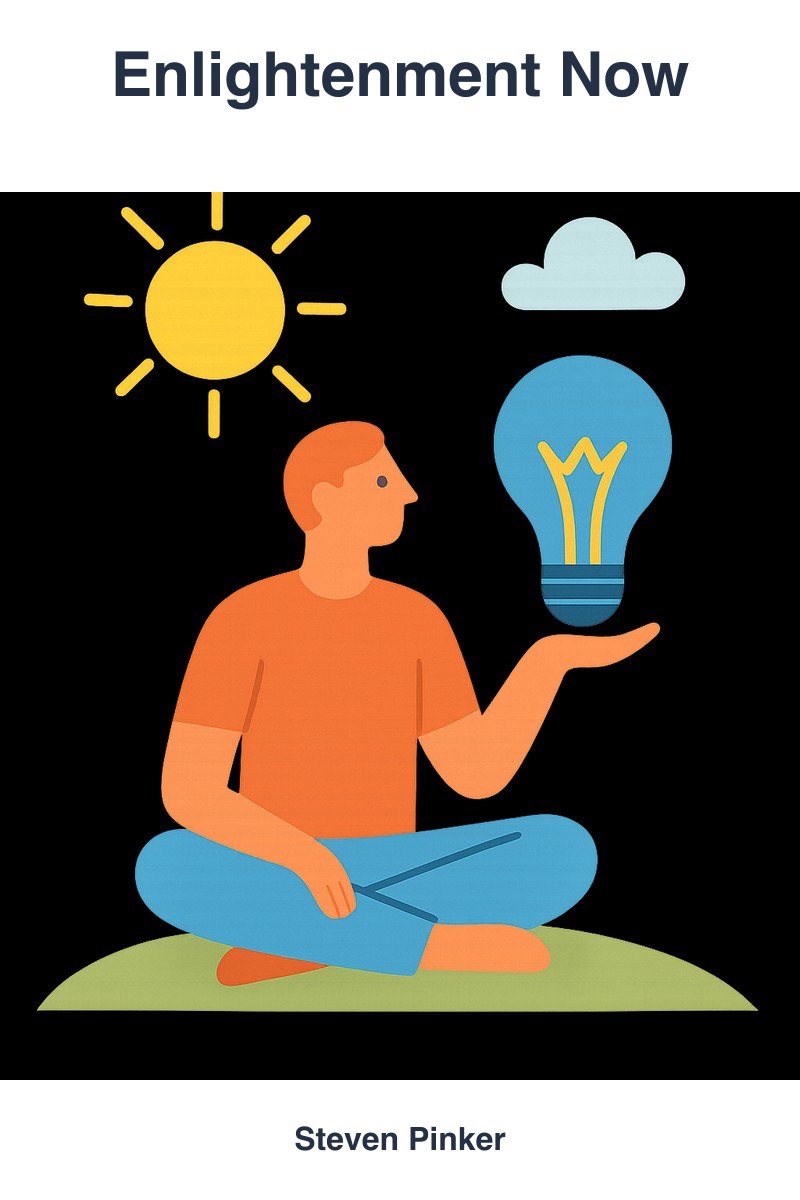
Enlightenment Now Book Summary
This Enlightenment Now Book Summary covers the key ideas, lessons, and takeaways in about 20 minutes.
Short Description:
Pinker's data driven case that reason and science keep improving the world
Pinker wants you to trust the data over your gut. Human life has gotten longer, safer, freer, richer, and more peaceful because people applied reason, science, and humanism to real problems, and the same tools can fix what is still broken. Progress is not automatic, and it is not even across the globe, but pessimism is not a safe default. It blinds us to what works and makes us wary of the tools that could do the most good, so the way forward is to keep counting, keep testing ideas, and keep putting human wellbeing first.
Helps with these goals
Want a Free Weekly Read?
Get a free summary every week straight to your mailbox.
Preview the Enlightenment Now book summary
Below is a preview of Sumizeit’s comprehensive human-written summary of Enlightenment Now by Steven Pinker. The full summary is 15-20 minutes long and covers the book’s key ideas in text, audio, visual, and video formats. Unlock the full 20 Minute Summary
Open any news app and you will probably walk away thinking the world is falling apart. Steven Pinker says that feeling is wrong, and he spends the whole book trying to prove it. His claim is simple. By almost every measure of human life, things have improved, and they have improved for people all over the planet.
Pinker backs this up with numbers on health, wealth, safety, rights, happiness, peace, and freedom. He credits three big ideas for the gains, and he traces all three to the European Enlightenment. Those ideas are reason, science, and humanism. His message is that we should keep using them, because they work.
What the Enlightenment actually stood for
The Enlightenment was a stretch of the 17th and 18th centuries when European thinkers like Descartes, Locke, Hume, Rousseau, and Kant asked how society could be run more sensibly. They talked about freedom, equality, and evidence. Pinker pulls four threads out of their work.
Reason comes first. Pinker says people are not naturally rational, which is exactly why we must make a habit of thinking things through instead of leaning on gut feeling, tradition, or scripture. Science comes next. Testing beliefs against evidence is the only dependable way to know what is true, and Pinker folds technological advance into this idea. Humanism is the third thread. It puts human wellbeing ahead of any divine or supernatural goal, and it gives us a morality that does not depend on religion, race, or nation. That is why Enlightenment thinkers turned against slavery, torture, and cruel punishments.
The fourth thread is progress itself. Pinker defines it as using reason, science, and humanism to make life better for everyone. He thinks progress comes from fixing institutions like laws and schools, not from trying to change human nature.
The enemies of progress
Pinker names four forces that he thinks hold us back.
Religion is the most obvious one. Faith clashes with evidence, and religious teaching often tells people to accept suffering now for a reward later, which cuts against humanism. He also points out that organized religion tends to come with power imbalances and limits on freedom. Next is the rejection of science, the idea that science is just another story. Pinker says this breeds distrust of experts, and he notes how that distrust during the COVID pandemic cost lives that could have been saved.
Tribalism is the third. It means putting the group above the person, as in nationalism or fierce loyalty to a religion, race, or class. Pinker argues that groups feel nothing. Only people feel pain and joy, so people should be the focus. The fourth enemy is declinism, the belief that modern society is sliding toward collapse. Fears that technology will wreck us, through war or through making us lazy and empty, feed a gloomy mood that makes people hostile to the very tools that could help.
What counts as better
Pinker admits that calling something better is a value judgment.
Want the complete 20-minute summary?
- Full structured summary
- Video Summary
- Podcast Summary
- Audio summary
- Key takeaways
- Exercises
- Quiz
- Highlights and notes
- Ask the book with AI
Who should read Enlightenment Now?
Enlightenment Now is for anyone feeling overwhelmed by negative news and wondering if the world is truly falling apart. It's essential reading for skeptics of progress, policy makers seeking evidence-based solutions, and anyone who wants to understand why data matters more than feelings when assessing human flourishing.
Why does Enlightenment Now matter?
In an age of relentless bad news and doomism, Steven Pinker's Enlightenment Now provides a reality check backed by decades of data showing measurable improvement in health, wealth, safety, and freedom globally. The book argues that the tools of reason, science, and humanism—not pessimism—are what will solve remaining problems from climate change to poverty.
What are the key themes in Enlightenment Now?
- The world is objectively better by most measurable standards
- Reason, science, and humanism drive human progress
- Media bias and cognitive biases distort our perception of reality
- Data and evidence should guide decisions, not emotion or nostalgia
- Inequality itself is less important than reducing absolute poverty
- Violence and war have declined dramatically over centuries
- Technology and scientific advancement are solutions, not threats
How can you apply ideas from Enlightenment Now?
- Fact-check emotional reactions to news by consulting data from reputable sources before forming opinions about major trends
- Advocate for reason and evidence-based policy in local government and community decisions rather than accepting tradition or popularity
- Teach children and colleagues to distinguish between memorable anecdotes and actual statistical trends when evaluating claims
- Support scientific and technological solutions to social problems rather than retreating into nostalgia or rejecting innovation
- Measure progress in poverty reduction and quality of life improvements rather than focusing primarily on wealth inequality metrics
- Promote data literacy and critical thinking about media bias in schools and workplaces to counter availability bias
- Evaluate personal and organizational decisions using evidence from trials and testing rather than intuition alone
What common mistakes do readers make with Enlightenment Now?
- Assuming that because news coverage has become more negative, the world itself has become worse—confusing media bias with reality
- Believing that any increase in inequality is unacceptable without considering absolute improvements in living standards for all groups
- Romanticizing the past without acknowledging historical suffering, disease, limited freedom, and constant drudgery
- Rejecting technological solutions to problems out of fear or nostalgic preference for 'natural' or 'traditional' approaches
Sumizeit Exercises Apply what you've learned
Turn ideas from Enlightenment Now into action with a short guided reflection: identify the biggest takeaway, connect it to your life, and commit to one step you can take in the next 24 hours.
What is the expert analysis of Enlightenment Now?
Overview
Enlightenment Now, authored by Steven Pinker, a distinguished Harvard psychology professor renowned for his work on language, cognition, and human nature, is a significant contribution to contemporary intellectual discourse. Published in 2018, this work builds on Pinker's earlier acclaimed book, The Better Angels of Our Nature, extending the narrative of human progress by anchoring it firmly in the values and principles of the European Enlightenment. Pinker’s stature as a public intellectual and his rigorous, data-driven approach lend considerable weight to his optimistic thesis about the trajectory of human civilization.
Core Thesis
Pinker’s central argument is that despite pervasive pessimism fueled by media and cognitive biases, human life has demonstrably improved in almost every measurable dimension—health, wealth, safety, rights, happiness, peace, and freedom. He attributes this progress to the enduring legacy of three Enlightenment ideals: reason, science, and humanism. These principles, Pinker contends, have enabled humanity to overcome ignorance, superstition, and tribalism, fostering institutions and innovations that enhance wellbeing globally. Progress, in Pinker’s view, is neither inevitable nor uniform but is achieved through the deliberate application of these ideals to reform social institutions and address challenges.
Strengths
- Empirical Rigor: Pinker’s extensive use of quantitative data across diverse domains provides a compelling, evidence-based counter-narrative to widespread cultural pessimism.
- Interdisciplinary Synthesis: The book skillfully integrates insights from psychology, history, economics, and political science, offering a panoramic view of human advancement.
- Clear Articulation of Enlightenment Values: By distilling the Enlightenment into reason, science, humanism, and progress, Pinker offers a lucid framework for understanding modernity’s achievements and challenges.
- Addressing Cognitive Biases: The analysis of psychological biases that distort perception—such as negativity bias and availability heuristic—adds depth to understanding why progress is often underappreciated.
- Optimistic yet Nuanced: While optimistic, Pinker acknowledges uneven progress and ongoing problems, avoiding simplistic triumphalism.
Critiques & Counterarguments
- Overreliance on Quantitative Metrics: Critics argue Pinker’s heavy focus on aggregate data can obscure qualitative dimensions of wellbeing, such as cultural meaning, social cohesion, and environmental sustainability, which are harder to quantify but equally vital.
- Environmental Concerns Understated: Pinker’s ecomodernist stance, emphasizing technological solutions to climate change, has been challenged by environmentalists who warn that technological optimism may downplay the urgency and systemic nature of ecological crises.
- Complexity of Inequality: The dismissal of inequality as a secondary concern relative to poverty overlooks research linking inequality to social dysfunction, reduced social mobility, and political instability, suggesting that rising disparities can undermine long-term progress.
- Critique of Enlightenment Rationalism: Some philosophers and social theorists question Pinker’s confidence in reason and science as unalloyed goods, pointing to the Enlightenment’s historical entanglements with colonialism, and the limits of rationality in grappling with moral and existential questions.
- Selective Historical Interpretation: Pinker’s portrayal of the Enlightenment and progress has been critiqued for glossing over darker episodes and ongoing systemic injustices, suggesting a more critical historiography is necessary to fully understand modernity’s complexities.
Who Should Read This
Enlightenment Now is essential reading for intellectually curious individuals who seek a data-informed, optimistic perspective on human progress amid contemporary anxieties. Scholars and students in the fields of psychology, history, political science, and philosophy will find Pinker’s interdisciplinary approach enriching. Additionally, policymakers and public intellectuals interested in the foundations of liberal democracy, science advocacy, and human rights will benefit from Pinker’s robust defense of Enlightenment values. However, readers should approach the book with a critical mindset, prepared to engage with its contested claims and the broader debates it provokes about the nature and direction of progress.
Discussion questions for Enlightenment Now Short questions you can actually use in a conversation
Frequently asked questions about the Enlightenment Now book summary
What is Enlightenment Now about?
Enlightenment Now by Steven Pinker argues that the world has objectively improved across virtually every measure—health, wealth, safety, rights, peace, and happiness—contrary to prevailing pessimism. Pinker credits three Enlightenment principles (reason, science, and humanism) for this progress and contends that these same tools should be applied to remaining problems.
Who should read Enlightenment Now?
Anyone feeling overwhelmed by negative news, skeptics of progress, policy makers seeking evidence, and people curious about whether human civilization is advancing or declining should read this book. It's particularly valuable for those who suspect their pessimism may be distorted by media bias and cognitive biases rather than facts.
What are the main takeaways from Enlightenment Now?
The core message is to trust data over gut feeling: human life has measurably improved because of reason, science, and humanism applied to real problems, and these same tools can address remaining challenges. Pinker emphasizes that pessimism blinds us to progress and makes us hostile to the very solutions we need, so counting, testing, and prioritizing human wellbeing is the path forward.
Why does Pinker say the news makes us feel pessimistic?
News outlets systematically cover negative events and dramatic stories, creating a distorted picture of reality. Combined with cognitive biases—availability bias making memorable events seem common, negativity bias making us expect the worst—and nostalgia for an imagined better past, media coverage creates a pessimism that data does not support.
Does Enlightenment Now address environmental concerns?
Yes, Pinker embraces ecomodernism: acknowledging that human flourishing has environmental costs but arguing that scientific progress and technology will solve resulting problems. He rejects both panic and retreat, insisting that reason, humanism, and continued innovation are the only realistic paths to addressing climate change.
What is Pinker's view on inequality?
Pinker argues that poverty is the real problem, not inequality itself. If both rich and poor improve their circumstances simultaneously—even if the gap widens—society is better off. He contends that the forces that create equality (tyranny, war, disease, collapse) are far worse than inequality maintained through freedom and prosperity.
How does Enlightenment Now address criticism that progress is uneven globally?
Pinker acknowledges that gains are uneven, with Africa and the Middle East still facing higher child mortality and food crises than developed regions. However, he argues this is reason to extend reason, science, and humanism globally, not to declare progress a failure because it is incomplete.
About Sumizeit
Sumizeit is a profitable Scomy LLC company based in Miami, Florida. Our founders, Clemens Raemy and Weina Scott, are successful entrepreneurs with several exits. Sumizeit is a popular book summary app / micro learning app used by busy professionals and entrepreneurs with over 2,500 non-fiction book summaries and 10,000 podcast summaries in text, audio, visual, podcast, and video format. We also have stellar retention tools to make ideas stick - such as flashcards with spaced repetition, quizzes, streaks, highlighting and notes, daily challenges, riddles, mini-courses, meditation, and more. You won't only learn the idea, but also remember it. Over 90% of our users change their habits with Sumizeit.
Upgrade Now
Here's why readers love Sumizeit
Join thousands of learners getting smarter every day
"Great experience. Detailed summaries. Loved the gamification feature. Makes learning fun. Good customer service. I recommend Sumizeit to anyone. You'll learn a lot."
"I always felt busy but still wanting to keep up with the book discussion in my friend group. This was a great supplement to help me keep reading the books I find fun while keeping up with important books."
"I love this website. Instead of scrolling social media, I find myself learning a lot. I use it everyday. I recommend this app for anyone who is too busy and wants to get up to speed with their favorite books."
Enlightenment Now Book Summary PDF
Looking for a Enlightenment Now Book Summary PDF you can save and revisit offline? Our Enlightenment Now Book Summary PDF captures the book’s core ideas in a clean, printable format — the key frameworks, takeaways, and structure without the fluff. Download the Enlightenment Now Book Summary PDF when you want a reference you can annotate, share with your team, or review on the go. Get your Enlightenment Now Book Summary PDF from the download page below.
Download Enlightenment Now Book Summary PDFPeople also liked these summaries
Readers who explored Enlightenment Now often enjoyed these titles next.



Ready to read the whole thing?
- Full structured summary
- Video Summary
- Podcast Summary
- Audio summary
- Key takeaways
- Exercises
- Quiz
- Highlights and notes
- Ask the book with AI
Featured Book Titles
Popular Book Summaries at sumizeit, leading book summary app
Atomic Habits Book Summary Rich Dad Poor Dad Book Summary The Four Agreements Book Summary The 48 Laws of Power Book Summary When Breath Becomes Air Book Summary Think and Grow Rich Book Summary