


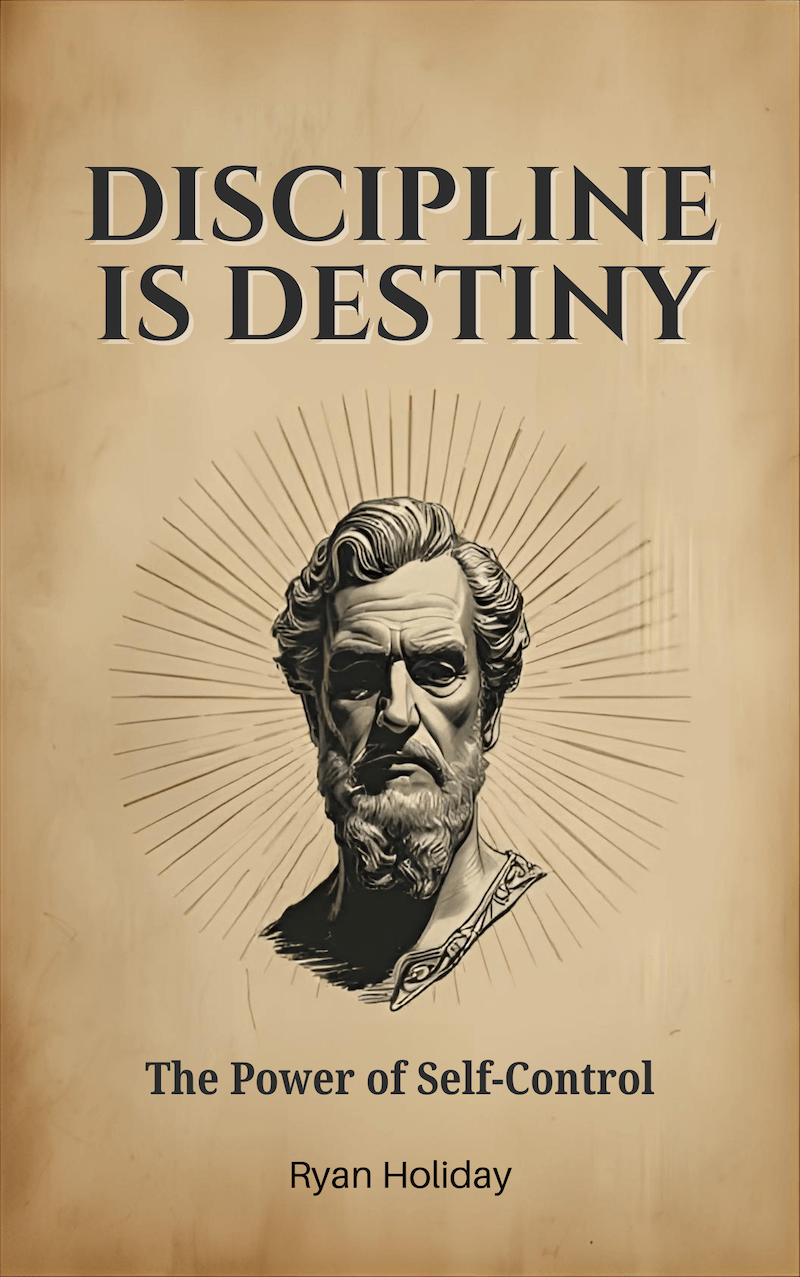
Prefer the print book? Buy on Amazon
As an Amazon Associate, Sumizeit earns from qualifying purchases.
Discipline Is Destiny Book Summary
This Discipline Is Destiny Book Summary covers the key ideas, lessons, and takeaways in about 20 minutes.
Short Description:
Discipline Is Destiny teaches self-discipline shapes success and character.
Helps with these goals
Preview the Discipline Is Destiny book summary
Below is a preview of Sumizeit’s comprehensive human-written summary of Discipline Is Destiny by Ryan Holiday. The full summary is 15-20 minutes long and covers the book’s key ideas in text, audio, visual, and video formats. Unlock the full 20 Minute Summary
Discipline Is Destiny by Ryan Holiday is a deep exploration of how self-mastery shapes human potential and how the ability to govern oneself determines the trajectory of one’s life. Holiday argues that discipline is not a rigid punishment or a joyless commitment to restraint, but rather the essential skill that allows a person to take control of their future instead of being a victim to impulse, emotion, and circumstance. Without discipline, dreams collapse into wishful thinking; with discipline, the impossible becomes attainable. It is the difference between drifting aimlessly and moving with deliberate purpose.
Holiday emphasizes that self-discipline grants true freedom—freedom from internal chaos, from destructive habits, from emotional volatility, and from the tyranny of instant gratification. Those without discipline are slaves to urges, addictions, distractions, and fear. Those who cultivate discipline create space for excellence and achievement. Instead of reacting to life, they shape it intentionally.
Drawing heavily from Stoic philosophy and historical figures, Holiday divides discipline into three interconnected dimensions: discipline of the body, discipline of the mind and temperament, and discipline of character and soul. Mastery in all three areas is the foundation of greatness. Holiday illustrates this through examples such as Marcus Aurelius, Queen Elizabeth, and others whose lives prove that discipline is the bedrock of integrity, influence, success, and inner peace.
Discipline Begins with the Body: The Physical Foundation of Self-Mastery
Holiday begins by exploring the physical dimension of discipline—the area many overlook while chasing abstract goals like mental strength or spiritual clarity. He asserts that controlling the body is the first gateway to controlling the mind. The way a person treats their body reflects and shapes their internal discipline. Strength, energy, clarity, and resilience develop through habits, not wishes.
A disciplined approach to the body is rooted in consistency and respect. This includes movement, nourishment, rest, hydration, and the refusal to indulge in excess. Holiday emphasizes that greatness is not built on occasional bursts of intensity but on reliable, sustainable routines. Refining physical habits develops willpower and heightens one’s capacity to endure discomfort.
Holiday stresses moderation and responsibility rather than extremes. Many people mistakenly replace lack of discipline with obsessive overcorrection—rigid diets, punishing workouts, or self-destructive perfectionism. These are still forms of impulsivity. True discipline aims for stability, health, and strength, not self-punishment. Mastery of the body is reflected in daily choices—going to sleep rather than scrolling a screen, finishing a workout rather than quitting early, or resisting the urge to abuse substances that cloud judgment.
Physical discipline strengthens mental discipline. When a person proves they can complete hard physical tasks, their mind becomes trained to withstand stress and adversity without collapsing. Controlling the body builds confidence in one’s ability to follow through. Holiday emphasizes that discipline is built like a muscle: through repeated effort over time. Commitment to physical well-being becomes a declaration of self-respect.
Developing Temperament: The Discipline of Mind, Emotion, and Focus
Once discipline is developed through the body, Holiday moves to the arena of temperament—self-control expressed in thoughts, reactions, and…
Want the complete 20-minute summary?
- Full structured summary
- Video Summary
- Podcast Summary
- Audio summary
- Key takeaways
- Exercises
- Quiz
- Highlights and notes
- Ask the book with AI
Who should read Discipline Is Destiny?
Discipline Is Destiny speaks to anyone seeking to take control of their life and build lasting success, whether you're an ambitious professional, a leader wanting to inspire others, or someone struggling with habits and impulses. This book is especially valuable for those who feel stuck between competing desires and recognize that willpower alone isn't enough—you need a deeper framework for self-mastery.
Why does Discipline Is Destiny matter?
In a world of constant distraction, instant gratification, and eroding attention spans, Ryan Holiday's argument that discipline is the foundation of freedom and achievement has never been more relevant. This book reframes discipline not as punishment or deprivation, but as the essential skill that separates people who drift through life from those who build it intentionally and shape their own destiny.
What are the key themes in Discipline Is Destiny?
- Self-discipline as the foundation of genuine freedom
- The three dimensions of discipline: body, mind, and character
- Ambition without restraint leads to ego and destruction
- Leadership radiates outward through consistent personal discipline
- Adversity reveals and strengthens disciplined character
- Integrity and character matter more than external achievement
- Discipline is a lifelong practice, not a destination
How can you apply ideas from Discipline Is Destiny?
- Establish a consistent physical routine of movement, nutrition, and sleep to build the foundation for all other discipline
- Practice journaling or mindfulness daily to process emotions and quiet mental noise before reacting to situations
- Set clear priorities and protect your focus by eliminating trivial stimuli and saying no to opportunities that don't align with your values
- Review your ambitions regularly against your core values to ensure you're pursuing meaningful goals rather than hollow status or validation
- Practice responding to provocations with composure—pause before reacting, choose your response thoughtfully, and maintain dignity in conflict
- Build resilience by intentionally facing small discomforts and viewing setbacks as opportunities to learn rather than reasons to surrender
- Demonstrate disciplined leadership by following through on commitments, admitting mistakes, and lifting others instead of competing destructively
- Make daily decisions based on who you want to become rather than what you want in the moment, anchoring choices to your long-term identity
What common mistakes do readers make with Discipline Is Destiny?
- Confusing discipline with harsh self-punishment or obsessive perfectionism—true discipline aims for sustainable strength, not self-destruction
- Attempting to overhaul all areas of life simultaneously instead of building discipline incrementally through small, repeated victories
- Pursuing ambition without restraint, chasing every opportunity and burning out instead of choosing the right direction with wisdom and patience
- Expecting discipline to feel natural or easy from the start—forgetting that it's built like a muscle through repeated effort and struggle over time
Sumizeit Exercises Apply what you've learned
Turn ideas from Discipline Is Destiny into action with a short guided reflection: identify the biggest takeaway, connect it to your life, and commit to one step you can take in the next 24 hours.
What is the expert analysis of Discipline Is Destiny?
Overview
Discipline Is Destiny is a compelling work by Ryan Holiday, a prominent contemporary author and philosopher renowned for his accessible reinterpretations of Stoic principles. Holiday’s reputation is built on his ability to distill ancient wisdom into practical guidance for modern readers, particularly within the realms of business, psychology, and self-improvement. This book stands out as a rigorous meditation on self-discipline as the cornerstone of human potential and fulfillment, weaving historical exemplars and philosophical insights into a cohesive framework for personal mastery.
Core Thesis
At the heart of Discipline Is Destiny lies the argument that discipline is not mere self-restraint or punitive rigor but the essential skill that enables individuals to govern their impulses, emotions, and circumstances. Holiday contends that discipline is the foundation of freedom, achievement, and character, shaping destiny by transforming chaotic desires into deliberate, value-aligned action. The book posits a tripartite model of discipline—physical, mental/emotional, and moral—that together forge greatness and resilience, ultimately enabling a life of purpose rather than passivity.
Strengths
- Integration of Stoic Philosophy and Historical Examples: Holiday’s use of figures like Marcus Aurelius and Queen Elizabeth provides concrete, inspiring illustrations that ground abstract concepts in lived experience.
- Holistic Approach to Discipline: By addressing the body, mind, temperament, ambition, leadership, resilience, and character, the book offers a comprehensive blueprint for self-mastery that transcends simplistic self-help formulas.
- Practicality and Accessibility: The inclusion of actionable strategies—such as journaling, mindfulness, boundary setting, and reflection—makes the philosophical insights applicable to everyday life.
- Balanced View of Ambition and Restraint: Holiday’s nuanced discussion avoids glorifying relentless drive, emphasizing instead the wisdom of measured, ethical ambition aligned with personal values.
- Emphasis on Discipline as Freedom: The reframing of discipline from punishment to liberation offers a psychologically empowering perspective that challenges common misconceptions.
Critiques & Counterarguments
- Potential Oversimplification of Complex Human Behavior: The book’s strong emphasis on discipline as the primary determinant of destiny may underplay the roles of systemic factors, socio-economic conditions, and mental health challenges that complicate self-mastery.
- Stoic Framework Limitations: While Stoicism offers valuable tools, its focus on internal control may risk underemphasizing the importance of external change and social justice, areas where other philosophical traditions (e.g., existentialism or critical theory) provide complementary insights.
- Historical Examples as Idealized Models: The reliance on elite historical figures might obscure the experiences of ordinary individuals or marginalized groups whose paths to discipline and success differ significantly.
- Competing Psychological Research: Contemporary studies in psychology highlight the complexity of motivation and self-regulation, including the roles of intrinsic versus extrinsic motivation, cognitive biases, and neurodiversity, which may not be fully addressed in Holiday’s framework.
- Risk of Moralizing Discipline: The framing of discipline as a moral imperative could inadvertently stigmatize those struggling with self-control issues, such as addiction or mental illness, by implying a lack of character rather than recognizing nuanced challenges.
Who Should Read This
Discipline Is Destiny is ideally suited for readers seeking a philosophically grounded yet practical guide to self-improvement, particularly those interested in Stoic philosophy’s application to modern life. It will resonate with professionals, leaders, and individuals committed to personal growth who appreciate historical context and ethical reflection. However, readers looking for nuanced discussions of systemic barriers or psychological complexity might find the book’s approach somewhat reductive. Ultimately, it offers a powerful manifesto for anyone ready to embrace discipline as a lifelong, transformative practice.
Frequently asked questions about the Discipline Is Destiny book summary
What is Discipline Is Destiny about?
Discipline Is Destiny by Ryan Holiday argues that self-discipline is the single most important force determining personal success, fulfillment, and character. The book explores discipline across three dimensions—body, mind, and character—showing how mastering these areas unlocks freedom, builds resilience, and allows you to shape your destiny intentionally rather than drift through life driven by impulse and circumstance.
Who should read Discipline Is Destiny?
This book is for anyone seeking genuine control over their life and authentic achievement, including ambitious professionals, leaders wanting to inspire others, and anyone struggling with habits, focus, or competing desires. It's particularly valuable for people who recognize that willpower alone isn't enough and who want a deeper framework for sustainable self-mastery rooted in Stoic philosophy.
What are the main takeaways from Discipline Is Destiny?
The main takeaways include: discipline is freedom, not restriction; physical habits form the foundation for mental and emotional control; focus and patience are rare and powerful; ambition requires restraint to avoid destruction; leadership radiates through personal consistency; adversity strengthens character; integrity matters more than achievement; and discipline is a lifelong practice that shapes destiny through daily, consistent choices aligned with your values.
How does Ryan Holiday define discipline differently than traditional views?
Holiday reframes discipline not as punishment or joyless restraint, but as the essential skill that grants genuine freedom from impulse, chaos, and emotional volatility. He argues that discipline isn't about harsh restriction—it's about elevating purpose and gaining control over your life so you can pursue meaningful goals instead of being enslaved to urges and distractions.
What role does hardship play in developing discipline according to this book?
Holiday argues that adversity is the proving ground of discipline—anyone can behave well when life is easy, but true discipline emerges when facing pain, setback, or unfair circumstances. A disciplined person reframes hardship as education rather than punishment, asking what can be controlled and learned, and using obstacles as fuel for growth and resilience.
How does discipline relate to leadership in Discipline Is Destiny?
Holiday emphasizes that disciplined leadership is influence without force—people follow leaders whose consistency, integrity, and composure inspire elevation. Disciplined leaders hold themselves to higher standards, demonstrate principles through their own behavior, take responsibility, and lift others rather than compete destructively. Their presence becomes a stabilizing force that others trust.
Can discipline be learned, or is it an innate talent?
Holiday is clear that discipline is not a natural talent but a practice strengthened through repetition, reflection, failure, correction, and recommitment. No one becomes perfectly disciplined, but everyone can become more disciplined than they were yesterday. It's a lifelong process of building habits and making choices aligned with your values and identity.
What's the connection between physical discipline and mental discipline in this book?
Holiday argues that controlling your body is the first gateway to controlling your mind and emotions. By mastering basic habits like sleep, exercise, nutrition, and moderation, you train your willpower and build confidence that extends to every other area of life. Physical discipline strengthens mental discipline and creates the foundation for character development.
About Sumizeit
Sumizeit is a profitable Scomy LLC company based in Miami, Florida. Our founders, Clemens Raemy and Weina Scott, are successful entrepreneurs with several exits. Sumizeit is a popular book summary app / micro learning app used by busy professionals and entrepreneurs with over 2,500 non-fiction book summaries and 10,000 podcast summaries in text, audio, visual, podcast, and video format. We also have stellar retention tools to make ideas stick - such as flashcards with spaced repetition, quizzes, streaks, highlighting and notes, daily challenges, riddles, mini-courses, meditation, and more. You won't only learn the idea, but also remember it. Over 90% of our users change their habits with Sumizeit.
Upgrade Now
Here's why readers love Sumizeit
Join thousands of learners getting smarter every day
"Great experience. Detailed summaries. Loved the gamification feature. Makes learning fun. Good customer service. I recommend Sumizeit to anyone. You'll learn a lot."
"I always felt busy but still wanting to keep up with the book discussion in my friend group. This was a great supplement to help me keep reading the books I find fun while keeping up with important books."
"I love this website. Instead of scrolling social media, I find myself learning a lot. I use it everyday. I recommend this app for anyone who is too busy and wants to get up to speed with their favorite books."
Discipline Is Destiny Book Summary PDF
Looking for a Discipline Is Destiny Book Summary PDF you can save and revisit offline? Our Discipline Is Destiny Book Summary PDF captures the book’s core ideas in a clean, printable format — the key frameworks, takeaways, and structure without the fluff. Download the Discipline Is Destiny Book Summary PDF when you want a reference you can annotate, share with your team, or review on the go. Get your Discipline Is Destiny Book Summary PDF from the download page below.
Download Discipline Is Destiny Book Summary PDFPeople also liked these summaries
Readers who explored Discipline Is Destiny often enjoyed these titles next.




Ready to read the whole thing?
- Full structured summary
- Video Summary
- Podcast Summary
- Audio summary
- Key takeaways
- Exercises
- Quiz
- Highlights and notes
- Ask the book with AI
Featured Book Titles
Popular Book Summaries at sumizeit, leading book summary app