


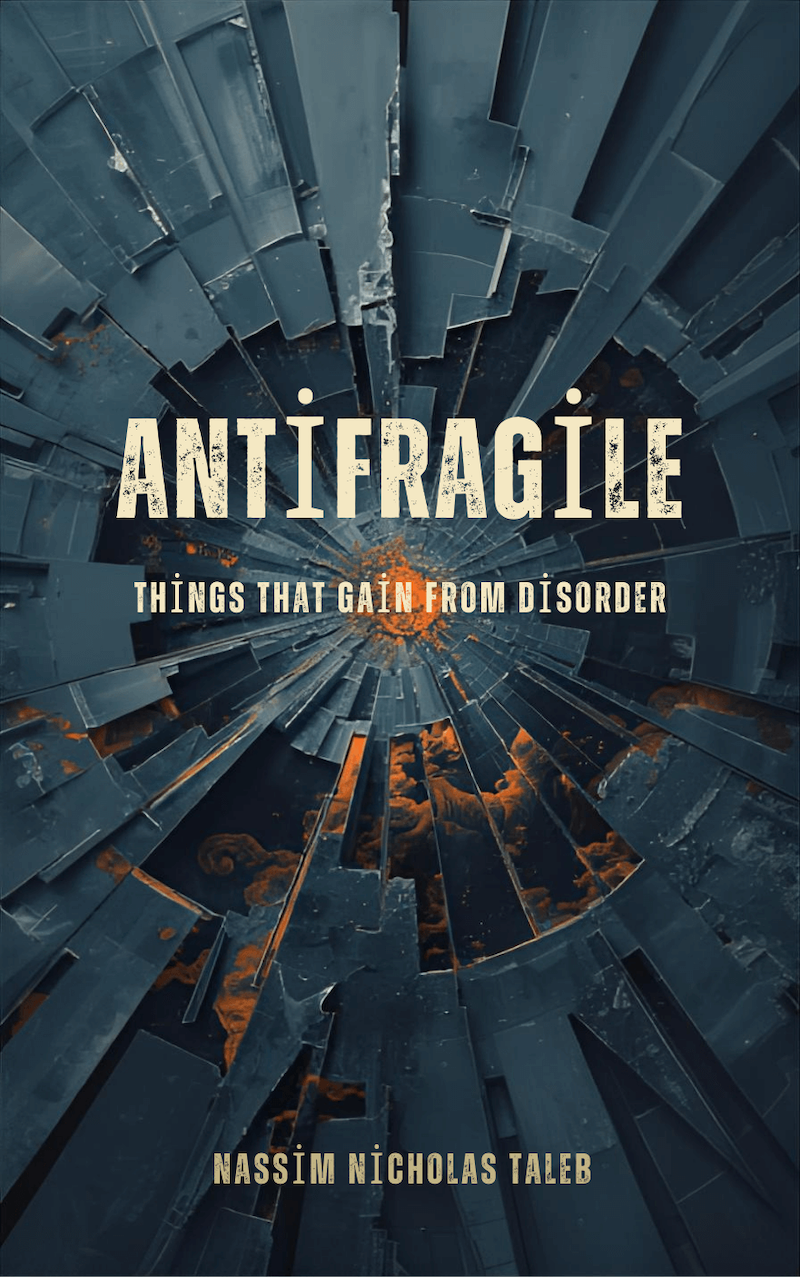
Prefer the print book? Buy on Amazon
As an Amazon Associate, Sumizeit earns from qualifying purchases.
Antifragile Book Summary
This Antifragile Book Summary covers the key ideas, lessons, and takeaways in about 20 minutes.
Short Description:
Antifragile thrives by gaining from disorder and embracing volatility.
Antifragility means designing structures, habits, and decisions so that volatility becomes a source of progress rather than destruction. It means allowing small failures to prevent large ones, preferring decentralized systems to centralized power, embracing experimentation, rejecting unnecessary intervention, and demanding skin in the game from all who make decisions for others. It is a philosophy that applies as much to economics and politics as to exercise, creativity, learning, and personal growth.
To be antifragile is to turn adversity into strength, uncertainty into opportunity, and randomness into advantage. In a world that cannot be controlled, the safest strategy is not avoiding disorder, but learning how to gain from it.
Helps with these goals
Preview the Antifragile book summary
Below is a preview of Sumizeit’s comprehensive human-written summary of Antifragile by Nassim Nicholas Taleb. The full summary is 15-20 minutes long and covers the book’s key ideas in text, audio, visual, and video formats. Unlock the full 20 Minute Summary
Most people imagine that the opposite of fragility is resilience—the ability to survive crises without breaking. But Nassim Nicholas Taleb argues that resilience is only the midpoint between weakness and strength. The true opposite of fragility is something far more powerful: the capacity to improve through disorder, shock, stress, volatility, and pressure. He calls this quality antifragility, a trait that turns randomness into a source of gain rather than damage. A fragile object shatters when dropped. A resilient object stays intact. An antifragile object gets stronger every time it falls.
In Antifragile, Taleb contends that modern society has become dangerously fragile because it attempts to eliminate uncertainty rather than harness it. We build systems dependent on predictions, control, and planning, rather than on adaptability and experimentation. This approach blinds us to how little we can truly foresee and amplifies the consequences of failure. Antifragility, by contrast, accepts volatility and uses it as fuel for growth. Taleb draws examples from medicine, economics, evolution, entrepreneurship, technology, and personal development to argue that both individuals and societies should stop resisting randomness and instead structure their lives and systems to benefit from it.
The book’s fundamental message is simple but profound: the world is unpredictable, and pretending otherwise is what creates disaster. Instead of asking how to avoid uncertainty, we should ask how to take advantage of it.
Fragile, Robust, and Antifragile
Taleb explains the difference between the three states using famous myths. The sword of Damocles represents fragility—the sword remains suspended over his head by a thread, and its inevitable fall defines vulnerability. The phoenix symbolizes robustness or resilience: it burns and is reborn unchanged but never improves. The Hydra, which grows two new heads whenever one is cut off, embodies antifragility. Every wound enhances its strength.
This distinction reveals why antifragility is more valuable than simple durability. A resilient system endures stress but does not become better because of it. An antifragile system evolves through pressure. Biological systems demonstrate this constantly. Exercise works by tearing muscle fibers, forcing them to rebuild stronger. Bones strengthen when subjected to impact. Immune systems mature through exposure to pathogens. Even evolution occurs through repeated failure and elimination of the weak.
Yet human beings frequently build institutions and technologies designed to remove discomfort, randomness, and risk. We smooth out fluctuations, enforce predictability, and intervene aggressively, imagining we are improving safety. Instead, we produce unseen vulnerability. When real volatility returns, the consequences are catastrophic.
Why Predicting the Future is a Losing Game
Taleb argues that contemporary society relies excessively on prediction. Governments, economists, analysts, and corporations attempt to anticipate the future and base decisions on models that assume certainty. This approach is fundamentally flawed because most large-scale events are rare, unexpected, and massively impactful. Predictive systems fail not because they are slightly inaccurate, but because they cannot capture the complexity and randomness of reality. Trying to calculate the future becomes more dangerous than acknowledging ignorance.
The 2008 financial crisis illustrates this: years of artificially controlled risk…
Want the complete 20-minute summary?
- Full structured summary
- Video Summary
- Podcast Summary
- Audio summary
- Key takeaways
- Exercises
- Quiz
- Highlights and notes
- Ask the book with AI
Who should read Antifragile?
Antifragile is for anyone frustrated by how fragile modern systems seem—from entrepreneurs and investors to parents, professionals, and policymakers. If you want to understand why the world keeps surprising us and how to actually benefit from uncertainty rather than fear it, this book reshapes how you think about risk, growth, and stability.
Why does Antifragile matter?
We live in an age obsessed with prediction, control, and eliminating risk—yet crises keep catching us off guard. Nassim Nicholas Taleb's Antifragile reveals why our strategy is backwards: the real path to success is not avoiding randomness but designing your life and systems to gain from it. In a world of black swans and tail events, understanding antifragility is not optional—it's survival.
What are the key themes in Antifragile?
- The illusion of stability through control and prediction
- Stress and volatility as necessary fuel for growth
- Decentralization and optionality as antidotes to fragility
- The hidden cost of intervention and the power of inaction
- Skin in the game as the foundation of ethical systems
- Evolution and innovation through trial-and-error, not planning
How can you apply ideas from Antifragile?
- In fitness and health: embrace varied, challenging workouts instead of isolated repetitive exercise; expose yourself to mild stressors (cold, heat, fasting) to build adaptive capacity
- In career and finance: use a barbell strategy with stable core income plus small high-risk bets on entrepreneurship or investments; prioritize optionality over status
- In business and innovation: run multiple small experiments and fail fast rather than betting everything on a single plan; allow teams autonomy to adapt locally
- In parenting and education: let children face manageable challenges, failure, and boredom instead of constant curation; let them make mistakes in low-stakes situations to build judgment
- In personal life: seek discomfort voluntarily (cold exposure, public speaking, challenging hobbies) to inoculate against fear; build redundancy in skills and resources
- In organizational design: decentralize decision-making, reduce hierarchy, and eliminate unnecessary layers; build slack and buffers into schedules and budgets
- In policy and governance: favor trial-and-error approaches over large-scale mandates; require decision-makers to have skin in the game; allow local regions to experiment
What common mistakes do readers make with Antifragile?
- Assuming stability is the goal: treating comfort and predictability as success when they actually hide fragility and invite catastrophe
- Confusing efficiency with robustness: optimizing every variable leaves no room for adaptation when reality diverges from the model
- Relying on expert prediction: trusting forecasts and models as if the future is calculable rather than designing systems that work regardless
- Overprotecting yourself or others: preventing all discomfort and failure removes the feedback loops that build actual strength and judgment
- Centralizing too much control: building large hierarchical systems that appear stable but collapse violently when something breaks at the top
Sumizeit Exercises Apply what you've learned
Turn ideas from Antifragile into action with a short guided reflection: identify the biggest takeaway, connect it to your life, and commit to one step you can take in the next 24 hours.
What is the expert analysis of Antifragile?
Overview
Antifragile is a seminal work by Nassim Nicholas Taleb, a polymath whose expertise spans mathematics, philosophy, risk theory, and finance. Published as part of his influential Incerto series, this book challenges prevailing paradigms about risk, uncertainty, and system design. Taleb’s unique vantage point—rooted in both rigorous theoretical insight and practical experience in financial markets—enables him to dissect the fragility inherent in modern institutions and propose a transformative concept: antifragility. This concept has resonated widely across disciplines including economics, medicine, and personal development, marking the book as a critical intervention in contemporary thought on complexity and resilience.
Core Thesis
Taleb’s central argument is that the conventional focus on resilience or robustness is insufficient for navigating an inherently unpredictable world. Instead, he introduces the notion of antifragility—systems and entities that not only withstand shocks and volatility but actually improve because of them. This reframing asserts that disorder, randomness, and stress are not merely threats to be mitigated but essential drivers of growth and innovation. Taleb critiques modern society’s obsession with prediction, control, and stability, arguing that these efforts paradoxically increase systemic fragility by suppressing variability and feedback mechanisms. The antidote lies in embracing uncertainty, decentralization, and optionality to build systems that thrive on volatility rather than collapse under it.
Strengths
- Innovative Conceptual Framework: The introduction of antifragility as a distinct category beyond fragility and resilience offers a powerful lens for understanding complex adaptive systems.
- Interdisciplinary Reach: Taleb draws compelling examples from biology, economics, technology, and personal health, demonstrating the broad applicability of antifragility across domains.
- Critique of Prediction and Control: The book incisively exposes the limitations and dangers of overreliance on forecasting models, especially in finance and policymaking.
- Practical Prescriptions: Taleb’s recommendations—such as embracing small-scale failures, decentralizing authority, and maintaining “skin in the game”—provide actionable strategies grounded in real-world dynamics.
- Ethical Dimension: The emphasis on accountability and responsibility in decision-making enriches the discussion by linking antifragility to moral philosophy.
Critiques & Counterarguments
- Empirical Ambiguity: While Taleb’s examples are vivid, the book sometimes lacks rigorous empirical validation or systematic data analysis to substantiate the universality of antifragility.
- Oversimplification of Complex Systems: The dichotomy between fragile and antifragile can obscure the nuanced behaviors of many systems that exhibit mixed or context-dependent responses to stress.
- Potential Romanticization of Disorder: The valorization of volatility risks underestimating scenarios where randomness causes irreversible harm, especially in social or ecological contexts where recovery is not guaranteed.
- Contrasting Research on Stability: Opposing schools in systems theory and organizational studies emphasize the necessity of stability and predictability for coordination and long-term planning, suggesting that antifragility is not universally optimal.
- Challenges in Implementation: Translating antifragile principles into policy or organizational design faces practical hurdles, including entrenched power structures and the difficulty of balancing risk exposure.
Who Should Read This
Antifragile is essential reading for scholars, practitioners, and thinkers engaged with complexity, risk, and innovation. It appeals particularly to economists, policymakers, entrepreneurs, and anyone interested in systems thinking and adaptive strategies. Readers who appreciate interdisciplinary analysis and are skeptical of conventional wisdom on stability and control will find Taleb’s insights provocative and enriching. Additionally, individuals seeking a philosophical framework to navigate uncertainty in personal and professional life will benefit from the book’s practical guidance and ethical considerations. However, those expecting a purely empirical or technical manual may find its style more conceptual and essayistic than methodologically rigorous.
Frequently asked questions about the Antifragile book summary
What is Antifragile about?
Antifragile by Nassim Nicholas Taleb argues that the world is shaped by unpredictable randomness, and modern society has become dangerously fragile by trying to eliminate uncertainty through control and prediction. The book proposes a radical alternative: design your life, organization, and systems so that volatility and disorder make them stronger, not weaker—turning randomness from a threat into an advantage.
Who should read Antifragile?
Antifragile is essential for entrepreneurs, investors, policymakers, parents, and anyone who wants to understand why crises keep catching us off guard. If you're frustrated by how fragile modern institutions seem, or you want practical strategies for thriving amid uncertainty, this book rewires your thinking about risk, growth, and stability.
What are the main takeaways from Antifragile?
The core insights are: (1) antifragility—gaining from stress—is more valuable than mere resilience; (2) prediction-based systems are fragile and fail catastrophically; (3) small, decentralized structures are stronger than large centralized ones; (4) intermittent stress is necessary for growth; (5) intervention and over-optimization hide risk; (6) innovation comes from trial-and-error, not planning; (7) decision-makers must have skin in the game for accountability.
What is the difference between fragile, robust, and antifragile?
A fragile object shatters when stressed (sword of Damocles). A robust object survives stress unchanged (phoenix). An antifragile object gets stronger from stress (Hydra). Most of modern society aims for robustness but actually creates fragility; the superior goal is antifragility.
How does Taleb define the barbell strategy?
The barbell strategy combines maximum safety in core positions with small, aggressive bets on high-risk opportunities. This structure protects you from catastrophe while capturing upside from randomness—the opposite of middle-ground mediocrity that takes moderate risks without adequate reward.
What is skin in the game and why does it matter?
Skin in the game means that decision-makers bear the consequences of their choices. When leaders are shielded from downside, they make reckless decisions that harm others—as seen in the 2008 financial crisis. Requiring skin in the game ensures accountability and ethical behavior.
Why does Taleb say comfort makes us fragile?
When we eliminate all discomfort and challenge, we prevent our bodies, minds, and organizations from adapting and strengthening. A child raised without difficulty cannot handle adulthood; a person avoiding all germs becomes chronically ill. Antifragility requires intermittent, manageable stress.
How can I apply antifragility to my own life?
Seek manageable challenges instead of avoiding them; build redundancy and buffers into your finances and skills; use a barbell strategy with stable income plus small high-risk bets; embrace varied, challenging experiences; expose yourself to mild stressors; decentralize your risks across multiple options rather than betting everything on one outcome.
About Sumizeit
Sumizeit is a profitable Scomy LLC company based in Miami, Florida. Our founders, Clemens Raemy and Weina Scott, are successful entrepreneurs with several exits. Sumizeit is a popular book summary app / micro learning app used by busy professionals and entrepreneurs with over 2,500 non-fiction book summaries and 10,000 podcast summaries in text, audio, visual, podcast, and video format. We also have stellar retention tools to make ideas stick - such as flashcards with spaced repetition, quizzes, streaks, highlighting and notes, daily challenges, riddles, mini-courses, meditation, and more. You won't only learn the idea, but also remember it. Over 90% of our users change their habits with Sumizeit.
Upgrade Now
Here's why readers love Sumizeit
Join thousands of learners getting smarter every day
"Great experience. Detailed summaries. Loved the gamification feature. Makes learning fun. Good customer service. I recommend Sumizeit to anyone. You'll learn a lot."
"I always felt busy but still wanting to keep up with the book discussion in my friend group. This was a great supplement to help me keep reading the books I find fun while keeping up with important books."
"I love this website. Instead of scrolling social media, I find myself learning a lot. I use it everyday. I recommend this app for anyone who is too busy and wants to get up to speed with their favorite books."
Antifragile Book Summary PDF
Looking for a Antifragile Book Summary PDF you can save and revisit offline? Our Antifragile Book Summary PDF captures the book’s core ideas in a clean, printable format — the key frameworks, takeaways, and structure without the fluff. Download the Antifragile Book Summary PDF when you want a reference you can annotate, share with your team, or review on the go. Get your Antifragile Book Summary PDF from the download page below.
Download Antifragile Book Summary PDFPeople also liked these summaries
Readers who explored Antifragile often enjoyed these titles next.



Ready to read the whole thing?
- Full structured summary
- Video Summary
- Podcast Summary
- Audio summary
- Key takeaways
- Exercises
- Quiz
- Highlights and notes
- Ask the book with AI
Featured Book Titles
Popular Book Summaries at sumizeit, leading book summary app