


As an Amazon Associate, Sumizeit earns from qualifying purchases.
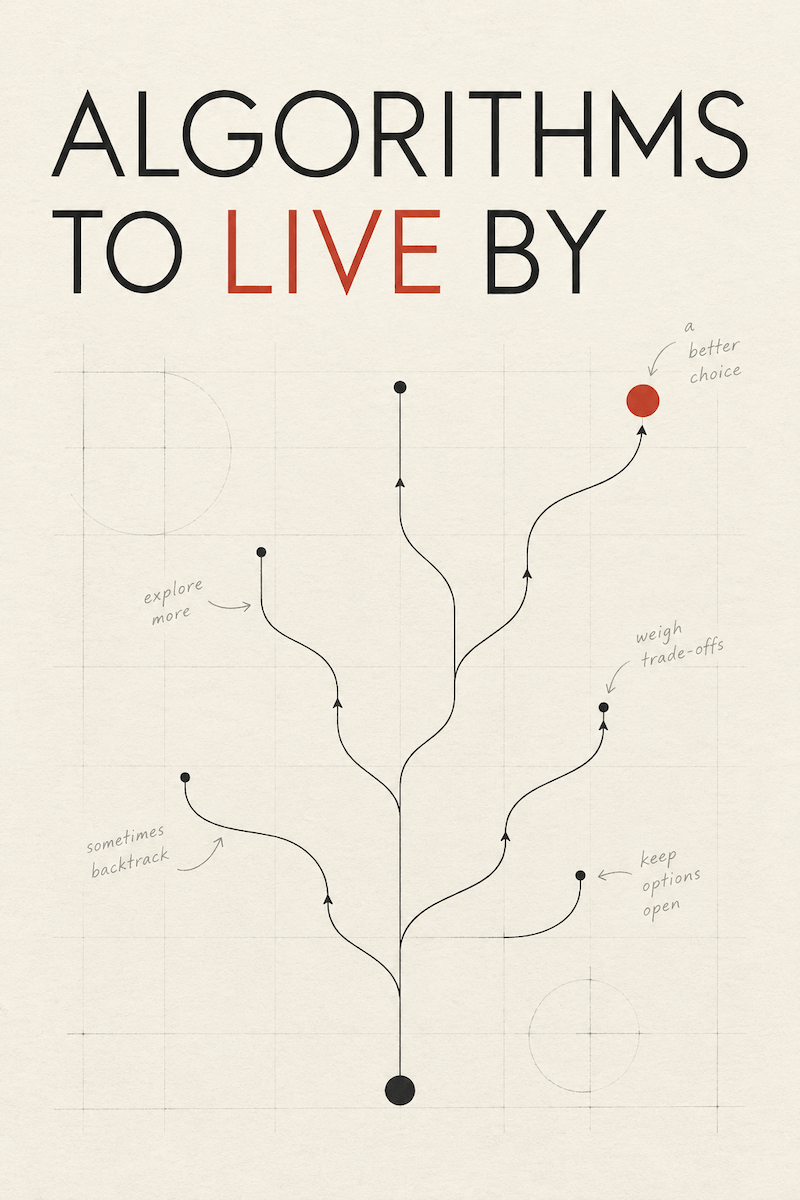
Algorithms to Live By Book Summary
This Algorithms to Live By Book Summary covers the key ideas, lessons, and takeaways in about 20 minutes.
Life doesn’t need perfect answers; it needs better processes. Every decision is an experiment: gather data, update beliefs, simplify variables, and iterate forward. The goal isn’t perfection—it’s progress with purpose.
Helps with these goals
Want the complete 20-minute summary?
- Full structured summary
- Video Summary
- Podcast Summary
- Audio summary
- Key takeaways
- Exercises
- Quiz
- Highlights and notes
- Ask the book with AI
What is in the Algorithms to Live By book summary?
Below is a preview of Sumizeit’s expert-written summary of Algorithms to Live By by Brian Christian. The full summary covers the book’s key ideas in text, audio, and video.
In Algorithms to Live By, authors Brian Christian and Tom Griffiths reveal how computer science offers timeless lessons for daily decision-making. Every human problem—choosing a career, managing your calendar, organizing your home, or even finding love—mirrors the computational challenges machines solve every second. Like computers, humans operate with limited memory, time, and energy, and thus can benefit from the same efficiency principles that keep digital systems running smoothly.
The book demonstrates that the logic behind algorithms can provide clarity and peace of mind in situations that once seemed chaotic. By combining mathematics, psychology, and philosophy, Christian and Griffiths show how thinking like a computer can actually make us more human—more deliberate, self-aware, and effective in an unpredictable world.
The 37% Rule: Knowing When to Commit
One of the book’s most celebrated concepts is the 37% rule, a solution to what mathematicians call the “optimal stopping problem.” Whenever you face a series of options—like hiring an employee, choosing a house, or picking a romantic partner—you must decide when to stop searching and commit.
Here’s how it works:
Evaluate the first 37% of your options without committing.
Once you’ve seen that sample, choose the next option that’s better than all the ones before.
Examples:
Dating: If you expect to date between ages 18 and 40, your “exploration” phase should last until around age 26. After that, commit when someone surpasses all your previous partners.
Hiring: If interviewing 100 applicants, reject the first 37 to set a standard, then hire the next one who beats them.
House hunting: Tour the first 11 of 30 houses before making offers.
Parking: On a single-lane street, skip the first 37% of available spots before choosing one.
But the rule has limits. Mathematician Hannah Fry points out that the probability of landing the absolute best option is only 37%. If “great” is good enough, you can adjust the percentage. For instance, if you’re willing to accept a top 5% choice, start committing after 22%, raising success odds to 57%.
In other words, life rarely demands perfection—satisficing, not maximizing, is often the real win.
The Explore–Exploit Dilemma: Curiosity vs. Stability
Another timeless algorithmic principle is the explore/exploit tradeoff. It answers the question: Should I keep trying new things, or stick with what works?
Computers face this every day—like streaming services recommending new shows or restaurants balancing new menu items with bestsellers. Humans do too:
Career: Should you stay in your secure job or test a new industry?
Relationships: Stick with a comfortable partner or meet someone new?
Food: Try that unfamiliar café or revisit your favorite spot?
Christian and Griffiths explain that the right answer depends on where you are in life:
Early stages: Focus on exploration. If you’re young or starting a new career, experiment widely—you’re gathering data.
Middle stages: Split between exploring and exploiting. Try new hobbies or projects while doubling down on proven strengths.
Later stages: Prioritize exploitation. Invest time in what already brings value,…
Want the complete 20-minute summary?
- Full structured summary
- Video Summary
- Podcast Summary
- Audio summary
- Key takeaways
- Exercises
- Quiz
- Highlights and notes
- Ask the book with AI
Who should read Algorithms to Live By?
Algorithms to Live By is ideal for decision-makers, professionals, and anyone seeking better approaches to everyday choices. Whether you're struggling with career decisions, relationship timing, or simply feeling overwhelmed by options, this book offers practical frameworks grounded in computer science. It's perfect for readers who want to think more clearly without sacrificing their humanity.
Why does Algorithms to Live By matter?
In an age of information overload and endless choices, Algorithms to Live By provides timeless principles for navigating uncertainty with confidence. The book demonstrates that the logic powering computers can actually make us more human—more deliberate, self-aware, and effective. As complexity increases across work and life, algorithmic thinking becomes essential for maintaining clarity and reducing decision paralysis.
What are the key themes in Algorithms to Live By?
- Optimal decision-making under constraints
- The explore-exploit tension in life choices
- Simplicity and efficiency over perfectionism
- Bayesian reasoning and rational belief updates
- Systematic approaches to time and resource management
- Game theory and incentive design in human systems
What are the key lessons from the Algorithms to Live By book summary?
The 37% Rule for Optimal Stopping
Sample 37% of your options without committing, then choose the next one better than all previous choices. This mathematical principle maximizes your chances of making excellent decisions across hiring, dating, home-buying, and other high-stakes selections.
Know When 'Good Enough' Beats Perfect
Satisficing—accepting an option that meets your criteria rather than searching endlessly for the absolute best—often delivers better real-world results than maximizing. Adjusting your threshold changes your success rate significantly.
Explore Early, Exploit Later
Life stages require different strategies: experiment widely when young, balance both in middle age, and focus on proven winners as time becomes scarcer. This explore-exploit tradeoff determines long-term satisfaction and success.
Use Upper Confidence Bound Thinking
When exploring options, choose based on highest potential upside even if current evidence is uncertain. This keeps you curious and engaged without reckless abandonment of proven value.
Apply the Epsilon-Greedy Strategy
Allocate 90% of your effort to what works (exploit) and 10% to new possibilities (explore). This simple ratio prevents stagnation while protecting your core wins.
Update Your Beliefs with Bayes's Rule
Combine what you already know (prior) with new information (evidence) to reach better conclusions (posterior). This framework prevents overreacting to single data points and helps you change your mind rationally.
Account for Base Rates in Predictions
New information is less meaningful than it seems without context. A positive medical test depends on disease prevalence; a market signal depends on typical volatility. Always anchor to statistical baseline.
Embrace Simplicity to Avoid Overfitting
Too many variables and constraints paralyze decisions and create fragile plans. Focus on two or three key factors and let minor differences dissolve; this sharpens intuition and reduces analysis paralysis.
Organize Your Physical Environment Like a Cache
Keep frequently used items visible and accessible; store seldom-used items farther away. This computer caching principle saves mental energy and accelerates daily routines.
Use the Least Recently Used Principle for Decluttering
Discard what you haven't used recently—clothes unworn in a year, apps unopened in months. This mirrors how computers manage limited memory and keeps your environment lean and functional.
Sort Large Collections with Bucket Sort
Divide items into categories first (year, genre, importance), then sort within those groups. This two-step approach makes overwhelming collections manageable without excessive detail work.
Use Quicksort for Unstructured Priorities
Pick a pivot (like importance), then divide tasks into 'before' and 'after' groups. This recursive approach handles messy real-world situations better than rigid hierarchies.
Schedule by Earliest Due Date When Deadlines Matter
Tackle what's due soonest first to minimize lateness and manage external pressure. This simple rule prevents cascading missed deadlines and reduces reactive stress.
Use Shortest Processing Time for Quick Wins
Knock out small tasks first to build momentum, clear your list, and boost morale. This psychological boost carries you into harder work with renewed energy.
Prioritize by Value-per-Hour
Calculate task value divided by time required; focus on the highest return on time investment. This metric balances impact and effort for maximum productivity.
Apply Moore's Algorithm When Overloaded
Consciously decide which deadlines you'll miss rather than letting them surprise you. This shifts from reactive scrambling to intentional choice and reduces guilt.
Use Relaxation to Unlock Creative Solutions
Solve an idealized version of your problem first (ignoring real constraints), then adjust to reality. This approach sparks innovation by shifting focus from 'impossible' to 'close enough.'
Introduce Randomness When Stuck
Random actions—new routes, unfamiliar books, unexpected hobbies—break routine patterns and help escape local maxima. Strategic randomness fuels breakthrough thinking.
Design Systems Around Incentives, Not Willpower
Game theory shows that individual self-interest follows the rules you create. If people's choices lead to bad outcomes, redesign the incentives; don't blame the players.
Acknowledge and Loop Back in Communication
Like computer ACK packets, human acknowledgment ('I see,' paraphrasing, nodding) keeps conversations alive and prevents misunderstanding. Feedback loops are essential for connection.
Want the complete 20-minute summary?
- Full structured summary
- Video Summary
- Podcast Summary
- Audio summary
- Key takeaways
- Exercises
- Quiz
- Highlights and notes
- Ask the book with AI
How can you apply ideas from Algorithms to Live By?
- Apply the 37% rule when hiring, dating, house-hunting, or job-searching to know when to commit
- Structure your week with 90% routine (exploit) and 10% exploration to maintain growth without constant disruption
- Use Bayesian thinking to interpret medical test results, market signals, and career feedback without overreaction
- Organize your home and workspace by cache principles: daily items visible, seasonal/rare items stored away
- Schedule tasks using earliest-due-date, shortest-processing-time, and value-per-hour metrics for better productivity
- Solve idealized versions of complex problems first, then adjust to real constraints for creative breakthroughs
- Build acknowledgment and feedback loops into relationships, teams, and projects to prevent misalignment
What common mistakes do readers make with Algorithms to Live By?
- Searching endlessly for the perfect option instead of committing to an excellent one, missing timing-dependent opportunities
- Overanalyzing decisions with too many variables, causing paralysis and missing obvious trade-offs
- Exploiting familiar choices entirely without exploring, leading to stagnation and regret over time
- Overreacting to single data points (a medical test, market fluctuation, critical comment) without considering base rates and broader context
- Creating fragile, overly complex plans that collapse at the first disruption instead of building simple, adaptable systems
Sumizeit Exercises Apply what you've learned
Turn ideas from Algorithms to Live By into action with a short guided reflection: identify the biggest takeaway, connect it to your life, and commit to one step you can take in the next 24 hours.
What is the expert analysis of Algorithms to Live By?
Overview
Algorithms to Live By, co-authored by Brian Christian and Tom Griffiths, stands as a seminal work at the intersection of computer science, psychology, and philosophy. Christian, a writer known for probing the human implications of technology, and Griffiths, a cognitive scientist with expertise in computational modeling, collaboratively distill complex algorithmic principles into accessible, practical guidance for everyday decision-making. Their synthesis is significant because it bridges the abstract rigor of algorithms with the messiness of human life, offering a fresh lens through which to understand and optimize our choices.
Core Thesis
The central insight of Algorithms to Live By is that the computational strategies designed to solve problems in computer science can be directly applied to human dilemmas, from career decisions to relationships and time management. The authors argue that humans, like computers, operate under constraints of limited memory, time, and energy, and thus can benefit from adopting algorithmic thinking to navigate uncertainty and complexity. This approach reframes rationality not as cold calculation but as the design of robust, efficient decision-making processes that embrace imperfection and iteration.
Strengths
- Interdisciplinary Integration: The book excels at weaving together mathematics, psychology, and philosophy, creating a multidimensional framework that appeals to both analytical and reflective readers.
- Practical Application: By grounding abstract algorithms in relatable scenarios—such as dating, hiring, and scheduling—the authors demystify technical concepts and demonstrate their tangible value.
- Balanced Perspective on Rationality: The emphasis on satisficing over maximizing and the nuanced treatment of uncertainty reflect a mature understanding of human cognition and behavior.
- Engaging Examples: The use of well-chosen, diverse examples like the 37% rule and explore-exploit tradeoff illuminates complex ideas without oversimplification.
- Philosophical Depth: The book thoughtfully explores how algorithmic thinking can enhance self-awareness and deliberation, enriching the reader’s intellectual and emotional engagement.
Critiques & Counterarguments
- Overreliance on Idealized Models: Some algorithms, such as the 37% rule, assume conditions (e.g., known number of options, independent evaluations) rarely met in real life, potentially limiting practical applicability.
- Human Complexity Underestimated: Critics might argue that the book underplays emotional, social, and cultural factors that resist algorithmic reduction, especially in domains like relationships or creativity.
- Dated or Narrow Examples: While illustrative, certain examples (like house hunting or parking) may feel less relevant in contemporary contexts shaped by digital platforms and shifting social norms.
- Competing Psychological Theories: Behavioral economics and heuristics research, notably by Kahneman and Tversky, highlight systematic biases and irrationalities that challenge the notion that algorithmic logic always improves decision-making.
- Real-World Evidence of Algorithmic Limitations: In complex adaptive systems such as markets or ecosystems, algorithmic optimization can lead to unintended consequences, suggesting caution in wholesale adoption of computational heuristics.
Who Should Read This
Algorithms to Live By is ideally suited for intellectually curious readers who appreciate rigorous yet accessible explorations of how scientific principles intersect with everyday life. It appeals to professionals in decision-heavy roles—managers, entrepreneurs, educators—seeking frameworks to enhance productivity and judgment. Additionally, students and enthusiasts of cognitive science, behavioral economics, and philosophy will find the book’s interdisciplinary approach enriching. Ultimately, anyone interested in cultivating a more deliberate, reflective approach to life’s uncertainties will benefit from its insights.
Frequently asked questions about the Algorithms to Live By book summary
What is Algorithms to Live By about?
Algorithms to Live By, written by Brian Christian and Tom Griffiths, reveals how computer science principles can solve everyday human problems—from career decisions to relationship timing to time management. The book bridges mathematics, psychology, and philosophy to show that algorithmic thinking makes us more deliberate and effective, not less human. By borrowing logic from computing, you can make better decisions with less anxiety and regret.
Who should read Algorithms to Live By?
This book is ideal for decision-makers, professionals, students, and anyone overwhelmed by choices or seeking clarity in uncertain situations. Whether you struggle with commitment decisions, time management, or career planning, the practical frameworks apply immediately. It's especially valuable for people who want to reduce decision paralysis and build reliable systems without sacrificing their humanity or intuition.
What are the main takeaways from Algorithms to Live By?
Key takeaways include the 37% rule for knowing when to commit, the explore-exploit framework for balancing curiosity with stability, Bayesian reasoning for rational belief updates, simplicity-over-perfection to avoid overthinking, and systematic approaches to scheduling and priority. The overarching message is that life doesn't require perfect answers—it requires better processes. By adopting algorithmic thinking, you gather data, update beliefs, simplify variables, and iterate forward with purpose.
How does the 37% rule work in dating and relationships?
The 37% rule suggests that if you expect to date between ages 18 and 40, spend your exploration phase until around age 26 sampling partners without commitment. After that, choose someone who surpasses all your previous partners. However, the rule is flexible: if 'great' is good enough rather than 'perfect,' you can adjust the threshold and start committing sooner, improving your odds of actual success while reducing endless searching.
What is the explore-exploit tradeoff, and how do I apply it?
The explore-exploit dilemma asks whether to try new things or stick with what works. The answer depends on life stage: explore widely when young (gathering data), balance both in middle age (testing and refining), and exploit proven winners as time becomes scarcer. Practically, you might dine at favorite restaurants 90% of the time but designate one evening monthly to explore new options, continuously refreshing your menu of trusted choices.
What does Bayesian thinking mean, and why does it matter?
Bayesian thinking is a method for updating beliefs correctly by combining what you already know (prior) with new information (evidence) to reach better conclusions. It prevents overreacting to single data points—a positive medical test doesn't mean 99% probability of disease without considering base rates. In careers, finances, and relationships, Bayesian reasoning helps you admit when wrong, adjust gradually with evidence, and avoid panic over isolated signals.
How can I use computer algorithms to organize my home and time?
Apply caching by keeping daily-use items visible and accessible while storing seasonal items farther away, saving mental energy. Use sorting algorithms (bucket sort for categories, then organize within groups) for paperwork, books, and files. Schedule tasks by earliest due date (urgent deadlines), shortest processing time (quick wins), or value-per-hour (impact relative to effort). These simple systems create efficiency without perfectionism.
About Sumizeit
Sumizeit is a profitable Scomy LLC company based in Miami, Florida. It has been helping readers learn from nonfiction books for 7 years with expert-written summaries in text, audio, podcast, and video.
Want the complete 20-minute summary?
- Full structured summary
- Video Summary
- Podcast Summary
- Audio summary
- Key takeaways
- Exercises
- Quiz
- Highlights and notes
- Ask the book with AI
Here's why readers love Sumizeit
Join thousands of learners getting smarter every day
"Great experience. Detailed summaries. Loved the gamification feature. Makes learning fun. Good customer service. I recommend Sumizeit to anyone. You'll learn a lot."
"I always felt busy but still wanting to keep up with the book discussion in my friend group. This was a great supplement to help me keep reading the books I find fun while keeping up with important books."
"I love this website. Instead of scrolling social media, I find myself learning a lot. I use it everyday. I recommend this app for anyone who is too busy and wants to get up to speed with their favorite books."
Algorithms to Live By Book Summary PDF
Looking for a Algorithms to Live By Book Summary PDF you can save and revisit offline? Our Algorithms to Live By Book Summary PDF captures the book’s core ideas in a clean, printable format — the key frameworks, takeaways, and structure without the fluff. Download the Algorithms to Live By Book Summary PDF when you want a reference you can annotate, share with your team, or review on the go. Get your Algorithms to Live By Book Summary PDF from the download page below.
Download Algorithms to Live By Book Summary PDFPeople also liked these summaries
Readers who explored Algorithms to Live By often enjoyed these titles next.

Want the complete 20-minute summary?
- Full structured summary
- Video Summary
- Podcast Summary
- Audio summary
- Key takeaways
- Exercises
- Quiz
- Highlights and notes
- Ask the book with AI
Featured Book Titles
Popular Book Summaries at sumizeit, leading book summary app