


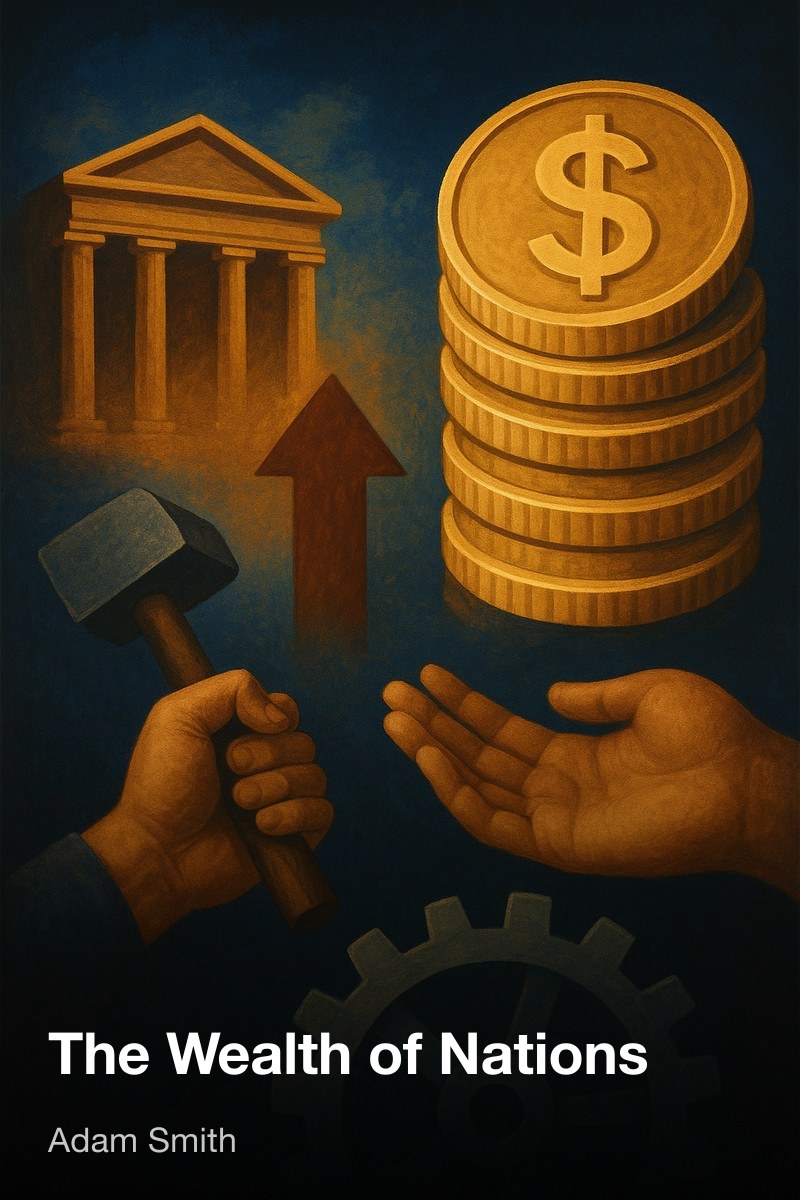
Prefer the print book? Buy on Amazon
As an Amazon Associate, Sumizeit earns from qualifying purchases.
The Wealth of Nations Book Summary
This The Wealth of Nations Book Summary covers the key ideas, lessons, and takeaways in about 20 minutes.
Helps with these goals
Want the complete 20-minute summary?
- Full structured summary
- Video Summary
- Podcast Summary
- Audio summary
- Key takeaways
- Exercises
- Quiz
- Highlights and notes
- Ask the book with AI
Want a Free Weekly Read?
Get a free summary every week straight to your mailbox.
Preview the The Wealth of Nations book summary
Below is a preview of Sumizeit’s expert-written summary of The Wealth of Nations by Adam Smith. The full summary covers the book’s key ideas in text, audio, visual, and video formats.
Adam Smith published this book in 1776, and it's basically the founding document of economics as we know it. Before Smith, nobody had really sat down and mapped out how markets work, why some countries get rich while others stay poor, or what governments should and shouldn't do about any of it. He wrote it as a Scottish philosopher, not a trained economist, because economics as a formal field didn't really exist yet. His central claim is still radical to a lot of people even now. He says the best way to grow a nation's wealth is to leave people alone to chase their own self interest in open, competitive markets, and that heavy handed government meddling usually does more harm than good.
What Wealth Actually Means
Smith opens with a definition that trips people up because it's so different from how we usually talk about money. A wealthy nation, to him, isn't one sitting on piles of gold. It's one that can actually meet the needs of its people, either by producing enough goods at home or by producing things it can trade for goods elsewhere. Poor nations fail at one or both of those. They can't make enough for their own citizens, and they don't produce anything valuable enough to trade for what they're missing. Wealth, in other words, is about production and exchange, not hoarded treasure.
Self Interest Is the Engine
The idea that ties the whole book together is that people acting selfishly, in a weird twist, end up serving everyone else. A baker doesn't bake bread because he loves you. He bakes it because he wants to make money. But to make money, he has to make bread people actually want to buy, at a price they're willing to pay, and of a quality that keeps them coming back instead of walking down the street to a competitor. So his personal greed gets channeled into producing something genuinely useful. Smith saw this as almost accidental. Nobody sat down and designed this system. It just emerges naturally once people are free to pursue their own gain in a competitive market.
This idea didn't come out of nowhere. Smith was part of a group of thinkers now known as the Scottish Enlightenment, which included people like David Hume and Smith's own teacher, Francis Hutcheson. A big theme running through that circle of thinkers was trust in ordinary common sense over abstract theorizing. Smith carried that same instinct into economics. He argued that regular people, chasing their own interests, will organize an economy better than some official trying to plan it all out from an office. Let people trust their own instincts about what to buy, sell, and produce, and the system tends to sort itself out.
Why Workers Specializing Makes Everyone Richer
One of Smith's most famous ideas is about splitting up labor into smaller, specialized tasks instead of having one person do everything from start to finish. Picture making bread the old way.
Want the complete 20-minute summary?
- Full structured summary
- Video Summary
- Podcast Summary
- Audio summary
- Key takeaways
- Exercises
- Quiz
- Highlights and notes
- Ask the book with AI
Who should read The Wealth of Nations?
The Wealth of Nations is essential for anyone seeking to understand the philosophical foundations of modern capitalism and free-market economics. It appeals to policymakers, business leaders, students of history and economics, and anyone curious about why nations succeed or fail economically. Whether you're debating trade policy, taxation, or the role of government, Smith's arguments remain the reference point for these conversations.
Why does The Wealth of Nations matter?
Published in 1776, The Wealth of Nations essentially invented economics as a discipline and continues to shape policy debates 250 years later. Smith's insights about how markets self-organize through competition, how specialization drives productivity, and where government should (and shouldn't) intervene are as relevant to modern debates about trade wars, subsidies, and regulation as they were to 18th-century Britain. Understanding Smith is understanding the intellectual DNA of the modern economy.
What are the key themes in The Wealth of Nations?
- Markets self-organize through competition without central planning
- Specialization and division of labor drive productive efficiency
- Self-interest channeled through competition serves the common good
- Government should focus narrowly on defense, justice, education, and infrastructure
- Trade restrictions and subsidies harm economic growth
- Capital naturally flows toward productive investment
- Prices reflect underlying costs and balance supply with demand
Want the complete 20-minute summary?
- Full structured summary
- Video Summary
- Podcast Summary
- Audio summary
- Key takeaways
- Exercises
- Quiz
- Highlights and notes
- Ask the book with AI
How can you apply ideas from The Wealth of Nations?
- Use specialization strategically in business to increase productivity and create room for process innovation
- Recognize that market size constraints determine how specialized roles or services can become in your industry
- Understand that competition forces quality improvement and fair pricing even without external regulation
- Evaluate government regulations and subsidies in your industry to see if they're protecting inefficiency rather than enabling growth
- Consider how information asymmetries advantage you or disadvantage you in negotiations, and work to level the playing field
- Build strategy around where capital is flowing, knowing it chases productive opportunity and avoids saturated markets
- Assess infrastructure investments and trade policies by their impact on market size and specialization potential, not just immediate protection
What common mistakes do readers make with The Wealth of Nations?
- Assuming wealthy nations are wealthy because they have valuable natural resources or gold reserves, rather than because they produce and trade efficiently
- Believing that government subsidies and protections help an industry when they actually waste capital and prevent efficient reallocation to more productive sectors
- Thinking that businesses bear the full burden of taxes rather than recognizing that much gets passed through to consumers in higher prices
- Underestimating how deeply connected trade, market size, and specialization are—closing off trade reduces specialization and shrinks the benefits for everyone involved
Sumizeit Exercises Apply what you've learned
Turn ideas from The Wealth of Nations into action with a short guided reflection: identify the biggest takeaway, connect it to your life, and commit to one step you can take in the next 24 hours.
What is the expert analysis of The Wealth of Nations?
Overview
The Wealth of Nations, authored by Adam Smith and published in 1776, stands as a monumental work that laid the intellectual foundation for modern economics. Smith, a Scottish moral philosopher rather than a formal economist, synthesized observations about human behavior, markets, and government roles into a coherent framework that has profoundly shaped economic thought and policy ever since. His work emerged from the Scottish Enlightenment, a milieu valuing reason, empirical observation, and common sense, and it remains significant for articulating the principles of free markets, specialization, and limited government intervention.
Core Thesis
At the heart of Smith’s argument is the assertion that the pursuit of individual self-interest within open and competitive markets naturally organizes economic activity in a way that benefits society as a whole. This “invisible hand” guides resources toward their most productive uses without centralized planning. Smith emphasizes that wealth is not about hoarded gold but about a nation’s capacity to produce and exchange goods efficiently. He further argues that specialization of labor, enabled by large markets, drives productivity and innovation. Government’s role, he contends, should be narrowly confined to defense, justice, education, and infrastructure—areas where markets alone fail to deliver optimal outcomes.
Strengths
- Foundational Economic Concepts: Smith’s articulation of specialization, division of labor, and market mechanisms like supply and demand remain cornerstones of economic theory and practice.
- Integration of Moral Philosophy and Economics: Drawing on his background in moral philosophy, Smith provides a nuanced understanding of human motivations, balancing self-interest with social benefit.
- Enduring Influence on Policy: His skepticism of protectionism and subsidies, along with advocacy for limited but essential government functions, continues to inform contemporary debates on trade and regulation.
- Market Dynamics and Price Theory: The concept of “natural price” and the detailed breakdown of cost components (wages, rent, capital) offer a sophisticated lens on price formation and economic equilibrium.
- Historical and Empirical Insight: Smith’s observations on how market size influences specialization and economic development anticipate later economic geography and development economics.
Critiques & Counterarguments
- Labor Theory of Value Limitations: Smith’s labor theory of value, while historically important, has been largely superseded by subjective value theories emphasizing individual preferences. Modern economics shows that price is not strictly tied to labor input but to marginal utility and scarcity.
- Oversimplification of Market Self-Regulation: The assumption that markets naturally equilibrate and efficiently allocate resources underestimates complexities like information asymmetry, externalities, and market failures, which often justify more active government intervention.
- Neglect of Power Dynamics: Smith’s framework insufficiently addresses how monopolies, monopsonies, and unequal bargaining power distort markets, sometimes requiring regulatory oversight beyond his limited government scope.
- Historical Context and Dated Examples: Some of Smith’s examples and assumptions reflect 18th-century economic structures and social norms, which may not fully translate to the complexities of modern globalized economies and technological innovation.
- Competing Economic Paradigms: Marxist critiques extend Smith’s labor theory to argue exploitation inherent in capitalism, while Keynesian economics challenges Smith’s laissez-faire stance by emphasizing the necessity of government intervention to stabilize economies during downturns.
Who Should Read This
The Wealth of Nations is essential reading for economists, historians, political scientists, and anyone interested in the intellectual origins of capitalism and market economies. It is particularly valuable for readers seeking to understand the philosophical and empirical roots of economic liberalism, the rationale behind free trade, and the enduring debates over the role of government in economic life. Scholars and policymakers will find Smith’s insights foundational, while intellectually curious readers will appreciate the rich historical context and the profound influence his ideas continue to exert on contemporary economic thought.
Frequently asked questions about the The Wealth of Nations book summary
What is The Wealth of Nations about?
The Wealth of Nations by Adam Smith, published in 1776, is the foundational text of modern economics. It explains how markets organize themselves through competition and self-interest, why specialization multiplies productivity, how prices naturally balance supply and demand, and which government functions (defense, justice, education, infrastructure) are worth public funding while most other interventions like trade restrictions and subsidies do more harm than good.
Who should read The Wealth of Nations?
Anyone interested in understanding the intellectual foundations of modern capitalism should read The Wealth of Nations. It's essential for policymakers, business leaders, economics students, and anyone engaged in debates about trade, taxation, regulation, or the role of government. Even if you disagree with Smith's conclusions, his arguments remain the reference point for most economic policy discussions.
What are the main takeaways from The Wealth of Nations?
The core insights are: free markets self-organize efficiently through competition; specialization dramatically increases productivity; self-interest in competitive markets benefits everyone; government should focus narrowly on defense, justice, education, and infrastructure; trade restrictions and subsidies harm economic growth; and capital naturally flows toward productive investment. Smith's framework—trusting markets while being wary of protectionism and limiting government to core functions—still shapes economic policy worldwide.
What is the invisible hand in The Wealth of Nations?
The invisible hand is Smith's famous concept that individuals pursuing their own self-interest end up serving the common good through market competition, even though benefiting society was never their intention. A baker seeking profit must make quality bread at fair prices to compete, so personal greed becomes channeled into producing something genuinely useful. It's the mechanism by which markets self-organize without central planning.
Why did Adam Smith think trade restrictions harm the economy?
Smith argued that trade restrictions like tariffs and embargoes backfire in three ways: they invite smuggling by creating artificial scarcity and high prices, they waste capital propping up uncompetitive domestic industries instead of letting it flow to what a country actually does best, and they shrink markets for both countries involved. Since deeper specialization depends on larger markets, blocking trade reduces specialization and slows growth for everyone.
What did Adam Smith say about government spending?
Smith believed government should spend only on what markets cannot handle well alone: national defense (modern warfare is too expensive for private citizens), justice systems (necessary for stability in wealthy societies and must be publicly funded to stay impartial), education (builds reasoning skills and social stability), and infrastructure like roads and ports (expands markets and enables deeper specialization). Beyond these, taxation for other purposes just drains capital from productive private investment.
How does The Wealth of Nations explain why some nations are rich and others poor?
Smith defines wealth as the ability to produce enough goods to meet a nation's needs or produce things valuable enough to trade for missing goods. Poor nations fail at one or both. Rich nations succeed by allowing specialization of labor, which multiplies productivity; maintaining competitive markets that drive efficiency; and enabling capital to flow toward productive investment. Coastal regions with strong trade routes develop faster because bigger markets support deeper specialization than isolated inland areas.
What is the labor theory of value in The Wealth of Nations?
Smith argued that value ultimately comes from labor—the effort required to produce something. Every price reflects layers of accumulated labor, from raw material extraction through final sale. Critics point out that labor hours don't precisely set prices (something taking twice as long doesn't sell for twice as much), and modern economics mostly shifted toward valuing things based on how much a buyer wants them. Still, defenders argue Smith meant labor is the foundational cost paid to nature, making it the root of all wealth even if it doesn't set exact prices.
About Sumizeit
Sumizeit is a profitable Scomy LLC company based in Miami, Florida. It has been helping readers learn from nonfiction books for 7 years with expert-written summaries in text, audio, podcast, and video.
Want the complete 20-minute summary?
- Full structured summary
- Video Summary
- Podcast Summary
- Audio summary
- Key takeaways
- Exercises
- Quiz
- Highlights and notes
- Ask the book with AI
Here's why readers love Sumizeit
Join thousands of learners getting smarter every day
"Great experience. Detailed summaries. Loved the gamification feature. Makes learning fun. Good customer service. I recommend Sumizeit to anyone. You'll learn a lot."
"I always felt busy but still wanting to keep up with the book discussion in my friend group. This was a great supplement to help me keep reading the books I find fun while keeping up with important books."
"I love this website. Instead of scrolling social media, I find myself learning a lot. I use it everyday. I recommend this app for anyone who is too busy and wants to get up to speed with their favorite books."
The Wealth of Nations Book Summary PDF
Looking for a The Wealth of Nations Book Summary PDF you can save and revisit offline? Our The Wealth of Nations Book Summary PDF captures the book’s core ideas in a clean, printable format — the key frameworks, takeaways, and structure without the fluff. Download the The Wealth of Nations Book Summary PDF when you want a reference you can annotate, share with your team, or review on the go. Get your The Wealth of Nations Book Summary PDF from the download page below.
Download The Wealth of Nations Book Summary PDFPeople also liked these summaries
Readers who explored The Wealth of Nations often enjoyed these titles next.


Want the complete 20-minute summary?
- Full structured summary
- Video Summary
- Podcast Summary
- Audio summary
- Key takeaways
- Exercises
- Quiz
- Highlights and notes
- Ask the book with AI
Featured Book Titles
Popular Book Summaries at sumizeit, leading book summary app