


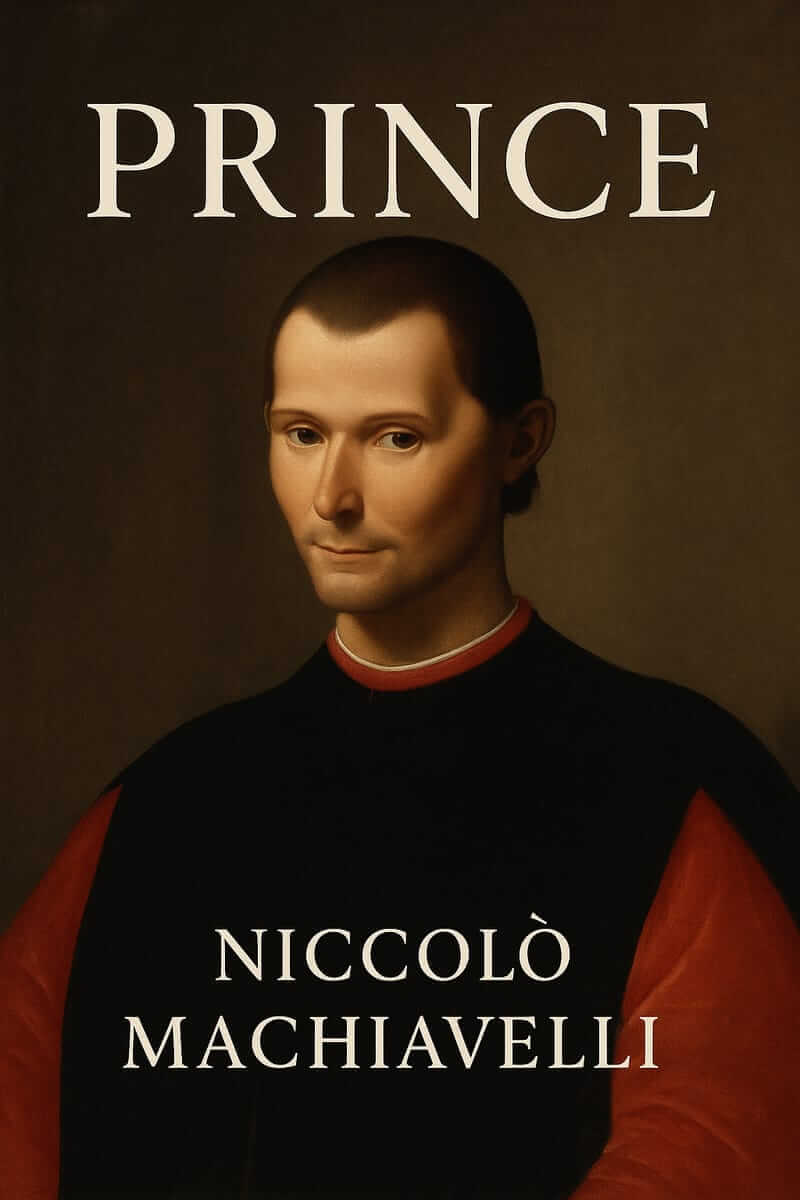
Prefer the print book? Buy on Amazon
As an Amazon Associate, Sumizeit earns from qualifying purchases.
Prince Book Summary
This Prince Book Summary covers the key ideas, lessons, and takeaways in about 20 minutes.
Helps with these goals
Want the complete 20-minute summary?
- Full structured summary
- Video Summary
- Podcast Summary
- Audio summary
- Key takeaways
- Exercises
- Quiz
- Highlights and notes
- Ask the book with AI
Not ready to upgrade?
Get this summary + 2 more picks sent to your inbox, free.
What is in the Prince book summary?
Below is a preview of Sumizeit’s expert-written summary of Prince by Niccolò Machiavelli. The full summary covers the book’s key ideas in text, audio, and video.
The Prince is a small book. You can read it in an afternoon. Yet few books have caused more arguments over the last five hundred years.
Niccolò Machiavelli wrote it in 1513, while he sat in forced retirement on his farm outside Florence. It's a handbook for rulers. It tells a prince how to grab power, how to keep it, and how to defend it from enemies inside and outside his borders. And it does this with a bluntness that still shocks people. Machiavelli says a ruler should lie when lying helps. He says cruelty, used well, is better than mercy used badly. He says it's safer to be feared than loved.
That's why his name became an insult. Call someone "Machiavellian" today and you mean they're sly, cold, and willing to do anything to win. But the book is more interesting than its reputation. Machiavelli wasn't cheering for evil. He was trying to describe politics as it actually works, not as priests and philosophers wished it worked. Once you see that, the book reads less like a villain's manual and more like a hard look at how power behaves.
Where the book came from
To get The Prince, you need to know a little about Italy in 1500. The country wasn't a country. It was a patchwork of city states, duchies, kingdoms, and lands ruled by the Pope. Florence, Venice, Milan, Naples, and the Papal States all fought and schemed against each other. Meanwhile France and Spain kept marching armies over the Alps and through the peninsula, taking whatever they wanted. Italian rulers hired mercenaries to fight for them, and the mercenaries often ran away or switched sides.
Machiavelli had a front row seat to all of this. For fourteen years he worked as a senior official in the Florentine Republic. He ran diplomatic missions to the King of France, to the Holy Roman Emperor, and to Cesare Borgia. He organized a citizen militia for Florence. Then in 1512 the Medici family came back to power with Spanish help, the republic fell, and Machiavelli lost his job. Soon after, he was accused of plotting against the Medici, jailed, and tortured. He was released but shut out of public life.
So he wrote. He dedicated The Prince to Lorenzo de' Medici, the young ruler of Florence. In the dedication he says other men offer princes horses, jewels, and gold, but he offers the only thing of value he has, which is his knowledge of how great men acted, gained from long experience and constant reading. Many readers think the book was partly a job application. Machiavelli wanted back in.
Machiavelli's big shift
Books of advice for rulers were common in Machiavelli's day. Scholars call them "mirrors for princes." Most of them said the same thing. Be pious. Be just. Be generous. Be a good Christian, and God will reward your reign.
Machiavelli breaks with all of that. He says he wants to write about the "effectual truth" of things, not…
Want the complete 20-minute summary?
- Full structured summary
- Video Summary
- Podcast Summary
- Audio summary
- Key takeaways
- Exercises
- Quiz
- Highlights and notes
- Ask the book with AI
Who should read Prince?
Prince is essential reading for leaders, strategists, and anyone interested in how power actually works. It appeals to business executives, politicians, military officers, and historians who want to understand the gap between idealistic leadership theory and real-world decision-making. Readers who question conventional wisdom about morality in leadership will find Machiavelli's unflinching analysis particularly valuable.
Why does Prince matter?
Written in 1513, Prince remains startlingly relevant because it describes power dynamics that transcend centuries and borders. In an era of political polarization, corporate scandals, and shifting global influence, Machiavelli's focus on what actually works—rather than what should work—offers crucial insights into leadership failures and successes. The book forces readers to confront uncomfortable truths about loyalty, fear, reputation, and the cost of holding power.
What are the key themes in Prince?
- Power requires understanding people as they are, not as we wish them to be
- Building your own strength beats relying on borrowed or borrowed-out resources
- Reputation and appearance matter as much as reality in maintaining power
- Fear can be more reliable than love, but hatred is always dangerous
- Fortune and skill each control roughly half of outcomes in leadership
Want the complete 20-minute summary?
- Full structured summary
- Video Summary
- Podcast Summary
- Audio summary
- Key takeaways
- Exercises
- Quiz
- Highlights and notes
- Ask the book with AI
How can you apply ideas from Prince?
- Assess whether you're leading from inherited stability or building new power—the strategies differ dramatically, with new leaders needing much stronger foundational work
- Build your own loyal team and infrastructure rather than relying on consultants, borrowed expertise, or external partners who can leave when circumstances change
- Make difficult decisions quickly and completely rather than gradually, minimizing lingering resentment from those affected
- Cultivate both competence (fox) and strength (lion) in your leadership style to handle the full range of challenges organizations face
- Track whether your team sees you as respected and decisive or as indecisive and easily influenced, since perception directly impacts followership and vulnerability to challenges
- Plan for crises during stable periods rather than reacting when disaster strikes; prepare defenses, build reserves, and strengthen relationships before emergencies demand them
- Audit your reputation regularly among stakeholders, paying attention to whether you're perceived as hated, despised, loved, or feared—each requires different corrective action
What common mistakes do readers make with Prince?
- Assuming that moral leadership and effective leadership are the same thing, leading to decisions that feel good but leave the organization vulnerable
- Relying too heavily on external allies, consultants, or borrowed resources instead of developing internal strength and loyalty
- Showing inconsistency in decisions and changing course based on the last person's advice, which destroys confidence in leadership
- Underestimating how much people value loyalty and property, focusing on dramatic measures like punishment when people actually forget deaths faster than financial loss
Sumizeit Exercises Apply what you've learned
Turn ideas from Prince into action with a short guided reflection: identify the biggest takeaway, connect it to your life, and commit to one step you can take in the next 24 hours.
What is the expert analysis of Prince?
Overview
The Prince by Niccolò Machiavelli stands as one of the most influential and controversial works in political philosophy and realpolitik. Written in 1513 during Machiavelli’s forced retirement, this concise treatise offers pragmatic advice to rulers on acquiring, maintaining, and consolidating power. Far from a mere manual for tyranny, it represents a seismic shift in political thought—eschewing idealism and moralistic prescriptions in favor of a candid, often ruthless analysis of power dynamics. Machiavelli’s firsthand experience as a diplomat and official in Renaissance Florence lends the work an empirical grounding that has ensured its enduring relevance across centuries.
Core Thesis
Machiavelli’s central argument pivots on the distinction between traditional moral virtue and what he terms virtù—a ruler’s practical skill, decisiveness, and adaptability in the face of fortune (fortuna). He rejects the notion that rulers should govern by abstract ideals of goodness or piety, asserting instead that the primary obligation of a prince is to secure and stabilize the state by whatever means necessary. This often entails deception, cruelty, and manipulation, but these are justified insofar as they preserve power and order. The book’s fundamental insight is a pragmatic reframing of politics as a domain governed by effectiveness rather than ethical purity.
Strengths
- Unflinching Realism: Machiavelli’s refusal to cloak political power in moralistic rhetoric provides a brutally honest appraisal of governance that resonates with both historical and contemporary political realities.
- Empirical Foundation: Drawing on his diplomatic experience and historical examples, Machiavelli grounds his advice in concrete cases, from Alexander the Great to Cesare Borgia, enhancing the book’s credibility.
- Timeless Concepts: The interplay of virtù and fortuna, the emphasis on perception versus reality, and the strategic use of cruelty and mercy remain foundational ideas in political science and leadership studies.
- Complex Characterization of Power: The nuanced treatment of power—not as inherently evil but as a force with its own logic—challenges simplistic binaries and invites deeper reflection on the ethics of leadership.
- Influence and Legacy: The Prince’s impact on political theory, statecraft, and even modern management underscores its significance as a foundational text in understanding authority and strategy.
Critiques & Counterarguments
- Ethical Oversimplification: While Machiavelli’s pragmatic detachment from morality is groundbreaking, it risks endorsing a cynical worldview that may justify tyranny and abuse under the guise of necessity.
- Historical Context Limitations: The book’s advice is deeply rooted in the volatile, fragmented Italian city-states of the Renaissance. Some prescriptions, such as reliance on citizen militias or the dismissal of mercenaries, may not translate directly to modern, complex states.
- Alternative Political Theories: Schools of thought advocating liberal democracy, rule of law, or ethical leadership challenge Machiavelli’s prioritization of power retention over justice, highlighting the long-term dangers of despotic rule.
- Questionable Examples: The elevation of figures like Cesare Borgia and Agathocles as exemplars of effective rule is contentious, as their methods and legacies often involved brutality and instability, undermining claims of sustainable leadership.
- Role of Fortune Underestimated: Some modern political scientists argue that Machiavelli underplays structural and systemic factors—economic, social, institutional—that constrain individual agency, thus oversimplifying the balance between luck and skill.
Who Should Read This
The Prince is essential reading for scholars and practitioners of political science, leadership, and history who seek a foundational understanding of power’s mechanics beyond idealistic frameworks. It appeals to those interested in the intersection of ethics and pragmatism, as well as readers willing to confront uncomfortable truths about human nature and governance. Business leaders, strategists, and students of psychology may also find Machiavelli’s insights into perception, influence, and decision-making invaluable. However, readers should approach the text critically, aware of its historical context and the ethical debates it continues to provoke.
Frequently asked questions about the Prince book summary
What is Prince about?
Prince by Niccolò Machiavelli is a handbook on how to acquire, maintain, and defend political power. Written in 1513, it abandons idealistic advice about virtuous leadership and instead analyzes how power actually works, covering topics from military strategy to managing reputation. Machiavelli argues that effective rulers must understand people as they are, build their own strength, and be willing to use deception and force when necessary.
Who should read Prince?
Anyone in a leadership position—whether in politics, business, military, or nonprofit work—will find value in Prince's unflinching analysis of power dynamics. Historians, strategists, and students of human nature will also benefit from Machiavelli's insights into motivation, loyalty, and decision-making under pressure. Readers seeking to understand why idealistic leadership principles often fail in practice should read this book.
What are the main takeaways from Prince?
Prince teaches that effective leadership requires understanding people as they are rather than as we wish them to be, building your own strength instead of borrowing others', and maintaining both reputation and actual capability. Key insights include: fear is more reliable than love (but hatred is dangerous), appearance matters as much as reality, cruelty must be swift and complete, and roughly half of success comes from skill while half comes from fortune. Machiavelli emphasizes that good intentions don't protect power; clear sight and decisive action do.
Is Prince a book about tyranny and evil leadership?
Machiavelli's book is often misread as a manual for tyranny, but he wasn't endorsing wickedness—he was describing how power actually operates. He distinguished between cruelty used well (swift, complete, followed by benefits) and cruelty used badly (gradual, ongoing). His core insight is that leaders must sometimes choose between competing bad options, not between good and evil, and that understanding these tradeoffs is essential to protecting a state and its people.
Why does Machiavelli say fear is better than love?
Machiavelli argues that fear is more reliable than love because people break promises of loyalty when it serves them, but dread of punishment never fails. His pessimistic view of human nature—that most people are ungrateful, fickle, and greedy—leads him to conclude that love depends on fragile chains of obligation while fear depends on consequences. However, he warns that fear must never tip into hatred, which destroys all control and invites rebellion.
What does Machiavelli mean by virtù?
Virtù doesn't mean moral virtue; it refers to a ruler's skill, boldness, nerve, and ability to judge situations and act decisively. It's closer to grit, courage, or keen judgment under pressure. Machiavelli contrasts virtù with fortuna (luck and circumstance), arguing that the best rulers possess high virtù but also prepare during calm times so they can resist when fortune turns against them.
How relevant is The Prince to modern leadership today?
Prince remains remarkably relevant because it describes power dynamics that transcend centuries: how loyalty forms and breaks, why reputation matters as much as results, how organizations fail when leaders fail to build internal strength, and why good intentions often fail against calculated opponents. Modern readers find Machiavelli's insights applicable to corporate governance, political strategy, and any situation where leaders must navigate conflicting interests and limited resources.
About Sumizeit
Sumizeit is a profitable Scomy LLC company based in Miami, Florida. It has been helping readers learn from nonfiction books for 7 years with expert-written summaries in text, audio, podcast, and video.
Want the complete 20-minute summary?
- Full structured summary
- Video Summary
- Podcast Summary
- Audio summary
- Key takeaways
- Exercises
- Quiz
- Highlights and notes
- Ask the book with AI
Here's why readers love Sumizeit
Join thousands of learners getting smarter every day
"Great experience. Detailed summaries. Loved the gamification feature. Makes learning fun. Good customer service. I recommend Sumizeit to anyone. You'll learn a lot."
"I always felt busy but still wanting to keep up with the book discussion in my friend group. This was a great supplement to help me keep reading the books I find fun while keeping up with important books."
"I love this website. Instead of scrolling social media, I find myself learning a lot. I use it everyday. I recommend this app for anyone who is too busy and wants to get up to speed with their favorite books."
Prince Book Summary PDF
Looking for a Prince Book Summary PDF you can save and revisit offline? Our Prince Book Summary PDF captures the book’s core ideas in a clean, printable format — the key frameworks, takeaways, and structure without the fluff. Download the Prince Book Summary PDF when you want a reference you can annotate, share with your team, or review on the go. Get your Prince Book Summary PDF from the download page below.
Download Prince Book Summary PDFPeople also liked these summaries
Readers who explored Prince often enjoyed these titles next.


Want the complete 20-minute summary?
- Full structured summary
- Video Summary
- Podcast Summary
- Audio summary
- Key takeaways
- Exercises
- Quiz
- Highlights and notes
- Ask the book with AI
Featured Book Titles
Popular Book Summaries at sumizeit, leading book summary app