


As an Amazon Associate, Sumizeit earns from qualifying purchases.
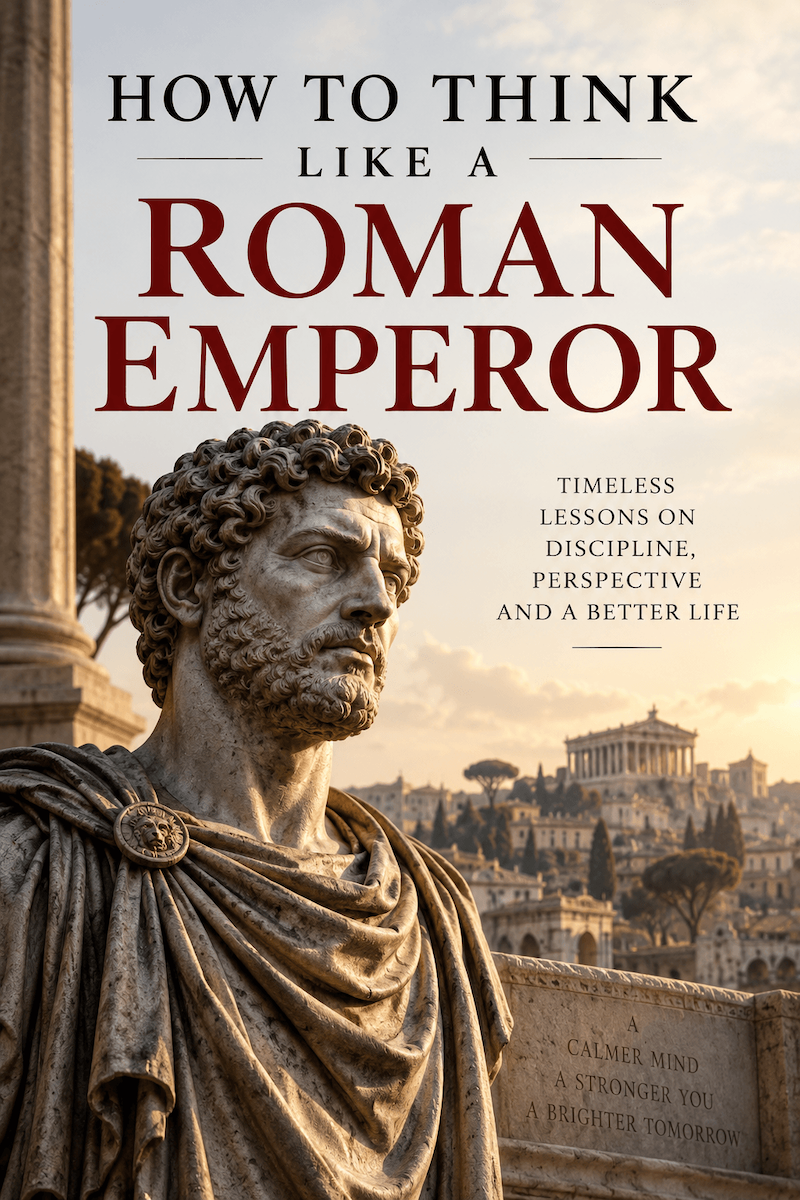
How to Think Like a Roman Emperor Book Summary
This How to Think Like a Roman Emperor Book Summary covers the key ideas, lessons, and takeaways in about 20 minutes.
Want the complete 20-minute summary?
- Full structured summary
- Video Summary
- Podcast Summary
- Audio summary
- Key takeaways
- Exercises
- Quiz
- Highlights and notes
- Ask the book with AI
What is in the How to Think Like a Roman Emperor book summary?
Below is a preview of Sumizeit’s expert-written summary of How to Think Like a Roman Emperor by Donald Robertson. The full summary covers the book’s key ideas in text, audio, and video.
Marcus Aurelius came into the world on April 26, in the year 121 CE, born into a family that already sat close to the center of Roman power. His grandfather was tight with Emperor Hadrian. His great aunt was Empress Sabina. That kind of pedigree usually points a boy toward one thing, a life of privilege, but Marcus took a different path almost from the start.
His father died when Marcus was still a small child, and that loss shaped him more than any title ever would. His mother and his paternal grandfather stepped in and raised him on a steady diet of honesty and plain decency. Hadrian noticed the boy early too. He pulled him into the equestrian order and got him a spot in the College of the Salii, a priestly group tied to the war god Mars, while Marcus was still young enough that none of it was his own doing.
But the person who really bent the direction of his life was a tutor named Diognetus. He pulled Marcus away from the usual noise that occupied wealthy Roman boys and pointed him toward philosophy and ethics instead. Diognetus also introduced him to the Cynics, a rougher, more austere school of thought that valued simplicity over comfort. Marcus took to it. He started wearing a rough philosopher's cloak and grew out his beard, the visual shorthand for someone chasing wisdom rather than status. You can still see that look on statues of him today, and it wasn't an accident or a costume. It reflected something real he was working through as a teenager.
Even the personal losses piled up early. Multiple people close to him died while he was still young, and that steady drumbeat of grief pushed him toward Stoicism rather than away from it. A philosophy built around accepting what you cannot change tends to make more sense to someone who has already lost things he couldn't get back. Robertson treats this early exposure to death and loss as one of the real engines behind Marcus's lifelong seriousness, the sense that he was never quite a carefree kid even when he technically had every reason to be one.
Adopted into the job before he wanted it
Marcus didn't choose to become emperor. Hadrian adopted him early, then arranged for Antoninus Pius to adopt him as well, effectively placing him in line for the throne while he was still a young man. Most people in that position would have leaned into the luxury that came with it. Marcus went the other way. Being pulled into the imperial household actually pushed him further into Stoicism rather than away from it, because he seems to have understood, even then, that power without some kind of internal anchor was a dangerous thing to hold.
His teachers reinforced that instinct. A Stoic tutor named Apollonius of Chalcedon introduced him to the writings of Epictetus, a former slave turned philosopher whose blunt, practical approach to Stoicism became the backbone of how…
Want the complete 20-minute summary?
- Full structured summary
- Video Summary
- Podcast Summary
- Audio summary
- Key takeaways
- Exercises
- Quiz
- Highlights and notes
- Ask the book with AI
Who should read How to Think Like a Roman Emperor?
This book is for anyone struggling with stress, anxiety, or the pressure of circumstances beyond their control. Whether you're a leader facing difficult decisions, someone navigating personal loss, or simply looking for practical mental strategies to build resilience, Marcus Aurelius's approach offers timeless tools that apply to modern life.
Why does How to Think Like a Roman Emperor matter?
In an era of constant crisis and information overload, learning how to separate your thoughts from events—and how to focus your energy only on what you can control—has never been more relevant. Donald Robertson shows that ancient Stoicism isn't abstract philosophy but a practical system for maintaining integrity and composure under extreme pressure, something we all face in different ways today.
What are the key themes in How to Think Like a Roman Emperor?
- The distinction between what you control and what you don't
- Building emotional resilience through mental preparation
- Living with integrity regardless of outcomes
- Finding peace through accepting mortality and impermanence
- The power of plain language to defuse emotional reactions
- Character development through daily practice, not theory
What are the key lessons from the How to Think Like a Roman Emperor book summary?
The Event Is Not the Problem; Your Judgment Is
What damages you emotionally isn't what happens, but the story you tell yourself about it. By pausing between an event and your reaction to it, you gain the freedom to choose a better response.
Use Neutral Language to Disarm Emotion
Describing setbacks in flat, factual terms rather than dramatic language prevents your mind from spiraling. Saying 'the object was lost' instead of 'I've been robbed' starves emotional reactions of fuel.
Rehearse Adversity Before It Arrives
Mentally preparing for potential setbacks, losses, and failures drains their shock value in advance. When real trouble comes, part of the emotional work is already done.
Face Your Fears Through Gradual Exposure
Anxiety doesn't dissolve through avoidance; it weakens through repeated, deliberate exposure. Each time you face what scares you, your nervous system learns it's less of an emergency.
Intentions and Effort Are Yours; Results Usually Aren't
Direct your energy toward acting with integrity and sound judgment, then release attachment to outcomes. Success lies in doing the right thing for the right reason, regardless of what follows.
Build an Inner Citadel of Unshakeable Calm
Develop a private mental space you can retreat into no matter what chaos surrounds you physically. This refuge becomes your anchor during the most difficult external circumstances.
Zoom Out to Reduce a Crisis's Grip
Imagining events from a bird's-eye view reveals how small individual crises are against the vast scale of time and the universe. Perspective transforms what feels overwhelming into something manageable.
Make Friends with Your Own Mortality
Accepting that death is certain and not far off clarifies how you should use your time. Once you genuinely make peace with mortality, smaller fears lose their power.
Appreciate Fully While Holding Loosely
Enjoy the good things in your life deeply while accepting they were never guaranteed to last. Real gratitude combines appreciation with acceptance of impermanence.
Learn Through Example, Not Just Theory
Watching someone you respect actually live out philosophical principles makes them feel achievable rather than abstract. Living examples teach more than books alone ever can.
Betrayal Cannot Damage Your Character Unless You Let It
Someone else behaving badly only affects your integrity if you allow it to change how you behave in return. Your character remains entirely your own responsibility.
Substance Matters More Than Style
Focus on ideas and actions that actually help you live better rather than on impressive rhetoric or appearance. Truth and utility should guide your thinking, not eloquence.
Philosophy Is a Way of Acting, Not Just Thinking
Real philosophical growth comes through daily practice and ethical conduct, not through clever debate or intellectual understanding alone. The point is to live better, not to sound smarter.
Understand Your Opponent's Reasoning
When facing betrayal or conflict, try to understand how the other person justifies their actions rather than simply hating them. This approach builds wisdom and often inspires loyalty.
Show Up Steadily, Day After Day
Character isn't built in moments of inspiration but through consistent, unglamorous effort over years. Marcus's private journals reveal him arguing himself into better behavior repeatedly, never assuming he'd arrived.
Want the complete 20-minute summary?
- Full structured summary
- Video Summary
- Podcast Summary
- Audio summary
- Key takeaways
- Exercises
- Quiz
- Highlights and notes
- Ask the book with AI
How can you apply ideas from How to Think Like a Roman Emperor?
- When facing a difficult situation, pause and describe what happened in plain, neutral language before reacting emotionally
- Spend quiet time imagining potential setbacks, losses, and insults so your mind can prepare responses in advance
- Deliberately practice small fears and discomforts to build your tolerance and reduce anxiety over time
- Before making an important decision, clarify what's actually in your control and where your responsibility ends
- During high-stress periods, mentally step back and view your problems from a broader perspective to regain clarity
- Keep a private journal where you remind yourself daily of your core values and the principles you want to live by
- When someone wrongs you, practice understanding their reasoning rather than dwelling on anger or revenge
What common mistakes do readers make with How to Think Like a Roman Emperor?
- Assuming Stoicism means becoming emotionless or not caring about outcomes—it actually means channeling emotions productively and working hard while accepting what you cannot control
- Treating philosophy as intellectual entertainment rather than a practical system for changing how you actually behave and respond to difficulty
- Focusing only on negative visualization without also practicing gratitude for what's currently good in your life
- Giving up your emotional responsibility by claiming things are 'not in your control' when your attitude and effort actually are
Sumizeit Exercises Apply what you've learned
Turn ideas from How to Think Like a Roman Emperor into action with a short guided reflection: identify the biggest takeaway, connect it to your life, and commit to one step you can take in the next 24 hours.
What is the expert analysis of How to Think Like a Roman Emperor?
Overview
How to Think Like a Roman Emperor by Donald Robertson is a compelling fusion of biography, philosophy, and practical psychology that resurrects the life and teachings of Marcus Aurelius, arguably the most philosophically inclined Roman emperor. Robertson, a psychotherapist and leading figure in the modern Stoicism movement, leverages his expertise in cognitive behavioral therapy and ancient philosophy to illuminate how Stoic principles can serve as enduring tools for resilience and ethical living. This book stands out for its dual commitment to historical narrative and actionable wisdom, making it significant not only as a scholarly account of Marcus Aurelius’s life but also as a manual for contemporary readers seeking mental clarity and emotional stability.
Core Thesis
At its core, the book argues that while external circumstances are largely beyond our control, the interpretation and response to those circumstances lie firmly within our power. Marcus Aurelius’s life, marked by personal loss, political upheaval, and relentless adversity, exemplifies how Stoicism offers a practical framework for cultivating inner strength, ethical integrity, and tranquility. Robertson contends that Stoicism is not an abstract or emotionless doctrine but a lived philosophy—an ongoing, deliberate practice of mental discipline that enables one to maintain composure and moral character amid life’s inevitable hardships.
Strengths
- Integration of Biography and Philosophy: Robertson skillfully weaves Marcus Aurelius’s personal history with Stoic teachings, grounding abstract concepts in vivid historical context that enhances their relevance and accessibility.
- Psychological Insight: The author’s background in psychotherapy enriches the exposition of Stoic techniques such as cognitive distancing, premeditation of adversity, and emotional regulation, linking ancient wisdom to modern cognitive behavioral therapy.
- Practical Application: The book excels in translating Stoic philosophy into concrete mental exercises and attitudes, such as reframing events in neutral language and distinguishing between what is and isn’t within one’s control, making it a valuable resource for self-improvement.
- Nuanced Portrayal of Marcus Aurelius: Rather than mythologizing the emperor, Robertson presents him as a fallible human being engaged in a continuous struggle to embody Stoic ideals, thereby humanizing a historical figure often rendered as a stoic archetype.
- Emphasis on Ethical Living: The book foregrounds ethics as the heart of Stoicism, emphasizing character development over rhetorical flourish or political power, which deepens the philosophical rigor of the narrative.
Critiques & Counterarguments
- Selective Historical Interpretation: Robertson’s portrayal of Marcus Aurelius as a near-ideal Stoic may underplay the complexities and contradictions inherent in his reign, including the brutal realities of imperial power and the limitations of Stoic philosophy in addressing systemic injustice.
- Potential Oversimplification of Stoicism: The book’s focus on practical techniques risks reducing Stoicism to a set of cognitive tools, potentially neglecting its broader metaphysical and cosmological dimensions that some scholars argue are essential to its full understanding.
- Modern Psychological Framing: While the integration with cognitive behavioral therapy is illuminating, it may also impose contemporary psychological frameworks onto ancient texts, which could distort or narrow the original philosophical intentions.
- Competing Philosophical Schools: Stoicism’s emphasis on emotional detachment and acceptance contrasts sharply with other traditions such as Epicureanism, which values pleasure as the highest good, or existentialism, which foregrounds individual freedom and angst—perspectives that challenge the Stoic ideal of equanimity.
- Real-World Limitations: The Stoic ideal of controlling one’s internal state in the face of external chaos may be psychologically demanding or inaccessible for individuals facing severe trauma, systemic oppression, or mental illness, raising questions about the universality of its prescriptions.
Who Should Read This
This book is ideally suited for readers who appreciate a sophisticated blend of history, philosophy, and psychology, particularly those interested in Stoicism as a living tradition rather than a purely academic subject. It will resonate with individuals seeking practical strategies for emotional resilience, ethical self-improvement, and mental discipline—such as professionals in high-stress environments, students of philosophy and psychology, and anyone grappling with adversity. Additionally, readers fascinated by Roman history and the personal struggles of historical figures will find Robertson’s narrative both enlightening and inspiring. However, those looking for a purely historical biography or a comprehensive philosophical treatise may find the book’s practical orientation somewhat limiting.
Frequently asked questions about the How to Think Like a Roman Emperor book summary
What is How to Think Like a Roman Emperor about?
How to Think Like a Roman Emperor is Donald Robertson's exploration of Marcus Aurelius's life and the Stoic philosophy that guided him through plague, war, betrayal, and the crushing weight of ruling an empire. Robertson shows how Marcus developed practical mental techniques—like separating events from your judgment of them, rehearsing adversity, and focusing only on what you can control—that allowed him to maintain integrity and composure under extreme pressure. The book presents these ancient strategies as a working system for modern emotional resilience.
Who should read How to Think Like a Roman Emperor?
Anyone dealing with stress, loss, difficult circumstances, or the pressure of making high-stakes decisions will find value here. Leaders, caregivers, people navigating chronic illness or grief, and anyone seeking practical tools for emotional stability benefit most from this book. You don't need to be interested in ancient Rome or philosophy—the appeal is purely practical, offering real techniques you can use starting today.
What are the main takeaways from How to Think Like a Roman Emperor?
The central insight is that you cannot control most external events, but you have remarkable control over how you interpret them and respond to them—and that gap is where character gets built. Key practical takeaways include: pause between an event and your reaction to create choice, use neutral language to defuse emotional spiraling, rehearse adversity mentally so real setbacks land with less shock, focus your effort only on what's actually yours to control, and zoom out perspective when problems feel overwhelming. Together, these techniques provide a working system for staying steady and decent when circumstances try to knock you off balance.
How does this book connect Stoicism to modern psychology?
Donald Robertson, a psychotherapist as well as a historian, shows how ancient Stoic techniques closely parallel modern cognitive behavioral therapy. Both systems focus on the gap between an event and your interpretation of it, both emphasize changing thought patterns to improve emotional outcomes, and both treat mental resilience as a skill you build through practice rather than something you either have or don't. This connection makes the ancient philosophy feel immediately relevant and scientifically grounded rather than dusty or theoretical.
Did Marcus Aurelius actually practice these techniques in real situations?
Yes—Robertson draws heavily on Marcus's private journal, later titled Meditations, which shows him repeatedly reminding himself of Stoic principles and working through emotional challenges. The book also documents real historical events like the revolt of his general Avidius Cassius and the devastating Antonine Plague, showing how Marcus applied these mental tools when facing actual betrayal, disease, military defeat, and the loss of people he loved. His steady composure under these circumstances suggests the techniques worked in practice, not just in theory.
Is this book pessimistic or negative?
No—while Stoics do practice imagining adversity and accepting mortality, the goal is liberation, not gloom. By accepting that bad things happen and that death is inevitable, Stoics become free from the constant anxiety of trying to prevent the impossible. Robertson shows that this acceptance actually enables Marcus to appreciate his life more deeply, to love the people and things he valued while holding them lightly, and to face each day with a clarity that worry-focused thinking never achieves. The philosophy leads to calm and steady contentment, not depression.
Can these ancient strategies actually work for modern problems?
Robertson argues—and provides evidence—that they do. The core human challenge of managing emotion, maintaining integrity under pressure, and finding peace despite uncertainty hasn't changed in two thousand years. The specific problems (social media, email, modern jobs) are different, but the underlying mental patterns you struggle with are the same ones Marcus faced. The techniques translate directly because they address the fundamental gap between events and how you choose to interpret them, which is universal.
About Sumizeit
Sumizeit is a profitable Scomy LLC company based in Miami, Florida. It has been helping readers learn from nonfiction books for 7 years with expert-written summaries in text, audio, podcast, and video.
Want the complete 20-minute summary?
- Full structured summary
- Video Summary
- Podcast Summary
- Audio summary
- Key takeaways
- Exercises
- Quiz
- Highlights and notes
- Ask the book with AI
Here's why readers love Sumizeit
Join thousands of learners getting smarter every day
"Great experience. Detailed summaries. Loved the gamification feature. Makes learning fun. Good customer service. I recommend Sumizeit to anyone. You'll learn a lot."
"I always felt busy but still wanting to keep up with the book discussion in my friend group. This was a great supplement to help me keep reading the books I find fun while keeping up with important books."
"I love this website. Instead of scrolling social media, I find myself learning a lot. I use it everyday. I recommend this app for anyone who is too busy and wants to get up to speed with their favorite books."
How to Think Like a Roman Emperor Book Summary PDF
Looking for a How to Think Like a Roman Emperor Book Summary PDF you can save and revisit offline? Our How to Think Like a Roman Emperor Book Summary PDF captures the book’s core ideas in a clean, printable format — the key frameworks, takeaways, and structure without the fluff. Download the How to Think Like a Roman Emperor Book Summary PDF when you want a reference you can annotate, share with your team, or review on the go. Get your How to Think Like a Roman Emperor Book Summary PDF from the download page below.
Download How to Think Like a Roman Emperor Book Summary PDFPeople also liked these summaries
Readers who explored How to Think Like a Roman Emperor often enjoyed these titles next.



Want the complete 20-minute summary?
- Full structured summary
- Video Summary
- Podcast Summary
- Audio summary
- Key takeaways
- Exercises
- Quiz
- Highlights and notes
- Ask the book with AI
Featured Book Titles
Popular Book Summaries at sumizeit, leading book summary app
