


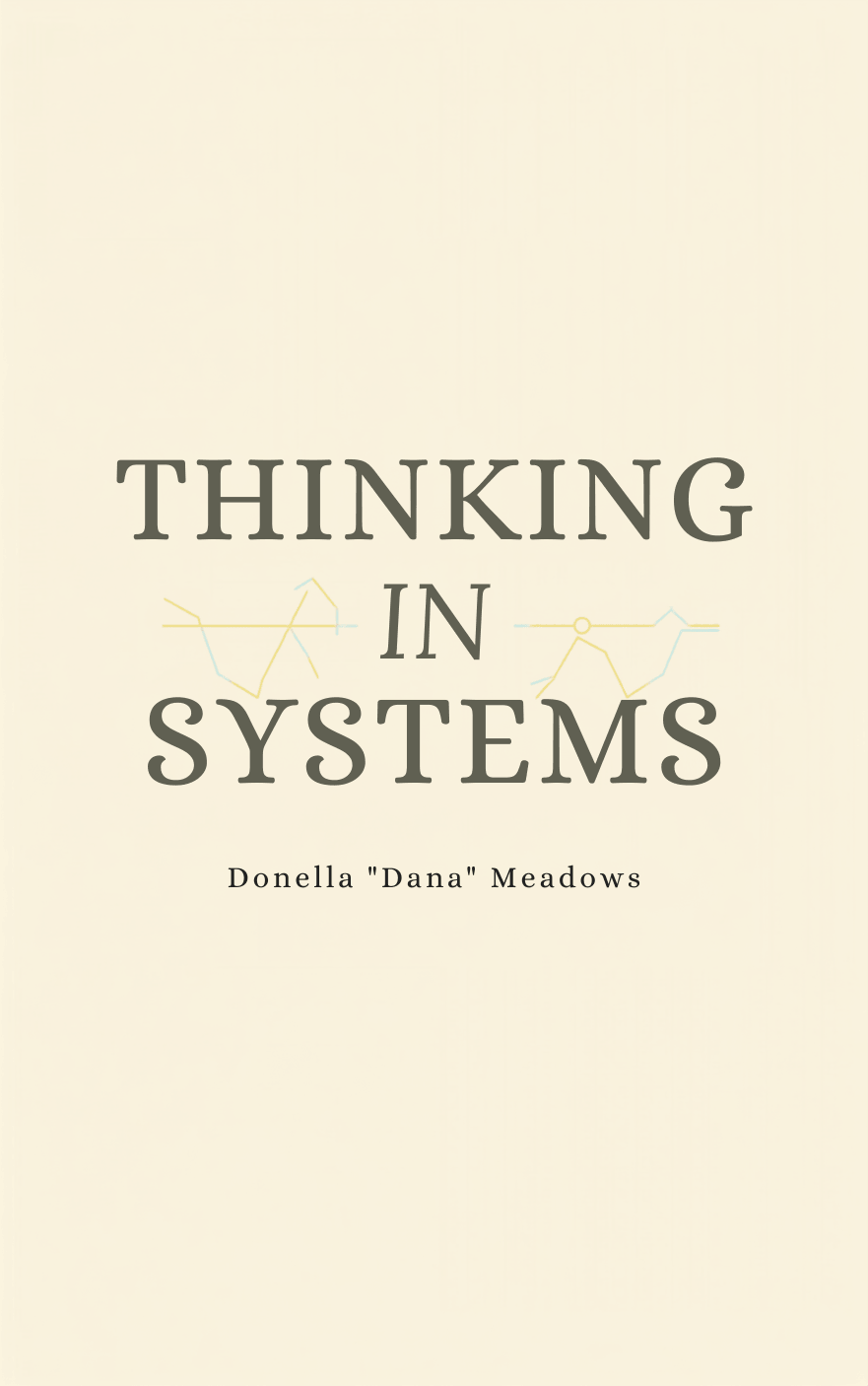
Prefer the print book? Buy on Amazon
As an Amazon Associate, Sumizeit earns from qualifying purchases.
Thinking in Systems Book Summary
This Thinking in Systems Book Summary covers the key ideas, lessons, and takeaways in about 20 minutes.
Short Description:
Learn to see stocks, loops, and leverage points that shape complex systems.
Want a Free Weekly Read?
Get a free summary every week straight to your mailbox.
Preview the Thinking in Systems book summary
Below is a preview of Sumizeit’s comprehensive human-written summary of Thinking in Systems by Donella "Dana" Meadows. The full summary is 15-20 minutes long and covers the book’s key ideas in text, audio, visual, and video formats. Unlock the full 20 Minute Summary
Most of us explain the world through straight lines: something happens, and we hunt for the single cause behind it. Oil prices climb, so we point fingers at greedy energy companies. We catch a cold, so we blame the virus. Someone struggles with substance dependence, so we fault their willpower. Donella Meadows argues that this instinct, while comforting, is fundamentally misleading. The world is not built from isolated cause-and-effect pairs. It is built from systems — webs of interacting parts whose collective structure generates the outcomes we observe. A system, in her framing, is any collection of components that interact with one another to generate a recognizable pattern of behavior. Your liver is a system of cells cooperating to filter your blood. A sports franchise is a system of athletes, coaches, staff, and supporters bound together by rules and shared objectives. A corporation is a system of people, equipment, and knowledge organized around commercial goals, and that corporation is itself nested inside the still-larger system of the economy. The crucial insight is that superficially unrelated systems can behave identically when their underlying architecture matches. A bathtub filling and draining follows the same logic as the planet's population growing through births and shrinking through deaths. Once you can recognize the skeleton beneath the surface, you gain predictive power over wildly different domains — and, more importantly, you gain the ability to change them. Meadows insists that interventions designed without understanding the underlying structure frequently backfire, sometimes making the original problem dramatically worse. Genuine change requires reshaping the system itself: its connections, its incentives, and its goals.
The Three Ingredients of Any System
Every system, no matter how vast or humble, contains three components. First come the elements — the visible pieces. For a professional sports team, these are the athletes, the coaching staff, the ball, and the field. Second come the interconnections — the relationships binding the elements together. Some connections are physical, like players passing to one another or positioning themselves against opponents. Many are informational: a coach reading the state of the game and relaying tactics, a broadcaster transmitting the match to millions, an agent whispering to a player about openings elsewhere. Information channels are easy to overlook, yet they often determine how the whole operates. Third comes purpose — what the system actually accomplishes. Purpose deserves special care, because it is the hardest ingredient to spot and the easiest to misjudge. Meadows offers a deceptively simple diagnostic: ignore what a system claims about itself and watch what it does. A government may announce its dedication to lifting people out of poverty, but if its actions never move in that direction, poverty reduction is not truly among its functions. A tree never declares its intentions, yet its behavior reveals them clearly — grow, reproduce, outcompete neighbors for light and water. And nearly every enduring system shares one quiet, universal aim: keeping itself alive. Which ingredient matters most?
Want the complete 20-minute summary?
- Full structured summary
- Video Summary
- Podcast Summary
- Audio summary
- Key takeaways
- Exercises
- Quiz
- Highlights and notes
- Ask the book with AI
Who should read Thinking in Systems?
Thinking in Systems is essential for anyone frustrated by why major problems persist despite good intentions—policymakers, business leaders, educators, activists, and informed citizens seeking deeper understanding. If you've watched interventions backfire or wondered why blaming individuals never solves systemic failures, this book rewires how you see the world.
Why does Thinking in Systems matter?
In an era of interconnected crises—climate change, inequality, pandemic response, financial instability—linear cause-and-effect thinking fails catastrophically. Donella Meadows' framework reveals why most interventions miss the mark and shows where real leverage lies, making systems thinking as essential as literacy for anyone seeking to create lasting change.
What are the key themes in Thinking in Systems?
- Systems are defined by structure, not components
- Feedback loops drive persistent behavior patterns
- Delays and lags create oscillation and surprises
- Growth collides with resource limits
- Interventions backfire when they ignore underlying structure
- Information flow and goals matter more than individual effort
- Paradigms shape what we can see and do
How can you apply ideas from Thinking in Systems?
- Map the feedback loops in your organization's recurring problems to identify whether you're addressing root structure or just symptoms
- Audit your intervention for unintended consequences by tracing how it affects multiple stocks, flows, and feedback loops across the system
- Strengthen information feedback between decision-makers and consequences—let leaders see the impact of their choices in real time
- Redesign incentive structures and rules rather than replacing personnel, since the same system structure produces the same behavior regardless of who fills the roles
- Identify the binding constraint in a system and focus resources there rather than investing in areas already at capacity
- Test whether a goal truly matters by checking whether the system's actual behavior aligns with its stated purpose
- Build redundancy and local problem-solving capacity into your supply chain, team, or organization to increase resilience against shocks
- Diagram the stocks, flows, delays, and goals in a system on paper, invite critics to attack your model, and redraw based on feedback
What common mistakes do readers make with Thinking in Systems?
- Fixating on events and news cycles instead of studying the underlying system behavior that generates them repeatedly
- Assuming linear relationships and simple cause-and-effect when real systems often exhibit nonlinear thresholds and delayed reactions
- Blaming individuals and replacing personnel instead of recognizing that the same system structure produces identical behavior in new occupants
- Tightening rules and enforcement to combat cheating when the better fix is redesigning the rule to anticipate and prevent the evasion
- Intervening at weak leverage points (budgets, parameters) while ignoring stronger ones (information flows, goals, paradigms) that actually move the system
Sumizeit Exercises Apply what you've learned
Turn ideas from Thinking in Systems into action with a short guided reflection: identify the biggest takeaway, connect it to your life, and commit to one step you can take in the next 24 hours.
What is the expert analysis of Thinking in Systems?
Overview
Thinking in Systems is a seminal work by Donella "Dana" Meadows, a distinguished environmental scientist and systems analyst renowned for her pioneering contributions to sustainability and complex systems theory. Published posthumously in 2008, this book distills decades of Meadows’ expertise into a lucid and accessible primer on systems thinking. Its significance lies in offering a transformative lens for understanding the interconnected and dynamic nature of real-world problems, ranging from environmental crises to organizational dysfunctions. Meadows’ unique blend of scientific rigor and humanistic insight makes this text a foundational resource for scholars and practitioners across disciplines.
Core Thesis
Meadows argues that the conventional linear cause-and-effect mindset is inadequate for grappling with the complexity of the world. Instead, she posits that all phenomena emerge from systems—interrelated components whose structure and feedback loops generate persistent behaviors and outcomes. The central insight is that understanding and intervening effectively in these systems requires recognizing their architecture—stocks, flows, feedback loops, delays, and goals—rather than focusing on isolated events or actors. Lasting change, therefore, demands interventions at deep leverage points such as information flows, rules, goals, and paradigms, rather than superficial parameter adjustments.
Strengths
- Clarity and Accessibility: Meadows masterfully translates complex systems theory into clear, relatable language without sacrificing intellectual depth, making the book approachable for both novices and experts.
- Comprehensive Framework: The book offers a robust conceptual toolkit—stocks and flows, feedback loops, system traps, and leverage points—that equips readers to analyze a vast array of systems in ecology, economics, organizations, and society.
- Practical Wisdom: Beyond theory, Meadows provides actionable guidance on how to observe, model, and intervene in systems thoughtfully, emphasizing humility, patience, and adaptability.
- Interdisciplinary Reach: The text draws on biology, economics, psychology, and environmental science, illustrating the universality of systems principles and fostering integrative thinking.
- Ethical and Humanistic Grounding: Meadows consistently underscores the moral dimension of systems thinking, advocating for transparency, shared goals, and respect for complexity as acts of care for communities and the planet.
Critiques & Counterarguments
- Abstractness and Generality: While the book’s broad conceptual framework is a strength, it can also be a limitation. Some readers may find the models and archetypes too abstract or simplified to capture the full nuance of specific, context-dependent systems, particularly in social and political domains.
- Limited Empirical Validation: Meadows’ insights are largely drawn from qualitative reasoning and illustrative examples rather than systematic empirical studies. This can invite skepticism from those demanding rigorous quantitative validation or predictive precision.
- Potential Overemphasis on Structure: The focus on system architecture might underplay the role of agency, power dynamics, and historical contingencies that shape how systems evolve and respond to interventions, a critique often raised by critical social theorists.
- Competing Paradigms: Alternative frameworks—such as complexity science emphasizing emergence and nonlinearity, or institutional economics focusing on governance and incentives—offer complementary or competing explanations that sometimes challenge Meadows’ more mechanistic metaphors.
- Challenges in Implementation: The book’s call to intervene at deep leverage points like paradigms and goals is intellectually compelling but practically daunting. Real-world systems are often resistant to such fundamental change, constrained by entrenched interests and cognitive biases.
Who Should Read This
Thinking in Systems is essential reading for anyone seeking a profound understanding of complexity and change. Ideal audiences include:
- Environmental scientists and sustainability practitioners grappling with ecological limits and resilience.
- Policy makers and organizational leaders aiming to design more adaptive, effective interventions.
- Social scientists and economists interested in systemic causes of persistent social problems.
- Educators and students across disciplines who wish to cultivate integrative, critical thinking skills.
- Philosophers and psychologists exploring the interplay between cognition, behavior, and systemic structures.
- General readers committed to deepening their understanding of how interconnected systems shape the world and how to engage with complexity responsibly.
Frequently asked questions about the Thinking in Systems book summary
What is Thinking in Systems about?
Thinking in Systems, by Donella Meadows, is a guide to understanding how complex systems work—from ecosystems to economies to organizations. Rather than hunting for single causes, Meadows teaches readers to recognize the underlying structures of stocks, flows, feedback loops, delays, and goals that generate the behavior we observe. The book shows why interventions often backfire and where real leverage exists to create lasting change.
Who should read Thinking in Systems?
Anyone puzzled by why major problems persist despite good intentions will benefit from this book—policymakers, business leaders, educators, activists, and engaged citizens. It's essential for people struggling to understand why blaming individuals never solves systemic failures, or why interventions backfire in unexpected ways. No technical background is required; Meadows writes for a general audience.
What are the main takeaways from Thinking in Systems?
The core insight is that stubborn problems are generated by system structures, not by foolishness or wickedness, and therefore require structural change rather than personnel replacement or surface tweaking. Lasting solutions come from strengthening the right feedback loops, opening information flows, rewriting rules, resetting goals, and questioning the paradigms beneath everything. Meadows also teaches that you cannot pilot a complex system like a machine; instead, you must learn to dance with it through careful observation, humility, and adaptive intervention.
How do feedback loops explain why systems get stuck?
Balancing feedback loops maintain a system around a target (like a thermostat), while reinforcing loops drive exponential growth or collapse (like compound interest or panic). When multiple balancing loops pull a shared resource toward incompatible goals—like drug wars where enforcement raises prices, which enriches suppliers—the system oscillates or stalls entirely. Understanding which loop dominates reveals why the system behaves as it does and where to intervene.
Why do well-intentioned interventions often backfire according to Meadows?
Interventions fail when they ignore the underlying structure of a system. Changes that boost one flow without considering the others, or that erode self-capacity while offering temporary help, create unintended consequences. For example, subsidies that rescue failing farms weaken self-reliance and breed dependence, so the problem worsens and demands stronger intervention. Lasting change requires understanding the full architecture—stocks, flows, delays, feedback, and goals—before pushing.
What does Meadows mean by leverage points in systems?
Leverage points are places where small changes can produce large effects. Meadows ranks them from weakest to strongest: parameters (budgets, tax rates) are weak; stocks and physical architecture are stronger; information flows, rules, and goals are powerful; and paradigms (the beliefs beneath goals) rank highest. Most people find the right lever but shove it the wrong way—politicians tinker with budgets while missing that information transparency or goal realignment would move the needle farther.
How can systems thinking help solve climate change or other global crises?
Thinking in Systems reveals that climate change, inequality, and pandemics persist because they are embedded in reinforcing loops and driven by paradigms like endless growth. Linear solutions—a tax here, a regulation there—cannot overcome structures that profit from inaction. Real progress requires understanding the feedback loops that encourage consumption and extraction, redesigning incentives and information flows, and questioning whether growth itself is the right goal. Meadows shows that this kind of systems-level thinking is both necessary and actionable.
What is the difference between stocks and flows?
A stock is anything measurable at a moment in time—a bank account, a forest, a population. A flow is a process that changes that stock—deposits and withdrawals, tree growth and harvest, births and deaths. The stock fills or drains depending on whether inflows exceed outflows. This simple model explains everything from bathtubs to economies: understanding the stocks, flows, and the delays between them is foundational to seeing how systems actually work.
About Sumizeit
Sumizeit is a profitable Scomy LLC company based in Miami, Florida. Our founders, Clemens Raemy and Weina Scott, are successful entrepreneurs with several exits. Sumizeit is a popular book summary app / micro learning app used by busy professionals and entrepreneurs with over 2,500 non-fiction book summaries and 10,000 podcast summaries in text, audio, visual, podcast, and video format. We also have stellar retention tools to make ideas stick - such as flashcards with spaced repetition, quizzes, streaks, highlighting and notes, daily challenges, riddles, mini-courses, meditation, and more. You won't only learn the idea, but also remember it. Over 90% of our users change their habits with Sumizeit.
Upgrade Now
Here's why readers love Sumizeit
Join thousands of learners getting smarter every day
"Great experience. Detailed summaries. Loved the gamification feature. Makes learning fun. Good customer service. I recommend Sumizeit to anyone. You'll learn a lot."
"I always felt busy but still wanting to keep up with the book discussion in my friend group. This was a great supplement to help me keep reading the books I find fun while keeping up with important books."
"I love this website. Instead of scrolling social media, I find myself learning a lot. I use it everyday. I recommend this app for anyone who is too busy and wants to get up to speed with their favorite books."
Thinking in Systems Book Summary PDF
Looking for a Thinking in Systems Book Summary PDF you can save and revisit offline? Our Thinking in Systems Book Summary PDF captures the book’s core ideas in a clean, printable format — the key frameworks, takeaways, and structure without the fluff. Download the Thinking in Systems Book Summary PDF when you want a reference you can annotate, share with your team, or review on the go. Get your Thinking in Systems Book Summary PDF from the download page below.
Download Thinking in Systems Book Summary PDFPeople also liked these summaries
Readers who explored Thinking in Systems often enjoyed these titles next.




Ready to read the whole thing?
- Full structured summary
- Video Summary
- Podcast Summary
- Audio summary
- Key takeaways
- Exercises
- Quiz
- Highlights and notes
- Ask the book with AI
Featured Book Titles
Popular Book Summaries at sumizeit, leading book summary app