


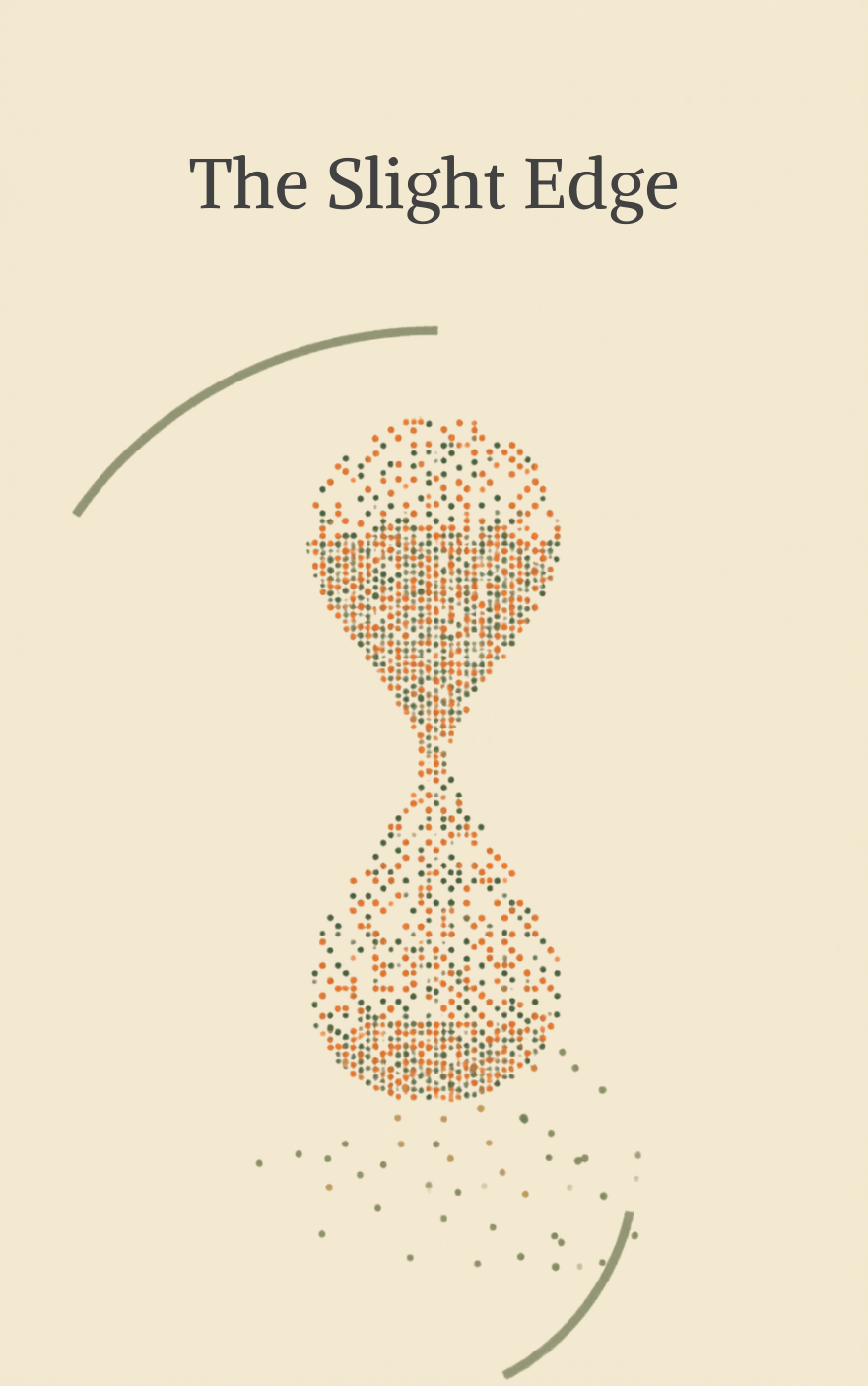
The Slight Edge Book Summary
This The Slight Edge Book Summary covers the key ideas, lessons, and takeaways in about 20 minutes.
Ultimately, the philosophy teaches patience, discipline, and personal responsibility. By focusing on simple actions—showing up, staying consistent, maintaining a positive mindset, and learning from experience—you create a steady path toward long-term success. The difference between where you are now and where you want to be is not a single breakthrough, but a series of small, intentional steps repeated over time.
Helps with these goals
Want the complete 20-minute summary?
- Full structured summary
- Video Summary
- Podcast Summary
- Audio summary
- Key takeaways
- Exercises
- Quiz
- Highlights and notes
- Ask the book with AI
What is in the The Slight Edge book summary?
Below is a preview of Sumizeit’s expert-written summary of The Slight Edge by Jeff Olson. The full summary covers the book’s key ideas in text, audio, and video.
The Slight Edge by Jeff Olson presents a simple but transformative idea: success is not the result of dramatic breakthroughs or rare opportunities. Instead, it grows from small, seemingly insignificant actions repeated consistently over time. These actions are easy to do—but also easy not to do—and that difference is what separates successful people from those who struggle.
At its core, the philosophy explains why two individuals with similar talents, resources, and opportunities can end up with completely different outcomes. The difference lies in their daily habits and choices. Over time, these small actions compound, just like interest in a bank account, leading either toward success or failure.
The book emphasizes that success is not immediate or visible in the beginning. Progress happens gradually, often unnoticed, until it reaches a tipping point where results suddenly become obvious. This delayed effect is why many people give up too early—they don’t see results fast enough to stay motivated.
Why Success Feels Invisible at First
One of the most important ideas in the book is that success and failure both follow a gradual curve. When you begin improving your habits—whether it’s saving money, exercising, or learning a new skill—you won’t see immediate results. In fact, it may feel like nothing is happening at all.
However, beneath the surface, change is occurring. Over time, these small improvements accumulate until they create noticeable outcomes. Conversely, small negative habits—like skipping workouts or overspending—also build up over time, eventually leading to poor results.
This explains why people often misjudge their progress. They expect immediate rewards and become discouraged when those rewards don’t appear. As a result, they abandon the very behaviors that would have led to long-term success.
The key insight here is patience. You must trust the process even when results are not yet visible.
Taking the First Step: Overcoming Resistance
The journey toward success begins with a simple but crucial action: starting. Many people delay taking action because they fear failure, judgment, or discomfort. This hesitation prevents them from ever gaining momentum.
The book highlights that showing up is the foundation of progress. Whether your goal is to start a business, improve your health, or learn a new skill, nothing happens until you take that first step.
Fear plays a major role in holding people back. People often avoid starting because they don’t want to experience failure or embarrassment. However, avoiding action guarantees failure in the long run.
To move forward, you must accept that discomfort is part of growth. Instead of waiting for the perfect moment, you begin with what you have and improve along the way.
The Role of Consistency in Long-Term Results
Starting is important, but consistency is what drives results. Doing something once has little impact. Doing it repeatedly over time creates transformation.
The book uses simple examples to illustrate this concept. One workout won’t make you fit, and saving money once won’t make you wealthy. But consistent effort over weeks, months, and years leads to significant change.
Consistency also builds discipline.…
Want the complete 20-minute summary?
- Full structured summary
- Video Summary
- Podcast Summary
- Audio summary
- Key takeaways
- Exercises
- Quiz
- Highlights and notes
- Ask the book with AI
Who should read The Slight Edge?
The Slight Edge is ideal for anyone feeling stuck or frustrated with slow progress toward their goals. If you're an entrepreneur, professional, student, or someone committed to personal growth who wants to understand how lasting success actually builds—rather than expecting overnight breakthroughs—this book offers practical wisdom you can apply immediately.
Why does The Slight Edge matter?
In a world obsessed with quick fixes and overnight success, The Slight Edge by Jeff Olson reveals the unglamorous truth: meaningful achievement comes from tiny, repeated actions that compound over time. This philosophy matters because it transforms how you approach goals by shifting focus from dramatic results to the daily habits that actually create them, making long-term success accessible to anyone willing to be consistent.
What are the key themes in The Slight Edge?
- Small daily actions compound into extraordinary results over time
- Success and failure follow gradual, invisible curves until reaching a tipping point
- Consistency and discipline matter more than talent or opportunity
- Mindset and personal accountability are foundational to achievement
- Progress often feels invisible at first, requiring patience and faith in the process
- Habits are the direct determinant of your future outcomes
What are the key lessons from the The Slight Edge book summary?
Success is Built on Insignificant Actions
Major achievements result not from rare breakthroughs but from small, ordinary actions repeated consistently. The key difference between successful and unsuccessful people lies in whether they do these easy-to-do actions daily.
The Curve of Invisibility
Results remain invisible for a long time before suddenly appearing obvious. This delay causes many people to quit prematurely, never reaching the tipping point where their effort would have paid off.
Starting Requires Overcoming Resistance
Fear of failure, judgment, and discomfort prevents people from beginning. The foundation of progress is simply showing up, even imperfectly, rather than waiting for the perfect moment.
Consistency Creates Transformation
One action produces negligible results, but the same action repeated over weeks, months, and years creates profound change. Consistency also builds discipline and turns actions into effortless habits.
Mindset Determines Your Response to Obstacles
A positive outlook doesn't ignore challenges but chooses constructive responses instead of giving up. Your mindset directly affects your resilience, motivation, and ability to find solutions.
Personal Responsibility Drives Results
Success requires self-discipline and accountability when no one is watching. Integrity means aligning your daily actions with your long-term goals, not just your short-term impulses.
Persistence Through Challenges Separates Winners
Everyone encounters obstacles and setbacks, but those who succeed view them as temporary and learn from them. Maintaining a strong desire for your goals keeps you moving forward during slow periods.
Success Always Requires Sacrifice
Meaningful goals demand giving up something—time, comfort, or immediate gratification. When you understand and accept this cost upfront, you're less likely to feel discouraged by the trade-offs required.
Momentum Perpetuates Progress
Once you begin taking consistent action, the effort required to continue decreases as momentum builds. Conversely, stopping creates stagnation that's harder to overcome.
Your Habits Determine Your Destiny
Results are a direct reflection of your daily habits. Small positive habits compound into significant outcomes, while small negative habits similarly accumulate into unfavorable results.
Completing What You Start Builds Confidence
Unfinished tasks create mental clutter and drain your energy. Systematically completing them frees mental space, builds confidence in your follow-through, and reinforces your ability to execute.
Celebrate Small Wins to Sustain Motivation
Acknowledging progress along the way maintains commitment far better than waiting until you reach your final goal. Celebration reinforces positive behavior and shifts focus to the process itself.
Reflection Unlocks Continuous Learning
Analyzing past experiences constructively helps you identify what works without dwelling on mistakes. Focus on what you can do differently next time rather than ruminating on what went wrong.
Small Actions Don't Feel Significant Enough to Prioritize
Because small daily actions seem insignificant, people postpone or neglect them—the primary obstacle preventing long-term success. Recognizing their compounding power is essential to avoiding this trap.
Vision Provides Direction for Daily Choices
A clear vision of what you want to achieve acts as a guide for your actions and decisions. Writing down goals and creating visual representations reinforces your commitment and keeps you focused.
Action Matters More Than Perfect Strategy
Beginning with an imperfect plan and adjusting as you learn trumps waiting for the ideal strategy. Taking action builds momentum and generates the knowledge needed to refine your approach.
Patience Unlocks the Compound Effect
Trusting the process even when results aren't visible requires faith in compounding. The slight edge philosophy demands patience as your daily habits gradually accumulate into transformation.
Your Daily Choices Determine Your Direction
Each small decision moves you either toward success or toward failure—there is no neutral. Over time, the direction of these daily choices compounds into vastly different outcomes.
Discomfort is the Price of Growth
Successful people accept that discomfort accompanies progress and proceed anyway, rather than avoiding it. Starting with what you have and improving along the way requires embracing this reality.
Internal Satisfaction Sustains Long-Term Effort
Relying on external rewards is fragile, but the internal sense of satisfaction from genuine progress is durable and self-reinforcing. This intrinsic motivation sustains the years of effort required for true success.
Want the complete 20-minute summary?
- Full structured summary
- Video Summary
- Podcast Summary
- Audio summary
- Key takeaways
- Exercises
- Quiz
- Highlights and notes
- Ask the book with AI
How can you apply ideas from The Slight Edge?
- Track your daily habits visually to create accountability and motivation—mark off each day you follow through on your commitment
- Identify one small action related to your goal (saving money, exercising, learning) and commit to doing it consistently for 90 days to see compound results
- Replace one negative habit with a positive alternative by inserting the new behavior into your existing routine at the same time each day
- Write down your goals and create a vision board to keep your direction clear and reinforce commitment during slow-progress periods
- Systematically complete all unfinished tasks to free mental space and build confidence in your ability to follow through
- Schedule regular reflection sessions to analyze what's working and what needs adjustment without dwelling on mistakes
- Build momentum by taking small actions toward your goal even on difficult days, rather than waiting for motivation to strike
What common mistakes do readers make with The Slight Edge?
- Postponing small actions because they seem insignificant, then wondering why results don't appear
- Expecting immediate visible results and quitting before reaching the tipping point where progress becomes obvious
- Searching for shortcuts or overnight success instead of committing to consistent, compounding effort over months and years
- Waiting for the perfect moment to start rather than beginning imperfectly and refining your approach along the way
Sumizeit Exercises Apply what you've learned
Turn ideas from The Slight Edge into action with a short guided reflection: identify the biggest takeaway, connect it to your life, and commit to one step you can take in the next 24 hours.
What is the expert analysis of The Slight Edge?
Overview
The Slight Edge by Jeff Olson stands as a significant contribution to the self-improvement and personal development genre, offering a distilled philosophy on the mechanics of success. Olson, an entrepreneur and seasoned speaker, draws on decades of experience to articulate a framework that privileges consistency and incremental progress over dramatic, singular breakthroughs. This book resonates particularly in an era where instant gratification often overshadows the value of patience and sustained effort, making Olson’s message both timely and enduring.
Core Thesis
At its core, Olson’s central argument is elegantly simple yet profound: success and failure are the cumulative results of small, daily choices and habits. These seemingly trivial actions, when repeated consistently over time, compound to produce significant outcomes—positive or negative. The “slight edge” is the marginal difference in behavior that separates those who succeed from those who do not. This thesis challenges conventional narratives that emphasize talent, luck, or singular moments of inspiration, instead underscoring the power of disciplined routine and mindset.
Strengths
- Clarity and Accessibility: Olson’s writing is straightforward and accessible, making complex behavioral psychology concepts digestible for a broad audience without sacrificing depth.
- Practical Framework: The book provides actionable strategies such as habit tracking, visualization, and embracing discomfort, which readers can immediately apply to their personal and professional lives.
- Emphasis on Mindset: The integration of positivity and personal responsibility enriches the behavioral focus, recognizing the psychological resilience required for long-term success.
- Holistic Approach: Olson addresses not only the mechanics of habit formation but also the emotional and motivational dimensions, such as overcoming fear, maintaining momentum, and celebrating incremental progress.
- Enduring Relevance: The principles transcend specific industries or trends, offering a timeless blueprint for growth that can be adapted across various life domains.
Critiques & Counterarguments
- Oversimplification of Success Factors: While the focus on small habits is compelling, the book tends to underplay structural and systemic factors such as socioeconomic status, access to resources, and external opportunities that also critically shape outcomes.
- Limited Empirical Evidence: Olson’s arguments rely heavily on anecdotal examples and intuitive reasoning rather than rigorous, peer-reviewed research, which may limit the book’s credibility in academic or scientific circles.
- Potential for Misinterpretation: The emphasis on personal responsibility might inadvertently foster a blame-the-individual mentality, overlooking contextual challenges or mental health issues that impede habit formation.
- Competing Psychological Models: Contemporary research in behavioral economics and psychology, such as the role of automaticity in habits or the impact of environmental cues, suggests more nuanced mechanisms than the linear compounding effect portrayed.
- Real-World Variability: In practice, not all small actions yield positive compounding effects; some habits may plateau or require strategic shifts, a complexity the book does not fully address.
Who Should Read This
The Slight Edge is ideally suited for readers seeking a motivational yet practical guide to personal transformation, particularly those who feel overwhelmed by the prospect of large-scale change. Entrepreneurs, professionals, and individuals interested in habit formation and mindset development will find Olson’s insights valuable. Additionally, readers new to self-help literature will appreciate the book’s clear framework and encouraging tone, while those experienced in personal development may find it a useful reminder of foundational principles often obscured by more complex theories.
Frequently asked questions about the The Slight Edge book summary
What is The Slight Edge about?
The Slight Edge by Jeff Olson explains that lasting success isn't built on dramatic breakthroughs but on small, seemingly insignificant actions repeated consistently over time. The book reveals that these easy-to-do habits compound like interest in a bank account, creating extraordinary results when maintained long enough—but most people quit before seeing visible progress because the payoff curve is gradual and invisible at first.
Who should read The Slight Edge?
Anyone committed to long-term personal growth should read this book, particularly entrepreneurs, professionals, and students who feel stuck or frustrated with slow progress. It's especially valuable for people tempted by quick-fix solutions, since it reveals why consistency and daily habits matter far more than rare opportunities or sudden breakthroughs.
What are the main takeaways from The Slight Edge?
The core takeaways are: success depends on daily habits, not on talent or opportunity; results remain invisible for extended periods, requiring patience and faith; consistency builds momentum that makes progress easier over time; and your mindset and personal accountability determine whether you persist or quit. Ultimately, the slight edge philosophy teaches that your daily choices compound into your destiny—small actions in one direction lead to vastly different outcomes than small actions in another direction.
How long does it take to see results from the slight edge approach?
Results follow an invisible curve—progress occurs beneath the surface for a long time before suddenly becoming visible. The book emphasizes that you typically won't see meaningful results for weeks or months, which is why most people quit prematurely. The timeline depends on your goal and consistency, but the key insight is that trust and patience are required before the tipping point arrives.
Can the slight edge philosophy apply to different areas of life?
Yes, the slight edge approach works universally because it's based on habit and compounding over time. Whether your goal is building wealth, improving health, developing relationships, advancing your career, or learning a skill, the same principle applies: small daily actions repeated consistently create transformation over weeks, months, and years.
What does Jeff Olson say about failure and setbacks?
Olson emphasizes that setbacks are inevitable and temporary, not permanent reflections of your ability. The distinction between successful and unsuccessful people isn't whether they experience obstacles, but how they respond to them. Those who succeed view setbacks as learning opportunities and maintain their commitment to consistent daily actions despite challenges.
How does The Slight Edge address motivation and staying committed?
Since visible results take time, motivation must come from internal sources rather than external rewards. The book recommends clarifying why your goal matters, celebrating small wins along the way, and understanding the cost of success upfront so you're not shocked by the sacrifices required. Regular reflection and tracking progress also helps sustain commitment during the invisible curve.
About Sumizeit
Sumizeit is a profitable Scomy LLC company based in Miami, Florida. It has been helping readers learn from nonfiction books for 7 years with expert-written summaries in text, audio, podcast, and video.
Want the complete 20-minute summary?
- Full structured summary
- Video Summary
- Podcast Summary
- Audio summary
- Key takeaways
- Exercises
- Quiz
- Highlights and notes
- Ask the book with AI
Here's why readers love Sumizeit
Join thousands of learners getting smarter every day
"Great experience. Detailed summaries. Loved the gamification feature. Makes learning fun. Good customer service. I recommend Sumizeit to anyone. You'll learn a lot."
"I always felt busy but still wanting to keep up with the book discussion in my friend group. This was a great supplement to help me keep reading the books I find fun while keeping up with important books."
"I love this website. Instead of scrolling social media, I find myself learning a lot. I use it everyday. I recommend this app for anyone who is too busy and wants to get up to speed with their favorite books."
The Slight Edge Book Summary PDF
Looking for a The Slight Edge Book Summary PDF you can save and revisit offline? Our The Slight Edge Book Summary PDF captures the book’s core ideas in a clean, printable format — the key frameworks, takeaways, and structure without the fluff. Download the The Slight Edge Book Summary PDF when you want a reference you can annotate, share with your team, or review on the go. Get your The Slight Edge Book Summary PDF from the download page below.
Download The Slight Edge Book Summary PDFPeople also liked these summaries
Readers who explored The Slight Edge often enjoyed these titles next.

Want the complete 20-minute summary?
- Full structured summary
- Video Summary
- Podcast Summary
- Audio summary
- Key takeaways
- Exercises
- Quiz
- Highlights and notes
- Ask the book with AI
Featured Book Titles
Popular Book Summaries at sumizeit, leading book summary app
