


As an Amazon Associate, Sumizeit earns from qualifying purchases.
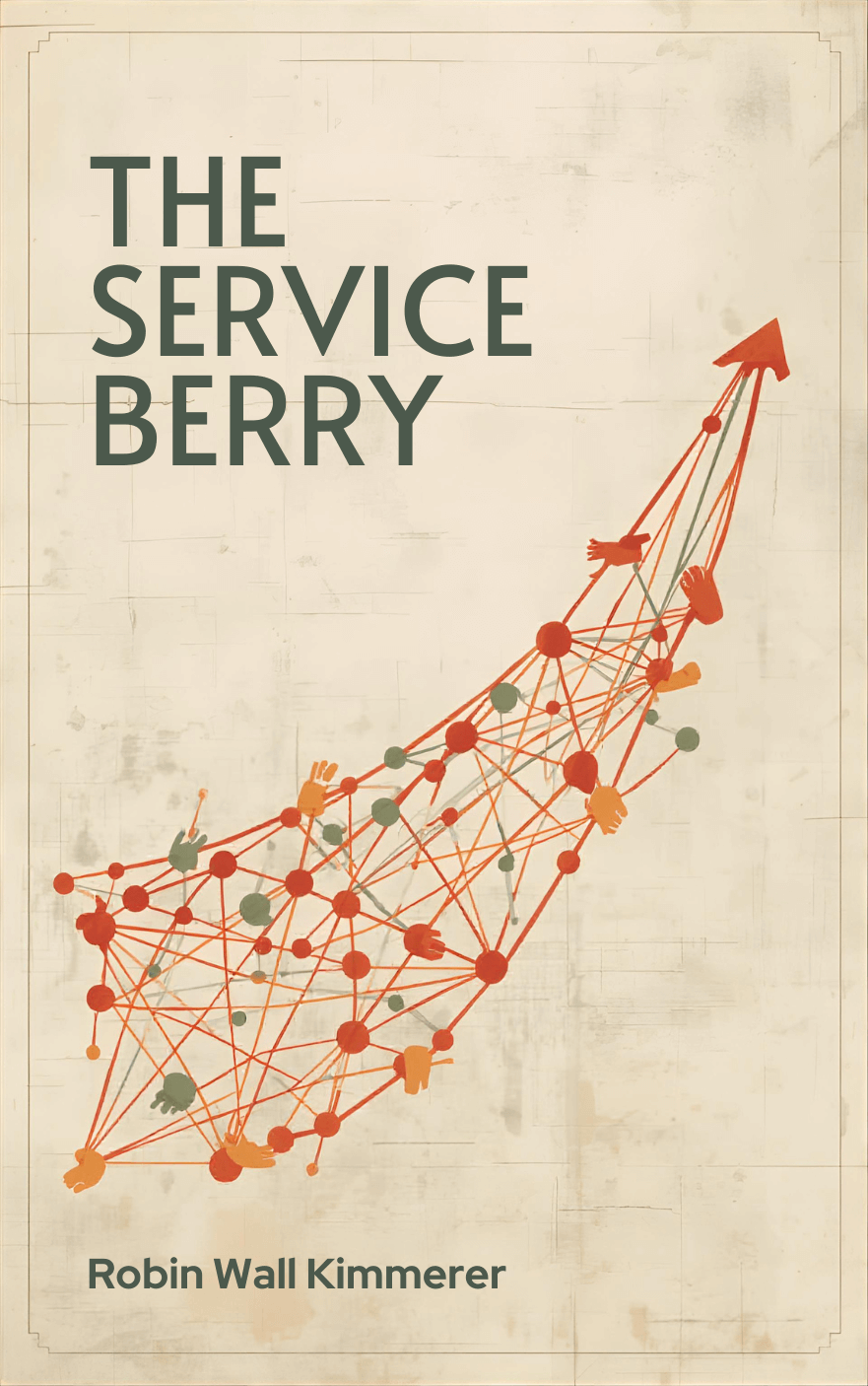
The Serviceberry Book Summary
This The Serviceberry Book Summary covers the key ideas, lessons, and takeaways in about 20 minutes.
Kimmerer does not demand utopia. She asks for participation. Gift economies already operate in kitchens, gardens, libraries, and friendships. By practicing gratitude, completing circles of giving, and supporting institutions built on shared access, we begin restoring balance. The transformation she proposes is both intimate and systemic: change how you receive, and you will change how you give. Change how you give, and you reshape the economy. The seeds of another world, she suggests, are already ripening.
Helps with these goals
Want the complete 20-minute summary?
- Full structured summary
- Video Summary
- Podcast Summary
- Audio summary
- Key takeaways
- Exercises
- Quiz
- Highlights and notes
- Ask the book with AI
What is in the The Serviceberry book summary?
Below is a preview of Sumizeit’s expert-written summary of The Serviceberry by Robin Wall Kimmerer. The full summary covers the book’s key ideas in text, audio, and video.
In The Serviceberry (2024), Robin Wall Kimmerer—botanist, author, and enrolled member of the Citizen Potawatomi Nation—offers a profound reconsideration of how human economies might function. Rather than accepting modern capitalism as the inevitable or superior way of organizing life, she invites readers to look to forests, meadows, and berry trees for guidance. There, she observes systems that operate not on competition and extraction, but on mutual flourishing.
Kimmerer argues that contemporary capitalism treats the Earth’s abundance as inventory—resources to be owned, priced, and consumed. In doing so, it creates ecological breakdown, widening inequality, and a spiritual estrangement between people and the living world. By contrast, natural systems demonstrate another possibility: networks of giving in which life is sustained through generosity, reciprocity, and trust.
The serviceberry tree becomes her central teacher. Through it, she demonstrates how economies based on gifting—not hoarding—are already thriving all around us.
The Architecture of Modern Market Systems
To understand Kimmerer’s proposal, we must first examine the dominant economic framework shaping most of the world today: the market economy.
In a market system, goods and services are treated as commodities. Land, water, food, and labor are considered assets that can be bought and sold. Exchange is immediate and transactional—you pay a price and receive a product. Value is measured through currency, and success is typically defined by accumulation.
These principles are ancient. Systems of trade using silver, barley, and standardized measures existed thousands of years ago in Mesopotamia. Over time, legal and philosophical frameworks strengthened these ideas. Laws formalized private ownership. Thinkers argued that individuals pursuing their own interests would ultimately benefit society as a whole. Markets became increasingly central to human life.
However, Kimmerer emphasizes two troubling consequences of this orientation:
Excessive consumption by the wealthy, which accelerates ecological damage.
Prioritization of individual gain over collective wellbeing, weakening communities.
When status is linked to accumulation, generosity loses prestige. Competition becomes normalized. Wealth pools rather than circulates. Over time, this distorts both ecosystems and social bonds.
Importantly, Kimmerer does not claim that humans are inherently selfish. Rather, she suggests that systems structured around competition can reward self-focused behavior while concealing moral consequences. Under such conditions, even well-intentioned people may act in ways that appear detached or exploitative.
The Logic of a Gift-Based Economy
In contrast to market exchange, Kimmerer describes what she calls a gift economy.
In a gift economy:
Goods and services move through relationships rather than through price tags.
Repayment is not immediate or direct.
Generosity builds belonging.
Wealth is defined as having enough to share.
When you give in such a system, you are not entering a contract. You are strengthening a web of mutual care. The return comes not as cash, but as resilience—knowing that when you need support, the community will respond.
In this framework, prestige comes from generosity rather than accumulation. The most respected members are not those who hoard the most, but those who circulate abundance widely.
This is not an imaginary ideal. Kimmerer points out that many…
Want the complete 20-minute summary?
- Full structured summary
- Video Summary
- Podcast Summary
- Audio summary
- Key takeaways
- Exercises
- Quiz
- Highlights and notes
- Ask the book with AI
Who should read The Serviceberry?
The Serviceberry speaks to anyone questioning whether modern capitalism is the only way to organize society. It resonates particularly with environmentalists, community advocates, and people seeking alternatives to purely extractive economics. If you're interested in Indigenous wisdom, ecology, or building more resilient local communities, this book offers both philosophical grounding and practical pathways forward.
Why does The Serviceberry matter?
As climate change, inequality, and social fragmentation deepen, The Serviceberry by Robin Wall Kimmerer challenges the assumption that competition and accumulation are inevitable or natural. The book arrives at a moment when many are searching for economic models that don't require endless growth or ecological destruction. By showing how gift-based systems already function in nature and in our communities, Kimmerer makes the case that another economy isn't utopian fantasy—it's possible, practical, and already beginning.
What are the key themes in The Serviceberry?
- Gift economies versus market-based systems
- Reciprocity as the foundation of resilience
- Humans as participants in natural cycles
- Redefining wealth as abundance to share rather than accumulation
- Manufactured scarcity versus natural limits
- Indigenous wisdom as guide for sustainable living
- Generosity and prestige in cultural transformation
- Circulation of resources as ecological and social health
What are the key lessons from the The Serviceberry book summary?
Gift-based systems build belonging, not debt
In a gift economy, goods move through relationships without immediate repayment or price tags, strengthening community bonds. This contrasts with market transactions, which prioritize individual gain over collective wellbeing.
The serviceberry tree demonstrates how nature operates on circulation
The serviceberry provides fruit to birds, which disperse seeds; it receives pollination and nutrients from other participants—none of these exchanges are priced or contracted. This mutual flourishing model shows that abundance increases through giving.
Artificial scarcity is created by systems that privatize abundance
Natural scarcity (drought, seasonal limits) requires adaptation and sharing, while artificial scarcity restricts plentiful resources for profit. When abundance is hoarded, communities suffer and ecosystems destabilize.
Prestige shifts from accumulation to generosity in gift economies
When cultural values reward sharing over hoarding, the most respected members are those who circulate wealth widely. This fundamental reorientation changes how people prioritize their actions.
The Windigo warns against insatiable growth without reciprocity
This Potawatomi figure embodies unbalanced accumulation—taking endlessly while giving little. The metaphor mirrors modern economies that demand constant growth regardless of ecological cost.
Reciprocity doesn't require exact repayment, only participation
When someone receives a gift, they contribute forward into the system—perhaps not to the original giver, but to the web that sustains all. This principle extends to environmental restoration, fair labor, and community care.
Humans are already embedded in gift systems through nature
Every meal depends on gifts from soil organisms, pollinators, sunlight, and farmers. Recognizing this transforms waste from neutral to unethical and extraction from acceptable to dishonorable.
Forest succession mirrors the evolution from competitive to cooperative economies
Young forests prioritize growth and competition; mature forests exhibit complex cooperation through fungal networks and self-sustaining systems. Human economies can similarly evolve from extraction toward circulation.
Gift economies can coexist with and gradually transform market systems
Rather than waiting for capitalism to collapse, individuals and communities can cultivate gift practices alongside existing structures. A farmer who allows free fruit picking still participates in markets while creating communal relationships.
Gratitude is the first step toward gift-based living
Recognizing resources as gifts—not entitlements—alters consumption behavior and fosters responsibility. In many Indigenous traditions, gratitude is ceremonial and embedded in daily life.
Interdependence is strength, not weakness
When wealth flows and relationships circulate, resilience grows. Individual flourishing depends on collective wellbeing, making community institutions and shared access essential.
Small everyday acts reshape cultural norms over time
Sharing produce, cooking for neighbors, volunteering, and supporting libraries gradually shift expectations about value and exchange. These everyday practices are not marginal—they are infrastructure for cultural transformation.
Libraries and community seed exchanges exemplify gift economies in action
These institutions demonstrate how knowledge and resources can circulate based on need rather than purchasing power. They model resilience through distribution rather than centralized control.
Wealth defined by circulation survives; wealth defined by hoarding stagnates
In ecological systems, nutrients must circulate or decay results. Similarly, modern economies that concentrate wealth without movement destabilize both society and environment.
Indigenous languages encode gift logic directly
In Potawatomi, the word for berry shares roots with the concept of gift, reflecting an understanding that Earth's offerings are not inert commodities but living offerings from other beings.
Systems structure behavior more than individual intention
Even well-intentioned people may act exploitatively within systems designed around competition. Changing structures changes outcomes more reliably than appealing to character alone.
Mapping your gift network reveals where reciprocity already exists and where it can deepen
Gift economies already operate in friendships, families, and neighborhoods. Reflecting on who gives to you and to whom you give illuminates existing abundance and opportunities for participation.
Receiving creates obligation—participation in the web that sustains us
Reciprocity transforms the relationship between individual and community from transaction to membership. Obligation becomes not burden but belonging.
Repairing and sharing transform material relationships
Practices like fixing broken items instead of discarding them, bartering skills, and sharing meals embody gift-economy principles in tangible, daily ways.
The crisis of climate, inequality, and fragmentation stems from distorted understandings of value
When wealth is defined by accumulation and success by competition, both ecosystems and communities suffer. Redefining wealth as having enough to share opens entirely different possibilities.
Want the complete 20-minute summary?
- Full structured summary
- Video Summary
- Podcast Summary
- Audio summary
- Key takeaways
- Exercises
- Quiz
- Highlights and notes
- Ask the book with AI
How can you apply ideas from The Serviceberry?
- Start or join a community seed exchange to distribute knowledge about local growing and build neighborhood resilience
- Allow free access to abundant resources you produce, like fruit or vegetables, to shift relationships from transactional to communal
- Practice gratitude rituals before meals, naming the organisms and people whose gifts made the food possible
- Map your own gift network by listing who gives to you and to whom you give, then identify gaps where reciprocity could deepen
- Support public institutions like libraries that operate on gift principles rather than profit models
- Volunteer time or share skills with neighbors rather than purchasing services, strengthening relationships and interdependence
- Choose repair and reuse over discarding, embodying circular practices in daily consumption
What common mistakes do readers make with The Serviceberry?
- Assuming gift economies are idealistic dreams rather than recognizing they already function in families, friendships, and nature
- Believing personal virtue is enough to solve systemic problems without recognizing that structures shape behavior more than individual intention
- Thinking reciprocity requires exact or immediate repayment, which misses the point that gifts strengthen the whole web, not individual debts
- Attempting to build gift economies only through individual action without addressing the systems and institutions that currently reward extraction
Sumizeit Exercises Apply what you've learned
Turn ideas from The Serviceberry into action with a short guided reflection: identify the biggest takeaway, connect it to your life, and commit to one step you can take in the next 24 hours.
What is the expert analysis of The Serviceberry?
Overview
The Serviceberry (2024) by Robin Wall Kimmerer stands as a significant contribution to contemporary ecological and economic thought, blending Indigenous wisdom with scientific insight. Kimmerer, a botanist and enrolled member of the Citizen Potawatomi Nation, is renowned for her ability to weave together empirical research and traditional knowledge. This book challenges dominant capitalist paradigms by proposing a radical reimagining of economies through the lens of natural gift systems, making it a vital read for those interested in sustainability, ethics, and alternative economic models.
Core Thesis
Kimmerer’s central argument is that the prevailing market economy, grounded in competition, accumulation, and commodification of natural resources, is fundamentally flawed and unsustainable. Instead, she advocates for adopting principles observed in natural ecosystems—specifically gift economies characterized by generosity, reciprocity, and mutual flourishing. Using the serviceberry tree as a metaphor and teacher, she illustrates how abundance circulates through relationships rather than being hoarded, and how redefining wealth as “having enough to share” can foster ecological balance and social cohesion.
Strengths
- Interdisciplinary Synthesis: Kimmerer masterfully integrates botany, Indigenous knowledge, philosophy, and economics, creating a holistic framework that transcends disciplinary boundaries.
- Relational Ethics: The book foregrounds relationality and reciprocity as foundational ethical principles, offering a profound moral critique of individualistic capitalism.
- Accessible Metaphors: The use of the serviceberry tree and ecological succession as metaphors makes complex economic and ecological concepts tangible and evocative.
- Practical Implications: Rather than abstract theorizing, Kimmerer provides concrete examples of gift economies in action and encourages everyday practices that embody gratitude and reciprocity.
- Bridging Knowledge Systems: Her dual grounding in Western science and Indigenous epistemologies lends credibility and depth, fostering cross-cultural dialogue.
Critiques & Counterarguments
- Idealization of Gift Economies: While compelling, the portrayal of gift economies may understate challenges in scaling such systems within complex, globalized societies. Critics might argue that gift economies work well in small, tightly knit communities but face difficulties in addressing large-scale economic coordination and technological innovation.
- Limited Engagement with Market Dynamics: The book critiques capitalism’s excesses but offers less detailed analysis of how gift economies might contend with market forces such as competition, innovation incentives, and regulatory frameworks.
- Potential Romanticization of Indigenous Practices: Although Kimmerer is herself Indigenous, some scholars caution against overly romanticizing traditional economies without acknowledging internal complexities, conflicts, or historical transformations.
- Empirical Evidence and Implementation: The argument would benefit from more extensive empirical data on contemporary gift economies’ efficacy and resilience, especially in urban or industrial contexts.
- Opposing Schools of Thought: Economic theories emphasizing market efficiency, such as neoliberalism or classical economics, might contest the feasibility of replacing price signals and competition with reciprocity as the primary organizing principle.
Who Should Read This
The Serviceberry is essential reading for scholars and practitioners in environmental studies, economics, anthropology, and Indigenous studies seeking alternative frameworks for sustainability. It will also resonate with activists and policymakers interested in reimagining economic systems beyond growth and extraction. Furthermore, readers drawn to philosophical and spiritual reflections on human-nature relationships will find Kimmerer’s work deeply enriching. Ultimately, it invites anyone concerned with ecological crises and social fragmentation to reconsider the foundational values shaping our world.
Frequently asked questions about the The Serviceberry book summary
What is The Serviceberry about?
The Serviceberry by Robin Wall Kimmerer explores how economies might function based on generosity and reciprocity rather than competition and accumulation. Using the serviceberry tree as a central metaphor—showing how it gives fruit to birds, receives pollination and nutrients, and sustains a web of life—Kimmerer proposes that gift-based systems already exist in nature and in our communities, offering alternatives to modern market capitalism.
Who should read The Serviceberry?
The Serviceberry appeals to environmentalists, community activists, and anyone questioning whether capitalism is inevitable or desirable. It resonates with readers interested in Indigenous wisdom, ecology, local resilience, and practical ways to build more generous economic systems. The book offers both philosophical depth and concrete applications, making it valuable for educators, policymakers, and anyone seeking to understand how societies might change.
What are the main takeaways from The Serviceberry?
The core insight is that abundance increases through circulation, not hoarding, and prestige should come from generosity rather than accumulation. Kimmerer shows that gift-based systems can coexist with market economies right now through everyday practices like sharing, volunteering, and supporting community institutions. Ultimately, the book argues that redefining wealth as having enough to share—and recognizing humans as participants in nature's gift economy—offers pathways to address climate change, inequality, and social fragmentation simultaneously.
How does Kimmerer define a gift economy?
In a gift economy, goods and services move through relationships rather than price tags, repayment is not immediate or direct, and generosity builds belonging. Unlike market transactions focused on individual gain, gift economies strengthen community bonds and define wealth as having enough to share. Kimmerer emphasizes that these are not primitive or outdated systems but represent deeply human tendencies toward cooperation.
Can gift economies actually work alongside modern capitalism?
Yes, according to The Serviceberry. Kimmerer argues that gift systems already operate in kitchens, gardens, libraries, and neighborhoods. Rather than waiting for capitalism to collapse, she proposes cultivating these parallel systems now—allowing people to give freely, supporting shared-access institutions, and practicing reciprocity. Over time, these everyday practices can gradually shift cultural values and economic expectations.
What does the Windigo represent in The Serviceberry?
The Windigo is a figure from Potawatomi tradition that embodies insatiable hunger and endless accumulation. In Kimmerer's framework, it serves as a metaphor for modern economies that demand constant growth regardless of ecological cost. The Windigo represents what happens when accumulation becomes the goal and generosity is abandoned—both personal and collective sickness.
Why does Kimmerer focus on gratitude and reciprocity?
Kimmerer views gratitude as the foundation for shifting behavior and values. When we recognize that our food, water, and air are gifts from living systems—not commodities we own—we become more mindful and responsible in consumption. Reciprocity then becomes not burden but participation in the web that sustains us, creating resilience and belonging.
About Sumizeit
Sumizeit is a profitable Scomy LLC company based in Miami, Florida. It has been helping readers learn from nonfiction books for 7 years with expert-written summaries in text, audio, podcast, and video.
Want the complete 20-minute summary?
- Full structured summary
- Video Summary
- Podcast Summary
- Audio summary
- Key takeaways
- Exercises
- Quiz
- Highlights and notes
- Ask the book with AI
Here's why readers love Sumizeit
Join thousands of learners getting smarter every day
"Great experience. Detailed summaries. Loved the gamification feature. Makes learning fun. Good customer service. I recommend Sumizeit to anyone. You'll learn a lot."
"I always felt busy but still wanting to keep up with the book discussion in my friend group. This was a great supplement to help me keep reading the books I find fun while keeping up with important books."
"I love this website. Instead of scrolling social media, I find myself learning a lot. I use it everyday. I recommend this app for anyone who is too busy and wants to get up to speed with their favorite books."
The Serviceberry Book Summary PDF
Looking for a The Serviceberry Book Summary PDF you can save and revisit offline? Our The Serviceberry Book Summary PDF captures the book’s core ideas in a clean, printable format — the key frameworks, takeaways, and structure without the fluff. Download the The Serviceberry Book Summary PDF when you want a reference you can annotate, share with your team, or review on the go. Get your The Serviceberry Book Summary PDF from the download page below.
Download The Serviceberry Book Summary PDFPeople also liked these summaries
Readers who explored The Serviceberry often enjoyed these titles next.





Want the complete 20-minute summary?
- Full structured summary
- Video Summary
- Podcast Summary
- Audio summary
- Key takeaways
- Exercises
- Quiz
- Highlights and notes
- Ask the book with AI
Featured Book Titles
Popular Book Summaries at sumizeit, leading book summary app
