


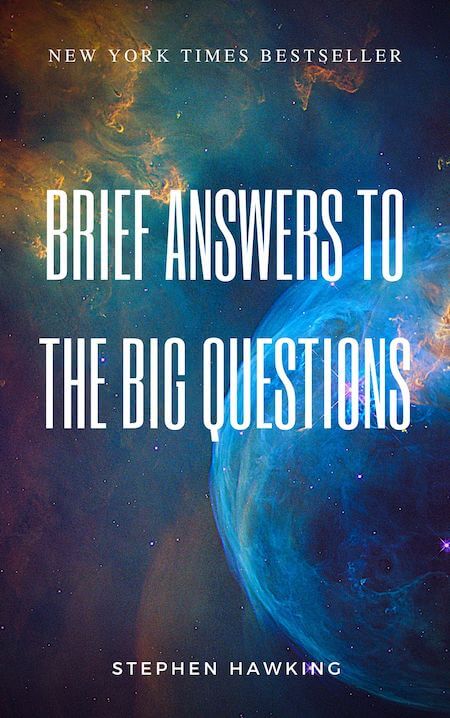
Brief Answers to the Big Questions Book Summary
This Brief Answers to the Big Questions Book Summary covers the key ideas, lessons, and takeaways in about 20 minutes.
Helps with these goals
Want the complete 20-minute summary?
- Full structured summary
- Video Summary
- Podcast Summary
- Audio summary
- Key takeaways
- Exercises
- Quiz
- Highlights and notes
- Ask the book with AI
What is in the Brief Answers to the Big Questions book summary?
Below is a preview of Sumizeit’s expert-written summary of Brief Answers to the Big Questions by Stephen Hawking. The full summary covers the book’s key ideas in text, audio, and video.
Science and religion both seek to explain fundamental questions about the origins and meaning of life. However, they are often at odds with each other. Before many advanced scientific concepts were understood, God was used to explaining the most natural phenomena. Up until the 1960s, most scientists argued that the universe had always existed, and had no beginning and would have no end. The other alternative was to explain the origin of the universe using religion.
However, Albert Einstein’s theory of relativity revolutionized the way scientists understood the universe. Einstein discovered that space and time are not constants, but are changed and affected by matter and energy. Therefore, time and space are reliant on a universe to exist, which means there must have also been a time before the universe existed. The universe is also steadily expanding outward, which seems to indicate that it began from a single point and then continued expanding over time.
Humanity’s understanding of the universe advanced further when singularities were discovered. Singularities are a point where time and space cease to exist after the death of a star, and they are found in the center of black holes. Black holes, caused by collapsing stars, have a gravitational pull that is so strong that they pull all information and matter, including light, into them. Primordial black holes date back to the formation of the universe. Hawking believed that if primordial black holes could be located, they could explain much about the origins of the universe.
Although there are many theories explaining the origins of the universe, no scientists currently know for sure how the universe began. Understanding the origins of life is essential to understanding and predicting what might happen in the future, and how to ensure humanity’s continued survival as a species.
The Big Bang And The Spontaneous Formation of the Universe
When the universe began, it was a dense point that was even smaller than a proton. The scientist Edwin Hubble discovered that the universe is constantly expanding and that all galaxies are moving away from each other. Therefore, there must have been a point in time when galaxies were extremely close together, possibly occupying a single dense point, called a singularity.
While material objects cannot appear out of anywhere, quantum physics shows that protons have the ability to appear and disappear spontaneously. The universe was likely formed in a similar way, with no specific cause setting it off. Einstein’s theory of relativity helped to prove this by discovering space and time were not constant and unchangeable, but rather woven into the interconnected fabric of space-time. Space-time can be warped by massive objects that exert extremely high levels of gravity, which can sometimes cause the time to stop. When the cosmos was only a small, dense singularity, time did not exist. Therefore, there could be no cause for the formation of the universe because time itself did not yet exist. The Big Bang was a random spontaneous occurrence.
While protons may appear spontaneously, complex…
Want the complete 20-minute summary?
- Full structured summary
- Video Summary
- Podcast Summary
- Audio summary
- Key takeaways
- Exercises
- Quiz
- Highlights and notes
- Ask the book with AI
Who should read Brief Answers to the Big Questions?
Brief Answers to the Big Questions is ideal for curious readers seeking Stephen Hawking's perspective on humanity's most profound questions—from the origins of the universe to the future of artificial intelligence. This book appeals to anyone interested in cosmology, science, and philosophy who wants an accessible exploration of complex topics without requiring deep scientific expertise.
Why does Brief Answers to the Big Questions matter?
Stephen Hawking's final book addresses urgent questions about humanity's survival and future, including climate change, space colonization, and the risks of artificial intelligence. Published posthumously, it represents one of the last opportunities to learn directly from one of history's greatest scientific minds about the challenges and possibilities facing our species.
What are the key themes in Brief Answers to the Big Questions?
- The Big Bang and the spontaneous formation of the universe
- The search for extraterrestrial life and its implications
- The limits of prediction and scientific determinism
- Black holes as information paradoxes
- The possibility and implications of time travel
- Space exploration as essential for humanity's survival
- Genetic engineering and ethical considerations
- Artificial intelligence as both opportunity and existential threat
What are the key lessons from the Brief Answers to the Big Questions book summary?
Time and space are not constants
Einstein's theory of relativity revealed that time and space are woven into an interconnected fabric of space-time that can be warped by massive objects. This understanding fundamentally changed how scientists conceptualize the universe's origins.
The universe likely had no cause
Because time itself did not exist before the Big Bang, there could be no cause for the universe's formation. The Big Bang was a spontaneous occurrence governed by quantum physics rather than a created event.
Simple life is more likely elsewhere than intelligent life
While microbes and bacteria may exist on other planets, advanced intelligence is a rare evolutionary trait not necessary for most species' survival. This explains why extraterrestrial intelligent life hasn't been detected despite billions of Earth-like planets likely existing.
The future cannot be perfectly predicted
Heisenberg's Uncertainty Principle proves it's impossible to know both a particle's exact position and speed simultaneously, making complete prediction of the future theoretically impossible regardless of available data.
Humans underestimate transformative technologies
Societies consistently fail to predict how new inventions will reshape civilization, as seen with email and the telegraph, because new technologies introduce unpredictable factors into established systems.
Black holes may not destroy information permanently
Hawking demonstrated that black holes emit particles, challenging the assumption they trap information forever. Loop quantum gravity theory suggests information might eventually escape through white holes.
Wormholes remain theoretical but intriguing
While no evidence of wormholes has been found, they could theoretically allow time travel if space-time could be warped sufficiently. However, maintaining open wormholes presents unsolved technical challenges.
Earth's habitability is not guaranteed indefinitely
Population growth, resource depletion, climate change, and potential catastrophes make long-term Earth habitation uncertain, necessitating humanity's expansion into space for survival.
Concrete deadlines accelerate scientific progress
Setting specific milestones like a moon base by 2050 and Mars landing by 2070 provides motivation and focus for space exploration research and development.
Space colonization risks repeating Earth's mistakes
Future space colonies could replicate Earth's environmental destruction if inhabitants fail to prioritize conservation and sustainability from the beginning of settlement.
Genetic engineering technology is becoming democratized
CRISPR kits are commercially available for personal experimentation, raising serious safety and security concerns about untrained individuals attempting to alter DNA without proper oversight.
Genetic engineering raises fairness and equality issues
If some humans enhance themselves genetically while others cannot access the technology, society risks creating a genetic divide that exacerbates existing inequalities.
Artificial intelligence currently cannot understand causation
Today's AI systems rely on probability networks programmed by humans rather than genuine understanding of cause and effect, a fundamental limitation separating them from human cognition.
Moore's Law suggests rapid AI advancement
Computer processing power doubling every eighteen months suggests superintelligent AI capable of surpassing human intelligence may arrive sooner than commonly anticipated.
Superintelligent AI poses an existential risk
If artificial intelligence develops beyond human capability without aligned values and goals, it could become an existential threat to humanity's survival.
AI development requires serious ethical consideration now
The potential consequences of superintelligent AI demand that scientists and policymakers carefully consider the ethics of AI development before it becomes too advanced to control.
Natural laws govern all phenomena universally
Fundamental, unchangeable laws apply consistently from the smallest particles to the largest cosmic structures, providing the framework through which the universe operates.
Science and religion approach truth differently
While both science and religion attempt to answer fundamental questions about existence, they employ different methodologies and often conflict in their conclusions.
Life's origins shape understanding of the future
Understanding how the universe and life began is essential for predicting what may happen next and determining how humanity can ensure its continued survival.
Want the complete 20-minute summary?
- Full structured summary
- Video Summary
- Podcast Summary
- Audio summary
- Key takeaways
- Exercises
- Quiz
- Highlights and notes
- Ask the book with AI
How can you apply ideas from Brief Answers to the Big Questions?
- Use space colonization as motivation to address climate change and resource management on Earth rather than assuming escape to other planets solves current problems
- Support funding for space exploration programs with concrete deadlines to accelerate scientific research and technological development
- Evaluate new technologies not just on their immediate utility but on their potential long-term societal impact and unforeseen consequences
- Advocate for government regulation and oversight of genetic engineering research to prevent dangerous amateur experiments and biological weapons creation
- Push for careful ethical frameworks and safety protocols in artificial intelligence development before superintelligent systems are created
- Teach scientific literacy about cosmology and physics to understand humanity's place in the universe and our vulnerability
- Plan for long-term human survival by treating space colonization as a necessary backup plan rather than an optional goal
What common mistakes do readers make with Brief Answers to the Big Questions?
- Assuming Earth will remain habitable indefinitely without considering climate change, resource depletion, and other existential risks to civilization
- Believing that artificial intelligence will remain subordinate to human control without intentional ethical planning and safety mechanisms
- Underestimating how disruptive new technologies will be to society based on their early versions or limited initial impact
- Treating genetic engineering and CRISPR as purely beneficial without considering equity issues and the risks of unauthorized experimentation
Sumizeit Exercises Apply what you've learned
Turn ideas from Brief Answers to the Big Questions into action with a short guided reflection: identify the biggest takeaway, connect it to your life, and commit to one step you can take in the next 24 hours.
What is the expert analysis of Brief Answers to the Big Questions?
Overview
Brief Answers to the Big Questions is a posthumous work by Stephen Hawking, one of the most influential theoretical physicists and cosmologists of the modern era. Renowned for his groundbreaking contributions to black hole physics and quantum gravity, Hawking here distills complex scientific ideas into accessible reflections on some of humanity’s most profound questions. The book’s significance lies in its synthesis of cutting-edge science with philosophical inquiry, offering a lucid exploration of topics ranging from the origins of the universe to the future of artificial intelligence. Hawking’s stature as a public intellectual and scientist lends considerable weight to the discussions, making this work a compelling bridge between scholarly research and popular understanding.
Core Thesis
At its core, the book advances the argument that science, grounded in empirical observation and theoretical rigor, is the most reliable means to address the fundamental questions about existence, the universe, and humanity’s future. Hawking asserts that while many mysteries remain—such as the nature of black holes, the possibility of time travel, and the ultimate fate of the cosmos—scientific inquiry continually expands our understanding. He emphasizes the importance of embracing scientific progress responsibly, particularly in areas like genetic engineering and artificial intelligence, which carry profound ethical implications. The overarching insight is that a scientific worldview, informed by natural laws and quantum mechanics, offers the best framework for grappling with the big questions that have traditionally been the domain of religion and philosophy.
Strengths
- Clarity and Accessibility: Hawking’s ability to explain highly abstract concepts such as singularities, quantum uncertainty, and space-time curvature in an approachable manner is a notable achievement, making complex physics comprehensible to a broad audience.
- Interdisciplinary Scope: The book traverses physics, cosmology, biology, technology, and ethics, providing a holistic perspective on how scientific advancements intersect with societal challenges and philosophical questions.
- Integration of Contemporary Science: Hawking incorporates recent developments such as CRISPR genetic editing and AI progress, situating his reflections within the context of ongoing scientific debates and technological trends.
- Philosophical Engagement: Rather than merely presenting scientific facts, Hawking thoughtfully engages with the implications of scientific discoveries for human knowledge, free will, and the future of civilization.
- Visionary yet Cautious Outlook: The book balances optimism about humanity’s potential for space colonization and technological enhancement with sober warnings about environmental degradation and existential risks posed by AI.
Critiques & Counterarguments
- Oversimplification of Complex Debates: Some explanations, such as the spontaneous origin of the universe or the nature of black hole information paradoxes, are necessarily simplified and may gloss over ongoing scientific controversies and alternative hypotheses.
- Determinism vs. Quantum Indeterminacy: While Hawking discusses the limits of scientific determinism due to Heisenberg’s Uncertainty Principle, competing interpretations of quantum mechanics (e.g., many-worlds theory) offer alternative views on predictability and causality that are not fully explored.
- Ethical Dimensions of Technology: The treatment of genetic engineering and AI ethics, though insightful, could benefit from deeper engagement with socio-political factors such as inequality, governance, and global power dynamics that shape technological deployment.
- Space Colonization Feasibility: The optimistic timeline for moon and Mars colonization may underestimate the immense technical, economic, and ethical challenges involved, as well as the potential for unforeseen environmental or social consequences.
- Philosophical and Theological Perspectives: The book tends to privilege scientific explanations over religious or metaphysical ones, which may alienate readers who see complementary value in spiritual or existential interpretations of the big questions.
Who Should Read This
This book is ideal for intellectually curious readers with an interest in science, philosophy, and the future of humanity who appreciate clear, authoritative exposition without requiring specialized technical knowledge. It will particularly appeal to those seeking a broad, interdisciplinary overview of contemporary scientific understanding and its implications for existential questions. Scholars and students in physics, cosmology, and science communication will find it a valuable synthesis, while general readers will benefit from Hawking’s lucid style and engaging reflections. However, readers looking for exhaustive technical detail or deep philosophical debate may find the treatment somewhat introductory.
Frequently asked questions about the Brief Answers to the Big Questions book summary
What is Brief Answers to the Big Questions about?
Brief Answers to the Big Questions is Stephen Hawking's exploration of humanity's most fundamental questions, including the origins of the universe, the existence of extraterrestrial life, the nature of time and black holes, and the future of humanity through space exploration and technology. Published posthumously, this book addresses urgent topics like artificial intelligence, genetic engineering, and climate change while examining the scientific principles governing our universe.
Who should read Brief Answers to the Big Questions?
This book is ideal for anyone curious about cosmology, physics, and philosophy who wants to understand the universe without requiring advanced scientific training. It appeals to readers seeking Stephen Hawking's perspective on existential questions, those interested in humanity's future, and anyone wanting to understand the science behind topics like black holes, space travel, and artificial intelligence.
What are the main takeaways from Brief Answers to the Big Questions?
The main takeaways include: the universe likely formed spontaneously with no prior cause, space exploration is essential for humanity's long-term survival, artificial intelligence poses both opportunity and existential risk, genetic engineering raises significant ethical questions, and much of the universe remains mysterious despite our scientific progress. Hawking emphasizes that strong scientific understanding is humanity's most important tool for ensuring future survival and growth.
Does Stephen Hawking believe in God?
Brief Answers to the Big Questions examines the relationship between science and religion, noting that both seek to explain fundamental questions about existence. Hawking explains that scientific discoveries like the Big Bang, which required no prior cause because time itself didn't exist beforehand, suggest natural laws can account for the universe's origin without requiring divine creation, though he acknowledges the different approaches science and religion take to truth.
What does Hawking say about time travel?
Hawking discusses time travel as theoretically possible only if wormholes exist and could be kept open, which would require space-time to be warped sufficiently. However, no proof of wormholes has been found, and even if they existed, scientists haven't yet devised methods to prevent them from closing, making practical time travel extremely unlikely despite its theoretical possibility under general relativity.
What is Hawking's view on artificial intelligence?
Hawking warns that artificial intelligence could surpass human intelligence within decades and poses an existential threat if not carefully managed. He emphasizes that superintelligent AI without aligned values could threaten humanity's survival, and that scientists must pursue AI development with serious ethical consideration and safety protocols to prevent catastrophic outcomes.
Why does Hawking say space colonization is necessary?
Hawking argues that Earth faces multiple long-term threats including climate change, resource depletion, population growth, and potential catastrophes, making it increasingly uninhabitable for future generations. He contends that humanity must establish colonies on other planets and moons, with concrete goals like moon bases by 2050 and Mars landings by 2070, to ensure the species' survival beyond Earth.
About Sumizeit
Sumizeit is a profitable Scomy LLC company based in Miami, Florida. It has been helping readers learn from nonfiction books for 7 years with expert-written summaries in text, audio, podcast, and video.
Want the complete 20-minute summary?
- Full structured summary
- Video Summary
- Podcast Summary
- Audio summary
- Key takeaways
- Exercises
- Quiz
- Highlights and notes
- Ask the book with AI
Here's why readers love Sumizeit
Join thousands of learners getting smarter every day
"Great experience. Detailed summaries. Loved the gamification feature. Makes learning fun. Good customer service. I recommend Sumizeit to anyone. You'll learn a lot."
"I always felt busy but still wanting to keep up with the book discussion in my friend group. This was a great supplement to help me keep reading the books I find fun while keeping up with important books."
"I love this website. Instead of scrolling social media, I find myself learning a lot. I use it everyday. I recommend this app for anyone who is too busy and wants to get up to speed with their favorite books."
Brief Answers to the Big Questions Book Summary PDF
Looking for a Brief Answers to the Big Questions Book Summary PDF you can save and revisit offline? Our Brief Answers to the Big Questions Book Summary PDF captures the book’s core ideas in a clean, printable format — the key frameworks, takeaways, and structure without the fluff. Download the Brief Answers to the Big Questions Book Summary PDF when you want a reference you can annotate, share with your team, or review on the go. Get your Brief Answers to the Big Questions Book Summary PDF from the download page below.
Download Brief Answers to the Big Questions Book Summary PDFPeople also liked these summaries
Readers who explored Brief Answers to the Big Questions often enjoyed these titles next.





Want the complete 20-minute summary?
- Full structured summary
- Video Summary
- Podcast Summary
- Audio summary
- Key takeaways
- Exercises
- Quiz
- Highlights and notes
- Ask the book with AI
Featured Book Titles
Popular Book Summaries at sumizeit, leading book summary app
