


Prefer the print book? Buy on Amazon
As an Amazon Associate, Sumizeit earns from qualifying purchases.
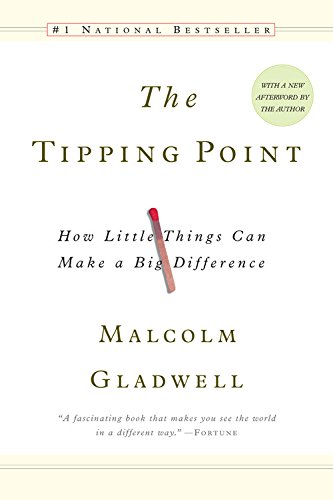
The Tipping Point Book Summary
This The Tipping Point Book Summary covers the key ideas, lessons, and takeaways in about 20 minutes.
Helps with these goals
Want the complete 20-minute summary?
- Full structured summary
- Video Summary
- Podcast Summary
- Audio summary
- Key takeaways
- Exercises
- Quiz
- Highlights and notes
- Ask the book with AI
Not ready to upgrade?
Get this summary + 2 more picks sent to your inbox, free.
What is in the The Tipping Point book summary?
Below is a preview of Sumizeit’s expert-written summary of The Tipping Point by Malcolm Gladwell. The full summary covers the book’s key ideas in text, audio, and video.
Throughout the 1970s and 1980s, the violent crime rate in New York City crept up slowly until it finally began to subside. But in 1993, the crime shot downward suddenly, and it’s been down ever since.
Paul Revere warned that “The British were coming,” and it spread like wildfire, in part sparking the American Revolution in the 18th century.
What do these significant events have in common? Contagion. They both represent ideas, messages, or public trends that “went viral.” And in the influential book The Tipping Point: How Little Things Can Make a Big Difference, Malcolm Gladwell dissects virality, and precisely the moment at which a person, thing, or product goes from merely accessible to a “household name.”
Malcolm Gladwell knows a thing or two about influential ideas. His books have ended up on the New York Times Bestseller list many times. He earned a $1-1.5 million advance for this one. So whether you’d like to sell your products or disseminate your ideas more widely, Gladwell is an excellent source. Once you know what makes something go viral, you can take steps to get there yourself.
What is the “tipping point?”
Gladwell defines the “tipping point” as the “threshold,” “boiling point,” or moment of critical mass. Launching a social media following is an excellent example of the “tipping point” phenomenon. Let’s say you have an Instagram account, and you’d like to become an influencer. At first, your growth will likely be sparse and slow as you develop content and make connections. Then, you might steadily grow a following. Perhaps you’ll get 25 new followers a day (or week), then 100, then 1,000.
But the most wildly popular social media mavens, with millions of followers, reach a “tipping point” of exponential growth. After months or even years of steady growth, one post or one news headline finally sends the influencer over the edge. That’s when you see accounts getting thousands of followers overnight and achieving bonafide viral status. Suddenly, it seems that everyone is talking about the person, and “everyone” knows who they are.
Now, let’s dig into what Gladwell says constitutes the cultural phenomenon of “contagion.”
The three characteristics of “contagious” ideas
According to Gladwell, ideas don’t become contagious by pure chance or accident. Here are the characteristics of most thoughts or trends that go viral: the Law of the Few, the Stickiness Factor, and the Power of Context.
The Law of the Few
The Law of the Few, which we’ll get into in more detail in the next section (“Who Tips Ideas?”), suggests that a few key actors or participants are the ones who make all the difference when it comes to your idea or product reaching the tipping point of contagion. In other words, when someone has a million followers on Instagram, it’s not that millionth follower that matters most. It’s probably a more dedicated audience of a few thousand followers, supporters, and influencers who propelled that idea or account into real mainstream popularity.
The Stickiness Factor
To…
Want the complete 20-minute summary?
- Full structured summary
- Video Summary
- Podcast Summary
- Audio summary
- Key takeaways
- Exercises
- Quiz
- Highlights and notes
- Ask the book with AI
Who should read The Tipping Point?
The Tipping Point is essential reading for entrepreneurs, marketers, product managers, and anyone looking to understand how ideas spread virally. If you want to know why some products become household names while others fade into obscurity, or how to intentionally build momentum for your own ideas, this book offers the framework you need.
Why does The Tipping Point matter?
In today's hyperconnected world where viral moments shape culture and commerce, understanding the mechanics of contagion is invaluable. Malcolm Gladwell's groundbreaking analysis reveals that success isn't random—it follows predictable patterns that you can learn and apply to your own initiatives, from launching a business to spreading a social movement.
What are the key themes in The Tipping Point?
- The mechanics of viral contagion and how ideas spread exponentially
- The critical importance of influential individuals in amplifying messages
- How timing and cultural context determine whether ideas take hold
- The power of making content memorable and audience-specific
- The 80/20 principle and the outsized impact of a dedicated few
Want the complete 20-minute summary?
- Full structured summary
- Video Summary
- Podcast Summary
- Audio summary
- Key takeaways
- Exercises
- Quiz
- Highlights and notes
- Ask the book with AI
How can you apply ideas from The Tipping Point?
- Identify and build relationships with connectors, salesmen, and mavens in your industry who can amplify your message
- Design your product or content specifically for your core audience rather than trying to appeal to everyone
- Test your messaging and format with your target demographic before full launch to ensure stickiness
- Monitor cultural trends and timing to launch ideas when society is primed to receive them
- Create memorable, distinctive elements in your branding or communication that make your idea easy to recall and share
- Build a small group of dedicated advocates who understand and believe in your vision before pursuing mass adoption
- Study successful viral campaigns in your field to identify patterns and apply those principles to your own work
What common mistakes do readers make with The Tipping Point?
- Assuming that the best idea will naturally win—timing and context matter as much as quality
- Trying to reach everyone at once instead of focusing first on a specific niche audience
- Neglecting to develop relationships with key influencers before launching
- Creating generic messaging that doesn't speak directly to target audience needs and preferences
Sumizeit Exercises Apply what you've learned
Turn ideas from The Tipping Point into action with a short guided reflection: identify the biggest takeaway, connect it to your life, and commit to one step you can take in the next 24 hours.
What is the expert analysis of The Tipping Point?
Overview
The Tipping Point is a seminal work by Malcolm Gladwell, a Canadian journalist renowned for his ability to translate complex social science research into compelling narratives. Published in 2000, this book explores the mechanics behind how ideas, trends, and behaviors spread rapidly through societies—akin to viral contagions. Gladwell’s interdisciplinary approach, weaving sociology, psychology, and marketing, has made this work a cornerstone in understanding social epidemics and cultural phenomena. Its significance lies in framing social change as a process driven by identifiable factors and key individuals, offering both scholars and practitioners a framework to analyze and influence cultural shifts.
Core Thesis
Gladwell’s central argument is that social phenomena reach a “tipping point”—a critical threshold where an idea or behavior spreads exponentially—due to three interrelated factors: the Law of the Few, the Stickiness Factor, and the Power of Context. He asserts that a small number of highly influential people (Connectors, Mavens, and Salesmen) catalyze this spread, that the idea must be inherently memorable and engaging (“sticky”), and that the timing and environment (“context”) must be conducive. Together, these elements explain how seemingly minor changes can precipitate large-scale social transformations.
Strengths
- Accessible Synthesis of Social Science: Gladwell excels at distilling complex sociological and psychological research into engaging, digestible stories that resonate beyond academia.
- Identification of Key Social Roles: The typology of Connectors, Mavens, and Salesmen provides a nuanced understanding of the social architecture behind idea propagation, highlighting the importance of interpersonal networks.
- Integration of Contextual Factors: Emphasizing the Power of Context underscores the dynamic interplay between individual agency and environmental conditions, a sophisticated insight often overlooked in simplistic diffusion models.
- Practical Applicability: The book offers actionable strategies for marketers, activists, and leaders aiming to engineer social change or viral success.
- Memorable Case Studies: Use of vivid historical and contemporary examples, such as New York City crime rates and Sesame Street, grounds abstract concepts in real-world phenomena.
Critiques & Counterarguments
- Oversimplification of Complex Dynamics: Critics argue that Gladwell’s framework can gloss over the multifaceted and often chaotic nature of social change, reducing it to neat categories that may not capture the full complexity.
- Selective Use of Evidence: The book sometimes relies on anecdotal or correlational examples without rigorous empirical validation, raising questions about the generalizability of its claims.
- Dated Examples and Context: Some case studies, such as fax machines or 1990s crime policies, may feel outdated in the digital age, where social media algorithms and global connectivity introduce new variables.
- Competing Theories of Diffusion: Alternative models, such as Everett Rogers’s Diffusion of Innovations theory, emphasize adopter categories and innovation attributes differently, suggesting that Gladwell’s focus on individuals may underplay systemic and structural factors.
- Real-World Contradictions: Not all ideas with “sticky” content and influential advocates reach tipping points, indicating that unpredictability and randomness play larger roles than Gladwell acknowledges.
Who Should Read This
The Tipping Point is essential reading for social scientists, marketers, entrepreneurs, and cultural commentators interested in the mechanics of influence and viral phenomena. It also benefits anyone curious about how small actions or decisions can precipitate significant societal shifts. Readers seeking a provocative, narrative-driven introduction to social contagion theories will find Gladwell’s work both enlightening and inspiring. However, those looking for rigorous empirical analysis or comprehensive theoretical frameworks may need to supplement this book with more specialized academic texts.
Frequently asked questions about the The Tipping Point book summary
What is The Tipping Point about?
The Tipping Point by Malcolm Gladwell explores why some ideas, products, and behaviors spread like epidemics while others remain niche. Gladwell identifies three key factors—the Law of the Few, the Stickiness Factor, and the Power of Context—that determine whether something reaches a critical threshold of popularity and goes viral. The book uses real-world examples to show that success isn't random but follows predictable patterns you can understand and leverage.
Who should read The Tipping Point?
The Tipping Point is essential for entrepreneurs, marketers, business leaders, and anyone seeking to understand how ideas spread and gain influence. It's valuable for innovators who want to launch products successfully, nonprofits trying to drive social change, and creatives looking to build audiences. Anyone curious about why certain trends dominate culture while others disappear will find Gladwell's insights compelling and actionable.
What are the main takeaways from The Tipping Point?
The main takeaways are: (1) Ideas become viral through the influence of specific types of people—connectors, salesmen, and mavens—not through mass effort; (2) Your message must be sticky, meaning it resonates deeply with your specific audience through memorable, audience-focused design; (3) Timing and cultural context are critical—even great ideas fail if society isn't ready to receive them; and (4) Success requires understanding and working with natural influencers rather than trying to convince everyone equally.
What is the Law of the Few?
The Law of the Few applies the 80/20 principle to idea adoption, stating that 20 percent of people do 80 percent of the work in spreading ideas. Gladwell identifies three key types of people who tip ideas: connectors (who have vast networks), salesmen (who are charismatic persuaders), and mavens (who are credible experts). Getting these influential individuals on your side matters far more than reaching a broad, passive audience.
How do you make something sticky according to Gladwell?
Gladwell defines stickiness as creating content so memorable and resonant that audiences can't look away and want to share it. Stickiness comes from designing specifically for your target audience's preferences, needs, and values, rather than creating generic content. He uses Sesame Street as an example—its success came from understanding children's short attention spans and creating concise, colorful, engaging content tailored to them, not from being universally appealing.
What is the Power of Context in The Tipping Point?
The Power of Context means that ideas spread when cultural circumstances, timing, and environment align perfectly to receive them. Gladwell shows how fax machines and personal computers reached their tipping points not just when the technology was ready, but when society was culturally and economically prepared to embrace them. Understanding and adapting to your cultural moment is as important as the quality of your idea itself.
How does The Tipping Point apply to modern social media?
The Tipping Point's principles directly explain social media virality. An account's growth follows the tipping point pattern—slow at first, then exponential once it reaches critical mass. The key is having connectors (those with large networks) and salesmen (charismatic creators) share your content, making it sticky enough that it resonates with audiences, and timing it when cultural interest aligns. The book's framework explains why some creators go viral while others plateau.
About Sumizeit
Sumizeit is a profitable Scomy LLC company based in Miami, Florida. It has been helping readers learn from nonfiction books for 7 years with expert-written summaries in text, audio, podcast, and video.
Want the complete 20-minute summary?
- Full structured summary
- Video Summary
- Podcast Summary
- Audio summary
- Key takeaways
- Exercises
- Quiz
- Highlights and notes
- Ask the book with AI
Here's why readers love Sumizeit
Join thousands of learners getting smarter every day
"Great experience. Detailed summaries. Loved the gamification feature. Makes learning fun. Good customer service. I recommend Sumizeit to anyone. You'll learn a lot."
"I always felt busy but still wanting to keep up with the book discussion in my friend group. This was a great supplement to help me keep reading the books I find fun while keeping up with important books."
"I love this website. Instead of scrolling social media, I find myself learning a lot. I use it everyday. I recommend this app for anyone who is too busy and wants to get up to speed with their favorite books."
The Tipping Point Book Summary PDF
Looking for a The Tipping Point Book Summary PDF you can save and revisit offline? Our The Tipping Point Book Summary PDF captures the book’s core ideas in a clean, printable format — the key frameworks, takeaways, and structure without the fluff. Download the The Tipping Point Book Summary PDF when you want a reference you can annotate, share with your team, or review on the go. Get your The Tipping Point Book Summary PDF from the download page below.
Download The Tipping Point Book Summary PDFPeople also liked these summaries
Readers who explored The Tipping Point often enjoyed these titles next.

Want the complete 20-minute summary?
- Full structured summary
- Video Summary
- Podcast Summary
- Audio summary
- Key takeaways
- Exercises
- Quiz
- Highlights and notes
- Ask the book with AI
Featured Book Titles
Popular Book Summaries at sumizeit, leading book summary app