


As an Amazon Associate, Sumizeit earns from qualifying purchases.
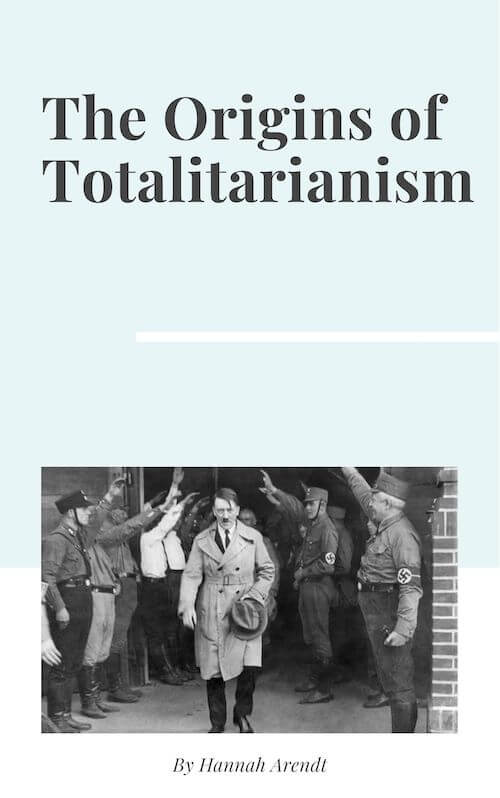
The Origins of Totalitarianism Book Summary
This The Origins of Totalitarianism Book Summary covers the key ideas, lessons, and takeaways in about 20 minutes.
The best way to prevent the rise of totalitarianism from happening is for all of society to be represented equally and to encourage free thinking. The protection of human rights and free will is essential to continue living in a democratic society.
Want the complete 20-minute summary?
- Full structured summary
- Video Summary
- Podcast Summary
- Audio summary
- Key takeaways
- Exercises
- Quiz
- Highlights and notes
- Ask the book with AI
What is in the The Origins of Totalitarianism book summary?
Below is a preview of Sumizeit’s expert-written summary of The Origins of Totalitarianism by Hannah Arendt. The full summary covers the book’s key ideas in text, audio, and video.
The rise of totalitarian regimes in the 20th Century culminated in a conflict that would become known as World War Two. The emergence of totalitarianism in Germany and the Soviet Union threatened world peace and forever changed the nature of war.
But totalitarianism was not a novel concept at that point. And even after the defeat of Nazi Germany, the threat of totalitarianism was not gone forever. At different points in history, circumstances can give rise to this ideology in small or large movements.
To understand how totalitarianism becomes a mainstream ideology, you need to first look at its origins and the catalyst for its emergence. It is important to be aware of these facts so that you can be aware of how society can prevent history from repeating itself.
Totalitarianism and antisemitism are not new ideas.
The rise of totalitarianism in the 20th Century was not something that occurred overnight. The foundations for it lay in Europe’s past, going as far back as the 17th Century. Its ties to anti-Semitic behavior go back just as far.
The social and class divide in Europe is centuries old. As European society evolved from feudal states to monarchies, the Jewish community played an integral role. Throughout history, Jewish people have been employed as financial managers to the ruling classes.
Because of their status, Jews became economically stable. However, their wealth did nothing to help include them in European society and for centuries the Jewish community found itself resented by nationalist Europeans.
If you were a witness to the changes in Europe over the centuries, you would see the growing discontent with the Jewish population. Unfounded accusations and conspiracy theories about the Jewish grab for power spread throughout Europe. Despite their contributions to society Jews were seen as outsiders and looked down upon by almost all classes of Europeans.
This all sounds ominous enough, but it got worse. As nationalist movements grew in parts of Europe, they promoted the idea that their people were racially superior. By the time the Nazi Party rose to power in Germany, the antisemitism sentiment was at the core of nationalistic ideas.
Democracy only works when you represent everyone.
You are probably wondering how nationalist movements gain a foothold in government. After all, just because they promote racist ideas, you would think that most people as decent law-abiding citizens, would not buy into it. The reality is that the nationalist movement had a lot of help from existing state governments, even if it was unintentional.
Before World War Two, European governments were losing supporters and discontent was growing with their leadership. Simultaneously, resentment towards Jewish people grew. One of the reasons for the resentment was the fact that a majority of Jewish people remained wealthy. Other communities were impacted by fluctuations in economic stability in European nations and they blamed the Jewish people for their bad situations.
As the years went by, many of the poor communities felt ignored by the politicians, who focused their energies on the…
Want the complete 20-minute summary?
- Full structured summary
- Video Summary
- Podcast Summary
- Audio summary
- Key takeaways
- Exercises
- Quiz
- Highlights and notes
- Ask the book with AI
Who should read The Origins of Totalitarianism ?
The Origins of Totalitarianism is essential reading for historians, political scientists, and engaged citizens seeking to understand how democracies become vulnerable to authoritarianism. Anyone concerned with protecting democratic institutions, recognizing propaganda patterns, or understanding 20th-century history will find Arendt's analysis deeply relevant.
Why does The Origins of Totalitarianism matter?
Hannah Arendt's examination of totalitarianism's roots remains urgently relevant as modern societies grapple with polarization, misinformation, and political extremism. By tracing how totalitarian ideologies gain power through the disenfranchisement of vulnerable populations, the book equips readers to recognize and resist similar threats in contemporary contexts.
What are the key themes in The Origins of Totalitarianism ?
- The historical foundations of totalitarianism and antisemitism in European society
- How democratic governments' failure to represent all citizens creates openings for extremism
- The role of propaganda and the distortion of truth in totalitarian regimes
- The suppression of free will and independent thought as mechanisms of control
- The exploitation of isolated and disenfranchised populations by totalitarian movements
- The rewriting of history to justify totalitarian ideology and maintain power
What are the key lessons from the The Origins of Totalitarianism book summary?
Totalitarianism has deep historical roots
Totalitarianism did not emerge suddenly in the 20th century but developed from centuries of social divisions and prejudices embedded in European society. Understanding these historical foundations helps explain how ideology becomes normalized over time.
Economic resentment fuels authoritarian movements
When communities experience economic hardship while blaming a scapegoat group for their suffering, they become vulnerable to populist movements that promise simple solutions. Totalitarian leaders exploit this resentment strategically.
Democratic governments must represent all citizens
When elected officials prioritize wealthy constituents and ignore the disenfranchised majority, they create a vacuum that extremist movements rush to fill. Inclusive representation is essential to democratic stability.
Propaganda replaces fact-based discourse in totalitarian systems
Totalitarian regimes deliberately blur the line between fact and fiction, suppressing critical thinking to maintain control over the narrative. Citizens stop questioning false claims when propaganda becomes the dominant mode of communication.
Historical revision serves ideological purposes
Totalitarian leaders rewrite history to justify their vision and create mythical narratives about their group's superiority. Fictional histories provide emotional and ideological motivation for followers while obscuring real motivations for power.
Free will is systematically eliminated in totalitarian states
Through sustained propaganda and the suppression of independent thought, totalitarian systems gradually erode citizens' ability to think and act freely. People eventually normalize rights violations and accept authoritarian control as inevitable.
Isolation makes populations susceptible to extremism
Individuals experiencing loneliness or social disconnection become vulnerable to totalitarian recruitment because extremist movements offer a sense of belonging and purpose. Totalitarians intentionally cultivate isolation to strengthen their grip.
Totalitarian movements exploit existing prejudices
Rather than inventing hatred from scratch, totalitarian regimes amplify and weaponize existing social divisions and prejudices for political gain. Antisemitism in Europe provided a ready-made ideological foundation for Nazi totalitarianism.
Democratic institutions can be eroded gradually through elections
Totalitarian movements do not always overthrow democracies violently; they can also exploit electoral systems and voter discontent to gain legitimacy and gradually dismantle democratic safeguards from within.
Dehumanization enables atrocities
When propaganda succeeds in portraying targeted groups as enemies or subhuman, ordinary citizens become complicit in or indifferent to mass violence. The suppression of empathy through ideology is a prerequisite for totalitarian atrocities.
Economic status alone does not protect minorities
Arendt shows that even financially successful minority groups face persecution in totalitarian contexts because totalitarian ideology targets entire categories of people regardless of individual circumstance or contribution.
Totalitarianism requires mass participation
Totalitarian regimes cannot function without significant popular support; they succeed by convincing ordinary people to embrace and enforce their ideology, making citizens complicit in their own and others' oppression.
Warning signs appear long before totalitarian takeover
Recognizable patterns precede totalitarian rise—growing disenfranchisement, scapegoating, erosion of democratic norms, and propaganda saturation. Awareness of these patterns enables societies to intervene earlier.
Totalitarianism thrives on collective narratives
Totalitarian movements succeed by offering coherent, emotionally resonant stories that explain social problems and promise solutions, even when those stories are factually baseless. Narrative power outweighs empirical truth in recruitment and control.
Democratic governments must actively defend inclusive representation
Democratic institutions cannot simply assume their survival; they require constant effort to ensure that all citizens feel heard and represented. Passivity in governance enables totalitarian alternatives to gain traction.
Free speech and critical thought are bulwarks against totalitarianism
Societies that protect the right to question authority, analyze information independently, and express dissent create friction against totalitarian consolidation. Suppression of these freedoms is a hallmark of totalitarian takeover.
Totalitarianism redefines human rights as irrelevant
Once totalitarian regimes establish control, they eliminate the concept of inalienable human rights, treating citizens as instruments of the state. The protection of rights is therefore a prerequisite for preventing totalitarian rise.
Scapegoating unites diverse groups against a common enemy
Totalitarian movements use scapegoating to create solidarity across class and regional lines by directing grievances toward a targeted group. This artificial unity fragments once unified opposition to authoritarian rule.
History can be prevented from repeating with awareness and action
While totalitarianism remains a recurring threat, recognizing its origins and mechanisms enables societies to implement preventive measures including inclusive governance, media literacy, and protection of dissent.
Want the complete 20-minute summary?
- Full structured summary
- Video Summary
- Podcast Summary
- Audio summary
- Key takeaways
- Exercises
- Quiz
- Highlights and notes
- Ask the book with AI
How can you apply ideas from The Origins of Totalitarianism ?
- Monitor political movements for signs of scapegoating and propaganda that exploit economic grievances or social divisions
- Evaluate whether your government's policies and representation include all demographic groups or whether certain populations are systematically neglected
- Practice critical media literacy by fact-checking claims and questioning narratives that appear emotionally compelling but lack empirical support
- Protect and exercise your rights to free speech, independent thought, and access to diverse information sources as safeguards against authoritarian control
- Build community connections and inclusive organizations that counter isolation and provide belonging outside totalitarian movements
- Educate others about historical patterns of totalitarian rise to build collective awareness and resistance capacity
- Support democratic institutions and policies that ensure equal representation and economic opportunity across all social groups
What common mistakes do readers make with The Origins of Totalitarianism ?
- Assuming totalitarianism can only emerge suddenly through violent revolution, when Arendt shows it often rises gradually through democratic institutions
- Believing that economically successful minorities are immune to persecution, when totalitarian ideology targets entire categories regardless of individual achievement
- Thinking that if you personally feel represented by government, disenfranchisement of others is not your concern—when widespread disenfranchisement enables totalitarian movements
- Dismissing propaganda as obviously false and assuming people would reject it rationally, when Arendt demonstrates that emotion and narrative often override fact-checking
Sumizeit Exercises Apply what you've learned
Turn ideas from The Origins of Totalitarianism into action with a short guided reflection: identify the biggest takeaway, connect it to your life, and commit to one step you can take in the next 24 hours.
What is the expert analysis of The Origins of Totalitarianism ?
Overview
The Origins of Totalitarianism, authored by Hannah Arendt, stands as a seminal work in political philosophy and modern history. Arendt, a German-American political theorist and philosopher, wrote this book in the aftermath of World War II, drawing on her personal experiences as a Jewish refugee and her rigorous academic background. The book’s significance lies in its profound analysis of the socio-political conditions that gave rise to totalitarian regimes, particularly Nazi Germany and Stalinist Soviet Union, and its enduring relevance in understanding the dynamics of power, ideology, and mass movements.
Core Thesis
Arendt’s central argument is that totalitarianism is not an accidental or isolated phenomenon but the culmination of historical processes rooted in social alienation, political disenfranchisement, and the erosion of democratic institutions. She traces the origins of totalitarianism to longstanding social divisions, including entrenched antisemitism and nationalist ideologies, which were exploited by totalitarian movements to mobilize disenfranchised masses. Totalitarian regimes succeed by dismantling free will through propaganda, rewriting history, and suppressing independent thought, thereby creating a society where truth is subordinated to ideology and power consolidates through fear and control.
Strengths
- Historical Depth: Arendt’s meticulous tracing of totalitarianism’s roots back to 17th-century Europe provides a rich historical context that deepens understanding beyond surface-level political events.
- Interdisciplinary Approach: Combining philosophy, sociology, and political theory, Arendt offers a nuanced analysis that captures the complexity of totalitarianism’s emergence and mechanisms.
- Insight into Mass Psychology: The exploration of how disenfranchisement and social isolation make populations vulnerable to totalitarian appeals is both psychologically astute and sociologically relevant.
- Timeless Warnings: Her emphasis on the fragility of democracy and the importance of inclusive representation resonates strongly in contemporary political discourse.
Critiques & Counterarguments
- Overgeneralization of Totalitarianism: Some scholars argue that Arendt’s conceptualization tends to homogenize distinct regimes, potentially overlooking significant ideological and structural differences between Nazi Germany and Stalinist Russia.
- Limited Empirical Evidence: While rich in philosophical insight, the book sometimes lacks rigorous empirical data, relying heavily on narrative and anecdotal evidence which may weaken its explanatory power in certain historical specifics.
- Neglect of Economic Factors: Critics from Marxist and economic historical perspectives might contend that Arendt underplays the role of economic crises and class conflict as primary drivers of totalitarianism.
- Competing Theories of Authoritarianism: Political scientists such as Juan Linz differentiate authoritarianism from totalitarianism, emphasizing that not all non-democratic regimes fit Arendt’s model, thus challenging the universality of her framework.
- Modern Contextual Challenges: The rise of digital media and globalization introduces new mechanisms of control and propaganda that Arendt’s mid-20th-century analysis does not fully anticipate, requiring updated frameworks for contemporary totalitarian tendencies.
Who Should Read This
This book is essential reading for scholars and students of political science, history, philosophy, and sociology who seek to understand the origins and mechanics of totalitarian regimes. It is also invaluable for policymakers, human rights advocates, and informed citizens concerned with the preservation of democratic institutions and the prevention of authoritarianism. Readers interested in the psychological and social dynamics of mass movements, as well as those reflecting on the ethical dimensions of power and governance, will find Arendt’s work profoundly illuminating.
Frequently asked questions about the The Origins of Totalitarianism book summary
What is The Origins of Totalitarianism about?
The Origins of Totalitarianism by Hannah Arendt is a foundational political analysis that traces how totalitarian regimes like Nazi Germany and the Soviet Union emerged from specific historical, social, and ideological conditions in Europe. The book examines the deep roots of totalitarianism—including centuries of antisemitism, economic division, and democratic failure—and explains how propaganda, rewriting of history, and suppression of free will enabled totalitarian movements to gain mass support and consolidate power.
Who should read The Origins of Totalitarianism?
The Origins of Totalitarianism is essential for historians, political scientists, and anyone concerned with democratic institutions and political extremism. It is particularly valuable for engaged citizens, educators, students of history, and policymakers who want to understand how democracies become vulnerable to authoritarianism and how to recognize warning signs in contemporary politics.
What are the main takeaways from The Origins of Totalitarianism?
Arendt's central argument is that totalitarianism emerges when large segments of society become disenfranchised by their governments, creating vulnerability to extremist movements that exploit scapegoating and propaganda. She emphasizes that democratic governments must ensure inclusive representation, protect free speech and independent thought, safeguard human rights, and actively build societies where citizens feel heard and connected. The book demonstrates that recognizing these patterns enables societies to prevent totalitarianism from recurring.
How did totalitarianism gain power in Europe?
According to Arendt, totalitarianism exploited longstanding prejudices (particularly antisemitism) combined with democratic governments' failure to represent all citizens. As economic hardship led to widespread disenfranchisement, people vulnerable to totalitarian messaging blamed scapegoat groups for their suffering. Totalitarian movements gained electoral support by appearing to understand these grievances, then gradually eroded democratic institutions and replaced factual discourse with propaganda.
What role does propaganda play in totalitarian systems?
In Arendt's analysis, propaganda is central to totalitarian control because it replaces fact-based discourse with compelling narratives that bypass critical thinking. Totalitarian regimes use propaganda to justify scapegoating, rewrite history, suppress dissent, and gradually eliminate citizens' capacity for independent thought. Once propaganda becomes the dominant mode of communication, people stop questioning false claims and accept the regime's ideology as truth.
Can totalitarianism happen again in modern democracies?
Yes, according to Arendt's analysis, totalitarianism remains a recurring threat whenever democratic governments lose sight of representing all citizens and widespread disenfranchisement creates vulnerability to extremist movements. She argues that modern societies can prevent this by ensuring inclusive governance, protecting free speech and critical thought, building community connections, and remaining vigilant about recognizing totalitarian warning signs.
Why is understanding totalitarianism's origins important today?
Arendt's analysis remains relevant because modern societies continue to face polarization, economic inequality, scapegoating, and misinformation—the very conditions that enabled totalitarian rise in the 20th century. By understanding how totalitarianism emerges from specific conditions, contemporary readers can recognize patterns in their own societies and take preventive action to strengthen democratic institutions and protect human rights before extremism gains momentum.
About Sumizeit
Sumizeit is a profitable Scomy LLC company based in Miami, Florida. It has been helping readers learn from nonfiction books for 7 years with expert-written summaries in text, audio, podcast, and video.
Want the complete 20-minute summary?
- Full structured summary
- Video Summary
- Podcast Summary
- Audio summary
- Key takeaways
- Exercises
- Quiz
- Highlights and notes
- Ask the book with AI
Here's why readers love Sumizeit
Join thousands of learners getting smarter every day
"Great experience. Detailed summaries. Loved the gamification feature. Makes learning fun. Good customer service. I recommend Sumizeit to anyone. You'll learn a lot."
"I always felt busy but still wanting to keep up with the book discussion in my friend group. This was a great supplement to help me keep reading the books I find fun while keeping up with important books."
"I love this website. Instead of scrolling social media, I find myself learning a lot. I use it everyday. I recommend this app for anyone who is too busy and wants to get up to speed with their favorite books."
The Origins of Totalitarianism Book Summary PDF
Looking for a The Origins of Totalitarianism Book Summary PDF you can save and revisit offline? Our The Origins of Totalitarianism Book Summary PDF captures the book’s core ideas in a clean, printable format — the key frameworks, takeaways, and structure without the fluff. Download the The Origins of Totalitarianism Book Summary PDF when you want a reference you can annotate, share with your team, or review on the go. Get your The Origins of Totalitarianism Book Summary PDF from the download page below.
Download The Origins of Totalitarianism Book Summary PDFPeople also liked these summaries
Readers who explored The Origins of Totalitarianism often enjoyed these titles next.




Want the complete 20-minute summary?
- Full structured summary
- Video Summary
- Podcast Summary
- Audio summary
- Key takeaways
- Exercises
- Quiz
- Highlights and notes
- Ask the book with AI
Featured Book Titles
Popular Book Summaries at sumizeit, leading book summary app