


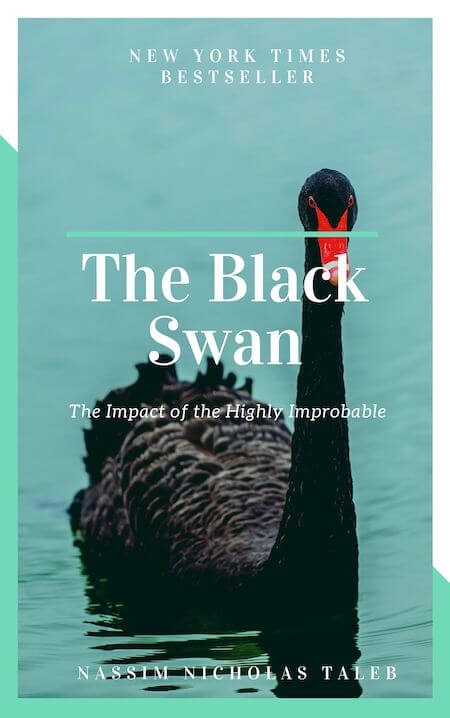
Prefer the print book? Buy on Amazon
As an Amazon Associate, Sumizeit earns from qualifying purchases.
The Black Swan Book Summary
This The Black Swan Book Summary covers the key ideas, lessons, and takeaways in about 20 minutes.
Short Description:
Accept randomness and prepare for unpredictable black swan e
Black swans are unpredictable. Because of their extreme nature, you don’t see them coming until they’re already there. Black swans are consequential. They have a widespread impact or a curve-breaking magnitude. Black swans are explainable. But this is only in retrospect once you have the benefit of hindsight.
Some randomness is not that impactful and you don’t really have to worry. You can control and predict to a certain degree in these areas free of black swans. This is the world of Mediocristan.
If you’re in Extremistan, you have to be willing to challenge your beliefs and look for evidence contrary to your theories. There are opportunities for success like J.K. Rowling and Bill Gates, but there is also the potential for mass devastation through war, terrorism, and pandemics.
It is hard to grapple with the unknown, especially because it can change everything so quickly. But you have to accept this truth to be as prepared as possible while also appreciating what you have.
Want the complete 20-minute summary?
- Full structured summary
- Video Summary
- Podcast Summary
- Audio summary
- Key takeaways
- Exercises
- Quiz
- Highlights and notes
- Ask the book with AI
Want a Free Weekly Read?
Get a free summary every week straight to your mailbox.
Preview the The Black Swan book summary
Below is a preview of Sumizeit’s comprehensive human-written summary of The Black Swan by Nassim Nicholas Taleb. The full summary is 15-20 minutes long and covers the book’s key ideas in text, audio, visual, and video formats. Unlock the full 20 Minute Summary
The events that shift the course of history for an economy, a country, or the whole planet are known as “black swans.” They cannot be predicted, although you can explain them in retrospect.
Humans don’t generally do well with chaos, randomness, and unpredictability, but the things that make the biggest impact are not the ones we see coming. Our brains try to make sense of the information and trick us into seeing patterns and causality where they don’t exist.
Black swans aren’t necessarily bad, but the things that rock the world (think 9/11, World War II, pandemics) cannot be predicted. It may be hard to accept that you can’t see the big, terrible things coming.
You have to learn to live with the unknown unless you want to delude yourself. Look for good black swans and appreciate the beauty of the randomness around us.
Not all swans are white, even if that’s the only kind you know.
So, why are these unpredictable events called black swans? For a long time, Europeans were taught that swans are white birds. It makes sense because this is all they knew. If you only see birds with white plumage, it would be reasonable to conclude that that’s what they all look like.
Then, in 1697, the European view of swans changed. Willem de Vlamingh, a Dutch explorer, landed in Australia. Many of the animals there were unlike the ones seen in Europe. Kangaroos, koalas, and duck-billed platypuses are unique to the Land Down Under. Then, there was a bird that looked just like a swan. Except, it had dark feathers.
These black swans were never imagined by Europeans. It seemed improbable that a creature identical to those around them but with different colored feathers. Of course, once you know they exist, it is easy to explain why the black swans are there.
You don’t have to see a black swan for it to exist.
The metaphorical black swan is unpredictable, consequential, and explainable only in retrospect.
Like its avian counterpart, a black swan event can exist even if you don’t see it coming. In fact, that is one of the hallmarks of a black swan. They are unpredictable. They are not likely or probable events, and they may not even seem like real possibilities. But they happen.
And when they happen, they’re a big deal. Consequences are also a key component of black swans. When there’s a black swan, it is impactful. Think about the terrorist attacks on September 11th. The tragedy of that day was hugely impactful on its own, but there were also large changes to the world after ranging from international conflict, the way we travel, and more.
Finally, black swans can be explained after the fact, but that’s with the benefit of hindsight. Take a stock market crash. Yes, they happen from time to time. However, they do not come on a predictable schedule.
Want the complete 20-minute summary?
- Full structured summary
- Video Summary
- Podcast Summary
- Audio summary
- Key takeaways
- Exercises
- Quiz
- Highlights and notes
- Ask the book with AI
Who should read The Black Swan?
The Black Swan is essential for investors, business leaders, policymakers, and anyone seeking to understand how unpredictable events shape our world. If you've ever wondered why major world-changing events catch us by surprise despite expert predictions, or if you want to build resilience against unforeseen catastrophes, this book will fundamentally shift how you think about probability and risk.
Why does The Black Swan matter?
In an increasingly complex world where major events—from financial crashes to pandemics—repeatedly blindside experts and institutions, understanding black swans has become critical for survival and success. Nassim Nicholas Taleb's framework reveals why traditional statistical models fail us and how we can better prepare for the extraordinary rather than waste resources predicting the ordinary. This book challenges the dangerous illusion that we can forecast the future and shows us how to think more clearly about uncertainty in our careers, investments, and lives.
What are the key themes in The Black Swan?
- The unpredictability of high-impact events despite expert analysis
- The difference between ordinary randomness (Mediocristan) and extreme randomness (Extremistan)
- Cognitive biases that prevent us from seeing black swans
- The role of luck and chance in success narratives
- The limitations of statistical models and expert predictions
- How to position yourself to benefit from positive black swans
Want the complete 20-minute summary?
- Full structured summary
- Video Summary
- Podcast Summary
- Audio summary
- Key takeaways
- Exercises
- Quiz
- Highlights and notes
- Ask the book with AI
How can you apply ideas from The Black Swan?
- Build investment portfolios with black swan protection rather than relying on expert market predictions to guide your stock picks
- Diversify your career skills and income streams to reduce vulnerability to industry-specific catastrophes
- Create a diverse social and professional network to increase exposure to unexpected opportunities and serendipitous connections
- Question expert advice in high-uncertainty domains like finance, epidemiology, and geopolitics by recognizing the limits of their predictive models
- Document and analyze your own luck by comparing your outcomes to others with similar starting conditions to better understand chance versus skill
- Actively seek out disconfirming evidence for your beliefs rather than only looking for support
- Build optionality into your plans to benefit from positive black swans when they arrive unexpectedly
What common mistakes do readers make with The Black Swan?
- Treating expert predictions as reliable forecasts when experts consistently fail at predicting rare, high-impact events
- Accepting success narratives that credit talent and effort while ignoring the significant role of luck and timing
- Using traditional statistical models and bell curves to assess risk in domains like wealth, markets, and rare events where they don't apply
- Seeking only information that confirms your existing beliefs instead of rigorously challenging your own theories
Sumizeit Exercises Apply what you've learned
Turn ideas from The Black Swan into action with a short guided reflection: identify the biggest takeaway, connect it to your life, and commit to one step you can take in the next 24 hours.
What is the expert analysis of The Black Swan?
Overview
The Black Swan: The Impact of the Highly Improbable is a seminal work by Nassim Nicholas Taleb, a statistician, former trader, and philosopher of uncertainty. Published as part of his broader Incerto series, this book challenges conventional wisdom about predictability, risk, and the nature of rare but consequential events. Taleb’s unique background in finance and academia informs a provocative critique of how humans perceive randomness and the limits of knowledge, making this book a landmark contribution to fields ranging from economics to epistemology.
Core Thesis
Taleb’s central argument is that the most impactful events in history—“black swans”—are inherently unpredictable, carry massive consequences, and can only be rationalized in hindsight. These events defy traditional statistical models, particularly the Gaussian bell curve, and expose the fragility of human cognition and expert predictions. Taleb distinguishes between “Mediocristan,” where randomness is mild and predictable, and “Extremistan,” where rare, extreme outliers dominate outcomes. He asserts that most of the world’s most significant changes arise from Extremistan-type phenomena, which our brains and conventional tools are ill-equipped to anticipate or understand.
Strengths
- Innovative Conceptual Framework: The black swan metaphor elegantly captures the paradox of rare, high-impact events that shape history yet evade prediction.
- Interdisciplinary Insight: Taleb weaves together philosophy, statistics, psychology, and finance to expose cognitive biases such as narrative fallacy and confirmation bias that distort our understanding of randomness.
- Critique of Expertise: The book compellingly challenges the authority of experts and models that rely on normal distributions, highlighting their blind spots in dealing with uncertainty.
- Practical Implications: Taleb’s call to embrace uncertainty and seek “positive black swans” offers a constructive approach to risk management and decision-making under uncertainty.
- Engaging Style: Through vivid examples—from 9/11 to the rise of Harry Potter—Taleb makes complex ideas accessible and memorable.
Critiques & Counterarguments
- Overemphasis on Unpredictability: While black swans are by definition unpredictable, some critics argue Taleb underestimates the potential of probabilistic forecasting and scenario planning to mitigate risk.
- Binary Worldview: The strict division between Mediocristan and Extremistan can oversimplify complex systems where predictability exists on a spectrum rather than a dichotomy.
- Retrospective Rationalization: Taleb’s emphasis on hindsight explanations may inadvertently encourage skepticism toward all causal narratives, potentially undermining meaningful analysis.
- Limited Empirical Rigor: Some of Taleb’s claims rely heavily on anecdotal evidence and personal experience rather than systematic empirical validation, which can weaken the generalizability of his conclusions.
- Opposing Schools of Thought: Alternative perspectives from behavioral economics and complexity science suggest that while perfect prediction is impossible, adaptive systems and learning algorithms can improve forecasting over time, challenging Taleb’s more fatalistic view.
Who Should Read This
The Black Swan is essential reading for scholars and practitioners across economics, finance, risk management, philosophy, and psychology who grapple with uncertainty and decision-making. It is particularly valuable for those skeptical of conventional models and eager to explore the limits of knowledge and prediction. Additionally, leaders, strategists, and policy makers seeking to understand and prepare for rare but transformative events will find Taleb’s insights both challenging and indispensable. Finally, intellectually curious readers interested in the interplay of randomness, human cognition, and history will appreciate the book’s depth and provocative style.
Frequently asked questions about the The Black Swan book summary
What is The Black Swan about?
The Black Swan by Nassim Nicholas Taleb explores how unpredictable, high-impact events shape history and our lives. The book explains why these rare, consequential events—from 9/11 to financial crashes to pandemics—cannot be reliably predicted, despite our tendency to explain them perfectly in hindsight. Taleb argues that our brains, our expert institutions, and our statistical models all fail to account for the role of extreme randomness in determining outcomes.
Who should read The Black Swan?
Anyone who invests, makes strategic decisions, or wants to understand how the world actually works should read this book. It's particularly valuable for investors, business leaders, policymakers, and professionals in fields like finance, risk management, and planning. Even if you've never thought about black swans before, this book will change how you think about uncertainty, luck, and the limits of expert knowledge.
What are the main takeaways from The Black Swan?
The core takeaways are: (1) The most consequential events in history and in our lives are fundamentally unpredictable; (2) Our brains, biases, and expert institutions systematically fail to account for rare, extreme events; (3) In some domains (Mediocristan) randomness is manageable, but in others (Extremistan) one outlier can change everything; (4) Success and luck are deeply intertwined in ways we rarely acknowledge; and (5) Rather than trying to predict the future, we should position ourselves to benefit from positive black swans and protect against negative ones.
What does Taleb mean by Mediocristan and Extremistan?
Mediocristan represents domains where bell curves and traditional statistics work—like human height or average income levels. Extremistan represents domains where extreme outliers can distort everything—like wealth, book sales, or casualty figures in wars. Understanding which world you're in determines whether averages are meaningful and whether your risk models actually apply.
Why can't experts predict black swans?
Experts typically rely on statistical models, historical patterns, and domain-specific knowledge that all assume the future will resemble the past. Black swans, by definition, are unprecedented events that fall outside normal probability distributions. Experts often mistake their modeling tools for truth and dismiss anything that doesn't fit their models as an outlier, making them blind to the very events that matter most.
How does the narrative fallacy prevent us from seeing black swans?
The narrative fallacy is our tendency to create compelling stories that explain events after they happen, while downplaying or ignoring the role of luck. Success stories attribute outcomes to talent and effort, but when you compare similar people with different results, you see how much chance was involved. This bias keeps us from recognizing how much randomness shapes outcomes.
Can you prepare for a black swan if you can't predict it?
Yes, though not by trying to forecast which black swan will occur. Instead, you can build resilience through diversification, maintain exposure to opportunities through diverse networks, and structure your life with optionality so you benefit from positive surprises. You can also reduce your vulnerability to catastrophic outcomes by not concentrating all your resources or risk in one area.
About Sumizeit
Sumizeit is a profitable Scomy LLC company based in Miami, Florida. Our founders, Clemens Raemy and Weina Scott, are successful entrepreneurs with several exits. Sumizeit is a popular book summary app / micro learning app used by busy professionals and entrepreneurs with over 2,500 non-fiction book summaries and 10,000 podcast summaries in text, audio, visual, podcast, and video format. We also have stellar retention tools to make ideas stick - such as flashcards with spaced repetition, quizzes, streaks, highlighting and notes, daily challenges, riddles, mini-courses, meditation, and more. You won't only learn the idea, but also remember it. Over 90% of our users change their habits with Sumizeit.
Upgrade Now
Want the complete 20-minute summary?
- Full structured summary
- Video Summary
- Podcast Summary
- Audio summary
- Key takeaways
- Exercises
- Quiz
- Highlights and notes
- Ask the book with AI
Here's why readers love Sumizeit
Join thousands of learners getting smarter every day
"Great experience. Detailed summaries. Loved the gamification feature. Makes learning fun. Good customer service. I recommend Sumizeit to anyone. You'll learn a lot."
"I always felt busy but still wanting to keep up with the book discussion in my friend group. This was a great supplement to help me keep reading the books I find fun while keeping up with important books."
"I love this website. Instead of scrolling social media, I find myself learning a lot. I use it everyday. I recommend this app for anyone who is too busy and wants to get up to speed with their favorite books."
The Black Swan Book Summary PDF
Looking for a The Black Swan Book Summary PDF you can save and revisit offline? Our The Black Swan Book Summary PDF captures the book’s core ideas in a clean, printable format — the key frameworks, takeaways, and structure without the fluff. Download the The Black Swan Book Summary PDF when you want a reference you can annotate, share with your team, or review on the go. Get your The Black Swan Book Summary PDF from the download page below.
Download The Black Swan Book Summary PDFPeople also liked these summaries
Readers who explored The Black Swan often enjoyed these titles next.


Want the complete 20-minute summary?
- Full structured summary
- Video Summary
- Podcast Summary
- Audio summary
- Key takeaways
- Exercises
- Quiz
- Highlights and notes
- Ask the book with AI
Featured Book Titles
Popular Book Summaries at sumizeit, leading book summary app