


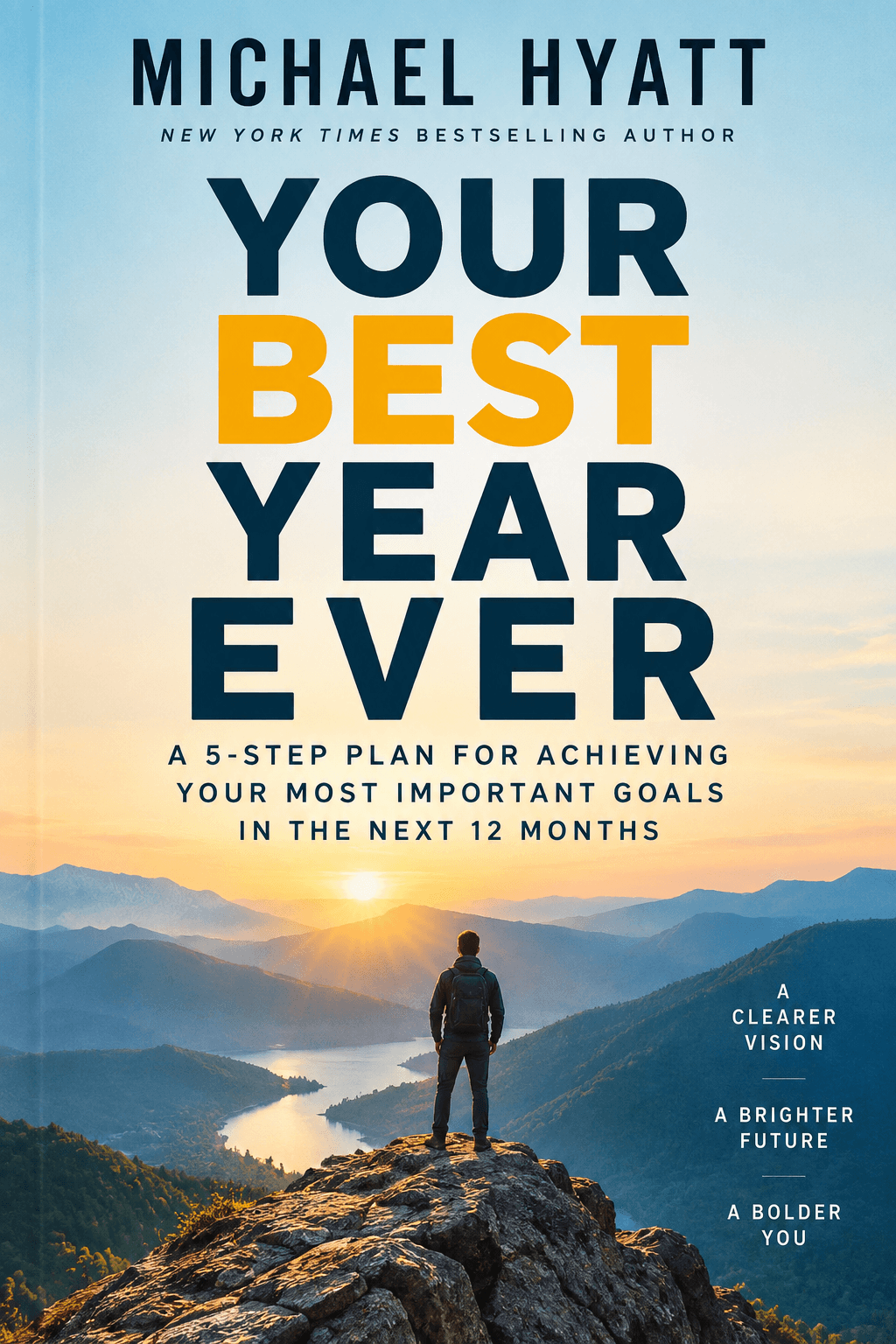
Prefer the print book? Buy on Amazon
As an Amazon Associate, Sumizeit earns from qualifying purchases.
Your Best Year Ever Book Summary
This Your Best Year Ever Book Summary covers the key ideas, lessons, and takeaways in about 20 minutes.
Short Description:
Michael Hyatt's five step system for setting goals that actually survive the year.
Helps with these goals
Preview the Your Best Year Ever book summary
Below is a preview of Sumizeit’s comprehensive human-written summary of Your Best Year Ever by Michael Hyatt. The full summary is 15-20 minutes long and covers the book’s key ideas in text, audio, visual, and video formats. Unlock the full 20 Minute Summary
Every January, people write down the same kinds of goals. Lose weight. Save money. Read more. Call parents more often. Twelve months later, most of those goals are quietly forgotten, and a new list gets written the following January as if the first one never happened.
Michael Hyatt spent years watching this cycle repeat, both in his own life and in the lives of the people he coaches, and he came to a conclusion that runs against the grain of most self help advice. Failing to hit a goal is almost never a personal failing. It is a systems failure. You did not fail because you lack willpower or discipline. You failed because nothing in your approach accounted for the predictable obstacles that show up whenever a person tries to change their life.
Hyatt breaks those obstacles into five categories that work against nearly everyone. There are limiting beliefs that quietly convince you a goal is out of reach before you even start. There is unresolved baggage from past attempts that failed, which colors how you approach anything new. There are goals that were designed poorly in the first place, vague enough that you can not tell whether you are making progress. There is motivation that fades once the initial excitement wears off. And there is a total absence of any structure to keep you moving once life gets busy again.
Most goal setting advice tackles one of these five problems and ignores the other four. A book about willpower will get you through the motivation problem but leaves your limiting beliefs untouched. A book about SMART goals will help you write a clearer goal but does nothing for the fact that you never process why last year's version of that same goal fell apart. Hyatt built his system to hit all five problems in sequence, which is why the book reads less like a pep talk and more like a five step process you actually walk through.
The three ideas everything else is built on
Before Hyatt gets into the five steps, he lays out three assumptions that shape the entire approach. If you disagree with these, the rest of the system will not make much sense, so it is worth understanding them first.
The first assumption is that a genuinely successful life has to be a balanced one. Hyatt divides life into ten domains, your career, your hobbies and interests, your finances, your relationship with a spouse or partner, your relationship with your children, your friendships and extended family, your physical health, your emotional health, your relationship with a higher power, and your engagement with ideas that matter to you. His point is not that you need to be excellent in all ten at once. It is that these domains are connected in ways people tend to ignore. Neglect your physical health long enough and it will eventually drain your career.
Want the complete 20-minute summary?
- Full structured summary
- Video Summary
- Podcast Summary
- Audio summary
- Key takeaways
- Exercises
- Quiz
- Highlights and notes
- Ask the book with AI
Who should read Your Best Year Ever?
Your Best Year Ever is for anyone tired of watching New Year's resolutions fail by February. Whether you're an ambitious professional, an entrepreneur, or simply someone who wants to make meaningful progress across multiple areas of life, this book provides a practical system rather than motivational platitudes. It's especially valuable for people who've tried goal-setting before and wondered why their plans never stuck.
Why does Your Best Year Ever matter?
Most goal-setting advice tackles only one obstacle to success while ignoring four others, which is why the same resolutions cycle through year after year. Your Best Year Ever by Michael Hyatt addresses all five barriers systematically—limiting beliefs, unprocessed past failures, poorly designed goals, fading motivation, and lack of structure. In a world where ambition is common but completion is rare, this book offers an engineering fix to a problem most people misdiagnose as personal failure rather than systemic failure.
What are the key themes in Your Best Year Ever?
- Systems beat willpower: success requires structure, not just motivation
- Beliefs shape outcomes: what you believe about yourself actively constrains or enables your results
- Life balance matters: neglecting one domain quietly sabotages success in others
- Growth precedes happiness: satisfaction follows genuine progress, not the reverse
- You have more control than you think: underestimating your power is often convenient but costly
How can you apply ideas from Your Best Year Ever?
- Use the LifeScore Assessment to honestly rate where you stand in all ten life domains, creating a baseline that shows where growth is most needed
- Write out limiting beliefs and deliberately search for counterexamples to prove the belief wrong, then commit to new belief-aligned behavior before it feels natural
- Complete the structured closure exercise on last year's disappointments, extracting two or three themes and translating each into one memorable lesson and one concrete behavior change
- Design goals using SMARTER criteria, ensuring each goal has both excitement (something you enjoy pursuing) and risk (something that stretches you past comfort)
- Implement the weekly-daily-quarterly check-in rhythm: 20 minutes weekly to review motivators and plan outcomes, 1 minute daily to commit to three actions, and 2 hours quarterly to celebrate and reassess
- Map out anticipated obstacles and decide in advance (if-then statements) exactly what you'll do when each one appears, keeping yourself on track toward the original goal
- Build gratitude into an existing daily routine (meal, morning coffee, bedtime) and return to your gratitude journal on hard days when motivation fades
- Identify your top three motivators for each goal and write both a rational reason and an emotional reason why you care, then refer to these when momentum drops
What common mistakes do readers make with Your Best Year Ever?
- Jumping straight to goal-writing without addressing the limiting beliefs that will quietly sabotage new attempts at the same old goals
- Setting too many goals across too many domains and trying to push hard on all of them simultaneously, which spreads effort too thin and leads to burnout or failure
- Treating a single setback as permanent proof of inability (universalizing) rather than extracting the specific lesson and moving forward with new information
- Announcing goals publicly too early and feeling accomplished by the praise and recognition, which removes the motivational pull that actually drives completion
Sumizeit Exercises Apply what you've learned
Turn ideas from Your Best Year Ever into action with a short guided reflection: identify the biggest takeaway, connect it to your life, and commit to one step you can take in the next 24 hours.
What is the expert analysis of Your Best Year Ever?
Overview
Your Best Year Ever is a goal-setting and personal development book authored by Michael Hyatt, a seasoned leadership expert and former CEO of Thomas Nelson Publishers. Hyatt’s extensive background in leadership development and his focus on balancing professional success with personal well-being lend the book a credible and practical foundation. This work stands out in the crowded self-improvement genre by diagnosing goal failure not as a personal deficiency but as a systemic issue, offering a structured, multi-faceted approach to achieving lasting change.
Core Thesis
Hyatt’s central argument challenges the conventional wisdom that failed resolutions stem from lack of willpower or discipline. Instead, he posits that goal failure is almost always a failure of system design—specifically, a system that neglects predictable psychological and practical obstacles. He identifies five key barriers to success: limiting beliefs, unresolved past disappointments, poorly designed goals, fading motivation, and absence of sustaining structures. His solution is a five-step process that sequentially addresses each barrier, culminating in a comprehensive framework that integrates belief work, honest reflection, strategic planning, immediate action, and sustained effort supported by motivation, accountability, and gratitude.
Strengths
- Holistic and Balanced Perspective: Hyatt’s insistence on viewing life through ten interconnected domains prevents the common pitfall of success in one area at the expense of others, promoting sustainable and integrated growth.
- Systematic and Practical Framework: The five-step process is methodical and actionable, moving beyond generic motivational advice to concrete tools like the LifeScore Assessment, SMARTER goals, and LEAP principle.
- Psychological Sophistication: The focus on identifying and reframing limiting beliefs, supported by the illustrative four-minute mile story, reveals a nuanced understanding of cognitive biases and their impact on behavior.
- Emphasis on Sustained Motivation: Hyatt’s layered check-in system and strategies such as “if-then” planning and selective accountability acknowledge the complexity of long-term goal maintenance.
- Integration of Emotional and Rational Drivers: By encouraging readers to articulate both rational and emotional reasons behind their goals, Hyatt taps into deeper motivational reservoirs often overlooked in goal-setting literature.
Critiques & Counterarguments
- Potential Oversimplification of Psychological Barriers: While Hyatt adeptly addresses limiting beliefs, the treatment of unresolved past failures as “baggage” may understate the complexity of emotional trauma and its impact on goal pursuit. More nuanced psychological interventions might be necessary for many readers.
- Limited Engagement with Socioeconomic and Structural Constraints: The assumption that readers have significant control over their lives, while empowering, risks minimizing systemic factors such as economic hardship, discrimination, or health challenges that can severely limit agency.
- Reliance on Self-Discipline and Internal Motivation: The framework presumes a baseline capacity for self-regulation and introspection that might not be accessible to all, particularly those with mental health challenges or limited support systems.
- Competing Research on Goal Setting: Some behavioral science research suggests that setting fewer, highly focused goals may be more effective than juggling multiple goals across domains, as Hyatt recommends. The cognitive load of managing seven to ten goals could dilute effort and increase burnout risk.
- Risk of Overemphasis on Individual Responsibility: Hyatt’s critique of “backup plans” as psychologically enabling failure might overlook the adaptive value of contingency planning in complex, uncertain environments, where flexibility rather than rigid persistence can be more strategic.
Who Should Read This
Your Best Year Ever is ideally suited for ambitious professionals, entrepreneurs, and individuals committed to personal growth who have struggled with traditional goal-setting methods. Readers who appreciate a structured, psychologically informed approach that integrates motivation, accountability, and balanced life domains will find Hyatt’s system especially valuable. It is also a strong fit for those who seek practical tools rather than abstract inspiration, and who are ready to engage in honest self-assessment and sustained effort. However, readers facing significant external constraints or deep psychological challenges may need to supplement Hyatt’s approach with additional support.
Frequently asked questions about the Your Best Year Ever book summary
What is Your Best Year Ever about?
Your Best Year Ever by Michael Hyatt is a practical system for setting and achieving goals by addressing the five obstacles that derail most people: limiting beliefs, unprocessed past failures, poorly designed goals, fading motivation, and lack of structure. Rather than offering motivational platitudes, the book provides a repeatable five-step process that treats goal failure as a systems problem rather than a personal failing.
Who should read Your Best Year Ever?
This book is for anyone who has watched New Year's resolutions fail by February, including ambitious professionals, entrepreneurs, and people juggling multiple life priorities. It's especially valuable for those who've attempted goal-setting before and wondered why their plans never stuck, or who want to succeed at work without quietly losing everything else in the process.
What are the main takeaways from Your Best Year Ever?
The core takeaways are that goal failure is usually a systems failure, not a personal failing; that limiting beliefs act as invisible ceilings on effort; that balance across life domains prevents success in one area from wrecking others; and that structure—through check-ins, if-then plans, support systems, and gratitude—is what keeps goals alive across a full year. Michael Hyatt's five-step system addresses belief-fixing, closure on past failures, goal design, rapid action, and sustained effort through predictable obstacles.
How does Michael Hyatt define the five obstacles that derail goals?
Hyatt identifies limiting beliefs that convince you a goal is out of reach before you start; unresolved baggage from past failed attempts that quietly sabotages new tries; poorly designed goals that are too vague to track progress on; motivation that fades once initial excitement wears off; and a total absence of structure to keep you moving when life gets busy. Most goal advice tackles only one of these five, which is why it fails.
What is the SMARTER framework and how does it differ from SMART goals?
SMARTER expands the traditional SMART framework (Specific, Measurable, Actionable, Relevant, Time-bound) by adding two critical elements: Exciting goals that you genuinely enjoy pursuing rather than just feel good finishing, and Risky goals that stretch you past comfort into growth. Hyatt argues that a goal feeling entirely safe and realistic won't push you to develop, so deliberately setting something slightly impossible—then softening it to difficult rather than paralyzing—creates the conditions for real progress.
What is the Law of Diminishing Intent and why does it matter for goal-setting?
The Law of Diminishing Intent states that the longer you wait after deciding to pursue a goal, the less likely you are to ever start it, because doubt has time to regroup and enthusiasm fades. This is why Hyatt emphasizes the LEAP principle—Lean in, Engage with details, Act on the next step, and Pounce immediately—to move from intention to action quickly before motivation evaporates.
How do if-then actions differ from backup plans in Your Best Year Ever?
If-then actions anticipate obstacles and commit you to solving for the original goal (for example, if you get too busy for lessons, you move them to weekends instead). Backup plans outline what you'll do if the goal fails entirely, which psychologically gives permission to quit. Hyatt distinguishes carefully between accommodating obstacles within the goal and planning for complete failure, with if-then actions keeping you committed to the original objective.
About Sumizeit
Sumizeit is a profitable Scomy LLC company based in Miami, Florida. Our founders, Clemens Raemy and Weina Scott, are successful entrepreneurs with several exits. Sumizeit is a popular book summary app / micro learning app used by busy professionals and entrepreneurs with over 2,500 non-fiction book summaries and 10,000 podcast summaries in text, audio, visual, podcast, and video format. We also have stellar retention tools to make ideas stick - such as flashcards with spaced repetition, quizzes, streaks, highlighting and notes, daily challenges, riddles, mini-courses, meditation, and more. You won't only learn the idea, but also remember it. Over 90% of our users change their habits with Sumizeit.
Upgrade Now
Here's why readers love Sumizeit
Join thousands of learners getting smarter every day
"Great experience. Detailed summaries. Loved the gamification feature. Makes learning fun. Good customer service. I recommend Sumizeit to anyone. You'll learn a lot."
"I always felt busy but still wanting to keep up with the book discussion in my friend group. This was a great supplement to help me keep reading the books I find fun while keeping up with important books."
"I love this website. Instead of scrolling social media, I find myself learning a lot. I use it everyday. I recommend this app for anyone who is too busy and wants to get up to speed with their favorite books."
Your Best Year Ever Book Summary PDF
Looking for a Your Best Year Ever Book Summary PDF you can save and revisit offline? Our Your Best Year Ever Book Summary PDF captures the book’s core ideas in a clean, printable format — the key frameworks, takeaways, and structure without the fluff. Download the Your Best Year Ever Book Summary PDF when you want a reference you can annotate, share with your team, or review on the go. Get your Your Best Year Ever Book Summary PDF from the download page below.
Download Your Best Year Ever Book Summary PDFPeople also liked these summaries
Readers who explored Your Best Year Ever often enjoyed these titles next.



Ready to read the whole thing?
- Full structured summary
- Video Summary
- Podcast Summary
- Audio summary
- Key takeaways
- Exercises
- Quiz
- Highlights and notes
- Ask the book with AI
Featured Book Titles
Popular Book Summaries at sumizeit, leading book summary app