Question 1 of 10


Prefer the print book? Buy on Amazon
As an Amazon Associate, Sumizeit earns from qualifying purchases.
Book Summary
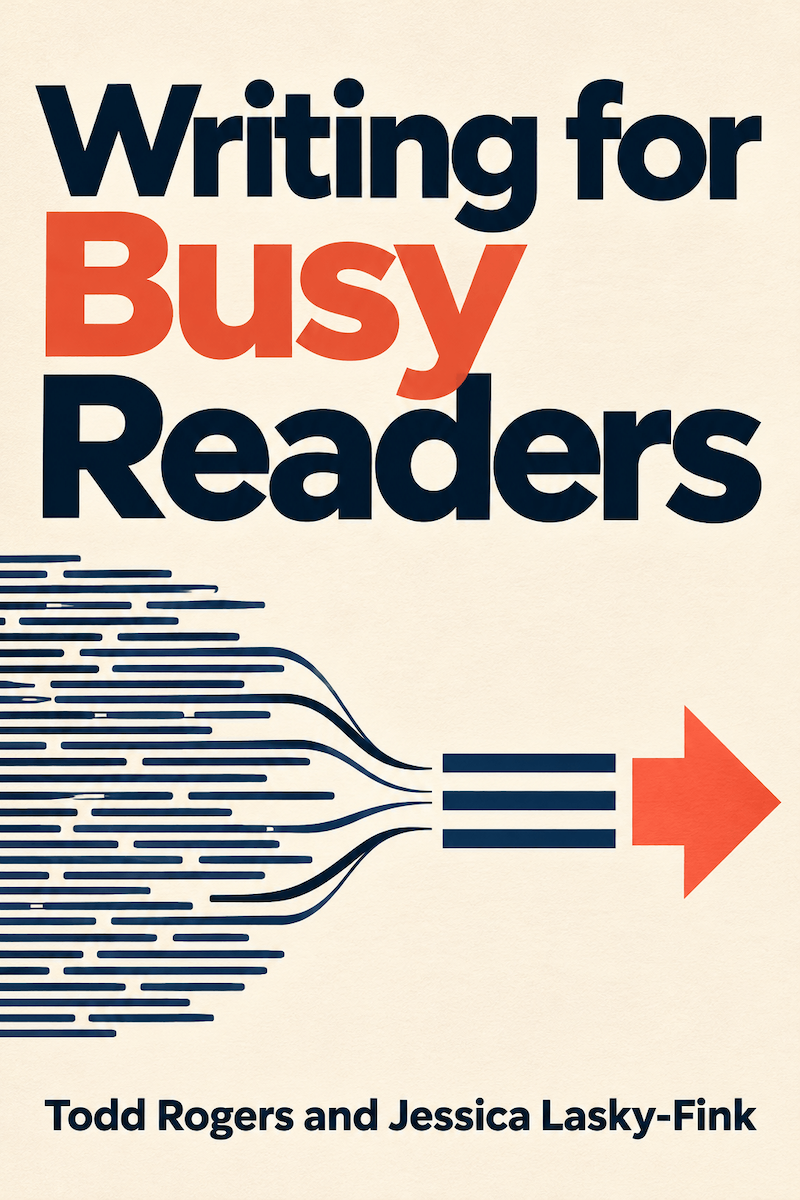
Writing for Busy Readers Book Summary
This Writing for Busy Readers Book Summary covers the key ideas, lessons, and takeaways in about 20 minutes.
Short Description:
A plain guide to writing messages busy readers actually read and act on
Your readers are busy, distracted, and quick to decide whether your message deserves their attention, so your job is to make that decision easy. Know exactly what you want to say and why it matters to the person reading, put your main point first, use short and simple words, and ask for one clear action. Then check how you format, revise more than once, think about who sends the message, how and when, and keep practicing. Do this and more people will read, understand, and act on what you write.
Helps with these goals
Preview the Writing for Busy Readers book summary
Below is a preview of Sumizeit’s comprehensive human-written summary of Writing for Busy Readers by Todd Rogers and Jessica Lasky-Fink. The full summary is 15-20 minutes long and covers the book’s key ideas in text, audio, visual, and video formats. Unlock the full 20 Minute Summary
You write all day. Emails, texts, memos, posts. And a lot of it gets skimmed, skipped, or forgotten. Todd Rogers and Jessica Lasky-Fink say the fix is to write effectively. That means two things. You convince readers your message is worth their time, and you make it easy to understand once they start reading.
The advice rests on behavioral science and on the authors' own work. They have spent years figuring out how to write to voters, families, and political constituents, including during the pandemic. Their book (published in 2023) gives you techniques that work whether you're writing a work update, a petition, or a text to a friend.
What effective writing is
Effective writing gives readers the information they need without extra complexity. It has a purpose, so you shape it to get a specific result. It is also clear, short, and direct, because almost every reader is pressed for time and buried in messages.
This is different from literary writing. A novel can be dense and layered because readers want to take their time with it. A message meant to inform people, solve a problem, or push someone to act should not make readers work. Use effective writing to announce an event, give instructions, or make your case.
Why it pays off
The authors point to two benefits.
First, effective writing captures attention. Attention is limited, so readers make a quick gut call about how much effort a piece deserves. They weigh what they might gain against the time and energy it will cost. People like low effort and fast rewards. If your writing looks easy to read and clearly useful, they dive in. If it looks like a slog, they move on.
Second, effective writing has more impact. Readers who understand your message are more likely to act on it. The authors say this matters well beyond your own goals. Confusing writing shuts people out, especially readers with limited literacy. A badly written government policy can leave citizens unsure of their rights. A patient who can't follow hospital aftercare instructions might skip something that matters for recovery. Clear writing helps people make better choices about their lives, and that makes for a healthier society.
The rest of this summary walks through the book's advice in the order you would use it, from planning to sending to improving over time.
Step 1. Refine your purpose
Start by deciding what key takeaway you want readers to leave with. Imagine they only skim, and a little distracted at that. What should still sink in? Your job is to get that one point across as clearly as you can.
You can have more than one takeaway, but keep the piece pointed. Say you're writing a project update. A tight message might be "We've met our deadlines so far, but we need more input on the marketing plan to stay on track." If you also want to mention a team building event, put it in a separate email so it doesn't water…
Want the complete 20-minute summary?
- Full structured summary
- Video Summary
- Podcast Summary
- Audio summary
- Key takeaways
- Exercises
- Quiz
- Highlights and notes
- Ask the book with AI
Who should read Writing for Busy Readers?
Writing for Busy Readers is for anyone who needs their messages to be understood and acted upon—professionals sending emails and reports, organizations communicating with constituents, and anyone tired of seeing their carefully crafted writing get skimmed or ignored. Whether you're managing a team, running a campaign, or simply trying to communicate more effectively, this book speaks to the universal challenge of capturing attention in an overloaded information environment.
Why does Writing for Busy Readers matter?
In a world where readers are drowning in messages and making split-second decisions about what deserves their time, the ability to write clearly and compellingly has never been more valuable. Writing for Busy Readers by Todd Rogers and Jessica Lasky-Fink draws on behavioral science to show that clear writing isn't just about style—it has real consequences for how people understand information, make decisions, and take action. From health outcomes to civic engagement, the stakes of effective communication extend far beyond any single message.
What are the key themes in Writing for Busy Readers?
- Attention is scarce and readers make quick judgments about effort versus reward
- Purpose-driven writing tailored to audience goals outperforms generic or self-focused messaging
- Simplicity and concision amplify impact, especially for readers with limited literacy or time
- Clear communication is an equity issue with real-world consequences for health, opportunity, and civic participation
- Structure and formatting guide reader attention and help key takeaways stick
- Effective writing is a learnable skill that improves with deliberate practice
How can you apply ideas from Writing for Busy Readers?
- Rewrite a routine email to lead with your main point and cut it by 30 percent to test if people respond faster
- Add a single bold sentence stating your key takeaway at the top of your next report or memo
- Replace one piece of jargon with plain language in your next communication and note whether readers ask fewer clarifying questions
- Design a call to action with only one option or button instead of giving readers multiple paths, and measure the difference in completion rates
- Use headings and short paragraphs in a long document to let readers quickly find the sections most relevant to them
- Send a message at a different time or through a different medium than usual and observe how response or engagement changes
- Revise something you wrote yesterday by cutting it down to half the length and ask a colleague if the meaning stayed clear
What common mistakes do readers make with Writing for Busy Readers?
- Assuming length signals expertise and stuffing writing with everything you know instead of cutting ruthlessly to your core message
- Burying the main takeaway in the middle or end of a piece because you think the context has to come first
- Using complex vocabulary or jargon to sound authoritative when plain language would be clearer and more credible
- Overusing formatting (bold, highlighting, color) until nothing stands out and readers miss the points you most wanted to emphasize
- Sending a message without thinking about timing or medium, then wondering why the response rate was low
Sumizeit Exercises Apply what you've learned
Turn ideas from Writing for Busy Readers into action with a short guided reflection: identify the biggest takeaway, connect it to your life, and commit to one step you can take in the next 24 hours.
What is the expert analysis of Writing for Busy Readers?
Overview
Writing for Busy Readers is a timely and practical guide authored by Todd Rogers and Jessica Lasky-Fink, both esteemed behavioral scientists affiliated with Harvard University. Their combined expertise in public policy and behavioral research lends significant credibility to this work, which addresses a ubiquitous modern challenge: how to communicate effectively in an era of information overload and fleeting attention spans. Published in 2023, the book distills years of empirical research and real-world application, particularly in political and public health communication, into actionable strategies for anyone who writes to inform, persuade, or prompt action.
Core Thesis
The central argument of Writing for Busy Readers is that effective writing is fundamentally about respecting the reader’s limited time and cognitive resources. Rogers and Lasky-Fink contend that to capture and sustain attention, writers must clarify their purpose, simplify their language, and structure their messages to highlight the most important points upfront. They emphasize that writing should be concise, clear, and purposeful, with a direct call to action when appropriate. This approach not only increases the likelihood that messages will be read and understood but also enhances their real-world impact, from improving civic engagement to supporting better health outcomes.
Strengths
- Behavioral Science Foundation: The book’s grounding in behavioral research distinguishes it from typical writing manuals. It leverages insights about human attention, decision-making, and cognitive load to inform practical advice, making its recommendations both scientifically robust and pragmatically effective.
- Clear, Stepwise Framework: The authors offer a systematic, eight-step process that guides readers from clarifying purpose to dissemination and ongoing practice. This structure makes the book accessible and actionable for professionals across fields.
- Emphasis on Audience-Centered Communication: Rogers and Lasky-Fink highlight the importance of aligning messages with readers’ goals and biases, acknowledging sociocultural dynamics such as credibility challenges faced by marginalized writers.
- Attention to Formatting and Medium: The nuanced discussion of visual emphasis and message delivery channels reflects a sophisticated understanding of modern communication ecosystems.
- Practical Examples and Language: The book’s advice to replace jargon with plain language and to prioritize brevity is compellingly illustrated, making it highly relevant for everyday professional and personal communication.
Critiques & Counterarguments
- Potential Oversimplification of Complex Communication: While the book excels at guiding clear, direct writing, it may underappreciate contexts where nuance, ambiguity, or layered meaning are necessary—such as in diplomacy, creative nonfiction, or complex policy debates.
- Limited Engagement with Diverse Literacy Levels: Although the authors address accessibility, the strategies may not fully account for the spectrum of literacy and cognitive abilities in global audiences, where cultural context and language barriers complicate simplification efforts.
- Risk of Formulaic Writing: The strong emphasis on structure and concision could lead to homogenized communication styles that sacrifice voice and creativity, potentially reducing engagement in contexts where emotional resonance or storytelling is key.
- Contrasting Schools of Thought: Some communication theorists argue for the value of reader effort and interpretive engagement, suggesting that making readers "work" a bit can deepen understanding and retention—an idea somewhat at odds with the book’s focus on minimizing reader effort.
- Real-World Evidence on Attention: Emerging research on digital distraction and multitasking suggests that even highly optimized messages may struggle to break through in saturated environments, indicating that writing clarity is necessary but not sufficient for impact.
Who Should Read This
Writing for Busy Readers is ideally suited for professionals and communicators who regularly craft messages intended to inform, persuade, or mobilize action under conditions of limited reader attention. This includes policy makers, public health officials, marketers, educators, and business leaders. Additionally, anyone interested in behavioral science applications to everyday communication will find the book’s insights valuable. Its accessible style and practical framework also make it a useful resource for students and emerging writers seeking to improve clarity and effectiveness in their writing.
Discussion questions for Writing for Busy Readers Short questions you can actually use in a conversation
Frequently asked questions about the Writing for Busy Readers book summary
What is Writing for Busy Readers about?
Writing for Busy Readers by Todd Rogers and Jessica Lasky-Fink is a behavioral science-based guide to writing messages that actually get read, understood, and acted upon. The book walks through eight practical steps—from refining your purpose and choosing a structure to revising and deciding when and how to send your message—all grounded in research about how busy people make decisions about where to spend their attention.
Who should read Writing for Busy Readers?
Anyone who writes regularly should read this book, including professionals writing emails and reports, nonprofit leaders and activists communicating with constituents, healthcare providers sharing instructions with patients, and anyone frustrated that their carefully written messages get skimmed or ignored. The techniques work for everything from a text to a friend to a policy memo to a fundraising campaign.
What are the main takeaways from Writing for Busy Readers?
The core insight is that busy readers make a quick gut call about whether your message is worth their time, so your job is to make that decision easy. The main takeaways include: know your one key point and lead with it, align your message with what readers already care about, use short and simple words, include a clear call to action if you want people to do something, format sparingly to highlight what matters most, revise multiple times, and choose the right timing and messenger for your audience.
How do I know if my writing is effective?
Effective writing gives readers the information they need without extra complexity, has a clear purpose, and is easy to understand because it's short and direct. Ask yourself: Could a distracted reader understand my main point in 30 seconds? Would someone know exactly what I want them to do? Does every sentence earn its place, or can I cut it? If you can answer yes to these, your writing is likely working.
What's the difference between effective writing and literary writing?
Literary writing like novels can be dense, layered, and complex because readers choose to spend time with it and want to linger. Effective writing for messages, instructions, announcements, and calls to action must work for busy, distracted readers who may skim or stop reading. The goal is clarity and impact, not artistry or depth.
Why does clear writing matter beyond just getting your message across?
Clear writing is an equity and public health issue. Confusing writing shuts out readers with limited literacy or language barriers. A poorly written health instruction might cause a patient to skip something important for recovery. Unclear government policy can leave citizens unsure of their rights. When you write clearly, you help everyone—especially those with the most constraints on time and cognitive energy—make better decisions about their lives.
Can I really learn to write more effectively, or is it just a natural talent?
Effective writing is a skill, not a talent, and everyone can get better at it with practice. Writing for Busy Readers emphasizes that deliberate practice—paying attention to what works, revising often, and staying curious about how communication norms shift—is how you improve. The more you write and revise with these principles in mind, the faster and more naturally they become part of your process.
About Sumizeit
Sumizeit is a profitable Scomy LLC company based in Miami, Florida. Our founders, Clemens Raemy and Weina Scott, are successful entrepreneurs with several exits. Sumizeit is a popular book summary app / micro learning app used by busy professionals and entrepreneurs with over 2,500 non-fiction book summaries and 10,000 podcast summaries in text, audio, visual, podcast, and video format. We also have stellar retention tools to make ideas stick - such as flashcards with spaced repetition, quizzes, streaks, highlighting and notes, daily challenges, riddles, mini-courses, meditation, and more. You won't only learn the idea, but also remember it. Over 90% of our users change their habits with Sumizeit.
Upgrade Now
Here's why readers love Sumizeit
Join thousands of learners getting smarter every day
"Great experience. Detailed summaries. Loved the gamification feature. Makes learning fun. Good customer service. I recommend Sumizeit to anyone. You'll learn a lot."
"I always felt busy but still wanting to keep up with the book discussion in my friend group. This was a great supplement to help me keep reading the books I find fun while keeping up with important books."
"I love this website. Instead of scrolling social media, I find myself learning a lot. I use it everyday. I recommend this app for anyone who is too busy and wants to get up to speed with their favorite books."
Writing for Busy Readers Book Summary PDF
Looking for a Writing for Busy Readers Book Summary PDF you can save and revisit offline? Our Writing for Busy Readers Book Summary PDF captures the book’s core ideas in a clean, printable format — the key frameworks, takeaways, and structure without the fluff. Download the Writing for Busy Readers Book Summary PDF when you want a reference you can annotate, share with your team, or review on the go. Get your Writing for Busy Readers Book Summary PDF from the download page below.
Download Writing for Busy Readers Book Summary PDFPeople also liked these summaries
Readers who explored Writing for Busy Readers often enjoyed these titles next.

Ready to read the whole thing?
- Full structured summary
- Video Summary
- Podcast Summary
- Audio summary
- Key takeaways
- Exercises
- Quiz
- Highlights and notes
- Ask the book with AI
Featured Book Titles
Popular Book Summaries at sumizeit, leading book summary app
Atomic Habits Book Summary Rich Dad Poor Dad Book Summary The Four Agreements Book Summary The 48 Laws of Power Book Summary When Breath Becomes Air Book Summary Think and Grow Rich Book Summary