
Question 1 of 10


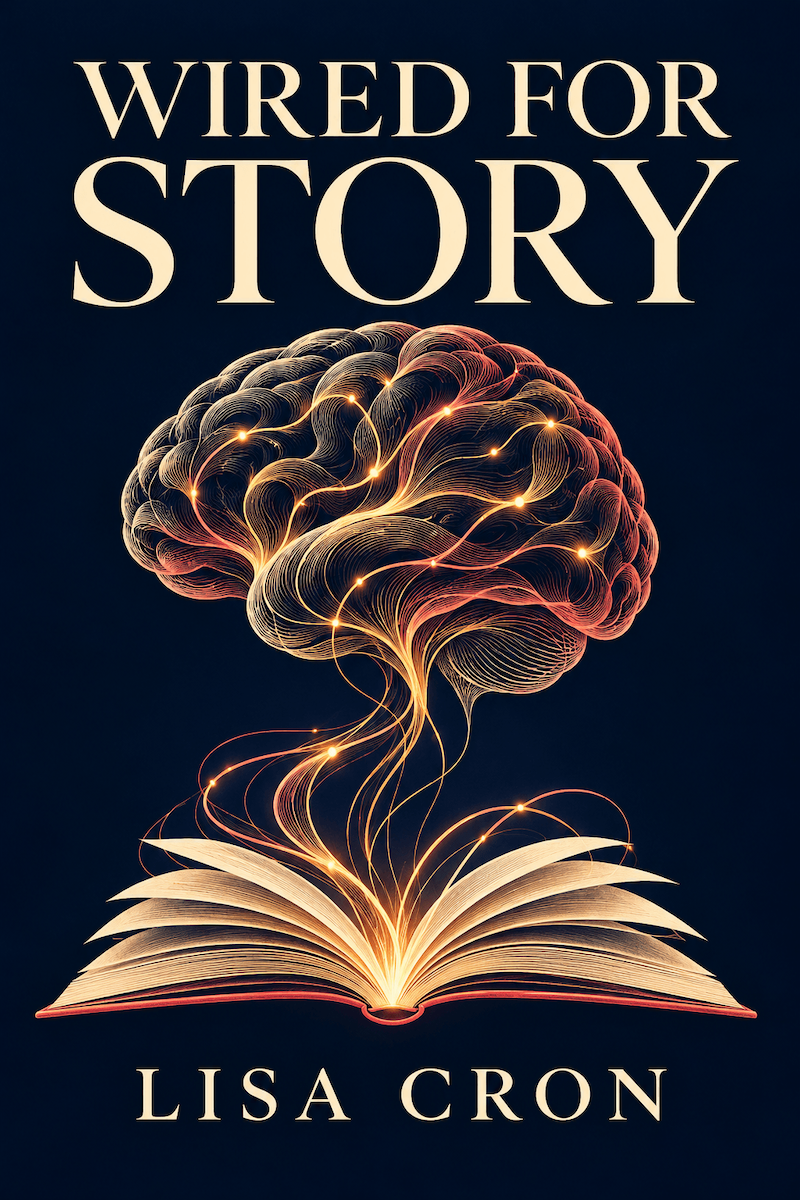
Prefer the print book? Buy on Amazon
As an Amazon Associate, Sumizeit earns from qualifying purchases.
Book Summary
Wired for Story Book Summary
This Wired for Story Book Summary covers the key ideas, lessons, and takeaways in about 20 minutes.
Short Description:
How the brain’s craving for story shapes what writers must put on the page
A story works when it gives the brain what it evolved to look for. That means a protagonist we can feel our way into, a goal that tells us what is at stake, and a chain of events that forces that person to change. Everything else serves those things. Details belong only if they matter emotionally to the protagonist. Events belong only if they follow from what came before and lead to what comes next. Conflict, suspense, foreshadowing, subplots, and flashbacks are all ways of managing what the reader knows and feels as the protagonist struggles toward the goal. Cron's lesson for writers is to stop polishing sentences first and start with what is happening inside your main character, because that inner change is the story.
Helps with these goals
Preview the Wired for Story book summary
Below is a preview of Sumizeit’s comprehensive human-written summary of Wired for Story by Lisa Cron. The full summary is 15-20 minutes long and covers the book’s key ideas in text, audio, visual, and video formats. Unlock the full 20 Minute Summary
Most writing advice starts with craft. Lisa Cron starts with the brain. Her argument is simple. People did not fall in love with stories because stories are fun. We need them. Long before anyone wrote anything down, a story was the safest way to learn about danger. If someone in your group barely escaped a bear and told everyone about it that night, the listeners walked away knowing where bears show up and what to do when one does. Nobody else had to get mauled to learn the lesson.
That advantage shaped us. Over hundreds of thousands of years, the brain learned to crave stories because they let us rehearse hard situations without living through them. We still use them that way. A novel is a simulation. You step into a life that isn't yours, watch what happens, and store what you learn.
Here's the catch for writers. Because this wiring is so old, the brain has firm expectations about what a story should deliver. When a story meets them, we keep reading. When it doesn't, we drift away, often without knowing why. Those expectations run on instinct, so most of us can't explain what makes a story work. We only feel it when one fails. Cron believes this is the real reason writing a good story is so hard. Her book spells out what the brain is looking for so you can give it exactly that. She aims her advice at novelists, but it holds for any kind of storytelling.
The four things every story needs
Cron boils a story down to four parts. The brain uses them to guess what will happen next, and that guessing is the pleasure of reading.
The first is the protagonist. This is the person whose skin the reader slips into. Everything in the story gets seen and judged through this one character.
The second is the protagonist's goal. It's the thing they want above all, and it tells the reader what is at stake. Every event gets measured against it. Does this bring them closer or push them further away?
The third is the plot, meaning the events that happen.
The fourth is what the story is really about, and Cron says most people confuse it with the plot. The plot is what happens on the outside. The story is what happens on the inside. It's how the protagonist changes because of those events. A story is never about a changing world. It's about a changing person.
Give the reader only what matters
Your senses send the brain more than 11 million pieces of information every second. Your conscious mind can handle about five to seven of them at a time. So the brain filters hard. It throws out whatever has nothing to do with you and your goals, and it expects a story to do the same filtering on its behalf.
For a writer, that means every detail has to earn its spot.
Want the complete 20-minute summary?
- Full structured summary
- Video Summary
- Podcast Summary
- Audio summary
- Key takeaways
- Exercises
- Quiz
- Highlights and notes
- Ask the book with AI
Who should read Wired for Story?
Wired for Story is for novelists, screenwriters, and anyone crafting narrative who wants to understand why some stories grip readers while others fall flat. Whether you're a beginner struggling with the basics or an experienced writer looking to deepen your craft, this book reveals the neuroscience behind storytelling so you can write with purpose rather than guesswork.
Why does Wired for Story matter?
Most writing advice focuses on technique—grammar, structure, dialogue—but Lisa Cron's Wired for Story goes deeper by explaining what the human brain actually craves in a story. In a world flooded with content competing for attention, understanding how our brains are literally wired to respond to narrative is the difference between a story that captivates and one that gets abandoned. This knowledge transforms writing from an art form driven by trial and error into a craft grounded in neuroscience.
What are the key themes in Wired for Story?
- The brain's evolutionary need for stories as a survival tool
- Internal change as the true subject of every story
- The protagonist's emotional response as the filter for what matters
- Cause and effect as the logic that makes stories believable
- The balance between specific detail and meaningful information
- Conflict as essential to character transformation
How can you apply ideas from Wired for Story?
- Before writing, identify your protagonist's broken belief and the specific moment it shattered, then build the entire story around fixing or accepting that wound
- List your protagonist's external goal and internal goal separately, then track scenes where these two goals pull in opposite directions for maximum tension
- Read your manuscript and mark every detail that doesn't affect the protagonist emotionally; delete or revise it to serve the story's core conflict
- Revise dialogue and actions to show the character's reasoning chain, so readers understand why they feel what they feel and do what they do
- Create a subplot that mirrors the main story by showing an alternate path the protagonist could take, then connect it meaningfully to the main plot and character arc
- Open your manuscript and verify that the first sentence or page answers who the story is about, what it's about, and what's at stake; if not, rewrite the opening
- Map your pacing by identifying where readers need emotional relief, then insert subplots or flashbacks at those moments to provide breathing room without losing engagement
What common mistakes do readers make with Wired for Story?
- Prioritizing beautiful prose over internal logic—readers abandon stories with elegant writing if the cause-and-effect chain breaks or protagonist motivation doesn't hold
- Including details that don't emotionally affect the protagonist, assuming readers will appreciate vivid description regardless of relevance to the character's struggle
- Confusing plot with story and thinking the external events alone create meaning, when in fact the protagonist's internal transformation is what matters
- Protecting characters from real suffering or consequences, which prevents them from changing and leaves readers with no reason to invest in the outcome
- Ending scenes without changing how the protagonist feels, missing the chance to build cumulative internal shifts that drive the story forward
- Withholding information from readers without planting hints or clues, creating confusion rather than suspense
Sumizeit Exercises Apply what you've learned
Turn ideas from Wired for Story into action with a short guided reflection: identify the biggest takeaway, connect it to your life, and commit to one step you can take in the next 24 hours.
What is the expert analysis of Wired for Story?
Overview
Wired for Story by Lisa Cron stands out as a pivotal work that bridges neuroscience and narrative craft, offering a fresh lens through which to understand storytelling. Cron, a seasoned story consultant and former television producer, leverages her extensive experience in publishing and media to dissect why stories captivate us at a fundamental, biological level. Unlike traditional writing guides that prioritize technique, this book roots its insights in cognitive science, making it significant for writers and thinkers interested in the intersection of psychology, storytelling, and human behavior.
Core Thesis
Cron’s central argument is that storytelling is hardwired into the human brain because it historically served as a critical survival tool. Stories function as simulations that allow us to rehearse real-life challenges vicariously. The brain craves stories that meet its instinctual expectations—primarily a relatable protagonist with clear goals, a logical chain of cause and effect, and an emotional journey that results in inner change. The book contends that successful stories must align with these neurological imperatives to engage readers fully, emphasizing that the essence of story lies not in external events but in the protagonist’s internal transformation.
Strengths
- Integration of Neuroscience and Storytelling: Cron’s use of brain science to explain narrative engagement provides a compelling and original framework that elevates the discussion beyond conventional craft advice.
- Clarity and Practicality: The book distills complex ideas into actionable principles, such as focusing on emotional relevance and the “goal behind the goal,” which are invaluable for writers seeking to deepen character development and plot coherence.
- Focus on Emotional Resonance: By emphasizing the protagonist’s emotional stakes, Cron highlights why details matter and how they must serve the story’s internal logic, offering a nuanced understanding of narrative economy.
- Comprehensive Coverage of Story Elements: The exploration of conflict, suspense, foreshadowing, pacing, and structural devices like subplots and flashbacks is thorough, linking each back to the brain’s processing needs.
- Accessible to a Broad Audience: Although aimed at novelists, the insights apply to any form of storytelling, including business narratives and self-improvement communication, broadening its relevance.
Critiques & Counterarguments
- Potential Oversimplification of Neuroscience: While Cron’s neuroscience foundation is compelling, some may argue that the book simplifies complex brain functions to fit narrative theory, potentially glossing over contradictory findings in cognitive psychology and neuroaesthetics.
- Emphasis on Protagonist-Centered Stories: The insistence on a single protagonist’s emotional journey may underrepresent alternative narrative forms, such as ensemble casts or experimental structures that challenge traditional goal-oriented storytelling.
- Limited Engagement with Cultural and Genre Variability: The framework assumes universality in how stories function neurologically, but cross-cultural studies and genre-specific storytelling (e.g., postmodern or non-linear narratives) suggest that reader expectations and engagement can vary significantly.
- Competing Theories on Story Impact: Schools of thought like structuralism or reader-response theory emphasize different facets of narrative meaning-making, such as language play or reader interpretation, which are less foregrounded in Cron’s biologically deterministic approach.
- Risk of Formulaic Writing: By prescribing a strict set of neurological “rules,” there is a danger that writers might prioritize mechanical adherence over creative experimentation, potentially stifling innovation in storytelling.
Who Should Read This
Wired for Story is ideal for writers—novelists, screenwriters, and storytellers of all kinds—who seek a scientifically grounded understanding of why stories resonate. It is equally valuable for editors, literary agents, and educators who want to sharpen their insight into narrative effectiveness. Beyond the creative industries, professionals in marketing, leadership, and communication will find Cron’s emphasis on emotional engagement and clarity instructive for crafting compelling messages. Readers interested in the cognitive underpinnings of art and human connection will appreciate the book’s interdisciplinary approach.
Discussion questions for Wired for Story Short questions you can actually use in a conversation
Frequently asked questions about the Wired for Story book summary
What is Wired for Story about?
Wired for Story by Lisa Cron explains the neuroscience behind why stories work, drawing on brain research to show what readers unconsciously crave. The book reveals that our brains evolved to need stories as a way to rehearse difficult situations, and that great storytelling means giving the brain what it's literally wired to look for: a protagonist we can feel our way into, a goal that stakes everything, and an internal transformation driven by conflict and change.
Who should read Wired for Story?
Wired for Story is essential for novelists, screenwriters, and anyone crafting narrative who wants to understand the deep mechanics of why stories compel readers. It's equally valuable for beginners learning to write and experienced writers looking to deepen their craft by grounding it in neuroscience rather than intuition alone.
What are the main takeaways from Wired for Story?
The core takeaways are: (1) the story is the protagonist's internal change, not external events; (2) every detail must matter emotionally to the protagonist; (3) readers need to understand the cause behind actions and feelings; (4) conflict and suffering are essential because they force change; and (5) the brain looks for cause-and-effect logic throughout, so breaking that chain loses the reader's trust and attention.
How do I hook readers in the first page?
Answer three questions immediately: Who is this story about? What is it about? What is at stake? This context is how the brain assigns meaning and decides whether something matters. When readers know what to watch for from the start, they'll wait patiently for the rest of the story.
What's the difference between external and internal goals?
An external goal is what the protagonist visibly pursues—win the case, get the job, stop the villain. The internal goal is the hidden struggle underneath, like proving you can succeed without becoming ruthless like your father. The story's power comes from watching these two goals grind against each other.
Why does emotion matter more than action in storytelling?
Without emotional context, events look neutral and boring to the reader. When a character slams a door, it's meaningless unless we understand what caused the anger and follow their reasoning. The reader must feel how events land on the protagonist to know why anything matters.
How do I know if a detail belongs in my story?
A detail earns its place only if it affects the protagonist emotionally and serves the goal, the plot, or the protagonist's inner change. If readers have to wade through material irrelevant to what the character cares about, they lose the thread and lose interest.
What makes a good reveal in a story?
A powerful reveal changes the meaning of everything that came before it in hindsight. Everything before the reveal must make sense without it, you must plant specific hints so readers sense a gap, and the reveal itself shouldn't be what gives the plot meaning—it should shift the meaning retroactively.
About Sumizeit
Sumizeit is a profitable Scomy LLC company based in Miami, Florida. Our founders, Clemens Raemy and Weina Scott, are successful entrepreneurs with several exits. Sumizeit is a popular book summary app / micro learning app used by busy professionals and entrepreneurs with over 2,500 non-fiction book summaries and 10,000 podcast summaries in text, audio, visual, podcast, and video format. We also have stellar retention tools to make ideas stick - such as flashcards with spaced repetition, quizzes, streaks, highlighting and notes, daily challenges, riddles, mini-courses, meditation, and more. You won't only learn the idea, but also remember it. Over 90% of our users change their habits with Sumizeit.
Upgrade Now
Here's why readers love Sumizeit
Join thousands of learners getting smarter every day
"Great experience. Detailed summaries. Loved the gamification feature. Makes learning fun. Good customer service. I recommend Sumizeit to anyone. You'll learn a lot."
"I always felt busy but still wanting to keep up with the book discussion in my friend group. This was a great supplement to help me keep reading the books I find fun while keeping up with important books."
"I love this website. Instead of scrolling social media, I find myself learning a lot. I use it everyday. I recommend this app for anyone who is too busy and wants to get up to speed with their favorite books."
Wired for Story Book Summary PDF
Looking for a Wired for Story Book Summary PDF you can save and revisit offline? Our Wired for Story Book Summary PDF captures the book’s core ideas in a clean, printable format — the key frameworks, takeaways, and structure without the fluff. Download the Wired for Story Book Summary PDF when you want a reference you can annotate, share with your team, or review on the go. Get your Wired for Story Book Summary PDF from the download page below.
Download Wired for Story Book Summary PDFPeople also liked these summaries
Readers who explored Wired for Story often enjoyed these titles next.

Ready to read the whole thing?
- Full structured summary
- Video Summary
- Podcast Summary
- Audio summary
- Key takeaways
- Exercises
- Quiz
- Highlights and notes
- Ask the book with AI
Featured Book Titles
Popular Book Summaries at sumizeit, leading book summary app
Atomic Habits Book Summary Rich Dad Poor Dad Book Summary The Four Agreements Book Summary The 48 Laws of Power Book Summary When Breath Becomes Air Book Summary Think and Grow Rich Book Summary