
Question 1 of 10


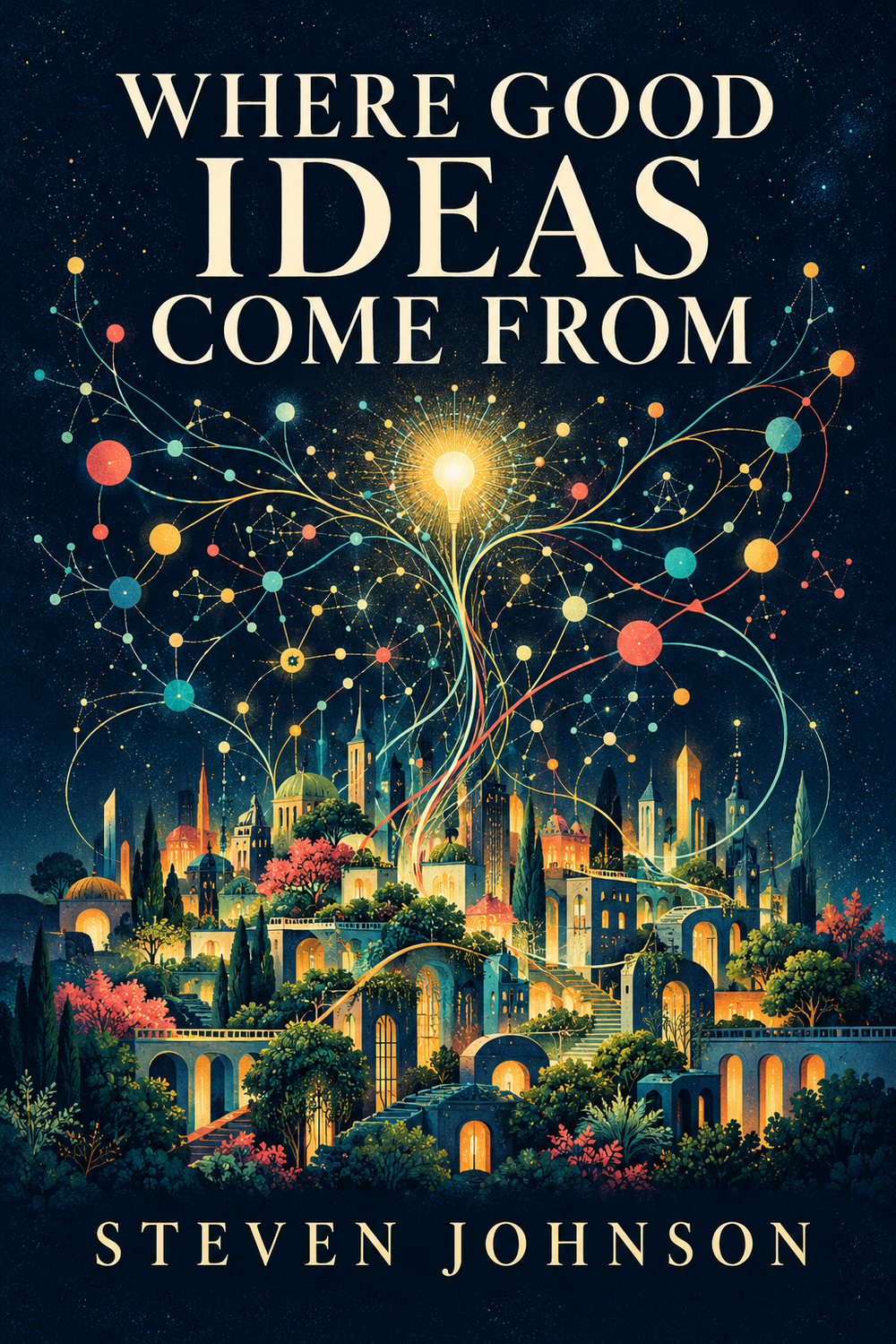
Prefer the print book? Buy on Amazon
As an Amazon Associate, Sumizeit earns from qualifying purchases.
Book Summary
Where Good Ideas Come From Book Summary
This Where Good Ideas Come From Book Summary covers the key ideas, lessons, and takeaways in about 20 minutes.
Short Description:
Seven patterns that explain how good ideas form, from adjacent possible to platforms Where good ideas come from summary Document·MD
Good ideas rarely come from isolated geniuses having sudden flashes. They grow in environments where old ideas can mix, collide, and get reused, and where people can connect, make mistakes, borrow from other fields, and build on each other's work. If you want more good ideas, stop waiting for a lightning bolt and start building the kind of surroundings, habits, and networks where good ideas can grow, then share what you make so someone else can take the next step.
Helps with these goals
Preview the Where Good Ideas Come From book summary
Below is a preview of Sumizeit’s comprehensive human-written summary of Where Good Ideas Come From by Steven Johnson. The full summary is 15-20 minutes long and covers the book’s key ideas in text, audio, visual, and video formats. Unlock the full 20 Minute Summary
Most of us picture a great idea as a lightning bolt. One brilliant person sits alone, waits for inspiration, and then it arrives. Steven Johnson thinks that picture is wrong. His book argues that good ideas come from the environment around the thinker. Some places and habits make new ideas more likely, and others shut them down. So instead of asking where a genius got an idea, Johnson asks what kind of surroundings made that idea possible.
He builds the case around seven patterns that show up again and again in science, technology, art, and nature. They are the adjacent possible, liquid networks, the slow hunch, serendipity, error, exaptation, and platforms. A final section looks at how money and markets affect all of this. The patterns work like a toolkit. You can use them to build a better workplace, a better city, or a better daily routine for your own mind.
The coral reef puzzle
Johnson opens with Charles Darwin and a mystery about coral reefs. Darwin noticed that reefs grow in warm tropical water that is clear and low in nutrients. Clear water means very little food, yet reefs are packed with life. They look like cities in a desert. For a long time nobody could explain how so much life survived on so little.
The answer came much later and from many fields at once. Reefs are tightly organized systems where almost nothing goes to waste. One creature's leftovers become another creature's meal, and nutrients keep cycling through the community instead of drifting away. Biologists, chemists, and systems thinkers each had a piece of the answer, and the answer only appeared when their knowledge came together. That mix of fields helped create the study of ecosystems.
Johnson uses the reef as a picture of what he wants to explain. A reef thrives because its structure lets resources get reused and recombined. A good environment for ideas works the same way. It helps old thoughts get reused, mixed, and turned into something new. The rest of the book looks at the features that make this happen.
The adjacent possible
The first pattern comes from the biologist Stuart Kauffman. Picture a house where every door you open leads to new rooms you couldn't reach before. At any moment, only some rooms are open to you. You can't jump to a room three doors away. Kauffman called this the adjacent possible, meaning the set of next steps that current conditions allow. Early in the history of life, the chemicals in the primordial soup could only combine into a few new molecules. Each new molecule opened the way to more combinations. The range of possible things grew with every step.
Johnson says ideas work the same way. At any time in history, the tools, knowledge, and materials on hand set the edge of what people can think up and build. You can't invent a microwave oven in the Stone Age. It isn't that people were too dim.
Want the complete 20-minute summary?
- Full structured summary
- Video Summary
- Podcast Summary
- Key takeaways
- Exercises
- Quiz
- Highlights and notes
- Ask the book with AI
Who should read Where Good Ideas Come From?
This book is for innovators, entrepreneurs, educators, and anyone seeking to understand how breakthrough ideas actually develop. Whether you're leading a team, building an organization, or simply wanting to become more creative, Where Good Ideas Come From reveals the environmental and social conditions that unlock your potential for innovation.
Why does Where Good Ideas Come From matter?
In an era obsessed with individual genius and sudden inspiration, Steven Johnson challenges the myth of the lone brilliant mind and offers evidence-based patterns for how ideas truly emerge. Understanding these patterns helps organizations, cities, and individuals design better conditions for innovation rather than waiting passively for lightning-bolt moments. In today's complex, interconnected world, the ability to recognize and cultivate idea-generating environments is a practical competitive advantage.
What are the key themes in Where Good Ideas Come From?
- Ideas emerge from environmental conditions, not isolated genius
- Networks and collaboration drive innovation more than individual effort
- Mistakes and serendipity are essential to breakthrough thinking
- Openness and knowledge-sharing accelerate idea development
- Slow hunches matter more than sudden inspiration
- Cross-disciplinary collision creates unexpected solutions
How can you apply ideas from Where Good Ideas Come From?
- Design your workspace or office to encourage people from different departments to interact naturally—use shared spaces, open layouts, and communal areas
- Establish a personal notebook or digital file for capturing hunches, quotes, and fragments, then review it regularly to watch ideas develop over time
- Allocate protected time for side projects and experimental work, even if they seem unrelated to core business goals
- Deliberately seek input from people with different backgrounds, specialties, and perspectives when solving problems
- Create a culture that treats productive mistakes as learning opportunities rather than failures to be hidden or punished
- Build platforms and share your knowledge so others can extend and innovate on top of your work
- Take regular walks, baths, or breaks away from focused problem-solving to let your subconscious reshuffle ideas
What common mistakes do readers make with Where Good Ideas Come From?
- Waiting for sudden inspiration instead of building systems and environments that generate ideas consistently
- Isolating teams by specialization rather than creating opportunities for cross-disciplinary collision
- Killing slow hunches by demanding finished results immediately instead of allowing ideas to gestate
- Over-controlling information and overly protecting intellectual property, which prevents the sharing that makes ideas grow
- Punishing all errors equally without distinguishing between destructive mistakes and productive failures that teach something valuable
- Confusing the timing of an idea with its quality—dismissing an idea because the world wasn't ready for it yet
Sumizeit Exercises Apply what you've learned
Turn ideas from Where Good Ideas Come From into action with a short guided reflection: identify the biggest takeaway, connect it to your life, and commit to one step you can take in the next 24 hours.
What is the expert analysis of Where Good Ideas Come From?
Overview
Where Good Ideas Come From is a seminal work by Steven Johnson, a distinguished American author and media theorist renowned for his insightful explorations into science, technology, and the diffusion of ideas. Johnson challenges the romanticized notion of the solitary genius struck by sudden inspiration, instead positing that innovation is deeply rooted in the environments and networks that nurture idea generation. His interdisciplinary approach draws from biology, history, psychology, and urban studies, making this book a significant contribution to understanding creativity and innovation in both individual and collective contexts.
Core Thesis
Johnson’s central argument dismantles the myth of the lone genius and the “eureka” moment, proposing instead that good ideas emerge from dynamic, interconnected environments he terms “liquid networks.” These environments facilitate the recombination and evolution of existing concepts through seven recurring patterns: the adjacent possible, liquid networks, the slow hunch, serendipity, error, exaptation, and platforms. He emphasizes that innovation is a gradual, collaborative, and often serendipitous process, heavily dependent on the right conditions—both social and cognitive—that allow ideas to collide, mutate, and build upon one another.
Strengths
- Interdisciplinary Synthesis: Johnson masterfully integrates insights from biology, history, cognitive science, and technology, offering a rich, multifaceted framework that transcends disciplinary boundaries.
- Empirical and Anecdotal Evidence: The book is replete with compelling historical examples—from Darwin’s coral reefs to the invention of the printing press and the development of the World Wide Web—that vividly illustrate his patterns of innovation.
- Practical Applicability: Beyond theory, Johnson offers actionable advice for individuals and organizations seeking to cultivate environments conducive to creativity, such as fostering diverse networks, embracing error, and encouraging slow hunches.
- Nuanced View of Innovation: By highlighting the role of networks and collaborative platforms, Johnson provides a sophisticated counterpoint to simplistic narratives of innovation driven solely by market forces or isolated inventors.
- Engaging Narrative Style: The accessible prose and well-structured arguments make complex concepts digestible without sacrificing intellectual rigor.
Critiques & Counterarguments
- Overemphasis on Environment at the Expense of Individual Agency: While Johnson rightly stresses the importance of context, some critics might argue that the book underplays the role of individual cognitive capacities and intrinsic motivation, which remain crucial for innovation.
- Romanticizing Networks and Openness: The advocacy for openness and collaborative networks may overlook instances where secrecy, competition, or hierarchical structures have accelerated breakthroughs, especially in proprietary or security-sensitive fields.
- Limited Engagement with Contradictory Research: Competing theories in creativity research emphasize divergent thinking, intrinsic personality traits, or even the necessity of solitude for deep work, which Johnson’s framework does not fully reconcile or address.
- Potential Oversimplification of Complex Processes: The seven patterns, while elegant, may risk reducing the multifaceted nature of innovation into somewhat formulaic categories, glossing over the messiness and unpredictability inherent in creative work.
- Historical and Technological Bias: Many examples focus on Western scientific and technological milestones, which might limit the universality of the patterns and overlook innovation dynamics in other cultural or historical contexts.
Who Should Read This
This book is essential reading for scholars and practitioners in innovation management, creativity research, and organizational leadership who seek a deeper understanding of how ideas emerge and flourish. It also appeals to thoughtful readers interested in the sociology of knowledge, the history of science, and cognitive psychology. Entrepreneurs, educators, and policymakers will find Johnson’s insights invaluable for designing environments that foster innovation. Finally, anyone curious about the nature of creativity and how to cultivate it in their personal or professional life will benefit from the book’s rich conceptual toolkit and practical guidance.
Discussion questions for Where Good Ideas Come From Short questions you can actually use in a conversation
Frequently asked questions about the Where Good Ideas Come From book summary
What is Where Good Ideas Come From about?
Where Good Ideas Come From by Steven Johnson argues that good ideas don't come from isolated genius having sudden flashes of inspiration, but rather from specific environmental conditions and social patterns. The book identifies seven patterns—the adjacent possible, liquid networks, slow hunches, serendipity, error, exaptation, and platforms—that appear repeatedly in breakthrough innovations across science, technology, art, and nature.
Who should read Where Good Ideas Come From?
This book is essential for innovators, entrepreneurs, organizational leaders, educators, and anyone interested in creativity and how ideas develop. It's particularly valuable for those managing teams or organizations who want to design better conditions for innovation, and for individuals seeking practical strategies to become more creative.
What are the main takeaways from Where Good Ideas Come From?
The central insight is that good ideas grow in environments where different people meet, old ideas mix and recombine, mistakes are treated as information, and knowledge is openly shared. Key practical takeaways include keeping a notebook for hunches, spending time in diverse networks, reading deeply, allowing time for side projects, embracing errors as learning opportunities, and building platforms so others can innovate on top of your work.
How does the adjacent possible explain innovation?
The adjacent possible describes the set of next steps that current conditions allow. Just as you can only enter rooms that connect to where you are now, innovators can only build on tools and knowledge that already exist. Most breakthroughs are small steps into neighboring possibilities, not giant leaps—which is why the same idea often emerges independently when multiple people have access to the same building blocks.
What is a liquid network and why do ideas thrive in them?
A liquid network is an environment where people and ideas can move freely but stay close enough to collide and form new combinations—unlike a solid where nothing moves or a gas where connections fall apart. Cities, labs, and online platforms are liquid networks because they balance openness with enough structure for ideas to stick, creating more chance encounters between different perspectives.
How does the slow hunch work in innovation?
A slow hunch is a vague suspicion or half-formed idea that simmers in the background for years before crystallizing into something real. Unlike gut feelings that give quick answers, slow hunches develop gradually as new pieces of information arrive through reading, conversation, and experience. The book recommends keeping a notebook to capture these fragments so they don't get lost while waiting to mature.
Can organizations really create more innovation by encouraging mistakes?
Yes, according to research Johnson cites. Many breakthrough discoveries came from errors—penicillin from a contaminated dish, photography from a mistake, the pacemaker from an accident. Organizations that treat mistakes as information and learning opportunities rather than pure failure keep discovering new doors in the adjacent possible, while those that punish every slip teach people to stay in safe, known territory.
What does Johnson say about open-source and non-market innovation?
Johnson's research found that most major innovations today come from networks rather than individuals, and surprisingly, many of the most transformative ideas—including the internet and World Wide Web—emerged from open, non-market environments like universities and research communities. He argues that while markets drive important innovation, excessive secrecy and intellectual property control can actually slow the sharing and cross-pollination that makes ideas flourish.
About Sumizeit
Sumizeit is a profitable Scomy LLC company based in Miami, Florida. Our founders, Clemens Raemy and Weina Scott, are successful entrepreneurs with several exits. Sumizeit is a popular book summary app / micro learning app used by busy professionals and entrepreneurs with over 2,500 non-fiction book summaries and 10,000 podcast summaries in text, audio, visual, podcast, and video format. We also have stellar retention tools to make ideas stick - such as flashcards with spaced repetition, quizzes, streaks, highlighting and notes, daily challenges, riddles, mini-courses, meditation, and more. You won't only learn the idea, but also remember it. Over 90% of our users change their habits with Sumizeit.
Upgrade Now
Here's why readers love Sumizeit
Join thousands of learners getting smarter every day
"Great experience. Detailed summaries. Loved the gamification feature. Makes learning fun. Good customer service. I recommend Sumizeit to anyone. You'll learn a lot."
"I always felt busy but still wanting to keep up with the book discussion in my friend group. This was a great supplement to help me keep reading the books I find fun while keeping up with important books."
"I love this website. Instead of scrolling social media, I find myself learning a lot. I use it everyday. I recommend this app for anyone who is too busy and wants to get up to speed with their favorite books."
Where Good Ideas Come From Book Summary PDF
Looking for a Where Good Ideas Come From Book Summary PDF you can save and revisit offline? Our Where Good Ideas Come From Book Summary PDF captures the book’s core ideas in a clean, printable format — the key frameworks, takeaways, and structure without the fluff. Download the Where Good Ideas Come From Book Summary PDF when you want a reference you can annotate, share with your team, or review on the go. Get your Where Good Ideas Come From Book Summary PDF from the download page below.
Download Where Good Ideas Come From Book Summary PDFPeople also liked these summaries
Readers who explored Where Good Ideas Come From often enjoyed these titles next.

Ready to read the whole thing?
- Full structured summary
- Video Summary
- Podcast Summary
- Key takeaways
- Exercises
- Quiz
- Highlights and notes
- Ask the book with AI
Featured Book Titles
Popular Book Summaries at sumizeit, leading book summary app
Atomic Habits Book Summary Rich Dad Poor Dad Book Summary The Four Agreements Book Summary The 48 Laws of Power Book Summary When Breath Becomes Air Book Summary Think and Grow Rich Book Summary