


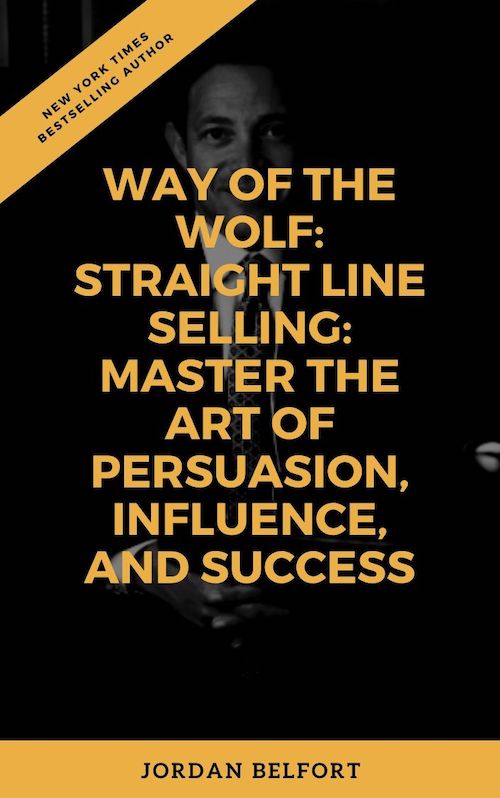
Prefer the print book? Buy on Amazon
As an Amazon Associate, Sumizeit earns from qualifying purchases.
Way of the Wolf Book Summary
This Way of the Wolf Book Summary covers the key ideas, lessons, and takeaways in about 20 minutes.
Short Description:
Persuasion blends psychology, structure, and trust to influ
Helps with these goals
Want a Free Weekly Read?
Get a free summary every week straight to your mailbox.
Preview the Way of the Wolf book summary
Below is a preview of Sumizeit’s comprehensive human-written summary of Way of the Wolf by Jordan Belfort. The full summary is 15-20 minutes long and covers the book’s key ideas in text, audio, visual, and video formats. Unlock the full 20 Minute Summary
In Way of the Wolf, Jordan Belfort presents his famous Straight Line Selling System, a proven, step-by-step formula for mastering influence and closing sales with precision, confidence, and integrity. Drawing from his real-world experience as the notorious stockbroker-turned-sales trainer known as “The Wolf of Wall Street,” Belfort distills decades of psychological insight into a method that transforms anyone—from beginner to expert—into a master closer.
At its core, Straight Line Selling is about control. Belfort argues that every sales conversation follows a path—a “straight line”—that runs from the opening of the interaction to the final close. The salesperson’s job is to keep the prospect moving along that line toward the destination: a confident, informed “yes.” Every deviation—small talk, uncertainty, objections—must be redirected back to the line.
But this system isn’t just for professional salespeople. Belfort believes everyone sells—whether you’re pitching investors, persuading a team, or convincing a friend. Selling, he insists, is life’s most universal skill.
The Three Tens: Building Total Certainty
Belfort’s Three Tens Model forms the psychological backbone of the Straight Line System. Every buyer subconsciously rates three factors on a scale from 1 to 10:
The Product or Idea – How strongly they believe in what’s being sold.
The Seller – How much they trust and like the person selling it.
The Company – How much they believe in the brand or organization behind it.
The closer the scores get to 10, the more likely the prospect is to buy. Belfort’s goal is to elevate all three simultaneously—through logic, emotion, and trust.
For instance, imagine selling a luxury mattress. You first establish logical certainty: you explain the 12-layer cooling foam, 20-year warranty, and spine alignment benefits. Then you build emotional certainty: you ask the customer to imagine waking up pain-free, energized, and excited to start the day. To strengthen the final “10,” you might highlight glowing reviews and the company’s 30-year reputation for customer satisfaction.
Belfort emphasizes that even if one certainty is low—say, the prospect likes you and trusts the company but isn’t sold on the product—you won’t close. You must address all three.
He compares the process to adjusting sound levels on a stereo mixer: if one dial is too low, the music (or sale) sounds off. The closer you get to full harmony, the smoother the close.
The First Four Seconds: Controlling the Frame
Belfort’s rule is simple: You have four seconds to make a powerful impression. Within that window, a prospect will subconsciously decide whether to trust and listen to you. To win that judgment, you must radiate three signals:
Sharp as a tack – Show alertness and intelligence in your tone and pacing. Speak clearly and confidently, as though you’ve done this a thousand times.
Enthusiastic as hell – Communicate genuine excitement for what you’re offering. Enthusiasm transfers energy and immediately builds emotional engagement.
An expert in your field – Convey quiet authority. Experts don’t chase—they guide.
For example, a financial advisor might begin a call with:
“Hi…
Want the complete 20-minute summary?
- Full structured summary
- Video Summary
- Podcast Summary
- Audio summary
- Key takeaways
- Exercises
- Quiz
- Highlights and notes
- Ask the book with AI
Who should read Way of the Wolf?
Way of the Wolf is essential for salespeople, entrepreneurs, and anyone seeking to master persuasion and influence. Whether you're closing deals, pitching ideas, or negotiating in everyday life, this book teaches the psychological mechanics of moving others toward agreement with clarity and confidence.
Why does Way of the Wolf matter?
In an attention-scarce world, the ability to communicate with conviction and build trust separates success from mediocrity. Jordan Belfort's Straight Line System translates decades of real-world sales experience into a structured, ethical framework that works across industries and contexts—proving that persuasion is a learnable skill, not an innate talent.
What are the key themes in Way of the Wolf?
- The psychology of certainty and trust in decision-making
- Controlling emotional state and physical presence for maximum impact
- Strategic prospecting to focus energy on viable buyers
- Tonality and body language as drivers of persuasion
- Ethical influence and responsible use of persuasive power
- Turning objections into opportunities through structured looping
How can you apply ideas from Way of the Wolf?
- Record yourself on sales calls and analyze your tonality—shift between certainty, scarcity, curiosity, and empathy deliberately to test what moves prospects emotionally.
- Implement olfactory anchoring by selecting a distinct scent and inhaling it before important meetings to trigger your peak confidence state instantly.
- Redesign your sales scripts to emphasize emotional benefits over features, then practice pausing for micro-confirmations that build psychological momentum.
- Qualify prospects using the four-type framework before investing time; ask about problems, timeline, and decision-makers to identify buyers in heat versus mistakes.
- Use the looping technique when you hear objections by isolating which of the Three Tens is weakest, then reinforce it with targeted logic and emotional proof.
- Practice the Four-Second Opening with conviction, enthusiasm, and expertise; record yourself and refine until your first sentence establishes immediate trust and control.
- Mirror the body language and energy of prospects subtly while maintaining 72% eye contact to build subconscious rapport and reduce defensive barriers.
What common mistakes do readers make with Way of the Wolf?
- Treating all prospects equally instead of separating buyers in heat from lookie-loos and mistakes, which wastes energy on low-probability targets.
- Prioritizing features over emotional benefits, which fails to connect with buyers' subconscious desire for how a product will improve their lives.
- Starting weak or uncertain in the first four seconds, which forces you to play catch-up throughout the conversation instead of establishing control early.
- Ignoring tonality and body language, which account for 90% of how your message is received, and relying solely on words to persuade.
Sumizeit Exercises Apply what you've learned
Turn ideas from Way of the Wolf into action with a short guided reflection: identify the biggest takeaway, connect it to your life, and commit to one step you can take in the next 24 hours.
What is the expert analysis of Way of the Wolf?
Overview
Way of the Wolf is a sales and persuasion manual authored by Jordan Belfort, a figure infamous for his past as a fraudulent stockbroker and later redemption as a motivational speaker and sales trainer. Belfort’s notoriety, amplified by the film adaptation of his memoir The Wolf of Wall Street, lends a complex backdrop to this work. The book distills Belfort’s signature Straight Line Selling System, a structured approach to influence and closing sales, blending psychological insight with practical techniques. Its significance lies in its promise to transform readers—from novices to seasoned professionals—into confident, ethical persuaders, making it a notable contribution to business and self-improvement literature.
Core Thesis
The central argument of Way of the Wolf is that selling is a universal skill governed by a predictable, linear process that can be mastered through discipline and psychological acumen. Belfort posits that every sales interaction follows a “straight line” from introduction to close, and the salesperson’s role is to maintain control of this trajectory by managing the prospect’s certainty across three dimensions: belief in the product, trust in the seller, and confidence in the company. By combining logical argumentation, emotional engagement, and trust-building—supported by nuanced use of tonality, body language, and state management—anyone can ethically persuade others to say “yes.” This system is not limited to sales but extends to all forms of human influence.
Strengths
- Practical Framework: Belfort offers a clear, repeatable methodology that breaks down the complex art of persuasion into actionable steps, making it accessible for readers at various skill levels.
- Psychological Depth: The integration of emotional and cognitive elements—such as the Three Tens Model and tonal variation—demonstrates a sophisticated understanding of human decision-making.
- Emphasis on Ethics: Belfort’s candid acknowledgment of his past and commitment to ethical persuasion adds a layer of credibility and responsibility often missing in sales literature.
- State Management Techniques: Introducing concepts like olfactory anchoring shows innovation in linking neuro-linguistic programming with performance psychology.
- Broad Applicability: The system’s relevance beyond sales—to leadership, negotiation, and everyday influence—expands its utility and appeal.
Critiques & Counterarguments
- Over-Simplification of Human Interaction: The “straight line” metaphor risks reducing the complexity and unpredictability of interpersonal communication to a rigid formula, potentially neglecting the nuance required in diverse relational contexts.
- Questionable Universality: While Belfort claims the system applies broadly, certain cultural or personality differences may limit its effectiveness; for example, high-context cultures might resist direct sales tactics.
- Ethical Ambiguities: Despite Belfort’s emphasis on integrity, some critics argue that intense persuasion techniques can border on manipulation, especially when applied without deep ethical grounding.
- Competing Research: Contemporary social psychology highlights the importance of authenticity and mutuality in influence, which may conflict with the controlled, scripted approach Belfort advocates.
- Real-World Evidence: Studies in behavioral economics suggest that decision-making is often irrational and influenced by unconscious biases, which may not be fully addressed by the Straight Line System’s structured approach.
Who Should Read This
Way of the Wolf is ideal for sales professionals, entrepreneurs, and business leaders seeking a structured, psychologically informed approach to influence and closing deals. It also appeals to individuals interested in personal development and communication mastery, especially those open to integrating neuro-linguistic programming and state management into their repertoire. However, readers should approach the book with a critical mindset, balancing Belfort’s techniques with ethical considerations and awareness of interpersonal complexity. Those looking for a nuanced exploration of persuasion beyond formulaic methods may find it less satisfying, but for pragmatic learners aiming to enhance their persuasive efficacy, this book offers a compelling toolkit.
Frequently asked questions about the Way of the Wolf book summary
What is Way of the Wolf about?
Way of the Wolf by Jordan Belfort presents the Straight Line Selling System, a psychological framework for mastering persuasion and closing sales with precision. The book distills Belfort's decades of real-world sales experience into a step-by-step formula that teaches anyone how to build certainty, control conversations, and guide prospects toward confident decisions—all grounded in ethics and genuine value.
Who should read Way of the Wolf?
Way of the Wolf is essential for salespeople, entrepreneurs, negotiators, and anyone seeking to master influence and communication. Whether you're pitching clients, leading teams, or navigating everyday persuasion, Belfort's framework applies universally because everyone sells at some point in their life.
What are the main takeaways from Way of the Wolf?
The core takeaways include understanding the Three Tens (certainty in product, seller, and company), mastering the four-second opening impression, using tonality and body language to drive persuasion, and employing the looping technique to turn objections into opportunities. Belfort also emphasizes prospecting discipline, state management, and ethical influence as foundations for sustainable success.
What is the Straight Line System?
The Straight Line System is a psychological framework that treats every sales conversation as a path from opening to close. The salesperson's job is to keep the prospect moving forward along that line, redirecting any deviation back to the goal: a confident, informed yes. It combines structure, emotion, and trust into a repeatable process.
How does the Three Tens Model work?
The Three Tens Model identifies that prospects subconsciously rate three factors on a 1-to-10 scale: their belief in the product, their trust in the seller, and their confidence in the company. All three must score high for a close to succeed; if any one is weak, the sale stalls. The goal is to build certainty across all three dimensions simultaneously through logic, emotion, and proof.
Why does tonality matter more than words in sales?
Belfort teaches that words account for only 10% of communication; tonality carries 45% and body language carries 45%. By mastering certainty tone, scarcity tone, curiosity tone, and empathy tone, you bypass logical resistance and connect directly with the prospect's emotional brain—where buying decisions actually happen.
About Sumizeit
Sumizeit is a profitable Scomy LLC company based in Miami, Florida. Our founders, Clemens Raemy and Weina Scott, are successful entrepreneurs with several exits. Sumizeit is a popular book summary app / micro learning app used by busy professionals and entrepreneurs with over 2,500 non-fiction book summaries and 10,000 podcast summaries in text, audio, visual, podcast, and video format. We also have stellar retention tools to make ideas stick - such as flashcards with spaced repetition, quizzes, streaks, highlighting and notes, daily challenges, riddles, mini-courses, meditation, and more. You won't only learn the idea, but also remember it. Over 90% of our users change their habits with Sumizeit.
Upgrade Now
Here's why readers love Sumizeit
Join thousands of learners getting smarter every day
"Great experience. Detailed summaries. Loved the gamification feature. Makes learning fun. Good customer service. I recommend Sumizeit to anyone. You'll learn a lot."
"I always felt busy but still wanting to keep up with the book discussion in my friend group. This was a great supplement to help me keep reading the books I find fun while keeping up with important books."
"I love this website. Instead of scrolling social media, I find myself learning a lot. I use it everyday. I recommend this app for anyone who is too busy and wants to get up to speed with their favorite books."
Way of the Wolf Book Summary PDF
Looking for a Way of the Wolf Book Summary PDF you can save and revisit offline? Our Way of the Wolf Book Summary PDF captures the book’s core ideas in a clean, printable format — the key frameworks, takeaways, and structure without the fluff. Download the Way of the Wolf Book Summary PDF when you want a reference you can annotate, share with your team, or review on the go. Get your Way of the Wolf Book Summary PDF from the download page below.
Download Way of the Wolf Book Summary PDFPeople also liked these summaries
Readers who explored Way of the Wolf often enjoyed these titles next.




Ready to read the whole thing?
- Full structured summary
- Video Summary
- Podcast Summary
- Audio summary
- Key takeaways
- Exercises
- Quiz
- Highlights and notes
- Ask the book with AI
Featured Book Titles
Popular Book Summaries at sumizeit, leading book summary app