
Question 1 of 10


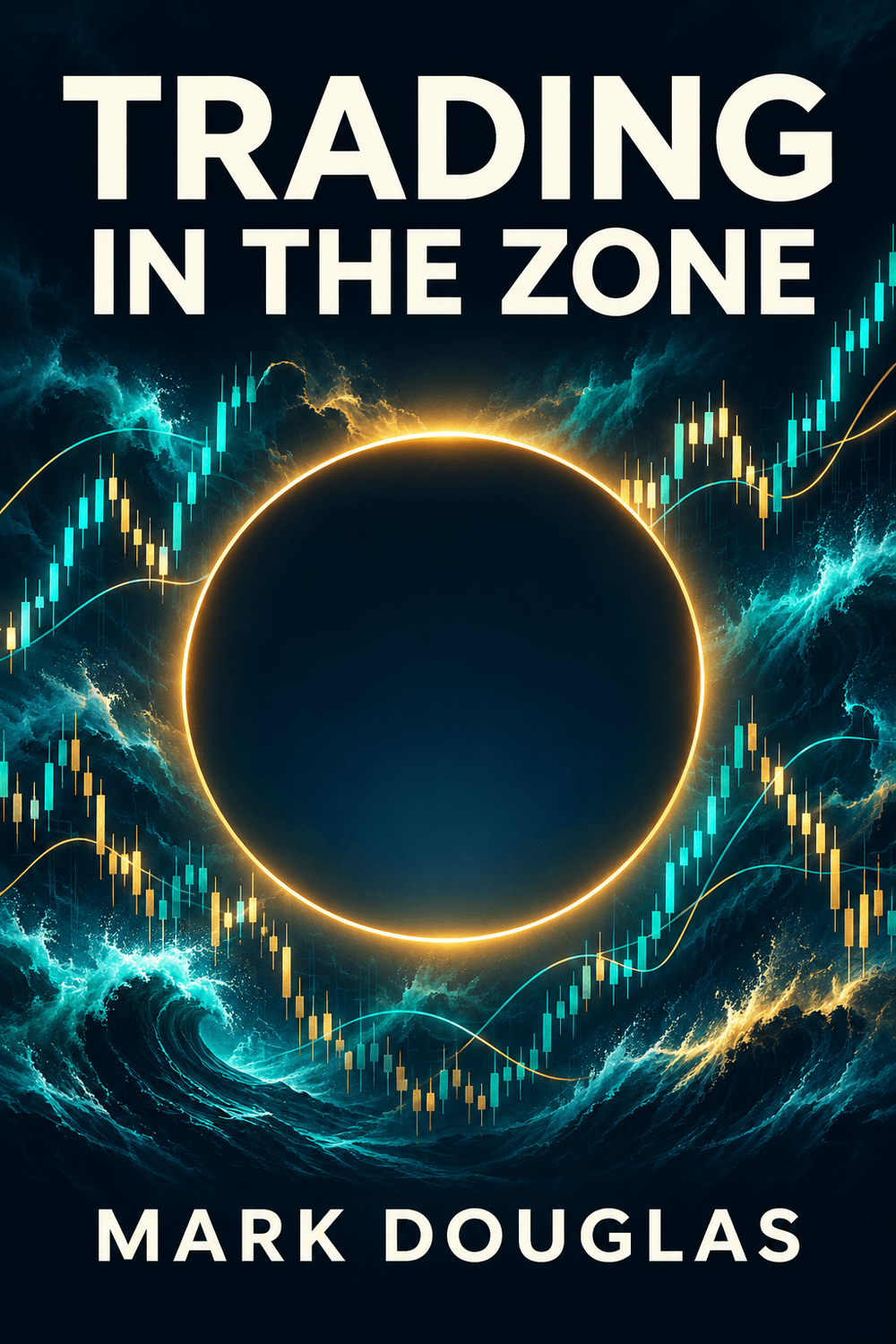
Prefer the print book? Buy on Amazon
As an Amazon Associate, Sumizeit earns from qualifying purchases.
Book Summary
Trading in the Zone Book Summary
This Trading in the Zone Book Summary covers the key ideas, lessons, and takeaways in about 20 minutes.
Short Description:
Why your mindset, not your method, decides if you win or lose as a trader
Trading success depends far more on your mindset than on your market knowledge. You can't know what any single trade will do, and you don't need to. If you have an edge, define your risk ahead of time, and truly accept that any trade can lose, then losses stop hurting and fear stops making your decisions. What's left is a trader who sees the market clearly, follows the plan, and lets the odds work over many trades. Douglas admits the change is slow, because it means retraining beliefs you've held for most of your life. I think that's the most honest part of the book. He doesn't promise a secret method. He tells you the hard part is you.
Helps with these goals
Preview the Trading in the Zone book summary
Below is a preview of Sumizeit’s comprehensive human-written summary of Trading in the Zone by Mark Douglas. The full summary is 15-20 minutes long and covers the book’s key ideas in text, audio, visual, and video formats. Unlock the full 20 Minute Summary
Mark Douglas spent years coaching traders, and he kept seeing the same thing. People who were sharp, well educated, and successful in other careers would come to the markets and lose. They studied harder. They bought better software. They still lost. His book starts with a blunt claim about why. The problem is almost never what a trader knows. It's how a trader thinks.
Before the first chapter, Douglas hands you a short attitude survey with questions about risk, losing, and why you trade. He asks you to take it again after you finish the book. The answers that change show you how far your thinking has moved.
His argument, in one line, is that the best traders have learned to think in probabilities and to accept risk completely. Everything else in the book explains what that means and how to get there.
Fundamental, technical, or mental analysis
Douglas opens with a short history of how traders try to read the market. Fundamental analysis came first. It uses economic models, things like interest rates, supply, demand, and company financials, to work out what a price should be. The trouble is that prices are moved by people, and people don't trade on models. They trade on hope, fear, and rumor. So there's a gap between what the model says should happen and what the market does. Douglas calls this the reality gap.
Technical analysis closed part of that gap. It studies price charts for patterns, on the idea that crowds of traders behave in ways that repeat. Douglas thinks this is the better tool, and by the time he wrote the book most traders agreed. But he points out something odd. Plenty of traders can read charts well and still can't make money consistently.
That's where his third category comes in, which he calls mental analysis. He says nearly all trading errors, about 95 percent by his estimate, come from four fears. You fear being wrong. You fear losing money. You fear missing out. You fear leaving money on the table. A trader with a good method and those four fears will find a way to wreck the method.
The lure and the danger of trading
Why are people drawn to trading in the first place? Douglas says it offers something most of life doesn't, which is total freedom. Nobody tells you when to get in, when to get out, or how much to risk. For anyone who grew up hearing "no" from parents and teachers and bosses, that freedom feels wonderful.
It's also the trap. A market has no beginning, no end, and no built in limits. If you don't create your own rules, nothing will stop you from doing damage. Yet the people attracted to trading are often the ones who least want rules. They came to get away from them.
Douglas adds two more problems. Many traders won't take responsibility for their results, and many get hooked on random rewards. He compares it to gambling.
Want the complete 20-minute summary?
- Full structured summary
- Video Summary
- Podcast Summary
- Audio summary
- Key takeaways
- Exercises
- Quiz
- Highlights and notes
- Ask the book with AI
Who should read Trading in the Zone?
Trading in the Zone is for anyone serious about trading who wants to understand why knowledge and technical skill alone don't guarantee profits. Whether you're a beginner struggling with losses or an experienced trader stuck in boom-and-bust cycles, this book addresses the psychological barriers that sabotage even smart, disciplined people. It's essential reading for traders ready to confront their own mindset rather than endlessly chase new systems and indicators.
Why does Trading in the Zone matter?
Most traders focus on what to trade but ignore how they think while trading, which is where the real problem lies. Mark Douglas spent decades coaching traders and discovered that roughly 95 percent of trading errors stem from fear and psychological blind spots, not from lack of knowledge. In a market driven by human emotion and irrational behavior, understanding your own mind is the competitive edge that separates consistent winners from everyone else.
What are the key themes in Trading in the Zone?
- Psychology determines trading outcomes more than technical skill
- Fear and unaccepted risk distort perception and decision-making
- Thinking in probabilities liberates you from needing any single trade to win
- Beliefs shape what you see in the market and must be actively rewired
- Taking full responsibility for results is the foundation of change
- The zone is a mental state achieved by removing limiting beliefs, not by trying harder
How can you apply ideas from Trading in the Zone?
- Take the attitude survey at the book's start, then again at the end, to measure shifts in how you think about risk and losing
- Create a simple trading system with exact rules for entry, stop loss, and profit targets on a fixed timeframe, then execute the next 20 trades without modification or skipping
- Before every trade, write down your predefined risk amount and risk-to-reward ratio to anchor acceptance of that outcome in advance
- Journal after each trade about whether you felt fear, hesitation, or relief rather than neutral acceptance, to identify active limiting beliefs
- Pick one market and one timeframe to focus on for 30 days, building automaticity in following your plan until discipline becomes a habit
- Review past losing trades to identify patterns in which setups still trigger emotional discomfort, then work to separate the current chart from the memory
- Create written statements embodying the five core trading truths and review them daily until they shift from intellectual knowledge to felt belief
What common mistakes do readers make with Trading in the Zone?
- Assuming that more technical knowledge or a better trading system will solve the real problem, which is psychological
- Believing you accept risk intellectually while still experiencing emotional pain when trades move against you, creating a gap between stated and actual risk tolerance
- Blaming the market or other external factors for losses instead of accepting complete responsibility for all results
- Trying to force consistency through willpower or harder effort rather than addressing the underlying beliefs that create hesitation and fear
- Skipping or adjusting trades in your system when old losses are triggered, breaking the sample size needed to truly reprogram your subconscious mind
Sumizeit Exercises Apply what you've learned
Turn ideas from Trading in the Zone into action with a short guided reflection: identify the biggest takeaway, connect it to your life, and commit to one step you can take in the next 24 hours.
What is the expert analysis of Trading in the Zone?
Overview
Trading in the Zone by Mark Douglas stands as a seminal work in the niche yet critical field of trading psychology. Douglas, a former trader turned coach, draws on decades of experience to illuminate why intelligent, well-prepared individuals repeatedly fail in financial markets. Published in 2000, this book transcends mere trading tactics by focusing on the trader’s mindset, making it a cornerstone text for anyone seeking sustainable success in markets. Douglas’s background as a practitioner who faced personal losses before mastering the psychological dimensions of trading lends the work authenticity and practical insight.
Core Thesis
At the heart of Trading in the Zone lies a profound assertion: trading success is less about technical knowledge or market analysis and far more about mastering one’s own psychology. Douglas argues that the primary obstacle to consistent profitability is the trader’s inability to think in probabilities and fully accept risk. He identifies that fear—manifesting as fear of loss, fear of being wrong, fear of missing out, and fear of leaving money on the table—undermines rational decision-making. The book advances the idea that only by adopting a mindset that embraces uncertainty and detaches emotionally from individual trade outcomes can traders achieve consistency and enter “the zone,” a state of optimal performance and clarity.
Strengths
- Psychological Depth: Douglas’s exploration of beliefs as dynamic, resistant constructs that shape perception is nuanced and resonates with broader psychological theories on cognitive biases and emotional conditioning.
- Practical Framework: The book offers actionable steps, including mindset exercises and a clear progression from mechanical rule-following to intuitive trading, which ground abstract concepts in real-world practice.
- Bridging Theory and Experience: Douglas’s use of relatable analogies—such as the child bitten by a dog or the casino’s probabilistic edge—effectively demystifies complex psychological phenomena for traders.
- Honest Appraisal of Difficulty: The candid acknowledgment that mindset change is slow and challenging adds credibility and sets realistic expectations for readers.
- Enduring Relevance: Despite its publication over two decades ago, the psychological principles Douglas outlines remain foundational in trading education and have influenced subsequent literature and coaching methodologies.
Critiques & Counterarguments
- Limited Empirical Evidence: While Douglas’s insights are compelling, the book relies heavily on anecdotal evidence and personal coaching experience rather than rigorous, peer-reviewed empirical studies, which may limit its scientific robustness.
- Oversimplification of Market Dynamics: The dichotomy between fundamental, technical, and mental analysis, while useful pedagogically, risks oversimplifying the complex interplay of macroeconomic factors, algorithmic trading, and behavioral finance that shape markets today.
- Neglect of Systemic and Structural Risks: Douglas’s focus on individual psychology may understate external market forces—such as regulatory changes, geopolitical events, or systemic shocks—that can overwhelm even the most disciplined trader’s mindset.
- Contrasting Schools of Thought: Some quantitative traders and proponents of algorithmic strategies might argue that removing emotion through automation is a superior method to the psychological retraining Douglas advocates, highlighting a tension between human-centric and technology-driven approaches.
- Potential for Cognitive Bias Reinforcement: The emphasis on belief change might inadvertently encourage traders to rationalize losses as psychological failures rather than acknowledging flawed strategies or market conditions, risking self-blame rather than objective evaluation.
Who Should Read This
Trading in the Zone is essential reading for traders at all levels who recognize that technical skill alone does not guarantee success. It is particularly valuable for:
- Individual traders struggling with inconsistency and emotional decision-making.
- Experienced traders seeking to deepen their understanding of the psychological barriers to sustained profitability.
- Trading coaches and psychologists interested in the intersection of behavioral science and financial markets.
- Investors and professionals in high-stakes decision environments where risk acceptance and probabilistic thinking are crucial.
Ultimately, Douglas’s work appeals to those willing to undertake the difficult but rewarding journey of self-mastery, recognizing that the greatest challenge in trading—and arguably in life—is the mind itself.
Discussion questions for Trading in the Zone Short questions you can actually use in a conversation
Frequently asked questions about the Trading in the Zone book summary
What is Trading in the Zone about?
Trading in the Zone by Mark Douglas is a book about trading psychology that argues most trading losses come from how traders think, not what they know. Douglas focuses on how fear, unaccepted risk, and limiting beliefs sabotage even knowledgeable traders, and he teaches readers to think in probabilities and achieve the zone—a mental state where you execute plans without emotional interference or hesitation.
Who should read Trading in the Zone?
This book is for anyone trading who wants to understand why technical knowledge and hard work alone don't guarantee profits. It's especially valuable for traders caught in boom-and-bust cycles, beginners struggling with losses, or experienced traders whose performance has plateaued. If you're ready to confront your own mindset rather than chase new systems, this book is essential.
What are the main takeaways from Trading in the Zone?
The core takeaways are: trading success depends far more on mindset than market knowledge, you don't need to know what any single trade will do to profit, and losses stop hurting when risk is truly accepted and beliefs are rewired. Douglas emphasizes that believing in five core trading truths—that anything can happen, that an edge works over many trades, and that each moment is unique—removes the fear that breaks discipline. Finally, he stresses that mindset change is slow because it requires retraining deeply held beliefs, not implementing a secret method.
How does Mark Douglas explain why traders fail?
Douglas identifies four core fears—fear of being wrong, losing money, missing out, and leaving money on the table—as the root cause of roughly 95 percent of trading errors. He argues that even traders with sound technical methods will sabotage themselves if these fears remain active, because fear distorts perception and causes hesitation, revenge trading, and rule-breaking. The problem is psychological, not analytical.
What is the zone in Trading in the Zone?
The zone is a mental state where you trade with absorbed focus, acting without hesitation or inner conflict, similar to what athletes experience in peak performance. Douglas describes it as a state you can't force through effort but can reach by removing the limiting beliefs that block it, such as fear of losses or doubt in your edge. Once in the zone, you follow your plan naturally and let probability work over many trades.
What are the five truths Douglas wants traders to believe?
The five core truths are: (1) anything can happen in any single trade, (2) you don't need to know what happens next to make money, (3) wins and losses fall in random order for any tested edge, (4) an edge is only a higher likelihood of one outcome over another, not a guarantee, and (5) every moment in the market is unique. Douglas argues that truly believing these removes the fear that creates trading errors.
How does the 20-trade exercise in Trading in the Zone work?
Douglas recommends picking one market, one timeframe, and a simple system with exact rules for entry, stop loss, and profit targets. You then execute the next 20 trades the system generates without skipping any or adjusting the rules. The goal isn't to make money on those 20 trades but to reprogram your subconscious mind through repetition, teaching yourself that you can follow a plan and that losses in a sample are normal.
About Sumizeit
Sumizeit is a profitable Scomy LLC company based in Miami, Florida. Our founders, Clemens Raemy and Weina Scott, are successful entrepreneurs with several exits. Sumizeit is a popular book summary app / micro learning app used by busy professionals and entrepreneurs with over 2,500 non-fiction book summaries and 10,000 podcast summaries in text, audio, visual, podcast, and video format. We also have stellar retention tools to make ideas stick - such as flashcards with spaced repetition, quizzes, streaks, highlighting and notes, daily challenges, riddles, mini-courses, meditation, and more. You won't only learn the idea, but also remember it. Over 90% of our users change their habits with Sumizeit.
Upgrade Now
Here's why readers love Sumizeit
Join thousands of learners getting smarter every day
"Great experience. Detailed summaries. Loved the gamification feature. Makes learning fun. Good customer service. I recommend Sumizeit to anyone. You'll learn a lot."
"I always felt busy but still wanting to keep up with the book discussion in my friend group. This was a great supplement to help me keep reading the books I find fun while keeping up with important books."
"I love this website. Instead of scrolling social media, I find myself learning a lot. I use it everyday. I recommend this app for anyone who is too busy and wants to get up to speed with their favorite books."
Trading in the Zone Book Summary PDF
Looking for a Trading in the Zone Book Summary PDF you can save and revisit offline? Our Trading in the Zone Book Summary PDF captures the book’s core ideas in a clean, printable format — the key frameworks, takeaways, and structure without the fluff. Download the Trading in the Zone Book Summary PDF when you want a reference you can annotate, share with your team, or review on the go. Get your Trading in the Zone Book Summary PDF from the download page below.
Download Trading in the Zone Book Summary PDFPeople also liked these summaries
Readers who explored Trading in the Zone often enjoyed these titles next.



Ready to read the whole thing?
- Full structured summary
- Video Summary
- Podcast Summary
- Audio summary
- Key takeaways
- Exercises
- Quiz
- Highlights and notes
- Ask the book with AI
Featured Book Titles
Popular Book Summaries at sumizeit, leading book summary app
Atomic Habits Book Summary Rich Dad Poor Dad Book Summary The Four Agreements Book Summary The 48 Laws of Power Book Summary When Breath Becomes Air Book Summary Think and Grow Rich Book Summary