


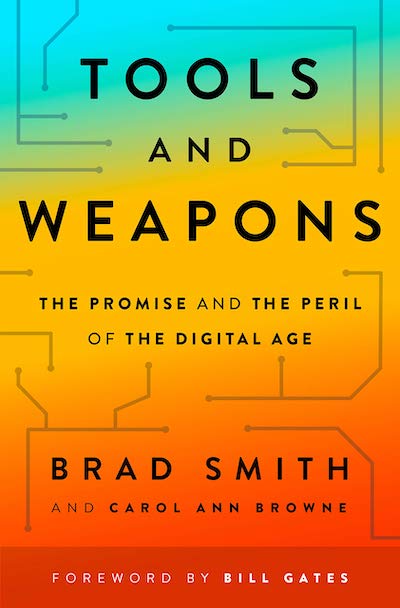
Prefer the print book? Buy on Amazon
As an Amazon Associate, Sumizeit earns from qualifying purchases.
Tools and Weapons Book Summary
This Tools and Weapons Book Summary covers the key ideas, lessons, and takeaways in about 20 minutes.
Short Description:
Tech safety requires shared responsibility between companies and governments.
Preview the Tools and Weapons book summary
Below is a preview of Sumizeit’s comprehensive human-written summary of Tools and Weapons by Brad Smith. The full summary is 15-20 minutes long and covers the book’s key ideas in text, audio, visual, and video formats. Unlock the full 20 Minute Summary
Technological advancement is a powerful thing. It can also be a scary one. Like when NSA employee Edward Snowden downloaded 1.5 million classified NSA documents, he left his job in Hawaii, and headed to Hong Kong. Later, he revealed the classified documents to journalists and the public discovered the NSA and the British Government had been copying user information from Yahoo and many other sources. One such program PRISM was an agreement between NASA and various companies where they shared private user data. The release of this information lead to citizens questioning how their data was being used by major tech companies, and more importantly if major tech companies could be trusted. In Tools and Weapons by Brad Smith and Carol Ann Brown, significant events in tech are analyzed, and lessons are shared: revealing that the relationship between user data and who can see it is actually a bit more complex than it may seem... especially when the government gets involved.
Customer approval seems ideal for determining whether or not to share their data, but there is a gray area.
Theoretically, customer data should not be shared without the legal process. If a person doesn’t agree to share their data, no one should have access to it, right?
Unfortunately, it's pretty hard to get legal consent from someone if you can’t find them, especially when someone’s life is on the line. For instance, when Wall Street Journal reporter Daniel Pearl was kidnapped by a group of terrorists in Pakistan, the only way to save him was to find him. The terrorists communicated with the US government through wifi hotspots throughout Pakistan. Pearl was killed before they were caught, but the terrorists were caught. They were found using web-based tracking. Was using data to track them ok, even though they didn’t receive explicit consent?
In this instance, yes, because it meant life could be saved. The point? All data tracking and sharing aren’t wrong. Even Microsoft thinks so: this chase led them to scale their ideas on customer privacy. They determined that when faced with an issue that could violate a user’s privacy, they would follow these principles: Privacy, security, transparency, and compliance.
The government shouldn’t use their powers to gain access to citizen’s personal data, and tech companies need to be protected.
The government began pursuing information from tech companies while trying to track terrorists, a noble deed, but it devolved into forcing tech companies to give them private information about American Citizens, and invoking “gagging orders”. These “gagging orders” were laws preventing the companies from disclosing that they were being hacked by the government. Eventually, Microsoft sued the government over this heinous breach of privacy. This lead to the Department of Justice ruling in favor of tech companies. Microsoft met with the Department of Justice, during which limits were set on gagging orders. This was one of the first steps taken to monitor the use of people’s data.
Each country needs to be treated differently when it comes to…
Want the complete 20-minute summary?
- Full structured summary
- Video Summary
- Podcast Summary
- Audio summary
- Key takeaways
- Exercises
- Quiz
- Highlights and notes
- Ask the book with AI
Who should read Tools and Weapons?
Tools and Weapons is essential for anyone concerned about digital privacy, cybersecurity, and the role of technology in society. This includes policymakers, tech professionals, business leaders, and informed citizens who want to understand the complex relationship between governments, corporations, and personal data. If you're questioning how your information is being used online or worried about AI bias and foreign interference, this book provides crucial context and real-world examples.
Why does Tools and Weapons matter?
In an era of unprecedented data collection and cyber threats, understanding the balance between innovation and privacy protection has never been more critical. Tools and Weapons addresses urgent real-world crises—from government surveillance overreach to election interference and hospital ransomware attacks—that directly affect everyone's digital life. Brad Smith's insider perspective from Microsoft reveals how tech companies, governments, and individuals must collaborate to build a safer, more trustworthy technological landscape.
What are the key themes in Tools and Weapons?
- The complexity of data privacy and government access
- Balancing security needs with individual privacy rights
- Shared responsibility between tech companies and government
- The global nature of technology governance
- AI bias and the importance of diverse engineering teams
- Cybersecurity threats and organizational resilience
- Disinformation and social media manipulation
- Technology's capacity for both good and harm
How can you apply ideas from Tools and Weapons?
- Evaluate your own digital footprint and understand what data companies collect about you, then make informed choices about platforms and services
- Advocate for stronger privacy protections and transparency requirements in your workplace, industry, or through civic engagement
- Support diversity and inclusion initiatives in tech companies and organizations, particularly in AI development and cybersecurity roles
- Develop critical thinking skills to identify disinformation and manipulated content on social media before sharing or believing it
- Push for your organization to implement data governance policies that balance security needs with privacy rights and require human oversight of automated decisions
- Engage with tech policy debates at local, national, and international levels to help shape regulations that protect privacy without stifling innovation
- Demand that government agencies operate transparently and seek legal warrants rather than demanding backdoor access to private company data
What common mistakes do readers make with Tools and Weapons?
- Assuming that simply clicking 'I agree' on terms of service truly gives you control over how your data is used—the reality is far more complex and often involves government requests
- Believing that technology companies are solely responsible for protecting privacy—governments and individual vigilance play equally important roles
- Trusting that AI systems are objective or unbiased simply because they're mathematical—they embed the assumptions and biases of their creators
- Underestimating the sophistication of foreign interference and disinformation campaigns on social media, leading to inadvertent spread of false information
- Thinking that privacy and security are always in direct opposition—Smith argues for frameworks that honor both with proper oversight and transparency
Sumizeit Exercises Apply what you've learned
Turn ideas from Tools and Weapons into action with a short guided reflection: identify the biggest takeaway, connect it to your life, and commit to one step you can take in the next 24 hours.
What is the expert analysis of Tools and Weapons?
Overview
Tools and Weapons is co-authored by Brad Smith, President of Microsoft, and Carol Ann Browne. The book is a significant contribution to contemporary discourse on the complex interplay between technological innovation, privacy, and governance. Smith’s authoritative position within one of the world’s leading tech companies lends the narrative both insider insight and a pragmatic perspective on the challenges faced by the industry. The book situates itself at the crossroads of business, ethics, and policy, addressing urgent questions about data privacy, government surveillance, cyber security, and the societal impact of emerging technologies such as artificial intelligence.
Core Thesis
The central argument of Tools and Weapons is that technology, while a powerful enabler of progress and innovation, simultaneously functions as a double-edged sword that can threaten individual privacy, democratic institutions, and global security. The authors assert that neither tech companies nor governments alone can bear the responsibility for the ethical use and protection of data; rather, a collaborative and nuanced approach is required. The book emphasizes the complexity of data governance, highlighting that legal consent, national contexts, and ethical considerations often collide, necessitating transparency, accountability, and adaptive regulation. Importantly, it challenges simplistic binaries of technology as either purely beneficial or harmful, advocating instead for informed stewardship and shared responsibility.
Strengths
- Insider Perspective: Brad Smith’s role at Microsoft provides rare access to real-world examples and legal battles, such as the company’s lawsuit against the U.S. government over gag orders, enriching the narrative with firsthand experience.
- Balanced Nuance: The book avoids alarmism by acknowledging both the risks and benefits of technology, illustrating positive applications like AI-assisted conservation and historical research alongside threats like cyberattacks and misinformation campaigns.
- Ethical Framework: By articulating principles such as privacy, security, transparency, and compliance, the authors offer a practical ethical framework for navigating the digital age’s dilemmas.
- Global Sensitivity: The discussion on differentiated data policies based on countries’ human rights records reflects an informed understanding of geopolitical complexities and the uneven landscape of digital rights.
- Engagement with AI Bias: The exploration of AI’s reflection of its creators’ biases is timely and critical, highlighting the importance of diversity in engineering teams to mitigate systemic inequities embedded in technology.
Critiques & Counterarguments
- Potential Corporate Bias: As a senior executive at Microsoft, Smith’s perspective may underrepresent the role of corporate interests in shaping privacy policies, potentially downplaying conflicts between profit motives and user rights.
- Limited Critical Distance: The narrative occasionally reads as a defense of tech companies’ actions, which might obscure deeper structural critiques about surveillance capitalism and the commodification of personal data.
- Oversimplification of Legal Complexities: The book’s treatment of legal consent and government data requests may not fully capture the intricate and often opaque nature of surveillance laws and their enforcement globally, especially in authoritarian regimes.
- Competing Research on AI Risks: While the book emphasizes bias in AI as the main concern, other scholars warn about existential risks posed by autonomous AI systems, which the authors address only tangentially, potentially underestimating future challenges.
- Real-World Evidence on Government Overreach: Despite the book’s call for balanced responsibility, numerous documented instances of government overreach and misuse of technology suggest that regulatory frameworks remain insufficient, raising questions about the feasibility of the proposed collaborative model.
Who Should Read This
Tools and Weapons is essential reading for policymakers, technology professionals, legal scholars, and informed citizens who seek a nuanced understanding of the ethical and societal implications of modern technology. It is particularly valuable for those interested in the intersection of technology and governance, offering a pragmatic roadmap for navigating the challenges of data privacy, cybersecurity, and AI ethics. Readers looking for a balanced insider’s perspective that neither demonizes nor blindly champions technology will find this book insightful. However, those seeking a more radical critique of the tech industry or a deep dive into the philosophical underpinnings of surveillance capitalism may need to supplement this with other works.
Frequently asked questions about the Tools and Weapons book summary
What is Tools and Weapons about?
Tools and Weapons by Brad Smith explores the complex intersection of technology, privacy, cybersecurity, and governance. The book examines real-world crises—from government surveillance and data abuse to AI bias and foreign interference—and argues that addressing these challenges requires shared responsibility between tech companies, governments, and informed citizens rather than simple solutions.
Who should read Tools and Weapons?
Anyone concerned about digital privacy, cybersecurity, and technology's role in society will benefit from this book. It's particularly valuable for policymakers, tech professionals, business leaders, and informed citizens who want to understand how governments and corporations handle personal data and how to protect themselves.
What are the main takeaways from Tools and Weapons?
The key takeaways are: privacy protection isn't always black-and-white, governments can abuse data access without proper checks, different countries require different policies, AI systems reflect their creators' biases, and responsibility for technology safety must be shared between companies, government, and individuals. Understanding these issues through informed engagement is essential for maintaining a trustworthy digital society.
Does Tools and Weapons argue that technology is bad?
No—Smith balances critique with recognition that technology has tremendous positive applications, from conservation efforts to historical research and disease prevention. The book's central argument is that technology itself is neither inherently good nor bad; rather, how it's used, governed, and designed determines its impact on society.
How does Brad Smith address government surveillance in Tools and Weapons?
Smith details how governments used national security justifications to demand private user data from tech companies and imposed gag orders preventing disclosure. He highlights Microsoft's legal challenge to these practices and the subsequent ruling that established limits on government overreach, illustrating the need for tech companies to defend user privacy against abuse.
What does Tools and Weapons say about artificial intelligence and bias?
Smith explains that AI systems aren't inherently dangerous—the primary risk is that they reflect and amplify the biases of their creators. The book advocates for diverse engineering teams, particularly including engineers with lived experience of discrimination, to identify and eliminate systemic bias before algorithms are deployed in high-stakes decisions.
How does Tools and Weapons address election interference and disinformation?
The book documents how foreign governments, like Russia's Internet Research Agency, use targeted disinformation and social media manipulation to interfere with democratic processes. Smith emphasizes the need for platform accountability, media literacy, and international cooperation to combat these threats.
What is Brad Smith's position on balancing privacy and security?
Rather than seeing privacy and security as opposites, Smith proposes they can coexist through proper governance frameworks based on principles of privacy, transparency, compliance, and oversight. He argues that life-or-death situations may require privacy compromises, but routine surveillance overreach must be prevented through legal and institutional checks.
About Sumizeit
Sumizeit is a profitable Scomy LLC company based in Miami, Florida. Our founders, Clemens Raemy and Weina Scott, are successful entrepreneurs with several exits. Sumizeit is a popular book summary app / micro learning app used by busy professionals and entrepreneurs with over 2,500 non-fiction book summaries and 10,000 podcast summaries in text, audio, visual, podcast, and video format. We also have stellar retention tools to make ideas stick - such as flashcards with spaced repetition, quizzes, streaks, highlighting and notes, daily challenges, riddles, mini-courses, meditation, and more. You won't only learn the idea, but also remember it. Over 90% of our users change their habits with Sumizeit.
Upgrade Now
Here's why readers love Sumizeit
Join thousands of learners getting smarter every day
"Great experience. Detailed summaries. Loved the gamification feature. Makes learning fun. Good customer service. I recommend Sumizeit to anyone. You'll learn a lot."
"I always felt busy but still wanting to keep up with the book discussion in my friend group. This was a great supplement to help me keep reading the books I find fun while keeping up with important books."
"I love this website. Instead of scrolling social media, I find myself learning a lot. I use it everyday. I recommend this app for anyone who is too busy and wants to get up to speed with their favorite books."
Tools and Weapons Book Summary PDF
Looking for a Tools and Weapons Book Summary PDF you can save and revisit offline? Our Tools and Weapons Book Summary PDF captures the book’s core ideas in a clean, printable format — the key frameworks, takeaways, and structure without the fluff. Download the Tools and Weapons Book Summary PDF when you want a reference you can annotate, share with your team, or review on the go. Get your Tools and Weapons Book Summary PDF from the download page below.
Download Tools and Weapons Book Summary PDFPeople also liked these summaries
Readers who explored Tools and Weapons often enjoyed these titles next.


Ready to read the whole thing?
- Full structured summary
- Video Summary
- Podcast Summary
- Audio summary
- Key takeaways
- Exercises
- Quiz
- Highlights and notes
- Ask the book with AI
Featured Book Titles
Popular Book Summaries at sumizeit, leading book summary app