


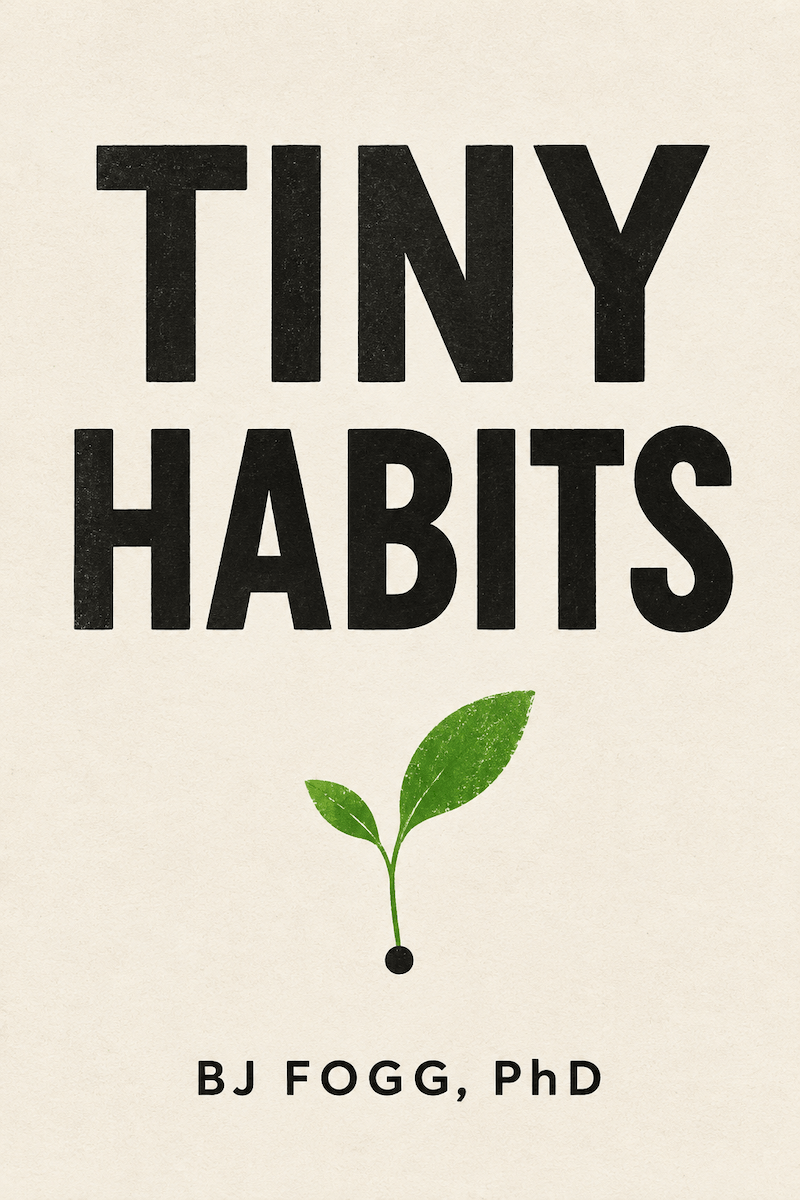
Prefer the print book? Buy on Amazon
As an Amazon Associate, Sumizeit earns from qualifying purchases.
Tiny Habits Book Summary
This Tiny Habits Book Summary covers the key ideas, lessons, and takeaways in about 20 minutes.
Tiny habits take an aspiration, like living a healthier lifestyle, and breaks it into one-minute chunks that you can start doing right away. Incorporating these behaviors into your routine creates habits.
Behaviors occur as a result of your desire to do them, your ability to do them, and a prompt triggering you to do them. Ideally, you should have all three of these to build a habit. You’re probably already motivated to change. You just have to figure out what you are capable of doing and what stimulus will work best to prompt you to do it.
The best prompt is an action prompt. You take an action that is already a habit and you use that to anchor your new, desirable behavior to it. If your prompt fits your desired habit by location, frequency, and theme, you have a good chance at cementing that tiny habit.
Each tiny habit on its own may not seem like much. But it is all progress. Don’t overwhelm yourself by trying to change everything. Just keep changing one thing at a time. It all adds up to the life you want to be living.
Helps with these goals
Want the complete 20-minute summary?
- Full structured summary
- Video Summary
- Podcast Summary
- Audio summary
- Key takeaways
- Exercises
- Quiz
- Highlights and notes
- Ask the book with AI
Not ready to upgrade?
Get this summary + 2 more picks sent to your inbox, free.
What is in the Tiny Habits book summary?
Below is a preview of Sumizeit’s expert-written summary of Tiny Habits by BJ Fogg. The full summary covers the book’s key ideas in text, audio, and video.
Trying to change your life is harder than it looks. You may have the best of intentions when you decide you’re going to finally lose that weight, practice yoga daily, or read more books. Jumping in, you make big changes and you’re excited to see results.
Time passes. Life happens. And you’re back to your old ways. You really wanted to change, but it just doesn’t seem to be happening for you. Why?
The short answer is that you asked too much of yourself too soon. Humans are creatures of habit. Replacing old habits with new ones is harder than it looks.
But change is possible. You just have to break it down into a series of “tiny habits” that get you closer to your big goal. Tiny Habits is all about setting yourself up for incremental success. In the end, it all adds up to big changes.
Knowing you should change isn’t enough.
You know that it’s important to eat less junk food, sleep enough, exercise, spend less time staring at your phone, avoid procrastination, and do all those other things that you should do. You know you could be healthier, happier, and more productive. But you don’t always get there.
The Information-Action Fallacy is the idea that attitudes and behaviors change when people have all the facts. If that were true, nobody would smoke, eat fast food, or take sedentary jobs. Information isn’t enough to build new and lasting habits.
If you haven’t been able to sustain change, you probably have the wrong approach.
What people do and what they should do doesn’t line up. It may feel like you’re not strong enough and that change comes down to willpower. You think that if you had the right mindset or were a more disciplined person, you would be able to succeed.
Let yourself off the hook. Motivation isn’t the only thing you need to be able to change your habits. Sure, there are people that seem to be able to make changes and stick to them without wavering. You can be one of those people. You need the right approach.
Once you understand that you’re not to blame for not changing your behavior, you can move on to the work of actually changing it for good. You just need to take the big goal and break it down. You can handle it in pieces better than you can if you tried to tackle the whole thing at once.
This approach works. BJ Fogg has tested it over the years with more than 40,000 people at the Stanford Behavior Design Lab. You can change and you can sustain the changes you make.
Small adjustments make up a successful approach to change.
Changes to behavior actually come from three places: epiphanies, environment, and incremental modifications. Of these, only the third one is truly in your control.
Epiphanies come out of nowhere. They are sudden revelations, which may be the push you need to change.
Want the complete 20-minute summary?
- Full structured summary
- Video Summary
- Podcast Summary
- Audio summary
- Key takeaways
- Exercises
- Quiz
- Highlights and notes
- Ask the book with AI
Who should read Tiny Habits?
Tiny Habits is for anyone who has struggled to maintain New Year's resolutions or feels stuck in old behavioral patterns. Whether you want to lose weight, exercise more, read daily, or break a bad habit, this book is designed for people who recognize they need change but haven't found an approach that sticks. It's especially valuable for those who believe willpower alone should be enough and feel frustrated when motivation fades.
Why does Tiny Habits matter?
In a world of competing demands and limited willpower, most people attempt change through massive overhauls that inevitably fail. BJ Fogg's research with over 40,000 people at Stanford shows that lasting transformation comes not from motivation or discipline, but from designing the right small behaviors anchored to existing routines. Understanding how to build tiny habits is essential for anyone serious about sustainable personal improvement in any area of life.
What are the key themes in Tiny Habits?
- Breaking large goals into one-minute behaviors
- The three drivers of behavior: motivation, ability, and prompts
- Why information and willpower alone fail to create lasting change
- Using action prompts to anchor new habits to existing routines
- Designing habits that match your current abilities
- The role of environment and incremental modification in behavior change
Want the complete 20-minute summary?
- Full structured summary
- Video Summary
- Podcast Summary
- Audio summary
- Key takeaways
- Exercises
- Quiz
- Highlights and notes
- Ask the book with AI
How can you apply ideas from Tiny Habits?
- Identify a daily routine you already do (brushing teeth, drinking coffee, using the bathroom) and anchor a one-minute new behavior to it
- Break a large goal like 'exercise more' into a 60-second behavior like 'do 2 wall pushups' or 'take 10 deep breaths' after an existing habit
- Simplify any desired behavior until it feels almost trivially easy, then build from there once it becomes automatic
- Design your prompts by considering location (where you'll actually be), frequency (how often it happens), and theme (how related it is to your goal)
- Replace willpower-dependent goals with environmental and habit-based solutions that require less mental energy
- When a tiny habit fails to stick, troubleshoot the prompt or simplify the behavior rather than blaming yourself
- Use the three-factor model (motivation, ability, prompt) to diagnose why a desired behavior isn't happening and adjust whichever factors you control
What common mistakes do readers make with Tiny Habits?
- Making your first attempt at a habit too ambitious, which leads to failure and reinforces the belief that change is impossible
- Relying on motivation to carry you through, then abandoning habits when motivation inevitably declines
- Choosing prompts that don't align with the location, frequency, or theme of your desired behavior, causing the habit to fail inconsistently
- Trying to change multiple habits at once instead of focusing on one tiny habit until it's automatic
Sumizeit Exercises Apply what you've learned
Turn ideas from Tiny Habits into action with a short guided reflection: identify the biggest takeaway, connect it to your life, and commit to one step you can take in the next 24 hours.
What is the expert analysis of Tiny Habits?
Overview
Tiny Habits: The Small Changes That Change Everything is authored by BJ Fogg, a prominent social scientist and founder of the Behavior Design Lab at Stanford University. Fogg’s expertise lies at the intersection of psychology, technology, and behavior change, making him uniquely qualified to address the complexities of habit formation. This book stands out for its practical approach to sustainable personal transformation, grounded in rigorous research and extensive real-world testing with over 40,000 participants. It contributes significantly to the self-improvement genre by shifting the focus from motivation and willpower to manageable, incremental behavioral adjustments.
Core Thesis
Fogg’s central argument is that lasting behavioral change is best achieved not through grand, sweeping efforts or bursts of motivation, but through the cultivation of “tiny habits” — small, easily achievable actions that accumulate into substantial life improvements over time. He posits that behavior is driven by the interplay of motivation, ability, and prompts, and that by optimizing these elements—particularly by simplifying actions and anchoring new habits to existing routines—individuals can overcome common barriers to change. This approach challenges the conventional wisdom that change requires extraordinary willpower or radical lifestyle overhauls.
Strengths
- Empirical Foundation: The methodology is backed by extensive empirical research and practical experimentation, lending credibility and applicability.
- Accessibility and Practicality: The book distills complex behavioral science into actionable steps, making it accessible to a broad audience without sacrificing intellectual rigor.
- Focus on Incrementalism: By emphasizing tiny, manageable changes, Fogg addresses the psychological resistance that often undermines larger change efforts.
- Integration of Environmental and Contextual Factors: The nuanced discussion of prompts—including contextual, person, and action prompts—demonstrates a sophisticated understanding of how environment shapes behavior.
- Scalability: The model’s simplicity allows for adaptation across diverse behaviors and settings, from personal health to professional productivity.
Critiques & Counterarguments
- Potential Oversimplification: While the tiny habits approach is elegant, it may understate the complexity of deeply ingrained behaviors influenced by socio-economic, cultural, and psychological factors beyond individual control.
- Limited Address of Motivation Fluctuations: Although Fogg acknowledges motivation’s limits, the model may insufficiently account for chronic motivational deficits seen in clinical populations such as depression or addiction.
- Competing Theories: Alternative frameworks, such as those emphasizing identity-based change (James Clear’s Atomic Habits) or cognitive-behavioral interventions, argue for a more integrated approach involving mindset shifts and emotional regulation alongside habit formation.
- Real-World Complexity: The reliance on action prompts assumes a degree of environmental stability and routine that may not exist for individuals in volatile or unpredictable life circumstances, limiting generalizability.
- Evidence Scope: Although the book references large-scale testing, much of the evidence is drawn from controlled or semi-controlled environments; longitudinal studies measuring sustained change over years remain sparse.
Who Should Read This
Tiny Habits is ideal for readers seeking a scientifically grounded yet highly practical guide to personal change. It appeals to those who have struggled with traditional goal-setting or motivational strategies and are looking for a more sustainable, less daunting path to improvement. Professionals in psychology, coaching, and behavioral design will find valuable insights for client interventions, while general readers interested in self-improvement, productivity, and wellness will appreciate the book’s clarity and actionable advice. It is particularly suited for individuals who prefer incremental progress over radical transformation and who want to understand the behavioral mechanics underpinning habit formation.
Frequently asked questions about the Tiny Habits book summary
What is Tiny Habits about?
Tiny Habits by BJ Fogg is a science-based guide to building lasting behavioral change through small, one-minute actions anchored to existing daily routines. Rather than relying on motivation or willpower, the book teaches you how to design habits by aligning three factors—motivation, ability, and prompts—so that positive behaviors become automatic and compound into major life improvements over time.
Who should read Tiny Habits?
Anyone who has struggled to maintain New Year's resolutions, break bad habits, or stick to lifestyle changes should read this book. It's ideal for people who want to lose weight, exercise regularly, read more, reduce phone time, or achieve any long-term goal but have repeatedly failed using willpower alone. Tiny Habits is also valuable for those who feel guilty about lack of discipline and need to understand that the problem is their approach, not their character.
What are the main takeaways from Tiny Habits?
The core takeaways are: (1) break large goals into one-minute behaviors, (2) focus on ability and prompts more than motivation, (3) anchor new habits to existing daily routines using action prompts, (4) design habits that match your current capabilities, and (5) make small consistent changes rather than attempting massive overhauls. BJ Fogg's research shows that when you align motivation, ability, and prompts correctly, lasting change becomes automatic.
How do I choose the right prompt for my tiny habit?
The best prompts are actions you already do daily. Choose a prompt by considering three factors: location (you should be in a place where the behavior makes sense), frequency (the prompt should happen as often as you want the behavior), and theme (ideally, the prompt relates to your desired habit). For example, if you want to floss daily, anchor it to brushing your teeth, which happens in the same location, at the same frequency, and relates thematically to oral care.
Why does willpower fail for building lasting habits?
Willpower is unreliable because motivation naturally fluctuates. Momentary bursts of motivation can fuel one-time achievements, but they cannot sustain long-term habits. Tiny Habits succeeds because it removes dependence on motivation by making behaviors so easy that you'll do them regardless of how motivated you feel. Instead of fighting your nature, you design systems that work with your abilities and automatic triggers.
What if my tiny habit keeps failing even though it seems small?
If a tiny habit isn't sticking, the problem is usually not your willpower but your habit design. Troubleshoot by checking if your prompt matches the location, frequency, and theme of your desired behavior. If it doesn't fit naturally, try a different prompt or simplify the behavior further. For example, if wall pushups still feel too hard, do them against a wall higher up or reduce the number. Adjustment, not blame, is the solution.
Can I build multiple tiny habits at the same time?
While technically possible, focusing on one tiny habit at a time is more effective. Building one habit until it becomes automatic takes weeks or months, and attempting too many changes simultaneously divides your attention and reduces success rates. Once your first tiny habit is solidly established, you can layer in a second one anchored to a different existing behavior.
About Sumizeit
Sumizeit is a profitable Scomy LLC company based in Miami, Florida. It has been helping readers learn from nonfiction books for 7 years with expert-written summaries in text, audio, podcast, and video.
Want the complete 20-minute summary?
- Full structured summary
- Video Summary
- Podcast Summary
- Audio summary
- Key takeaways
- Exercises
- Quiz
- Highlights and notes
- Ask the book with AI
Here's why readers love Sumizeit
Join thousands of learners getting smarter every day
"Great experience. Detailed summaries. Loved the gamification feature. Makes learning fun. Good customer service. I recommend Sumizeit to anyone. You'll learn a lot."
"I always felt busy but still wanting to keep up with the book discussion in my friend group. This was a great supplement to help me keep reading the books I find fun while keeping up with important books."
"I love this website. Instead of scrolling social media, I find myself learning a lot. I use it everyday. I recommend this app for anyone who is too busy and wants to get up to speed with their favorite books."
Tiny Habits Book Summary PDF
Looking for a Tiny Habits Book Summary PDF you can save and revisit offline? Our Tiny Habits Book Summary PDF captures the book’s core ideas in a clean, printable format — the key frameworks, takeaways, and structure without the fluff. Download the Tiny Habits Book Summary PDF when you want a reference you can annotate, share with your team, or review on the go. Get your Tiny Habits Book Summary PDF from the download page below.
Download Tiny Habits Book Summary PDFPeople also liked these summaries
Readers who explored Tiny Habits often enjoyed these titles next.

Want the complete 20-minute summary?
- Full structured summary
- Video Summary
- Podcast Summary
- Audio summary
- Key takeaways
- Exercises
- Quiz
- Highlights and notes
- Ask the book with AI
Featured Book Titles
Popular Book Summaries at sumizeit, leading book summary app