


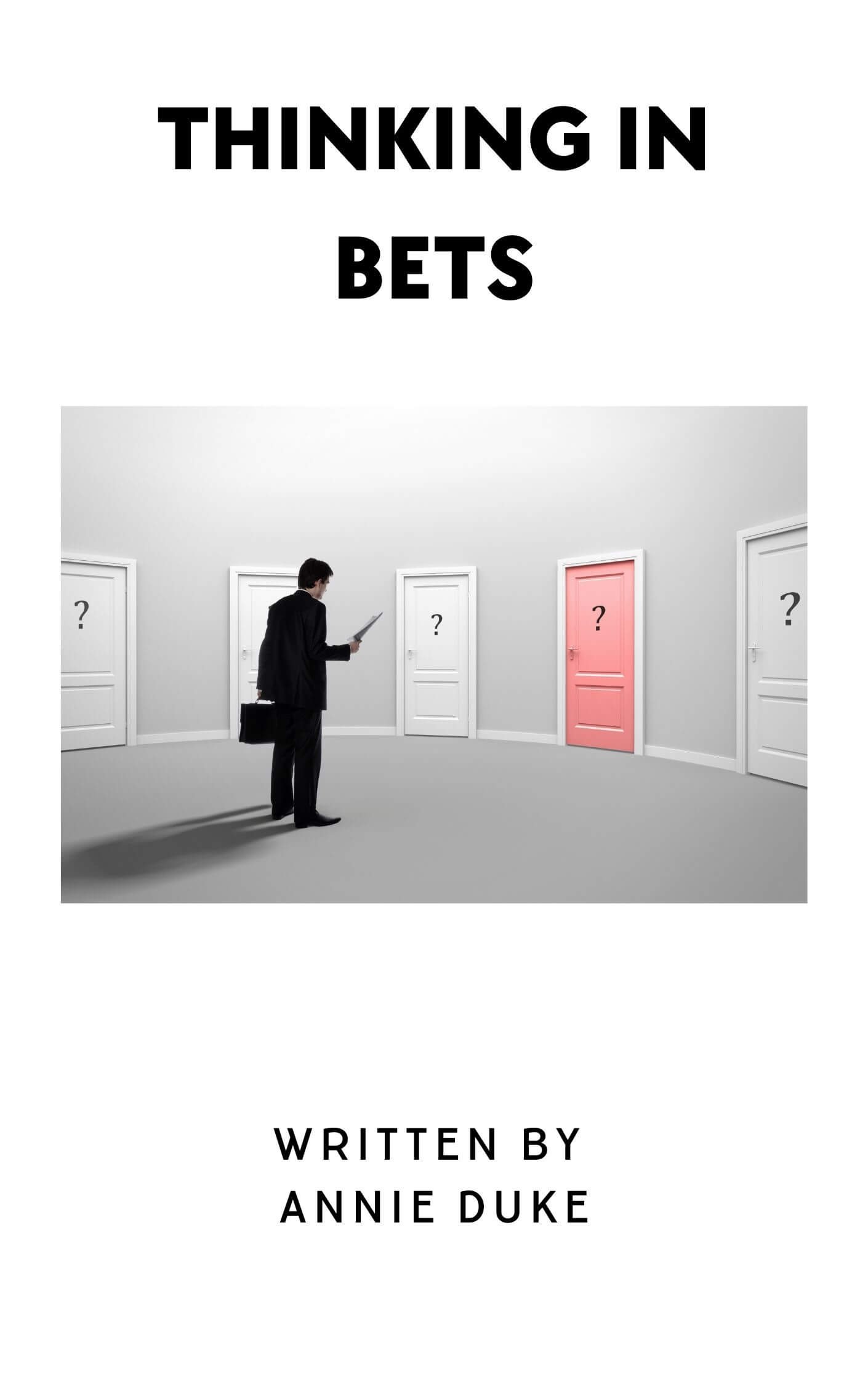
Prefer the print book? Buy on Amazon
As an Amazon Associate, Sumizeit earns from qualifying purchases.
Thinking in Bets Book Summary
This Thinking in Bets Book Summary covers the key ideas, lessons, and takeaways in about 20 minutes.
Short Description:
Thinking in Bets teaches decision-making as managing risk and uncertainty.
Want a Free Weekly Read?
Get a free summary every week straight to your mailbox.
Preview the Thinking in Bets book summary
Below is a preview of Sumizeit’s comprehensive human-written summary of Thinking in Bets by Annie Duke. The full summary is 15-20 minutes long and covers the book’s key ideas in text, audio, visual, and video formats. Unlock the full 20 Minute Summary
Tactics for successful living are often compared to the game of Chess. In her book, Thinking in Bets, Annie Duke outlines how the best strategies for making good decisions actually come from the game of Poker. Duke is a professional Poker player and uses her expertise to explain these strategies and how to apply them in daily living. Thinking in Bets is ultimately a blueprint for identifying decision-making deficiencies and creating a plan to overcome them. It is personal coaching with an original approach.
Negative Outcomes are NOT a Reflection of Poor Decisions
Associating negative outcomes with bad decisions can be instinctive. When something doesn’t go the way we expect, it’s common to blame the choices we made. Duke warns not to instantly make such associations. She says the fear and caution that can result may stifle the aggressive, game-changing decisions needed for future successes. One example used in the book is how the Seahawks lost to the Patriots in the Super Bowl. The play used was backed by solid data. According to Duke, it was the ever-present element of luck, not poor decision making that led to the loss.
Uncertainty is NOT Bad, and Being Wrong isn’t Either
It is built into our culture to believe that not knowing something is bad. In education, if we don’t know the answers on a test, it is considered a failure. To progress towards good decision making, we need to acknowledge and even embrace uncertainty. This keeps us from viewing everything in black and white. According to Duke, bets aren’t right or wrong based solely on the outcome. She points out that decision making improves when we don’t view past choices as “wrong” but as periods of learning. By redefining wrong as lessons instead of mistakes, we free ourselves from the fear of getting a bad result and are able to move towards more educated risk-taking.
Skill AND Luck Influence the Outcome of Every Bet
Winning Poker players are comfortable with uncertainty. They can place their bets without a great deal of evidence to rationalize the outcome. The ability to make impromptu decisions and live with them is an important skill. Accepting the existence of LUCK is required to play the game successfully. Knowing that you can’t predict most things will help you accept the fundamental truth that life is uncertain. Accepting this truth allows decision making to improve. Interestingly, we feel the pain of losses twice as much as the joy of wins, and in life, or Poker, we will actually be wrong more often than we will be right, setting ourselves up for unnecessary pain.
Most Often, We Bet AGAINST Ourselves
While this may sound negative, betting against ourselves simply means that we aren’t hedging our wagers against someone else. Its other versions of ourselves that we are rejecting. This is because every bet is gambling on a potential future. While one future will win, other future scenarios will lose.
Want the complete 20-minute summary?
- Full structured summary
- Video Summary
- Podcast Summary
- Audio summary
- Key takeaways
- Exercises
- Quiz
- Highlights and notes
- Ask the book with AI
Who should read Thinking in Bets?
Thinking in Bets is ideal for anyone who struggles with decision-making, risk aversion, or the fear of failure. Professionals, entrepreneurs, and leaders will benefit most, as will anyone seeking to improve their judgment under uncertainty and reduce the emotional toll of setbacks.
Why does Thinking in Bets matter?
In an increasingly uncertain world, the ability to make sound decisions despite incomplete information is more valuable than ever. Annie Duke's framework redefines failure and luck in ways that free people from paralyzing fear and enable smarter risk-taking. By shifting how we evaluate our choices, we can build resilience, improve outcomes, and achieve greater success in work and life.
What are the key themes in Thinking in Bets?
- Separating decision quality from outcomes
- Embracing uncertainty as an advantage
- The role of luck in every outcome
- Overcoming cognitive biases through accountability
- Emotional regulation in high-stakes moments
- Long-term thinking over short-term impulses
- Learning from observation and peer feedback
- Committing to rational behavior in advance
How can you apply ideas from Thinking in Bets?
- Create a personal decision group of 3-5 trusted advisors who will give you honest feedback on major choices before you commit
- Use the 10-10-10 framework before making any significant decision: pause and ask how it will affect you in 10 minutes, 10 months, and 10 years
- Establish Ulysses Contracts for areas where impulse control typically fails—predetermine your rules before temptation strikes
- After a disappointing outcome, analyze the decision-making process rather than judging yourself as right or wrong; extract lessons for next time
- Spend 30 minutes weekly observing others' decisions and outcomes in your field or industry; build judgment through low-cost observation
- When facing a high-stakes decision, take a 15-minute break to meditate, walk, or breathe before responding; interrupt emotion-driven thinking
- Document your major decisions alongside your reasoning; review them quarterly to identify patterns in your biases and blind spots
What common mistakes do readers make with Thinking in Bets?
- Assuming a bad outcome means you made a bad decision—conflating results with reasoning quality and creating excessive fear of risk
- Relying solely on your own perspective when making important decisions, leaving blind spot bias unchecked
- Making impulsive choices in moments of high emotion (whether anger or excitement) without a predetermined boundary or cooling-off period
- Interpreting new information through the lens of existing beliefs rather than updating beliefs based on evidence, reinforcing confirmation bias
Sumizeit Exercises Apply what you've learned
Turn ideas from Thinking in Bets into action with a short guided reflection: identify the biggest takeaway, connect it to your life, and commit to one step you can take in the next 24 hours.
What is the expert analysis of Thinking in Bets?
Overview
Thinking in Bets is authored by Annie Duke, a celebrated professional Poker player with multiple championship titles and a reputation for insightful analysis of decision-making under uncertainty. The book stands out by leveraging Poker—a game inherently tied to probability, risk, and incomplete information—as a metaphor and practical framework for navigating complex life and business decisions. Duke’s unique vantage point as a world-class gambler and decision strategist lends the book both credibility and originality, positioning it as a significant contribution to literature on rational thinking, behavioral psychology, and risk management.
Core Thesis
Duke’s central argument is that all decisions are essentially bets placed amidst uncertainty, where outcomes are influenced by both skill and luck. She challenges the conventional tendency to equate negative outcomes with poor decisions, advocating instead for a mindset that embraces uncertainty, learns from mistakes without self-recrimination, and adopts probabilistic thinking. By thinking in bets, individuals can better calibrate their confidence, manage emotions, and improve decision quality over time through objective feedback and reflective practices.
Strengths
- Innovative Framework: Duke’s analogy between Poker and life decision-making provides a fresh lens that demystifies complex cognitive biases and emotional pitfalls.
- Practical Tools: The book offers actionable strategies such as the “Decision Group,” “Ulysses Contract,” and the “10-10-10” approach, which empower readers to implement abstract concepts in real-world contexts.
- Psychological Insight: The exploration of motivated reasoning, temporal discounting, and emotional “tilt” enriches the reader’s understanding of the subconscious forces that undermine rationality.
- Balanced View on Luck and Skill: By acknowledging the dual influence of luck and skill, Duke encourages humility and resilience, fostering a healthier relationship with risk and failure.
- Engaging Anecdotes: The use of vivid examples, such as the Seahawks’ Super Bowl decision and the Poker community’s culture, makes complex ideas accessible and memorable.
Critiques & Counterarguments
- Overreliance on Poker Metaphor: While illuminating, the Poker analogy may oversimplify decision-making in domains where stakes, information asymmetry, and ethical considerations differ markedly from gambling scenarios.
- Limited Empirical Evidence: The book leans heavily on anecdotal and experiential knowledge from Poker and behavioral science, but it lacks rigorous, large-scale empirical validation of its decision frameworks across diverse real-world settings.
- Potential Underestimation of Structural Factors: Duke’s emphasis on individual cognitive processes may underplay systemic and contextual influences—such as socioeconomic constraints or organizational dynamics—that shape decision outcomes.
- Opposing Views on Rationality: Some schools of behavioral economics and philosophy argue that decision-making is often boundedly rational and context-dependent, suggesting that strict probabilistic thinking may not always be optimal or feasible.
- Emotional Intelligence Nuances: The book’s framing of emotional states like “tilt” as primarily detrimental might overlook how emotions can sometimes enhance intuition and adaptive decision-making, a perspective supported by affective neuroscience.
Who Should Read This
Thinking in Bets is ideally suited for readers interested in improving their decision-making skills through a blend of psychology, strategy, and practical wisdom. Business leaders, entrepreneurs, and professionals facing high-stakes uncertainty will find Duke’s insights particularly valuable. Additionally, those fascinated by cognitive biases, risk assessment, and behavioral change will appreciate the book’s nuanced exploration of human judgment. Finally, readers seeking a fresh, intellectually engaging approach to self-improvement and rational thinking will benefit from Duke’s compelling synthesis of Poker expertise and decision science.
Frequently asked questions about the Thinking in Bets book summary
What is Thinking in Bets about?
Thinking in Bets by Annie Duke is a decision-making guide that applies poker strategy to everyday life. The core premise is that all decisions are bets—you're putting your resources at risk in hopes of a favorable outcome. Duke teaches readers to separate decision quality from outcomes, embrace uncertainty, acknowledge luck, overcome cognitive biases through accountability, and make choices aligned with their long-term well-being rather than short-term impulses.
Who should read Thinking in Bets?
Anyone who struggles with decision-making, fear of failure, or risk aversion will benefit from this book. It's especially valuable for professionals, entrepreneurs, leaders, and executives who regularly make high-stakes choices under uncertainty. The book also appeals to anyone seeking to build confidence, reduce emotional decision-making, and improve their judgment in work and personal life.
What are the main takeaways from Thinking in Bets?
The main takeaways include: (1) outcomes don't define decision quality—luck plays a role in every result; (2) embrace uncertainty rather than fear it; (3) reframe failures as learning opportunities, not mistakes; (4) surround yourself with a trusted decision group for honest feedback; (5) use frameworks like 10-10-10 and Ulysses Contracts to align choices with your long-term goals; and (6) recognize emotional hijacking and interrupt it before making choices.
How does Annie Duke apply poker strategy to real life?
Duke uses poker concepts like managing uncertainty, separating skill from luck, observing opponents, and controlling emotions to frame everyday decisions. Poker players must make high-stakes choices with incomplete information and live with the outcomes—a skill directly applicable to business, relationships, and personal goals. She emphasizes that successful poker players accept luck, avoid outcome bias, and continuously learn, all of which translate to better decision-making in any domain.
What is a 'Decision Group' and why is it important?
A Decision Group is a circle of 3-5 trusted advisors who commit to giving you honest, candid feedback on your major choices and decisions. It's important because humans are naturally biased and prone to blind spots—we rationalize our beliefs rather than challenging them. A good decision group helps you see situations more objectively, catch reasoning flaws, and make smarter choices by prioritizing truth over feelings.
What does 'tilt' mean in Thinking in Bets?
Tilt is a poker term that Duke applies to emotional hijacking in everyday life. It occurs when emotions run so high that your brain's cognitive control center shuts down, impairing judgment. Both extreme stress and excessive confidence can trigger tilt. When tilted, people make poor decisions—both poker players and humans in general. Recognizing when you're tilting and stepping back to calm yourself is essential to preventing regrettable choices.
What is a 'Ulysses Contract' and how do I use one?
A Ulysses Contract is a commitment you make to yourself in advance to prevent irrational behavior when temptation or emotion strikes. Based on the Greek hero who had himself tied to a mast to resist the Sirens' song, this contract involves predetermining rules or boundaries before a high-stakes moment arrives. For example, deciding in advance not to eat sugar makes it easier to say no when offered. These pre-commitments act as insurance against self-sabotage.
How does the 10-10-10 framework help with decision-making?
The 10-10-10 framework, recommended by Suzy Welch, asks you to evaluate a decision's impact across three time horizons: 10 minutes, 10 months, and 10 years. This temporal perspective naturally shifts you away from short-term impulses toward choices that align with your long-term well-being. Before committing to a decision, pause and ask yourself how it will affect you at each interval, which helps counter the tendency to favor immediate gratification over future success.
About Sumizeit
Sumizeit is a profitable Scomy LLC company based in Miami, Florida. Our founders, Clemens Raemy and Weina Scott, are successful entrepreneurs with several exits. Sumizeit is a popular book summary app / micro learning app used by busy professionals and entrepreneurs with over 2,500 non-fiction book summaries and 10,000 podcast summaries in text, audio, visual, podcast, and video format. We also have stellar retention tools to make ideas stick - such as flashcards with spaced repetition, quizzes, streaks, highlighting and notes, daily challenges, riddles, mini-courses, meditation, and more. You won't only learn the idea, but also remember it. Over 90% of our users change their habits with Sumizeit.
Upgrade Now
Here's why readers love Sumizeit
Join thousands of learners getting smarter every day
"Great experience. Detailed summaries. Loved the gamification feature. Makes learning fun. Good customer service. I recommend Sumizeit to anyone. You'll learn a lot."
"I always felt busy but still wanting to keep up with the book discussion in my friend group. This was a great supplement to help me keep reading the books I find fun while keeping up with important books."
"I love this website. Instead of scrolling social media, I find myself learning a lot. I use it everyday. I recommend this app for anyone who is too busy and wants to get up to speed with their favorite books."
Thinking in Bets Book Summary PDF
Looking for a Thinking in Bets Book Summary PDF you can save and revisit offline? Our Thinking in Bets Book Summary PDF captures the book’s core ideas in a clean, printable format — the key frameworks, takeaways, and structure without the fluff. Download the Thinking in Bets Book Summary PDF when you want a reference you can annotate, share with your team, or review on the go. Get your Thinking in Bets Book Summary PDF from the download page below.
Download Thinking in Bets Book Summary PDFPeople also liked these summaries
Readers who explored Thinking in Bets often enjoyed these titles next.


Ready to read the whole thing?
- Full structured summary
- Video Summary
- Podcast Summary
- Audio summary
- Key takeaways
- Exercises
- Quiz
- Highlights and notes
- Ask the book with AI
Featured Book Titles
Popular Book Summaries at sumizeit, leading book summary app