
Question 1 of 10


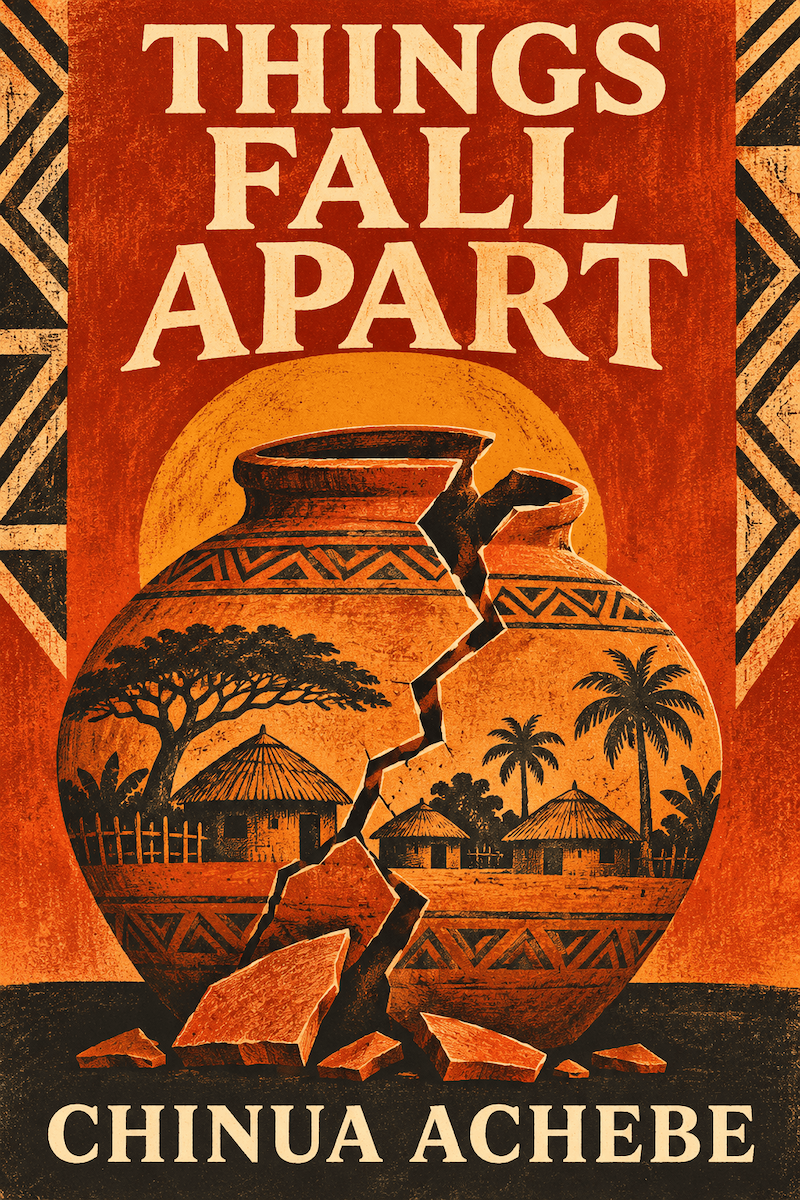
Prefer the print book? Buy on Amazon
As an Amazon Associate, Sumizeit earns from qualifying purchases.
Book Summary
Things Fall Apart Book Summary
This Things Fall Apart Book Summary covers the key ideas, lessons, and takeaways in about 20 minutes.
Short Description:
A proud Igbo warrior watches colonial rule and a new faith break his world apart.
Things Fall Apart is a tragedy on two levels, and the book works because Achebe refuses to simplify either one. Okonkwo destroys himself. His terror of weakness makes him beat his wives, kill a boy who called him father, and drive away his own son, and when change arrives he has only one answer for it, which is violence. At the same time, a whole way of life is being pulled apart by forces no single person could have stopped. Achebe shows that Igbo society was whole and worked well, with courts, religion, art, and room for men like Obierika to question it. He also shows the cracks that were already there, like the abandoned twins and the outcasts, and those cracks are exactly where the new faith got in. The colonizers did not conquer Umuofia in battle. They divided it, and a divided clan could no longer act as one. The lesson I keep coming back to is that strength that cannot bend will break, in a person and in a society, and that whoever gets to write the story afterward can shrink an entire world down to a paragraph. Achebe wrote this novel so that would not be the last word.
Helps with these goals
Preview the Things Fall Apart book summary
Below is a preview of Sumizeit’s comprehensive human-written summary of Things Fall Apart by Chinua Achebe. The full summary is 15-20 minutes long and covers the book’s key ideas in text, audio, visual, and video formats. Unlock the full 20 Minute Summary
Okonkwo is famous across the nine villages of Umuofia, an Igbo clan in what is now southeastern Nigeria. He earned that fame at eighteen, when he threw Amalinze the Cat, a wrestler nobody had beaten in seven years. By the time the novel opens he is around forty. He has three wives, two barns full of yams, two titles, and a reputation as the clan's fiercest warrior. He is tall and heavy browed, he stammers a little when he is angry, and when words fail him he uses his fists.
To understand Okonkwo you have to understand his father. Unoka was charming and gentle. He loved his flute, good palm wine, and the season when the village musicians played. He also hated work and the sight of blood, and he owed money to nearly everyone he knew. Achebe gives us one small scene that tells the whole story. A neighbor named Okoye comes to collect a debt. Unoka laughs, points to the chalk lines on his wall that record what he owes, and explains that he plans to pay his biggest debts first. Okoye goes home with nothing.
Unoka died with no titles and deep in debt. Okonkwo has spent his entire life running from that memory. His whole character rests on one fear, which is that he might turn out like his father. So he despises anything his father loved. Gentleness looks like weakness to him. So does idleness, and so does music. He works his farm from dawn to dark and rules his household with a heavy hand. His wives and children live in fear of his temper. Achebe is clear that Okonkwo is not a cruel man at heart. He is a frightened one, and he has decided that the only emotion worth showing is anger.
How Okonkwo made himself
Okonkwo inherited nothing. No barn, no title, not even a young wife. Before Unoka died, he had gone to consult Agbala, the Oracle of the Hills and Caves, about his poor harvests. The priestess told him flatly that his problem was not the gods. His problem was laziness. Unoka later died of a swelling sickness the clan considered an offense against the earth, so he was carried to the Evil Forest and left there to die without a proper burial.
As a young man Okonkwo went to a wealthy elder named Nwakibie, brought him palm wine and kola nut, and asked for seed yams to farm as a sharecropper. Nwakibie had turned away plenty of young men, but he trusted this one and gave him eight hundred. A friend of his father added four hundred more. Sharecropping was a slow road because the farmer kept only a third of the harvest, and Okonkwo was also feeding his mother and sisters.
Then came the worst farming year anyone could remember. First a drought burned the early yams. Then the rain fell without stopping and rotted what was left. One farmer hanged himself.
Want the complete 20-minute summary?
- Full structured summary
- Video Summary
- Podcast Summary
- Audio summary
- Key takeaways
- Exercises
- Quiz
- Highlights and notes
- Ask the book with AI
Who should read Things Fall Apart?
Things Fall Apart is essential reading for anyone interested in African literature, postcolonial studies, or understanding how colonialism disrupted non-Western societies. It's also vital for readers who want to encounter a complex tragic protagonist whose flaws are rooted in fear rather than pure villainy, and for those seeking to understand how cultures with rich traditions and functioning systems can be internally divided and destabilized.
Why does Things Fall Apart matter?
Published in 1958 on the eve of Nigerian independence, Chinua Achebe's Things Fall Apart fundamentally challenged the Western narrative of Africa as a continent without history or civilization. The novel demonstrates that pre-colonial Igbo society had its own laws, courts, religion, and art, correcting decades of European depictions of Africans as savages. Today it remains crucial for understanding how colonialism succeeded not through military conquest alone but by exploiting internal contradictions and dividing communities from within.
What are the key themes in Things Fall Apart?
- The destructive power of fear and shame in shaping identity
- How personal trauma can drive self-sabotage and violence
- The tension between tradition and social change
- Colonialism as cultural division rather than military conquest
- The danger of rigidity in the face of inevitable change
- How history is written by those in power
- The complexity of non-Western societies before colonialism
- The cost of toxic masculinity and emotional suppression
How can you apply ideas from Things Fall Apart?
- Examine your own foundational fears and how they shape your decisions and relationships; ask whether you're running from something or moving toward something.
- When facing success, consciously practice humility and remember those who struggled—use it to build empathy rather than impatience with others' failures.
- Develop flexibility in your worldview by seeking out people who think differently and asking genuine questions about their perspective, as Akunna and Mr. Brown do.
- In times of organizational or personal crisis, notice where divisions are forming and actively work to maintain connection across differences rather than allowing factions to harden.
- Before taking drastic action, ask whether you're responding to the actual situation or to your own wounded pride or fear of appearing weak.
- Recognize that in any power transition, the new order gains footholds through appealing to those marginalized by the old system; strengthen communities by addressing their internal inequities.
- When documenting or telling stories about others' lives or cultures, pause to consider what details you're leaving out and whose perspective you're centering.
What common mistakes do readers make with Things Fall Apart?
- Viewing Okonkwo as simply a villain rather than a frightened man whose fear has calcified into rigidity; this misses the novel's deeper tragedy.
- Seeing the colonizers as wholly evil invaders rather than recognizing how they exploit existing faults and divisions within Igbo society.
- Reading the novel as a simple story of tradition versus progress, when Achebe's point is far more nuanced: that the new order divides the clan and uses that division to consolidate power.
- Assuming that pre-colonial Africa was perfect or that all customs were justified; Achebe shows real problems like osu discrimination and infanticide alongside functional systems of law and spirituality.
- Missing the irony in the final paragraph—that the Commissioner will reduce a complex tragedy to a footnote in his book about pacifying primitives, which is exactly what Western histories did to African civilizations.
- Focusing only on Okonkwo's flaws without recognizing how external forces beyond any individual's control are reshaping his entire world.
Sumizeit Exercises Apply what you've learned
Turn ideas from Things Fall Apart into action with a short guided reflection: identify the biggest takeaway, connect it to your life, and commit to one step you can take in the next 24 hours.
What is the expert analysis of Things Fall Apart?
Overview
Things Fall Apart, written by Chinua Achebe and first published in 1958, stands as a seminal work in African literature and postcolonial studies. Achebe, an Igbo Nigerian deeply rooted in both Christian and indigenous traditions, crafted this novel as a powerful counter-narrative to colonial depictions of Africa as a continent devoid of history and complexity. The book’s significance lies in its nuanced portrayal of Igbo society before and during the early incursions of European colonialism, offering a richly textured exploration of cultural identity, tradition, and change. It remains the most widely read African novel worldwide, translated into over fifty languages, and has shaped generations of readers and writers alike.
Core Thesis
Achebe’s central argument is that African societies, exemplified by the Igbo clan of Umuofia, possessed intricate social, religious, and legal systems that were disrupted and ultimately fractured by colonial intervention. Through the tragic figure of Okonkwo, Achebe explores the personal and societal consequences of inflexibility and fear in the face of inevitable change. The novel asserts that strength untempered by adaptability leads to destruction, both on an individual level and within the broader community. Achebe also critiques the colonial narrative that reduces complex civilizations to simplistic stereotypes, emphasizing the importance of storytelling and perspective in preserving cultural dignity.
Strengths
- Complex Characterization: Okonkwo is portrayed with psychological depth, embodying the tensions between tradition and change, strength and vulnerability, pride and fear. This complexity elevates him beyond a mere cultural symbol into a tragic hero whose flaws and virtues resonate universally.
- Rich Cultural Detail: Achebe meticulously reconstructs Igbo customs, religious beliefs, and social institutions, providing readers with an immersive experience of a society often marginalized or misunderstood in Western literature.
- Balanced Perspective: The novel neither idealizes Igbo society nor demonizes colonial forces. Instead, it presents internal contradictions—such as the treatment of outcasts and twins—that complicate the narrative and invite critical reflection.
- Literary Craftsmanship: Achebe’s narrative structure, blending folklore, oral tradition, and tragic drama, creates a layered storytelling approach that honors African narrative forms while engaging a global readership.
- Political and Historical Insight: The book anticipates the devastating impact of colonialism not through overt battle scenes but through cultural erosion and division, making its critique both subtle and profound.
Critiques & Counterarguments
- Romanticization vs. Realism: While Achebe presents Igbo society with admirable complexity, some critics argue that the novel occasionally romanticizes pre-colonial life, downplaying internal conflicts and inequalities such as gender oppression and social stratification.
- Determinism in Okonkwo’s Tragedy: Okonkwo’s downfall is largely attributed to his personal flaws and rigid adherence to tradition, which might oversimplify broader socio-political dynamics. Alternative readings suggest that the colonial encounter’s systemic violence and economic disruption play a more decisive role than individual agency.
- Limited Female Perspectives: Although women are present and significant, the narrative centers predominantly on male experiences and viewpoints. Feminist critiques highlight the need for a more robust exploration of women’s roles and resistances within Igbo society.
- Opposing Schools of Thought: Postcolonial theorists like Ngũgĩ wa Thiong'o advocate for decolonizing literature through indigenous languages rather than writing in colonial languages, suggesting Achebe’s English-language narrative may inadvertently perpetuate colonial linguistic dominance.
- Historical Accuracy and Generalization: Some historians caution against reading the novel as a definitive ethnographic account of the Igbo or African societies at large, emphasizing the fictional and selective nature of Achebe’s portrayal.
Who Should Read This
Things Fall Apart is essential reading for scholars and enthusiasts of postcolonial literature, African history, and cultural studies. It is invaluable for those interested in understanding the complexities of colonial impact beyond political events—through the lens of individual lives and communal traditions. Students of psychology and philosophy will find rich material in Okonkwo’s tragic psychology and the ethical dilemmas posed by cultural collision. Moreover, anyone engaged in conversations about identity, power, and narrative authority will benefit from Achebe’s masterful interrogation of who gets to tell history and how. Finally, readers seeking a profound, humanistic story about resilience, loss, and transformation will find this novel deeply rewarding.
Discussion questions for Things Fall Apart Short questions you can actually use in a conversation
Frequently asked questions about the Things Fall Apart book summary
What is Things Fall Apart about?
Things Fall Apart by Chinua Achebe is a novel about Okonkwo, a respected warrior in an Igbo village in southeastern Nigeria, whose personal tragedy unfolds alongside the arrival of European colonizers and Christian missionaries. The novel chronicles Okonkwo's rise through sheer determination, his moral crisis when he kills a boy he loves to avoid appearing weak, his exile, and ultimately his suicide as his entire world—both personal and cultural—collapses under colonial pressure. It is simultaneously a portrait of a complex, flawed man and a portrait of how a functioning African society is dismantled from within.
Who should read Things Fall Apart?
Anyone interested in African literature, postcolonial studies, or understanding how colonialism actually worked should read this novel. It's essential for students of history, literature, and cultural studies, but it's also vital for general readers who want to encounter a genuinely complex tragic character and a nuanced portrayal of a non-Western society before colonialism. If you've only encountered Africa through a Western lens, or if you want to understand how the written word can erase entire civilizations, this book is crucial.
What are the main takeaways from Things Fall Apart?
The main takeaways are: strength without flexibility will break in both individuals and societies; fear-based identity leads to self-sabotage and cruelty; colonialism succeeded by exploiting internal divisions rather than through direct conquest; and history is written by those with the power to record it. Achebe also shows that pre-colonial Igbo society was complex and functioning, with its own courts, religion, and art, and that the cracks the colonizers exploited—like the treatment of twins and outcasts—were real problems but did not justify the destruction of the entire culture.
Why did Okonkwo kill Ikemefuna?
Okonkwo killed Ikemefuna because he feared being thought weak. The Oracle had decreed that the boy must die, and an elder explicitly warned Okonkwo to take no part in it. When the moment came and Ikemefuna ran toward him calling him father, Okonkwo's terror of appearing soft overrode his better instincts, and he struck the fatal blow. This act is the moral center of the novel and represents how Okonkwo's entire life—built on fear of weakness—ultimately destroys what he loves most.
What does the title 'Things Fall Apart' mean?
The title comes from a W.B. Yeats poem and refers to the disintegration on two levels: Okonkwo's personal collapse and the breakdown of Igbo society under colonialism. It captures the irony that neither the individual tragedy nor the cultural tragedy is straightforward. Okonkwo falls apart partly because of his own fear and rigidity, but also because external forces beyond his control are destroying his entire world. The title suggests that when a society (or person) cannot adapt and bend, it will break.
How did colonialism succeed in Umuofia without a military battle?
Colonialism succeeded in Umuofia by dividing it from within. The missionaries converted those who felt marginalized by traditional society—the osu outcasts, women who had suffered from the custom of infanticide, men without titles. The colonial government then established courts and administrative power. By the time the clan realized the threat, some of its own brothers stood on the colonizers' side, and a divided clan could not act with unified strength. Obierika diagnoses this perfectly: the white man cut the things that bound the people together, and they fell apart.
What is significant about the final paragraph of Things Fall Apart?
The final paragraph shifts inside the Commissioner's head as he walks away from Okonkwo's body. He is already planning a book about his years bringing civilization to Africa, and he decides Okonkwo's story—the tragedy of a great man driven to suicide—would make an interesting paragraph, maybe not a whole chapter. This is devastating because we have just spent an entire novel inside Okonkwo's world, and the colonizer will reduce all that complexity to a paragraph in a book titled The Pacification of the Primitive Tribes of the Lower Niger. It shows how history erases entire cultures and civilizations.
Why does Nwoye convert to Christianity?
Nwoye converts to Christianity partly because the new faith offers answers to questions that have haunted him since childhood—specifically about the twins abandoned in the forest and about Ikemefuna's death. The missionaries' hymn about brothers living in darkness and fear resonates with him deeply. But he also converts to escape his father's world and the violence that defines it. His father's killing of Ikemefuna breaks something fundamental in Nwoye, and Christianity becomes his way out. When his father beats him for joining the church, Nwoye leaves and never returns.
About Sumizeit
Sumizeit is a profitable Scomy LLC company based in Miami, Florida. Our founders, Clemens Raemy and Weina Scott, are successful entrepreneurs with several exits. Sumizeit is a popular book summary app / micro learning app used by busy professionals and entrepreneurs with over 2,500 non-fiction book summaries and 10,000 podcast summaries in text, audio, visual, podcast, and video format. We also have stellar retention tools to make ideas stick - such as flashcards with spaced repetition, quizzes, streaks, highlighting and notes, daily challenges, riddles, mini-courses, meditation, and more. You won't only learn the idea, but also remember it. Over 90% of our users change their habits with Sumizeit.
Upgrade Now
Here's why readers love Sumizeit
Join thousands of learners getting smarter every day
"Great experience. Detailed summaries. Loved the gamification feature. Makes learning fun. Good customer service. I recommend Sumizeit to anyone. You'll learn a lot."
"I always felt busy but still wanting to keep up with the book discussion in my friend group. This was a great supplement to help me keep reading the books I find fun while keeping up with important books."
"I love this website. Instead of scrolling social media, I find myself learning a lot. I use it everyday. I recommend this app for anyone who is too busy and wants to get up to speed with their favorite books."
Things Fall Apart Book Summary PDF
Looking for a Things Fall Apart Book Summary PDF you can save and revisit offline? Our Things Fall Apart Book Summary PDF captures the book’s core ideas in a clean, printable format — the key frameworks, takeaways, and structure without the fluff. Download the Things Fall Apart Book Summary PDF when you want a reference you can annotate, share with your team, or review on the go. Get your Things Fall Apart Book Summary PDF from the download page below.
Download Things Fall Apart Book Summary PDFPeople also liked these summaries
Readers who explored Things Fall Apart often enjoyed these titles next.


Ready to read the whole thing?
- Full structured summary
- Video Summary
- Podcast Summary
- Audio summary
- Key takeaways
- Exercises
- Quiz
- Highlights and notes
- Ask the book with AI
Featured Book Titles
Popular Book Summaries at sumizeit, leading book summary app
Atomic Habits Book Summary Rich Dad Poor Dad Book Summary The Four Agreements Book Summary The 48 Laws of Power Book Summary When Breath Becomes Air Book Summary Think and Grow Rich Book Summary