
Question 1 of 10


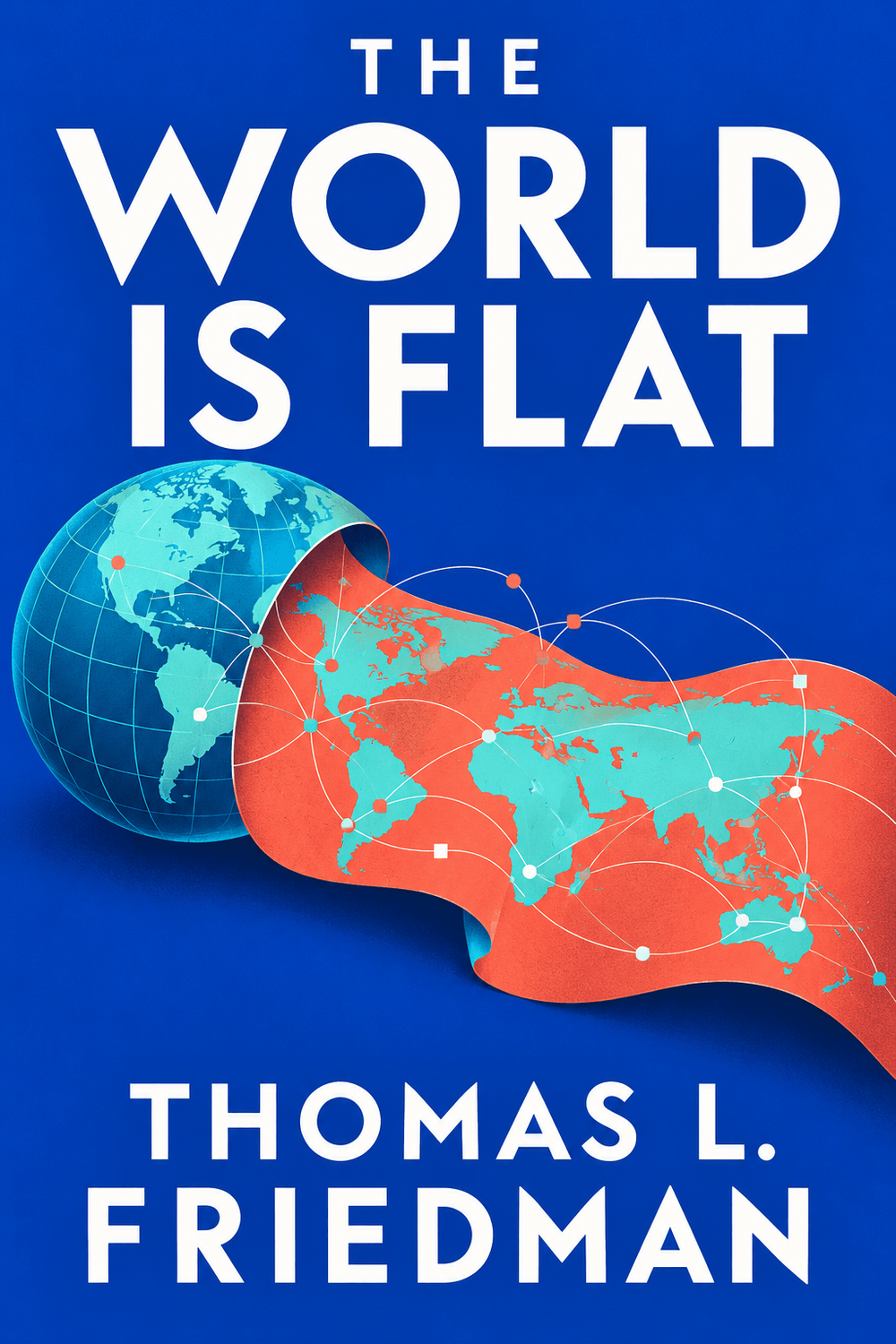
Prefer the print book? Buy on Amazon
As an Amazon Associate, Sumizeit earns from qualifying purchases.
Book Summary
The World Is Flat Book Summary
This The World Is Flat Book Summary covers the key ideas, lessons, and takeaways in about 20 minutes.
Short Description:
Friedman explains how politics, tech, and teamwork flattened the world.
The world has flattened, and the forces behind it are not going away. The fall of the Berlin Wall spread free markets, personal computers and the internet gave ordinary people global reach, and new ways of working together through search, outsourcing, and supply chains tied it all into one connected field around the year 2000. Friedman admits this brings real pain, especially for workers who lose jobs, but he believes the world gains more than it loses. His answer is to stop resisting and start preparing. Countries should invest in education, balanced regulation, and strong infrastructure, and you should build the cooperative, creative, and versatile skills that let you add value no matter how the work around you changes.
Helps with these goals
Preview the The World Is Flat book summary
Below is a preview of Sumizeit’s comprehensive human-written summary of The World Is Flat by Thomas L. Friedman. The full summary is 15-20 minutes long and covers the book’s key ideas in text, audio, visual, and video formats. Unlock the full 20 Minute Summary
Around the year 2000, the world changed faster than at almost any other point in history. Politics shifted, technology jumped ahead, and businesses found new ways to work together, all at once. The result is a world where free markets dominate, trade sits at the center of national economies, and ordinary people can reach more information and more of each other than ever before. The playing field has leveled out. Friedman's name for this is a flat world.
Friedman wrote for The New York Times about foreign affairs and globalization for years. For this book, published in 2005, he traveled the globe and talked with business executives, entrepreneurs, and politicians about the changes they saw and the instability those changes brought. The book covers what caused the flattening, makes the case that globalization helps the world despite real dangers, and then gives advice to governments and to you as an individual. His message is simple. Adapt fast or fall behind.
Three eras of globalization
Friedman says globalization today moves at a pace no earlier era matched. It also hands more power to people outside the West, and to people who aren't white, than any generation had before. To show why, he splits history into three periods.
The first runs from 1492 to 1800 and he calls it the period of nations. It starts with Columbus reaching the Americas, which opened up trade across the oceans. Governments drove this era. Imperial powers in Western Europe, like Great Britain, Portugal, and Spain, sent ships around the world to grow their empires and trade.
The second runs from 1800 to 2000 and belongs to international companies. The Industrial Revolution let big multinational corporations chase new markets and cheaper labor. Steam engines and railroads made shipping cheaper and faster in the 19th century. In the 20th century the telegraph, telephone, computer, and satellite did the same for communication. Cheap trade plus cheap communication meant companies could use opportunities anywhere on the planet.
The third era starts around 2000 and belongs to individuals. Personal computers, the internet, and new software let a single person communicate, collaborate, and compete with people anywhere. Governments and corporations still carry a lot of weight, but the old top down structures are giving way to looser, crowd sourced ones. Billions of people who had no power before now have some.
Friedman also sees this as a way out of poverty. When people in poorer countries can sell to rich consumers, they earn far more. That money creates jobs in manufacturing, exporting, and other industries. And as a country opens up to trade, its people pick up the skills and knowledge they need to compete globally.
Political change started it
Friedman points to November 9, 1989 as the political spark. The fall of the Berlin Wall ended the Cold War and handed victory to capitalism and free markets over communism and government run economies. That pushed the rest of the world toward free markets too.
Want the complete 20-minute summary?
- Full structured summary
- Video Summary
- Podcast Summary
- Audio summary
- Key takeaways
- Exercises
- Quiz
- Highlights and notes
- Ask the book with AI
Who should read The World Is Flat?
The World Is Flat is essential for business leaders, policymakers, and anyone navigating a rapidly changing economy. Students and professionals seeking to understand how globalization reshapes careers will find practical guidance, as will educators and parents preparing younger generations for a competitive global marketplace.
Why does The World Is Flat matter?
Thomas L. Friedman's exploration of globalization remains urgently relevant as economies continue to integrate and technology accelerates change. The book provides a framework for understanding why jobs move, why education and adaptability matter more than ever, and how individuals and nations can thrive rather than fall behind in an interconnected world.
What are the key themes in The World Is Flat?
- The three eras of globalization: nations, corporations, and individuals
- How political change, technology, and collaboration flattened the world
- The power of free markets and open economies
- The necessity of continuous learning and adaptation
- Global supply chains and their economic consequences
- Balancing trade with strategic regulation
- Building diverse, versatile skill sets for job security
How can you apply ideas from The World Is Flat?
- Invest in continuous learning and skill development, especially in technology, languages, and cross-disciplinary knowledge that makes you adaptable across industries.
- Build a global professional network and cultivate cross-cultural collaboration skills to remain valuable in an integrated economy.
- Develop multiple competencies rather than specializing narrowly, protecting yourself against disruption in any single field or tool.
- Pursue a liberal arts education that combines technical skills with knowledge in humanities, arts, and social sciences to enable creative problem-solving.
- Stay informed about supply chain dynamics and global economic trends to anticipate which skills and industries will remain in demand.
- Teach young people to think adaptively, embrace technology, and make connections across disciplines rather than memorizing static information.
- Advocate for education and infrastructure policies that prepare entire populations for global competition, not just elite groups.
What common mistakes do readers make with The World Is Flat?
- Believing that narrowly specialized skills provide lasting job security when rapid technological change makes versatility far more valuable.
- Resisting globalization rather than preparing to compete in it, which leaves individuals and nations unprepared for inevitable changes.
- Assuming the jobs of the past will return instead of developing skills for the emerging opportunities that globalization creates.
- Neglecting international awareness and cross-cultural skills when the ability to collaborate globally has become essential to most professional success.
Sumizeit Exercises Apply what you've learned
Turn ideas from The World Is Flat into action with a short guided reflection: identify the biggest takeaway, connect it to your life, and commit to one step you can take in the next 24 hours.
What is the expert analysis of The World Is Flat?
Overview
The World Is Flat, authored by Thomas L. Friedman, is a seminal work that captures the transformative era of globalization at the dawn of the 21st century. Friedman, a seasoned journalist and three-time Pulitzer Prize winner for his foreign affairs reporting, offers a comprehensive narrative on how political shifts, technological advancements, and new collaborative business models have leveled the global economic playing field. Published in 2005, the book is significant for its accessible yet profound synthesis of complex global trends, making it a cornerstone text in understanding modern globalization’s impact on economies, societies, and individuals.
Core Thesis
Friedman’s central argument is that the world has become “flat” — meaning that barriers to competition and collaboration across borders have dramatically diminished. This flattening results from a confluence of political events, notably the end of the Cold War, rapid technological innovations like the personal computer and the internet, and emergent collaborative practices such as outsourcing, offshoring, and global supply chains. These forces have democratized access to information and economic opportunity, empowering individuals worldwide and reshaping the global economic order. The imperative, Friedman contends, is adaptation: nations, businesses, and individuals must evolve rapidly to thrive in this interconnected, competitive environment.
Strengths
- Comprehensive Historical Context: Friedman’s division of globalization into three distinct eras—nations, multinational corporations, and individuals—provides a clear framework for understanding the evolution of global economic integration.
- Interdisciplinary Insight: The book deftly weaves political history, technological innovation, and economic theory, offering readers a multidimensional perspective on globalization’s drivers and consequences.
- Accessible and Engaging Prose: Friedman’s journalistic background shines through in his vivid storytelling and use of real-world examples, making complex global dynamics comprehensible to a broad audience.
- Pragmatic Prescriptions: The focus on education, government policy, and infrastructure as pillars for national competitiveness is both actionable and forward-looking, emphasizing adaptability and skill development.
- Emphasis on Individual Agency: By highlighting cooperation, integration, and versatility as key personal skills, Friedman empowers readers to navigate and capitalize on globalization’s challenges.
Critiques & Counterarguments
- Overoptimistic View of Globalization: Friedman’s portrayal tends to emphasize the benefits of globalization while downplaying its uneven impacts, particularly on labor markets in developed countries. Critics argue that the book underestimates the social dislocation and inequality exacerbated by outsourcing and offshoring.
- Technological Determinism: The narrative sometimes implies that technology alone drives globalization’s flattening, neglecting the complex socio-political and economic forces that mediate technological adoption and impact.
- Insufficient Attention to Power Dynamics: The metaphor of a “flat” world can obscure persistent inequalities in wealth, influence, and access to technology. Globalization has not uniformly empowered all individuals or nations; structural disparities remain entrenched.
- Competing Research on Global Supply Chains: While Friedman suggests supply chains reduce conflict by creating economic interdependence, real-world evidence, such as trade wars and geopolitical tensions, challenges this optimistic linkage between economic ties and peace.
- Alternative Theories of Globalization: Schools of thought like dependency theory or world-systems theory offer counterpoints, emphasizing how globalization can perpetuate core-periphery inequalities rather than flattening the world.
Who Should Read This
The World Is Flat is essential reading for policymakers, business leaders, educators, and students seeking a foundational understanding of globalization’s recent history and its implications. It is particularly valuable for those interested in the intersection of technology, economics, and international relations. Moreover, individuals aiming to grasp how global shifts affect labor markets and personal career strategies will find Friedman’s insights on adaptability and skill development compelling. While the book’s optimistic tone may invite critical scrutiny, it serves as a vital starting point for informed debate on how to navigate and shape the globalized world.
Discussion questions for The World Is Flat Short questions you can actually use in a conversation
Frequently asked questions about the The World Is Flat book summary
What is The World Is Flat about?
The World Is Flat by Thomas L. Friedman explores how the convergence of political change, technological innovation, and new collaborative practices around 2000 created an integrated global economy. The book examines the forces that flattened the world, the opportunities and dangers this integration creates, and practical advice for how nations and individuals can thrive in a hyperconnected global marketplace.
Who should read The World Is Flat?
The book is essential for business leaders, policymakers, and professionals seeking to understand globalization's impact on careers and economies. It is also valuable for educators, parents, and students who want to understand how to prepare for a competitive global future, and for anyone curious about why economic forces have reshhaped work and opportunity over the past two decades.
What are the main takeaways from The World Is Flat?
The key takeaways include: political change, technology, and new collaboration methods converged around 2000 to create unprecedented global integration; individuals now compete with billions of workers worldwide; success requires continuous adaptation, versatility, and skills in cooperation and cross-disciplinary thinking; nations must invest in education, balanced regulation, and infrastructure to remain competitive; and resisting globalization is futile—the focus should be on preparing for it.
How did the world become flat according to Friedman?
Friedman identifies three key drivers: the fall of the Berlin Wall in 1989 spread free markets and capitalism globally; technological breakthroughs like personal computers, the internet, and search engines gave individuals unprecedented reach and connectivity; and new ways of working together—through outsourcing, offshoring, and global supply chains—integrated economies and workforces. These forces converged around 2000 to create the flattened, interconnected world.
What does Friedman say about job losses from outsourcing?
Friedman acknowledges that outsourcing causes real hardship for displaced workers but argues the costs are outweighed by broader economic gains. He advises against trying to stop outsourcing, since it is inevitable and unstoppable, instead recommending that nations invest heavily in education so workers can transition to new opportunities created by economic growth. Consumers also benefit significantly from cheaper goods and services.
What skills does Friedman say are most valuable in a flat world?
Friedman identifies three essential skills: cooperation and the ability to work effectively across cultures in global teams; integration of diverse knowledge and skills across disciplines to drive innovation; and versatility to adapt quickly and add value in multiple roles. He warns that narrow specialists face greater risk than professionals who build broad, adaptable skill sets.
What does Friedman recommend for national competitiveness?
Friedman recommends three strategies: investing heavily in education that emphasizes adaptability, technology literacy, and cross-disciplinary thinking; implementing balanced government regulation that supports free trade while protecting workers and maintaining a strong middle class; and building robust infrastructure in internet technology and research institutions to drive innovation and productivity.
About Sumizeit
Sumizeit is a profitable Scomy LLC company based in Miami, Florida. Our founders, Clemens Raemy and Weina Scott, are successful entrepreneurs with several exits. Sumizeit is a popular book summary app / micro learning app used by busy professionals and entrepreneurs with over 2,500 non-fiction book summaries and 10,000 podcast summaries in text, audio, visual, podcast, and video format. We also have stellar retention tools to make ideas stick - such as flashcards with spaced repetition, quizzes, streaks, highlighting and notes, daily challenges, riddles, mini-courses, meditation, and more. You won't only learn the idea, but also remember it. Over 90% of our users change their habits with Sumizeit.
Upgrade Now
Here's why readers love Sumizeit
Join thousands of learners getting smarter every day
"Great experience. Detailed summaries. Loved the gamification feature. Makes learning fun. Good customer service. I recommend Sumizeit to anyone. You'll learn a lot."
"I always felt busy but still wanting to keep up with the book discussion in my friend group. This was a great supplement to help me keep reading the books I find fun while keeping up with important books."
"I love this website. Instead of scrolling social media, I find myself learning a lot. I use it everyday. I recommend this app for anyone who is too busy and wants to get up to speed with their favorite books."
The World Is Flat Book Summary PDF
Looking for a The World Is Flat Book Summary PDF you can save and revisit offline? Our The World Is Flat Book Summary PDF captures the book’s core ideas in a clean, printable format — the key frameworks, takeaways, and structure without the fluff. Download the The World Is Flat Book Summary PDF when you want a reference you can annotate, share with your team, or review on the go. Get your The World Is Flat Book Summary PDF from the download page below.
Download The World Is Flat Book Summary PDFPeople also liked these summaries
Readers who explored The World Is Flat often enjoyed these titles next.




Ready to read the whole thing?
- Full structured summary
- Video Summary
- Podcast Summary
- Audio summary
- Key takeaways
- Exercises
- Quiz
- Highlights and notes
- Ask the book with AI
Featured Book Titles
Popular Book Summaries at sumizeit, leading book summary app
Atomic Habits Book Summary Rich Dad Poor Dad Book Summary The Four Agreements Book Summary The 48 Laws of Power Book Summary When Breath Becomes Air Book Summary Think and Grow Rich Book Summary