Question 1 of 5
When Nvidia was founded, what market did the company primarily target?
The founders bet that personal computer gaming would require new computational performance and built graphics cards for gamers.


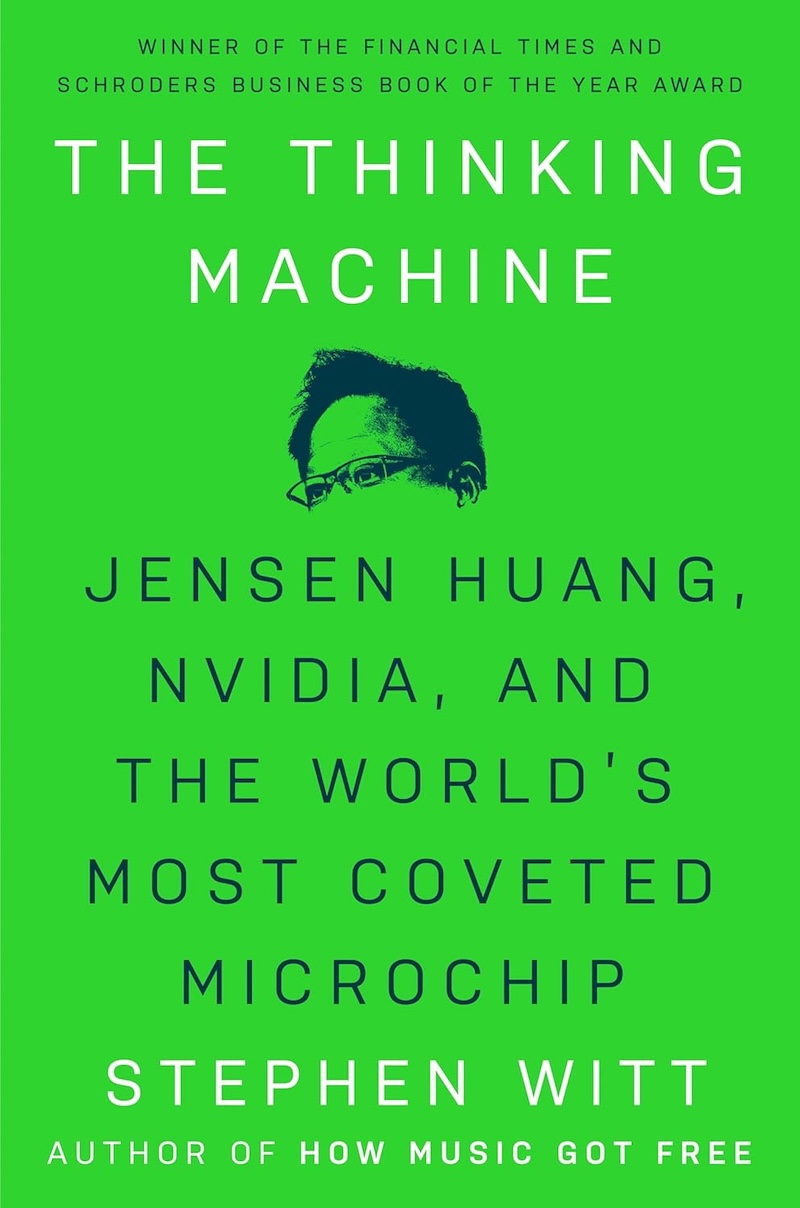
Prefer the print book? Buy on Amazon
As an Amazon Associate, Sumizeit earns from qualifying purchases.
This The Thinking Machine Book Summary covers the key ideas, lessons, and takeaways in about 20 minutes.
Helps with these goals
Want a Free Weekly Read?
Get a free summary every week straight to your mailbox.
Below is a preview of Sumizeit’s expert-written summary of The Thinking Machine by Stephen Witt. The full summary covers the book’s key ideas in text, audio, visual, and video formats.
The Thinking Machine is journalist Stephen Witt's deeply reported account of how an obscure maker of graphics cards for video gamers ended up holding the most consequential position in the entire artificial intelligence economy. The company is Nvidia, the man running it is Jensen Huang, and Witt's central argument is that the company's astonishing dominance is not a stroke of luck or a single brilliant pivot. It is the cumulative payoff of more than a decade of patient, contrarian work on a kind of computing that almost no one else thought mattered.
Witt earned access to Huang himself and to the engineers, researchers, and executives whose decisions, conflicts, and friendships shaped Nvidia's trajectory. The book operates on three layers simultaneously. It is a biography of an unusual immigrant entrepreneur. It is a history of the technical breakthroughs that converted gaming hardware into the engine of modern artificial intelligence. And it is a study in how technological revolutions actually happen — through long, often unrewarded labor on ideas that the mainstream dismisses as irrelevant, until the moment arrives when those ideas suddenly become indispensable.
The book is also, to a degree Witt does not flinch from, a study in concentration of power. Nvidia today sits at a chokepoint that almost every major actor in the AI industry depends upon, and the decisions made by one company, and largely by one man, ripple through the entire global technology economy. Witt is admiring of much of what he documents, but he is also clear-eyed about the risks of letting so much of humanity's most consequential infrastructure pass through such a narrow set of hands.
The book opens with the formation of Jensen Huang, and the formation matters because so much of Nvidia's later character is recognizably his. Born in Taiwan in 1963, raised partly in Thailand during a period of regional instability, Huang was dispatched at the age of ten with an older brother to the United States. His parents had located what they believed to be a prestigious boarding school in Kentucky. The school they had actually enrolled their son in turned out to be closer to a juvenile reform institution. The misunderstanding deposited a ten-year-old, fresh from Asia and barely speaking English, into an environment of bullying, harsh discipline, and survival-grade improvisation.
Huang adapted. The trait the experience seems to have instilled in him most permanently was a kind of unshowy self-reliance under pressure, combined with a refusal to be moved by social discomfort. When his family eventually reunited in Oregon, he excelled academically and worked nights as a busboy at a Denny's restaurant. He also took up table tennis with such seriousness that he competed at the national level.
He studied electrical engineering at Oregon State, where he met his future wife Lori Mills in a lab class, and graduated with honors.
The Thinking Machine is essential reading for anyone seeking to understand how artificial intelligence came to dominate global technology and economics. Whether you're a technologist, investor, policymaker, or simply curious about the forces reshaping our world, this book reveals the human decisions and engineering choices that created today's AI infrastructure. It's particularly valuable for those who want to understand not just what happened, but why it happened the way it did.
Nvidia controls the computational infrastructure underlying every major AI system in use today, yet few people understand how a gaming-chip maker became the indispensable gatekeeper of artificial intelligence. Stephen Witt's account shows that this dominance wasn't inevitable—it resulted from contrarian bets made when parallel computing seemed commercially irrelevant. Understanding this history is crucial for grasping the concentration of power in AI development and the risks it creates for the future.
Turn ideas from The Thinking Machine into action with a short guided reflection: identify the biggest takeaway, connect it to your life, and commit to one step you can take in the next 24 hours.
The Thinking Machine by Stephen Witt offers a meticulously researched narrative that chronicles the rise of Nvidia and its enigmatic CEO, Jensen Huang, as central architects of the contemporary artificial intelligence revolution. Witt, an accomplished journalist known for his incisive explorations of technology and culture, situates Nvidia’s ascent within a broader historical and technological context, revealing how a niche focus on gaming hardware evolved into commanding control over AI infrastructure. The book stands out not only as a corporate biography but also as a nuanced study of innovation, power concentration, and the unpredictable pathways through which technological revolutions unfold.
Witt’s central argument is that Nvidia’s dominance in AI was neither serendipitous nor solely the product of visionary genius but the cumulative result of a decade-long, contrarian commitment to parallel computing—a paradigm largely dismissed by the mainstream. This patient investment in GPUs and the CUDA software ecosystem positioned Nvidia as the indispensable backbone of AI development once machine learning’s computational demands exploded. More broadly, Witt contends that genuine technological revolutions often emerge from marginalized ideas nurtured quietly by a few contrarians, rather than from sudden breakthroughs embraced by the majority.
The Thinking Machine is essential reading for scholars and professionals at the intersection of technology, business strategy, and innovation studies. It appeals to those interested in the mechanics of technological revolutions, the sociology of entrepreneurship, and the geopolitics of critical infrastructure. Additionally, policymakers and ethicists grappling with AI governance will find Witt’s exploration of power concentration and risk management particularly salient. Finally, readers fascinated by the human stories behind technological change will appreciate the nuanced portrayal of Jensen Huang’s leadership and vision.
Try a few questions from the The Thinking Machine quiz. Unlock the full summary for the full quiz and answers that will help the ideas stick.
Question 1 of 5
The founders bet that personal computer gaming would require new computational performance and built graphics cards for gamers.
Question 2 of 5
GPUs were specialized to perform many calculations at once—parallel processing—needed for rendering thousands of polygons per frame.
Question 3 of 5
CUDA (released in 2006) allowed developers using familiar languages like C to access GPU parallel processing for general purposes.
Question 4 of 5
In 2012 AlexNet, trained on two Nvidia gaming cards and CUDA, dramatically outperformed previous image-recognition methods and signaled deep learning's arrival.
Question 5 of 5
Transformers compare every-to-every elements simultaneously, which maps directly onto GPUs' strength in massively parallel operations.
The Thinking Machine is Stephen Witt's account of how Nvidia, founded as a maker of graphics cards for video games, became the controlling infrastructure company of the artificial intelligence economy. The book traces Jensen Huang's leadership, the technical breakthroughs that converted gaming hardware into AI's computational engine, and the concentration of power this dominance has created in the hands of a single company and largely one man.
Anyone seeking to understand how modern AI came to be shaped should read this book—technologists, investors, policymakers, and informed citizens. It reveals the human decisions, institutional choices, and historical contingencies that made today's AI infrastructure possible, and it examines the risks created by concentrating so much technological power in one organization.
The main takeaway is that technological revolutions are typically built quietly by contrarians pursuing dismissed ideas for years, not through sudden brilliance or luck. Witt shows how Huang's patient decade-long bet on parallel computing created an advantage that became unassailable when AI's needs suddenly aligned with the capability Nvidia had quietly developed. The book also argues that this success has created dangerous concentrations of power, with Nvidia controlling infrastructure that every major actor in AI depends on.
Gaming required specialized hardware to perform thousands of calculations simultaneously—exactly the parallel processing capability that modern AI would need. Researchers discovered in the early 2000s that Nvidia's gaming GPUs could accelerate scientific computing if code was cleverly restructured. When Huang released CUDA in 2006, he made this capability accessible to programmers through familiar languages, building a software ecosystem that became inseparable from Nvidia's hardware. By the time AlexNet demonstrated AI's breakthrough moment in 2012, Nvidia was the only company at scale with the right architecture and ecosystem.
Huang's approach combined three unusual elements: willingness to publicly confront and criticize employees, a flat organizational structure with sixty direct reports and weekly emails from all staff, and cultivation of a 'thirty-days-to-live' urgency mindset rooted in the company's near-bankruptcy in 1996. This style kept Huang unusually close to technical reality and gave him psychological cover to make long-horizon bets like CUDA that more comfortable organizations would have abandoned. However, Witt notes the approach also suppressed psychological safety and may have depended on Huang's particular form of attention in ways that wouldn't survive his departure.
Witt identifies several risks: Nvidia's manufacturing is concentrated in Taiwan, which China claims as territory and has openly rehearsed taking by force, creating a geopolitical vulnerability. The company sits at the chokepoint of AI development yet appears to have no serious internal mechanisms for engaging with AI safety concerns. Current AI scaling trajectories are already stressing global energy infrastructure. Finally, Nvidia has no clear succession plan for a company whose significance to the global economy rivals many nations' strategic importance.
Parallel processing had been studied academically since the 1960s, but earlier commercial attempts failed because programmers found it cognitively difficult to design code with thousands of simultaneous calculations choreographed together. Nvidia succeeded because it had a clear, immediate use case—rendering game graphics—where the benefit was obvious enough to justify the effort. This specificity let Nvidia build a massive user base and ecosystem before the field needed to solve the broader problem of making parallel computing accessible for arbitrary tasks.
CUDA was a programming platform released in 2006 that allowed developers using familiar languages like C to access Nvidia's GPUs for any purpose. While competitors could eventually copy Nvidia's chip designs, they couldn't easily replicate the entire software ecosystem—libraries, documentation, tooling, integration with research workflows, and an entire generation of developers trained on Nvidia's tools. This software moat turned out deeper and more durable than any hardware advantage, locking in Nvidia's position once AI became the dominant use case.
Sumizeit is a profitable Scomy LLC company based in Miami, Florida. It has been helping readers learn from nonfiction books for 7 years with expert-written summaries in text, audio, podcast, and video.
Join thousands of learners getting smarter every day
"Great experience. Detailed summaries. Loved the gamification feature. Makes learning fun. Good customer service. I recommend Sumizeit to anyone. You'll learn a lot."
"I always felt busy but still wanting to keep up with the book discussion in my friend group. This was a great supplement to help me keep reading the books I find fun while keeping up with important books."
"I love this website. Instead of scrolling social media, I find myself learning a lot. I use it everyday. I recommend this app for anyone who is too busy and wants to get up to speed with their favorite books."
Looking for a The Thinking Machine Book Summary PDF you can save and revisit offline? Our The Thinking Machine Book Summary PDF captures the book’s core ideas in a clean, printable format — the key frameworks, takeaways, and structure without the fluff. Download the The Thinking Machine Book Summary PDF when you want a reference you can annotate, share with your team, or review on the go. Get your The Thinking Machine Book Summary PDF from the download page below.
Download The Thinking Machine Book Summary PDFReaders who explored The Thinking Machine often enjoyed these titles next.
Popular Book Summaries at sumizeit, leading book summary app