


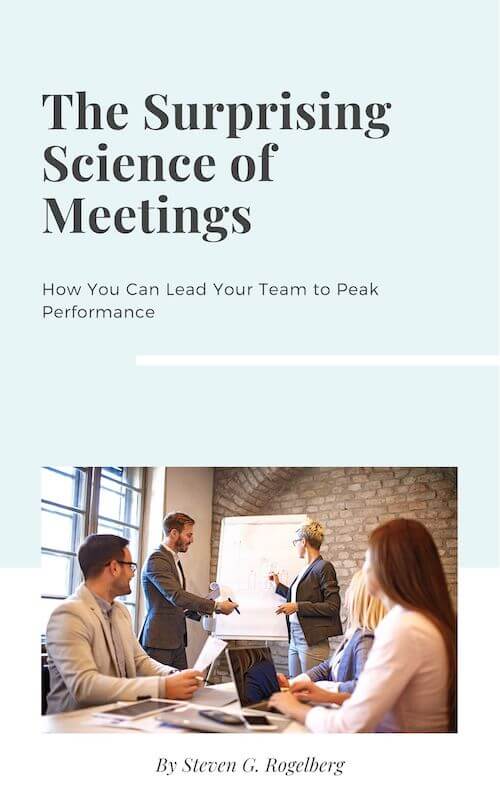
Prefer the print book? Buy on Amazon
As an Amazon Associate, Sumizeit earns from qualifying purchases.
The Surprising Science of Meetings Book Summary
This The Surprising Science of Meetings Book Summary covers the key ideas, lessons, and takeaways in about 20 minutes.
Short Description:
Effective meetings need structure, energy, and clear agendas.
Helps with these goals
Preview the The Surprising Science of Meetings book summary
Below is a preview of Sumizeit’s comprehensive human-written summary of The Surprising Science of Meetings by Steven Rogelberg, Ph.D.. The full summary is 15-20 minutes long and covers the book’s key ideas in text, audio, visual, and video formats. Unlock the full 20 Minute Summary
In workplaces around the world, meetings feel tedious, boring, and like a waste of time. In fact, Steven Rogelberg documents the various ways meetings are lowering workplace productivity and stifling creativity. In this book, he points to various evidence on how we can break out of frustrating meeting structures and maximize their efficiency. With a few simple changes, you too can revamp your meetings and turn them into a space of creativity, collaboration, and progress.
Meetings can be unenjoyable for everyone but are inevitable for teams. Start assessing your meetings to find ways to improve.
Across the United States, nearly 55 million meetings happen every single day. That’s a lot of time (and foregone working hours) spent sitting in boardrooms or Zoom calls. Author Steven Rogelberg wondered if this time was being well spent.
According to some studies, many Americans would say no. In a 2005 survey, Microsoft surveyed its 40,000 employees on what they thought of meetings. 69% said they were unproductive. In another survey by management software Clarizen, over 50% off workers said they’d rather do another unpleasant work activity than sit in on a weekly team update. So, if people would rather be working why not scrap meetings altogether?
Getting rid of meetings isn’t an option for many teams. They were created to facilitate collaboration between team members, allowing colleagues and departments to connect. The author suggests that instead of cutting down on meetings, there are many proven actionable ways to improve meeting culture from the bottom up.
Rate your meeting facilitation skills and start asking for frequent feedback.
In this section, the author directs his attention to managers and meeting facilitators looking to change their meetings. To start improving, he asks us to rate ourselves as meeting facilitators.
Studies show that many of us are likely to overestimate our abilities as leaders. In his own research, the author discovered that meeting facilitators rated their performance higher than their attendees. He also found that most facilitators believe they were above average, a statistical impossibility.
To give yourself a fair and measured assessment start by looking around your meetings. Do you feel in control of your meetings? Are some people talking way more than others who hardly talk at all? Are some participants distracted and checking their phones the entire time? All these signs mean there is room to improve.
Next, get a more objective picture by asking your meeting attendees for regular feedback. For example, Weight Watchers keeps screens outside of their meeting rooms to collect feedback about each meeting. Employees anonymously rate the meetings on an emoji scale. This way, they were able to track if changes were making participants happier, like when they added a white board to the meeting rooms and say dissatisfaction drop from 44% to 16%.
The author also suggests using a variety feedback instruments. Maybe you could send an e-mail out or have a place where people can submit written anonymous feedback.
Want the complete 20-minute summary?
- Full structured summary
- Video Summary
- Podcast Summary
- Audio summary
- Key takeaways
- Exercises
- Quiz
- Highlights and notes
- Ask the book with AI
Who should read The Surprising Science of Meetings?
This book is essential for managers, team leaders, and anyone who regularly facilitates meetings. Whether you're struggling with disengaged participants, lengthy unproductive discussions, or simply want to understand why meetings drain your team's energy, The Surprising Science of Meetings offers research-backed solutions. It's also valuable for anyone curious about the psychology of group dynamics and workplace productivity.
Why does The Surprising Science of Meetings matter?
With millions of meetings happening every day across workplaces, the quality of these gatherings directly impacts productivity, creativity, and employee morale. Steven Rogelberg's book addresses a widespread frustration—most workers find meetings unproductive—by providing evidence-based strategies to transform them into spaces for genuine collaboration. In an era of hybrid and remote work, these insights are more relevant than ever for leaders looking to maximize the value of their team's time.
What are the key themes in The Surprising Science of Meetings?
- The science of meeting effectiveness and group dynamics
- Leadership mindset and servant-leader approaches
- Meeting design: structure, timing, and agendas
- Participant engagement and psychological safety
- Technology and remote meeting challenges
- Time management and Parkinson's Law in meetings
How can you apply ideas from The Surprising Science of Meetings?
- Ask attendees for anonymous emoji-based or written feedback after meetings and track changes quarterly to measure improvement
- Shorten your next meeting by 5-10% from the standard duration and apply time pressure to keep discussion focused and efficient
- Limit your next meeting invite to seven people maximum and use shared notes to keep the broader team informed afterward
- Restructure your agenda to place employee-suggested items first and critical discussion items within the first 10-15 minutes
- Introduce 3-5 minutes of silent brainwriting time before open discussion to capture unique ideas before groupthink sets in
- Schedule daily team huddles at unconventional times (like 8:47 AM) for 15 minutes maximum to improve punctuality and focus
- Conduct your next meeting while standing or walking to increase energy and reduce the tendency toward rambling discussion
What common mistakes do readers make with The Surprising Science of Meetings?
- Assuming a one-hour meeting length is necessary without evaluating actual agenda requirements and group size
- Including too many participants (more than seven) and then wondering why decisions take longer and engagement drops
- Creating agendas hastily or reusing the same template without intentional thought about what matters most to your team
- Overlooking your own mood and energy level before meetings, not realizing how your negativity or indifference spreads to participants
- Failing to collect feedback on meeting quality and assuming that because you ran it, people found it productive
Sumizeit Exercises Apply what you've learned
Turn ideas from The Surprising Science of Meetings into action with a short guided reflection: identify the biggest takeaway, connect it to your life, and commit to one step you can take in the next 24 hours.
What is the expert analysis of The Surprising Science of Meetings?
Overview
The Surprising Science of Meetings is a seminal work by Steven Rogelberg, Ph.D., a distinguished professor and editor in the fields of organizational science and psychology. Rogelberg’s expertise is evident as he navigates the pervasive yet often overlooked domain of workplace meetings, a staple of modern professional life. His book stands out for its empirical grounding and practical orientation, offering a much-needed antidote to the widespread malaise surrounding meetings in corporate culture. By combining rigorous research with actionable strategies, Rogelberg elevates the conversation about meetings from mere annoyance to a critical lever for organizational productivity and employee engagement.
Core Thesis
Rogelberg’s central argument is that while meetings are often perceived as tedious and unproductive, they remain an indispensable mechanism for collaboration and communication within teams. Rather than advocating for the elimination of meetings, he posits that their quality and effectiveness can be dramatically improved through evidence-based practices. Key to this transformation is the role of the meeting facilitator, who must adopt a servant leadership mindset, curate purposeful agendas, limit participant numbers, and foster an environment conducive to open dialogue and creativity. The thesis underscores that meetings, when thoughtfully designed and executed, can become vibrant spaces of innovation and collective progress.
Strengths
- Empirical Foundation: Rogelberg anchors his recommendations in robust social science research, including psychological studies and organizational behavior data, lending credibility and depth to his insights.
- Practical Applicability: The book offers concrete, actionable advice such as shortening meeting durations, limiting attendees to seven, and incorporating silent reflection periods, making it highly accessible for practitioners.
- Leadership Focus: By emphasizing the facilitator’s role and promoting a servant leadership approach, the book situates meetings within broader conversations about effective management and organizational culture.
- Innovative Techniques: Suggestions like walking meetings, tech-free zones, and playful elements introduce novel ways to disrupt stale meeting routines and enhance engagement.
- Adaptation to Modern Contexts: Rogelberg addresses the challenges of virtual meetings with practical strategies, acknowledging the evolving nature of work environments.
Critiques & Counterarguments
- Overemphasis on Facilitation: While the facilitator’s role is crucial, the book may understate systemic organizational factors—such as hierarchical dynamics, corporate culture, and incentive structures—that also profoundly influence meeting effectiveness.
- Potential Oversimplification of Group Dynamics: The recommendation to cap meetings at seven participants, though supported by research, might not account for the complexity of cross-functional or large-scale strategic meetings where broader input is necessary.
- Limited Exploration of Cultural Variability: The book primarily draws on Western corporate contexts, potentially limiting its applicability across diverse cultural settings where meeting norms and communication styles differ significantly.
- Competing Research on Meeting Length: Although Parkinson’s Law is invoked to justify shorter meetings, some studies suggest that complex problem-solving and creative brainstorming may require longer, less time-constrained sessions to allow for depth and nuance.
- Virtual Meeting Challenges Understated: The book’s advice on teleconferencing, while useful, might not fully capture the cognitive overload and digital fatigue increasingly documented in remote work research, which require more systemic solutions beyond facilitation techniques.
Who Should Read This
- Meeting Facilitators and Team Leaders: Professionals responsible for organizing and leading meetings will find invaluable, research-backed strategies to enhance engagement and productivity.
- Organizational Psychologists and HR Professionals: Those interested in improving workplace dynamics and culture can leverage this book’s insights to inform training and development programs.
- Business Executives and Managers: Leaders seeking to optimize communication flows and foster innovation within their teams will benefit from the practical leadership advice.
- Researchers and Students of Organizational Behavior: The book offers a comprehensive synthesis of meeting-related research that can serve as a foundation for further academic inquiry.
- Anyone Frustrated by Ineffective Meetings: Individuals at any level who experience the common frustrations of meetings will gain actionable tools to advocate for and implement change.
Frequently asked questions about the The Surprising Science of Meetings book summary
What is The Surprising Science of Meetings about?
The Surprising Science of Meetings by Steven Rogelberg is a research-based guide to transforming meetings from draining time-wasters into productive spaces for collaboration and creativity. The book combines psychological research and organizational science to show leaders how to redesign meetings—from agenda structure and participant count to timing and physical setup—in ways that measurably improve engagement, decision-making, and team morale.
Who should read The Surprising Science of Meetings?
This book is ideal for managers, team leaders, and meeting facilitators who want to break the cycle of unproductive meetings. It's also valuable for HR professionals, organizational consultants, and anyone curious about workplace psychology and group dynamics. Whether you lead large organizations or small teams, the evidence-based strategies apply across contexts.
What are the main takeaways from The Surprising Science of Meetings?
Key takeaways include: limit meetings to seven participants maximum, shorten meeting length by 5-10% to create natural efficiency, place the most important items first and early in the discussion, build in silent thinking time to prevent groupthink, collect regular anonymous feedback to improve, adopt a servant leadership mindset that prioritizes employee wellbeing, and use unconventional scheduling and formats to maintain engagement. Small structural changes compound into significant improvements in meeting quality and satisfaction.
Why do most people find meetings unproductive?
According to research cited in The Surprising Science of Meetings, 69% of surveyed workers consider meetings unproductive, and over 50% would rather do other work tasks. Common causes include poor agenda design, too many participants, arbitrary time lengths, groupthink that suppresses unique ideas, and facilitators who don't actively manage energy and engagement. Most organizations give little thought to meeting structure, treating them as default activities rather than strategic tools.
What is Parkinson's Law and how does it apply to meetings?
Parkinson's Law states that tasks expand to fill the time allocated to them. In The Surprising Science of Meetings, Rogelberg explains that when you automatically schedule a one-hour meeting, people unconsciously stretch discussion to fill that hour even if the work could be completed in 50 minutes. By intentionally shortening meeting time by 5-10%, you create natural pressure that keeps discussion focused and efficient without sacrificing quality.
How can I improve engagement in remote or teleconference meetings?
The Surprising Science of Meetings recommends several strategies for virtual meetings: ban or discourage the mute button to prevent multitasking, address participants by name to keep attention high, use breakout rooms for groups over five people to increase participation, and alternate between discussion periods and focused work in shared documents. These techniques compensate for the distraction and disengagement that naturally occur in remote settings.
What is servant leadership and why does it matter for meetings?
Servant leadership is an approach where leaders prioritize the wellbeing and growth of their team members as much as outcomes. In meetings, this means facilitators take responsibility for running efficient sessions that respect people's time, creating a psychologically safe atmosphere where disagreement is encouraged, and ensuring quieter voices are heard. Research shows companies with servant-minded leaders perform better across all business sectors.
About Sumizeit
Sumizeit is a profitable Scomy LLC company based in Miami, Florida. Our founders, Clemens Raemy and Weina Scott, are successful entrepreneurs with several exits. Sumizeit is a popular book summary app / micro learning app used by busy professionals and entrepreneurs with over 2,500 non-fiction book summaries and 10,000 podcast summaries in text, audio, visual, podcast, and video format. We also have stellar retention tools to make ideas stick - such as flashcards with spaced repetition, quizzes, streaks, highlighting and notes, daily challenges, riddles, mini-courses, meditation, and more. You won't only learn the idea, but also remember it. Over 90% of our users change their habits with Sumizeit.
Upgrade Now
Here's why readers love Sumizeit
Join thousands of learners getting smarter every day
"Great experience. Detailed summaries. Loved the gamification feature. Makes learning fun. Good customer service. I recommend Sumizeit to anyone. You'll learn a lot."
"I always felt busy but still wanting to keep up with the book discussion in my friend group. This was a great supplement to help me keep reading the books I find fun while keeping up with important books."
"I love this website. Instead of scrolling social media, I find myself learning a lot. I use it everyday. I recommend this app for anyone who is too busy and wants to get up to speed with their favorite books."
The Surprising Science of Meetings Book Summary PDF
Looking for a The Surprising Science of Meetings Book Summary PDF you can save and revisit offline? Our The Surprising Science of Meetings Book Summary PDF captures the book’s core ideas in a clean, printable format — the key frameworks, takeaways, and structure without the fluff. Download the The Surprising Science of Meetings Book Summary PDF when you want a reference you can annotate, share with your team, or review on the go. Get your The Surprising Science of Meetings Book Summary PDF from the download page below.
Download The Surprising Science of Meetings Book Summary PDFPeople also liked these summaries
Readers who explored The Surprising Science of Meetings often enjoyed these titles next.

Ready to read the whole thing?
- Full structured summary
- Video Summary
- Podcast Summary
- Audio summary
- Key takeaways
- Exercises
- Quiz
- Highlights and notes
- Ask the book with AI
Featured Book Titles
Popular Book Summaries at sumizeit, leading book summary app