
Question 1 of 10


Prefer the print book? Buy on Amazon
As an Amazon Associate, Sumizeit earns from qualifying purchases.
Book Summary
The Sun and Her Flowers Book Summary
This The Sun and Her Flowers Book Summary covers the key ideas, lessons, and takeaways in about 20 minutes.
Short Description:
Poetry guide to leaving abuse, healing old trauma, and learning self love
The Sun and Her Flowers argues that healing from abuse and heartbreak is slow, uneven, and worth doing. Kaur starts by leaving a man who hurt her, then digs into the shame and childhood trauma that made her think she deserved it, and ends by finding belonging in her family, her culture, and a kind partner. Along the way she shows that private pain often has public roots, from beauty standards to the way women are taught to stay quiet, and that the most reliable way out is learning to love yourself first so you stop begging for love from people who can't give it.
Helps with these goals
Preview the The Sun and Her Flowers book summary
Below is a preview of Sumizeit’s comprehensive human-written summary of The Sun and Her Flowers by Rupi Kaur. The full summary is 15-20 minutes long and covers the book’s key ideas in text, audio, visual, and video formats. Unlock the full 20 Minute Summary
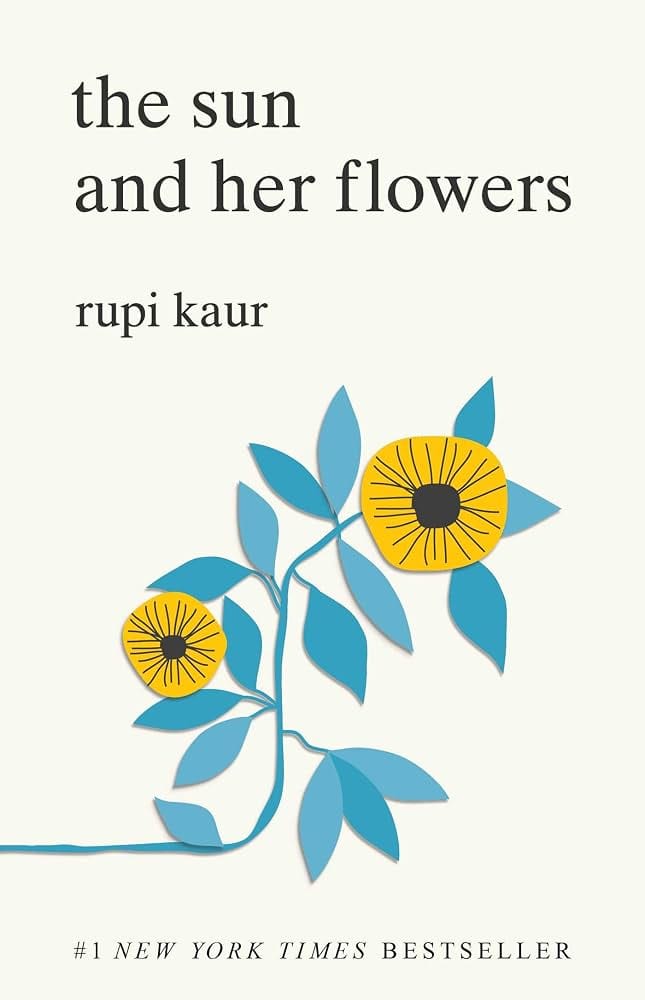
The Sun and Her Flowers is Rupi Kaur's second poetry collection. It follows her first book, Milk and Honey, and keeps the same short, plain poems and simple line drawings. The poems follow one woman's road through heartbreak, grief, shame, and slow repair. Kaur uses her own life as the thread, but she keeps tying it to bigger problems she sees around her, including misogyny, sexual violence, the killing of baby girls, and the way women learn to hate their own bodies.
The book has five sections named for the life of a flower. Wilting, Falling, Rooting, Rising, and Blooming. Each one marks a stage in her recovery. You can read them as three big movements. First comes the pain of ending a bad relationship. Then comes a deeper look at the old wounds underneath. Last comes a hopeful turn toward family, culture, and a healthier kind of love.
Wilting and the pain of leaving
The first section opens in the aftermath of a breakup. Kaur writes about the weeks and months after a long relationship ends, and the poems swing between rage, longing, and sadness. She doesn't paint her ex as a villain with no good side. She admits she loved him, and she admits how much she still wanted him even after he hurt her. That mix of feelings is the point. Leaving someone who treated you badly doesn't feel clean or brave in the moment. It feels like losing a limb.
Part of the section asks a hard question. Why did she stay? Her answers are honest. She wanted affection, and when he cheated on her or lost interest, she wondered what she could change about her looks or her behavior to win him back. She also feared being alone. That fear was strong enough that she wanted to be in a relationship, any relationship, more than she wanted to be in a good one. She was in love with the idea of having a partner as much as she was in love with the man himself.
Other writers have described the same trap. When someone's self worth is low, they lean on a partner to feel like a whole person. The relationship then hurts them, which lowers their self worth further, which makes them cling harder. Fear also plays a big role for many people who stay with an abuser, whether it's fear of loneliness, money trouble, or physical harm. Friends and family who want to help tend to do better when they say they're worried about the person's safety without judging their choices.
The section also explains why she finally left and stayed gone. The first reason is simple. His words never matched his behavior. He kept saying things would improve and that they could fix it, but nothing changed, so she stopped believing him. She decided that what a person does counts for more than what a person promises.
The second reason goes deeper. Kaur realized she had been hunting for love in other…
Want the complete 20-minute summary?
- Full structured summary
- Video Summary
- Podcast Summary
- Audio summary
- Key takeaways
- Exercises
- Quiz
- Highlights and notes
- Ask the book with AI
Who should read The Sun and Her Flowers?
This book is for anyone healing from heartbreak, trauma, or a difficult relationship. It speaks especially to women navigating body image struggles, past abuse, or the gap between their heritage and their current life, as well as readers seeking poetry that blends personal vulnerability with social critique.
Why does The Sun and Her Flowers matter?
The Sun and Her Flowers connects individual emotional pain to larger cultural forces like misogyny, beauty standards, and violence against women, making it relevant to ongoing conversations about healing and justice. Its accessible, illustrated style has made poetry resonate with millions of readers who might not otherwise turn to the genre, proving that honest, simple language can address complex trauma.
What are the key themes in The Sun and Her Flowers?
- Healing from heartbreak and abuse as a nonlinear journey
- Self-love as the foundation for healthy relationships
- Body image and beauty standards imposed on women of color
- Intergenerational trauma and cultural inheritance
- Reclaiming sexuality and agency after trauma
- The relationship between personal pain and systemic oppression
How can you apply ideas from The Sun and Her Flowers?
- Notice when you're judging your body as pretty or ugly, and redirect that energy toward appreciating what your body lets you do—work, move, feel, create.
- When someone repeatedly breaks promises and their behavior doesn't match their words, practice trusting their actions instead of their reassurances and give yourself permission to leave.
- If you recognize a pattern of staying in bad relationships out of fear of loneliness, spend time building friendships and activities that give you a sense of worth outside of romantic partnership.
- After a breakup or trauma, resist the urge to jump into a new relationship; instead, practice self-compassion by noticing your feelings without adding self-criticism on top.
- In a new relationship, communicate openly about past trauma so your partner can understand why certain actions might trigger old fears, helping you distinguish past from present.
- When exploring your heritage, practice holding gratitude for your parents' sacrifices alongside honest conversations about cultural beliefs that may have harmed you.
- If you survived childhood abuse, seek professional support to talk through what happened rather than bottling it up, which tends to create ongoing physical and emotional illness.
What common mistakes do readers make with The Sun and Her Flowers?
- Believing that your self-worth depends on how you look or on being in a relationship, rather than recognizing your inherent value.
- Staying silent about trauma because you think you caused it or because shame feels too overwhelming to voice.
- Expecting one moment of courage to permanently change your mind about leaving or healing, rather than committing to repeated small acts of self-love.
- Blaming mothers or other women for perpetuating harmful cultural beliefs instead of recognizing that they too are trapped in the same system.
- Trusting a partner's words over their actions, or believing that this time will be different even when the pattern continues to repeat.
Sumizeit Exercises Apply what you've learned
Turn ideas from The Sun and Her Flowers into action with a short guided reflection: identify the biggest takeaway, connect it to your life, and commit to one step you can take in the next 24 hours.
What is the expert analysis of The Sun and Her Flowers?
Overview
The Sun and Her Flowers is the second poetry collection by Rupi Kaur, a poet and performer of Indian-Canadian descent who rose to prominence through social media platforms like Instagram. Building on the success of her debut, Milk and Honey, Kaur continues to employ her signature minimalist style—short, accessible poems paired with simple line drawings—to explore deeply personal and culturally resonant themes. This book is significant for its candid engagement with trauma, healing, and identity, framed within a feminist and diasporic context. Kaur’s work has become emblematic of a new wave of poetry that blends confessional intimacy with social critique, appealing to a broad, often younger, readership.
Core Thesis
The central argument of The Sun and Her Flowers is that healing from heartbreak, abuse, and cultural dislocation is a nonlinear, multifaceted process rooted in self-love and self-acceptance. Kaur traces this journey through five metaphorical stages—Wilting, Falling, Rooting, Rising, and Blooming—representing the emotional and psychological phases of recovery. The book contends that personal pain is intertwined with systemic issues such as misogyny, colonial beauty standards, and cultural trauma. Ultimately, Kaur asserts that reclaiming one’s body, narrative, and heritage is essential to breaking cycles of violence and finding genuine love and belonging.
Strengths
- Emotional Accessibility: Kaur’s straightforward language and brevity make complex and painful subjects approachable, inviting readers who might otherwise shy away from poetry into a space of empathy and reflection.
- Intersectional Perspective: The book skillfully weaves together personal trauma with broader sociopolitical issues, such as sexual violence, immigrant experience, and colorism, highlighting the interconnectedness of individual and collective suffering.
- Structural Metaphor: Organizing the collection around the life cycle of a flower provides a compelling and organic framework that mirrors the natural rhythms of decay and renewal in healing.
- Representation and Voice: Kaur amplifies the experiences of women of color and survivors of abuse, contributing to a much-needed diversification of poetic voices in mainstream literature.
- Encouragement of Self-Love: The emphasis on self-love as a radical act of resistance against internalized oppression and toxic relationships offers a hopeful and empowering message.
Critiques & Counterarguments
- Simplicity and Style: Critics often argue that Kaur’s poetry is overly simplistic, lacking the complexity and nuance found in more traditional or academic poetry. This minimalism can sometimes border on cliché or sentimentality, potentially limiting interpretive depth.
- Evidence and Specificity: The book’s reliance on personal narrative and generalized social observations occasionally risks flattening diverse experiences, particularly within the broad category of “women of color.” This has led to accusations of cultural flattening and even plagiarism controversies, which complicate its claim to originality.
- Competing Psychological Models: While Kaur emphasizes self-love as the cornerstone of healing, some psychological research suggests that recovery from trauma often requires more structured therapeutic interventions and community support. The book’s focus on individual agency may underplay systemic barriers and the need for professional help.
- Opposing Feminist Views: The feminist framework presented aligns with radical feminist critiques of patriarchy but may not fully engage with intersectional feminism’s more nuanced takes on agency, consent, and cultural relativism, especially regarding immigrant family dynamics.
- Reception in Literary Circles: Despite commercial success, some literary critics dismiss Kaur’s work as “Instagram poetry,” questioning its lasting artistic value and contribution to the canon, suggesting it is more a cultural phenomenon than a literary one.
Who Should Read This
The Sun and Her Flowers is ideally suited for readers seeking an accessible entry point into poetry that grapples with trauma, identity, and healing through a feminist and diasporic lens. It resonates particularly with young adults, survivors of abuse, and those interested in contemporary expressions of intersectional feminism and immigrant experiences. Readers who appreciate emotionally candid and socially conscious literature will find value here, as will educators and therapists looking for relatable texts to facilitate discussions about self-worth, cultural belonging, and recovery. However, those seeking more complex poetic forms or rigorous theoretical analysis might find the book’s simplicity limiting.
Discussion questions for The Sun and Her Flowers Short questions you can actually use in a conversation
Frequently asked questions about the The Sun and Her Flowers book summary
What is The Sun and Her Flowers about?
The Sun and Her Flowers by Rupi Kaur is a poetry collection that follows a woman's journey through heartbreak, trauma, and healing. Divided into five sections named for the stages of a flower's life, the book traces her path from the pain of leaving a harmful relationship, through uncovering childhood trauma and body image struggles, to rooting herself in family and culture, and finally blooming into a healthier, self-loving life.
Who should read The Sun and Her Flowers?
This book is ideal for anyone healing from heartbreak, abuse, or trauma, particularly women navigating body image issues, past sexual assault, or cultural pressures. It speaks to readers seeking poetry that blends personal vulnerability with social critique, as well as those interested in how individual pain connects to larger systems of oppression.
What are the main takeaways from The Sun and Her Flowers?
The main takeaways are that healing is slow and nonlinear, that self-love is the foundation for healthy relationships, that beauty standards and cultural misogyny harm women in profound ways, and that recognizing the link between personal pain and systemic oppression is key to breaking cycles of trauma. Kaur emphasizes that actions matter more than promises, that trusting your instincts about mistreatment is essential, and that you deserve kindness and good treatment.
How does The Sun and Her Flowers address sexual trauma?
Kaur addresses her childhood rape from multiple angles: the social systems that enable it, the emotional impact it had on her ability to experience intimacy, and her gradual process of reclaiming her sexuality and agency. She argues that sexual violence is rooted in systems that teach men they can control women's bodies, and that healing requires speaking about what happened rather than staying silent.
What role does culture and family play in The Sun and Her Flowers?
Culture and family are woven throughout the book as both sources of strength and sites of inherited harm. Kaur expresses gratitude for her immigrant parents' sacrifices while also critiquing misogynistic aspects of South Asian culture, including female infanticide. She explores how mothers and daughters can recognize they are trapped in the same systems and work together to challenge them.
How does Rupi Kaur connect personal pain to larger social issues?
Throughout The Sun and Her Flowers, Kaur ties her individual experiences—body image shame, sexual trauma, difficulty leaving a bad relationship—to broader cultural systems including beauty standards centered on whiteness, patriarchal control of women's sexuality, and violence against women in her heritage. This approach shows that private struggles are often responses to public oppression.
What is the significance of the five sections in The Sun and Her Flowers?
The five sections—Wilting, Falling, Rooting, Rising, and Blooming—mirror the life cycle of a flower and represent different stages of healing. Wilting captures the pain of heartbreak, Falling explores deeper trauma, Rooting reconnects with family and culture, Rising marks growing strength, and Blooming celebrates a healthier relationship and self-love. This structure shows that recovery is a process with distinct phases.
Why is self-love emphasized in The Sun and Her Flowers?
Kaur argues that low self-worth creates a cycle in which people accept mistreatment, which further erodes their sense of value, making them cling harder to harmful relationships. By prioritizing self-love—including the act of leaving someone who hurts you—she breaks this cycle and builds the foundation for healthy future relationships. Self-love is portrayed not as vanity but as the practical foundation for survival and thriving.
About Sumizeit
Sumizeit is a profitable Scomy LLC company based in Miami, Florida. Our founders, Clemens Raemy and Weina Scott, are successful entrepreneurs with several exits. Sumizeit is a popular book summary app / micro learning app used by busy professionals and entrepreneurs with over 2,500 non-fiction book summaries and 10,000 podcast summaries in text, audio, visual, podcast, and video format. We also have stellar retention tools to make ideas stick - such as flashcards with spaced repetition, quizzes, streaks, highlighting and notes, daily challenges, riddles, mini-courses, meditation, and more. You won't only learn the idea, but also remember it. Over 90% of our users change their habits with Sumizeit.
Upgrade Now
Here's why readers love Sumizeit
Join thousands of learners getting smarter every day
"Great experience. Detailed summaries. Loved the gamification feature. Makes learning fun. Good customer service. I recommend Sumizeit to anyone. You'll learn a lot."
"I always felt busy but still wanting to keep up with the book discussion in my friend group. This was a great supplement to help me keep reading the books I find fun while keeping up with important books."
"I love this website. Instead of scrolling social media, I find myself learning a lot. I use it everyday. I recommend this app for anyone who is too busy and wants to get up to speed with their favorite books."
The Sun and Her Flowers Book Summary PDF
Looking for a The Sun and Her Flowers Book Summary PDF you can save and revisit offline? Our The Sun and Her Flowers Book Summary PDF captures the book’s core ideas in a clean, printable format — the key frameworks, takeaways, and structure without the fluff. Download the The Sun and Her Flowers Book Summary PDF when you want a reference you can annotate, share with your team, or review on the go. Get your The Sun and Her Flowers Book Summary PDF from the download page below.
Download The Sun and Her Flowers Book Summary PDFPeople also liked these summaries
Readers who explored The Sun and Her Flowers often enjoyed these titles next.

Ready to read the whole thing?
- Full structured summary
- Video Summary
- Podcast Summary
- Audio summary
- Key takeaways
- Exercises
- Quiz
- Highlights and notes
- Ask the book with AI
Featured Book Titles
Popular Book Summaries at sumizeit, leading book summary app
Atomic Habits Book Summary Rich Dad Poor Dad Book Summary The Four Agreements Book Summary The 48 Laws of Power Book Summary When Breath Becomes Air Book Summary Think and Grow Rich Book Summary