


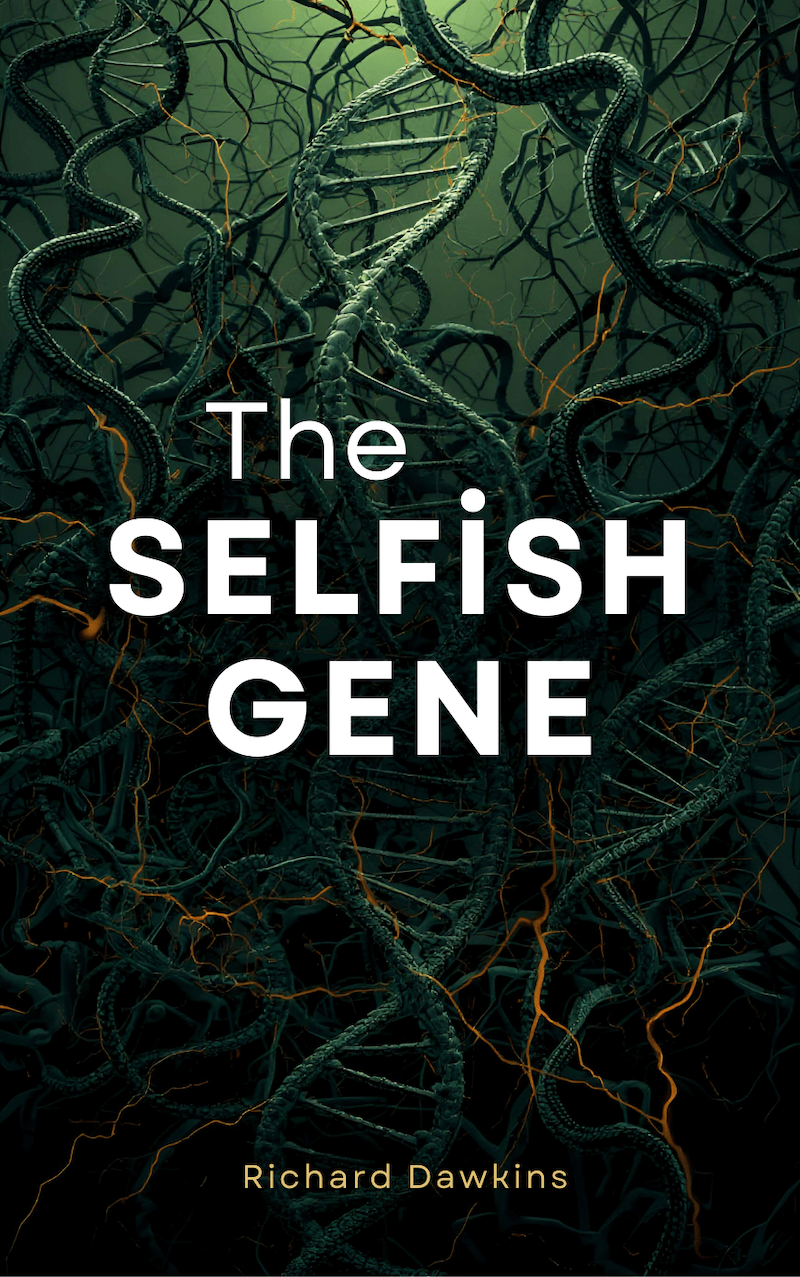
Prefer the print book? Buy on Amazon
As an Amazon Associate, Sumizeit earns from qualifying purchases.
The Selfish Gene Book Summary
This The Selfish Gene Book Summary covers the key ideas, lessons, and takeaways in about 20 minutes.
Short Description:
The Selfish Gene views life as genes’ quest to replicate through bodies.
Life, viewed through this lens, becomes a story of information—restless, self-propagating, endlessly inventive—writing itself into the world through flesh, behavior, society, and thought.
Helps with these goals
Preview the The Selfish Gene book summary
Below is a preview of Sumizeit’s comprehensive human-written summary of The Selfish Gene by Richard Dawkins. The full summary is 15-20 minutes long and covers the book’s key ideas in text, audio, visual, and video formats. Unlock the full 20 Minute Summary
Richard Dawkins transforms the way we understand life by shifting focus away from organisms, groups, or species and toward the fundamental units of heredity—genes. Rather than regarding animals or humans as the primary actors of evolution, he suggests that genes themselves are the central players, and living creatures are vehicles constructed by genes for their own continuation. A giraffe, a bird, a fish, or a human is not the purpose of evolution, but a temporary carrier for genetic material determined to copy itself forward in time. From this perspective, survival, reproduction, social behavior, cooperation, love, aggression, and even culture become strategies that genes employ to persist across generations.
Dawkins argues that evolution becomes more coherent when we view biological events through this genetic lens. While traditional biology teaches that organisms evolve to enhance their survival and reproductive success, many biological puzzles—especially altruism, self-sacrifice, and cultural behavior—become clearer when interpreted as tools that serve the interest of genes. Genes behave “selfishly” not in a moral sense, but in a mathematical and evolutionary one: a gene survives if it is good at making copies of itself. Everything else—bodies, behaviors, social systems—is secondary.
This conceptual leap forms the core thesis of The Selfish Gene: life is a competition among replicators, with organisms acting merely as sophisticated machines built to protect and propagate those replicators.
The Origin of Life as a Battle of Replicators
To grasp why genes hold this central position, Dawkins begins at the dawn of life. In Earth’s early oceans, chemical reactions occasionally produced molecules capable of replicating themselves. Once a self-copying molecule emerged, evolution ignited. Replicators that copied faster or more accurately became more prevalent, while inefficient ones vanished. This early world lacked intention, thought, or complexity—just blind chemistry unfolding over time. But small copying errors (mutations) eventually created diversity, and some versions replicated more effectively than others. Incrementally, advantageous changes accumulated into systems that could gather food, protect resources, and ward off damage.
Those ancient replicators are the ancestors of modern DNA. The competition between them led to the creation of increasingly elaborate “survival machines.” Bodies evolved because genes that built effective vehicles were more successful at preserving their lineage. Muscles, nerves, brains, eyesight, feathers, claws, and social instincts are all tools forged through this relentless contest.
Life, therefore, did not begin with organisms—it began with replicating information. Organisms are temporary. Genes are the enduring thread.
Genes Build Bodies as Strategy, Not Purpose
Genes do not think or plan. They simply persist if they are good at replicating. A gene that causes its carrier to survive, escape predators, metabolize nutrients efficiently, or raise healthy young will spread. A gene that causes disaster disappears. Over millions of years this filtering process sculpts organisms into intricate patterns of adaptation.
Genes influence bodies indirectly rather than micromanaging every behavior. They direct cells to form proteins, which influence other cells, which together shape tissues, organs, instincts, and behavioral tendencies. A gazelle flees because nervous systems built by genes respond to danger.
Want the complete 20-minute summary?
- Full structured summary
- Video Summary
- Podcast Summary
- Audio summary
- Key takeaways
- Exercises
- Quiz
- Highlights and notes
- Ask the book with AI
Who should read The Selfish Gene?
The Selfish Gene is essential for anyone curious about why life behaves the way it does—from scientists and students to general readers seeking to understand evolution beyond textbook basics. It appeals to those interested in biology, psychology, philosophy, and culture, as well as anyone who wants to fundamentally rethink what drives human and animal behavior.
Why does The Selfish Gene matter?
Richard Dawkins' gene-centered view of evolution has shaped modern biology, psychology, and our understanding of human nature for nearly 50 years. In an age of rapid cultural change and information spread, the book's insights into how ideas replicate like genes offer unexpected tools for understanding society, morality, and technology. It challenges us to see ourselves not as the heroes of evolution, but as temporary vehicles for information that predates and will outlive us.
What are the key themes in The Selfish Gene?
- Genes as the fundamental unit of natural selection
- Organisms as survival machines built by genes
- Altruism explained through genetic self-interest and kinship
- Evolutionary stable strategies and biological balance
- Memes: ideas as cultural replicators
- Extended phenotype: genes shaping environments beyond bodies
- Conflict and cooperation within families and groups
- Replication as the core driver of all life
How can you apply ideas from The Selfish Gene?
- Recognize hidden selfish interests in apparently altruistic behavior, especially within families and close-knit groups
- Understand workplace and social conflicts as arising from misaligned interests rather than personal malice
- Evaluate cultural trends and ideas by asking how copyable they are, not how true or beneficial they are
- Predict animal and human behavior by analyzing what genetic advantage a behavior provides rather than assuming conscious intent
- Design social systems and incentives that align individual self-interest with group benefit, since pure cooperation is unstable
- Recognize that your own moral intuitions may reflect ancient survival strategies rather than universal truths
- Analyze institutions, traditions, and norms as memes competing for cultural transmission and replication
What common mistakes do readers make with The Selfish Gene?
- Assuming organisms evolved to benefit their species or group rather than to replicate genes efficiently
- Viewing altruism as proof that evolution produces genuine selflessness, when it often masks genetic self-interest through kinship
- Thinking that genes have intent or foresight, when they simply persist if they cause adaptive behavior
- Believing that natural selection produces moral or perfect outcomes when it only produces strategies stable enough to resist invasion
Sumizeit Exercises Apply what you've learned
Turn ideas from The Selfish Gene into action with a short guided reflection: identify the biggest takeaway, connect it to your life, and commit to one step you can take in the next 24 hours.
What is the expert analysis of The Selfish Gene?
Overview
The Selfish Gene, authored by the eminent evolutionary biologist Richard Dawkins, stands as a landmark work that fundamentally reshaped evolutionary biology and popular understanding of life’s processes. Published in 1976, the book introduced a gene-centered perspective on evolution, challenging traditional organism- or group-focused paradigms. Dawkins’ eloquent synthesis and accessible prose brought complex genetic and evolutionary concepts to a broad audience, cementing his role as a pivotal figure in modern evolutionary thought. This work is significant not only for its scientific insights but also for its profound philosophical implications regarding the nature of life, altruism, and culture.
Core Thesis
Dawkins’ central argument is that genes, rather than organisms or species, are the primary units of natural selection. Organisms are conceptualized as “survival machines” or vehicles constructed by genes to ensure their own replication and persistence through time. Behaviors, social structures, and even cultural phenomena are reframed as strategies employed by genes to maximize their reproductive success. Altruism and cooperation, traditionally viewed as paradoxes in evolutionary theory, are explained through mechanisms such as inclusive fitness and reciprocal altruism, which ultimately serve gene propagation. The book extends this replicator concept beyond biology to culture through the introduction of “memes,” cultural replicators that evolve analogously to genes. Dawkins further expands the phenotype concept to include environmental modifications orchestrated by genes, emphasizing the pervasive influence of genetic information.
Strengths
- Innovative Gene-Centered Perspective: Dawkins’ reframing of evolution around genes provided a unifying framework that elegantly explains complex biological phenomena, including altruism and social behavior, which had previously been puzzling.
- Clarity and Accessibility: Despite the scientific depth, the book is written in a lucid, engaging style that makes sophisticated evolutionary concepts approachable to both specialists and lay readers.
- Interdisciplinary Reach: By introducing the concept of memes, Dawkins anticipated and influenced fields such as cultural evolution, memetics, and information theory, demonstrating the broad applicability of evolutionary principles.
- Philosophical Depth: The work challenges anthropocentric and teleological views of life, provoking reflection on the nature of purpose, morality, and identity in biological and cultural contexts.
- Empirical and Theoretical Rigor: The use of game theory and evolutionary stable strategies to model behavior adds mathematical robustness to the qualitative arguments.
Critiques & Counterarguments
- Reductionism and Oversimplification: Critics argue that focusing exclusively on genes risks neglecting higher-level selection processes and emergent properties at the organism or group level. Multi-level selection theory, for instance, posits that selection can act simultaneously on genes, individuals, and groups, offering a more nuanced picture.
- Limited Empirical Support for Memes: While memetics is conceptually compelling, empirical validation remains elusive. Cultural transmission is influenced by complex cognitive, social, and environmental factors that may not neatly parallel genetic replication.
- Neglect of Epigenetics and Developmental Systems: Since the book’s publication, advances in epigenetics and developmental biology have highlighted the importance of gene-environment interactions and non-genetic inheritance, challenging the strict gene-centric view.
- Human Behavior Complexity: The application of gene selfishness to human morality and culture can be critiqued for underestimating conscious agency, social constructs, and cultural evolution’s unique dynamics that may not be fully reducible to genetic imperatives.
- Alternative Explanations for Altruism: Some evolutionary biologists emphasize direct benefits, mutualism, or group selection variants as viable explanations for cooperation, suggesting that gene-level selection is not the sole or always dominant force.
Who Should Read This
The Selfish Gene is essential reading for evolutionary biologists, geneticists, and students of the life sciences seeking a foundational understanding of gene-centered evolution. Beyond specialists, it appeals to philosophers of biology, psychologists interested in evolutionary explanations of behavior, and scholars of culture and social theory intrigued by the interplay between biology and society. The book is also invaluable for intellectually curious readers who appreciate rigorous scientific thought presented with clarity and who are interested in the profound implications of evolutionary theory for understanding life, cooperation, and human nature.
Frequently asked questions about the The Selfish Gene book summary
What is The Selfish Gene about?
The Selfish Gene by Richard Dawkins argues that genes—not organisms, groups, or species—are the fundamental units of natural selection and evolution. The book proposes that organisms are temporary vehicles built by genes to replicate themselves, and that seemingly altruistic, cooperative, or moral behaviors often mask genetic self-interest operating through kinship, reciprocity, or cultural replication.
Who should read The Selfish Gene?
The Selfish Gene appeals to scientists, students, and general readers interested in understanding evolution, biology, human nature, and behavior. It is valuable for anyone curious about why life works the way it does, including those exploring psychology, philosophy, economics, and cultural dynamics.
What are the main takeaways from The Selfish Gene?
The main takeaways are: genes, not organisms, drive evolution; altruism often serves genetic self-interest through relatives or reciprocal advantage; cooperation and conflict both have genetic roots; ideas replicate like genes through culture; and genes extend their influence beyond bodies into the environment. Understanding life requires shifting focus from organisms as actors to genes as replicators.
How does The Selfish Gene explain altruism and cooperation?
Dawkins explains altruism through inclusive fitness: helping relatives increases copies of your own genes in them, making self-sacrifice genetically profitable. Cooperation persists through reciprocal altruism when individuals remember and reward helpers while punishing cheaters. Both mechanisms serve genetic replication rather than true selflessness.
What is a meme according to The Selfish Gene?
A meme is a unit of cultural information that replicates through imitation, just as genes replicate through reproduction. Ideas, songs, religious concepts, and jokes spread because they are good at being copied, and they succeed or fail based on their copyability rather than their truth or benefit to humans.
What is the extended phenotype concept?
The extended phenotype proposes that genes do not just build bodies; they shape the environment around those bodies. Beaver dams, bird nests, termite mounds, and human structures are outward expressions of genetic influence, demonstrating that genes extend their effects far beyond the individual organism.
Does The Selfish Gene suggest life has no meaning or morality?
The Selfish Gene does not claim life is meaningless, but it does suggest that meaning and morality may ultimately be evolutionary strategies rather than objective truths. It argues that human values like fairness and altruism likely evolved because they promoted survival, which does not diminish their importance but reframes their origins.
How has The Selfish Gene influenced science and culture?
Published in 1976, The Selfish Gene has profoundly shaped evolutionary biology, psychology, economics, and cultural studies. It popularized the gene-centered view of evolution and introduced the concept of memes, both of which remain central to understanding life and culture decades later. The book continues to influence how scientists and thinkers approach behavior and evolution.
About Sumizeit
Sumizeit is a profitable Scomy LLC company based in Miami, Florida. Our founders, Clemens Raemy and Weina Scott, are successful entrepreneurs with several exits. Sumizeit is a popular book summary app / micro learning app used by busy professionals and entrepreneurs with over 2,500 non-fiction book summaries and 10,000 podcast summaries in text, audio, visual, podcast, and video format. We also have stellar retention tools to make ideas stick - such as flashcards with spaced repetition, quizzes, streaks, highlighting and notes, daily challenges, riddles, mini-courses, meditation, and more. You won't only learn the idea, but also remember it. Over 90% of our users change their habits with Sumizeit.
Upgrade Now
Here's why readers love Sumizeit
Join thousands of learners getting smarter every day
"Great experience. Detailed summaries. Loved the gamification feature. Makes learning fun. Good customer service. I recommend Sumizeit to anyone. You'll learn a lot."
"I always felt busy but still wanting to keep up with the book discussion in my friend group. This was a great supplement to help me keep reading the books I find fun while keeping up with important books."
"I love this website. Instead of scrolling social media, I find myself learning a lot. I use it everyday. I recommend this app for anyone who is too busy and wants to get up to speed with their favorite books."
The Selfish Gene Book Summary PDF
Looking for a The Selfish Gene Book Summary PDF you can save and revisit offline? Our The Selfish Gene Book Summary PDF captures the book’s core ideas in a clean, printable format — the key frameworks, takeaways, and structure without the fluff. Download the The Selfish Gene Book Summary PDF when you want a reference you can annotate, share with your team, or review on the go. Get your The Selfish Gene Book Summary PDF from the download page below.
Download The Selfish Gene Book Summary PDFPeople also liked these summaries
Readers who explored The Selfish Gene often enjoyed these titles next.



Ready to read the whole thing?
- Full structured summary
- Video Summary
- Podcast Summary
- Audio summary
- Key takeaways
- Exercises
- Quiz
- Highlights and notes
- Ask the book with AI
Featured Book Titles
Popular Book Summaries at sumizeit, leading book summary app