Star

New Feature! Download infographics with key insights from bestselling non-fiction books

Download Now
Book Summary

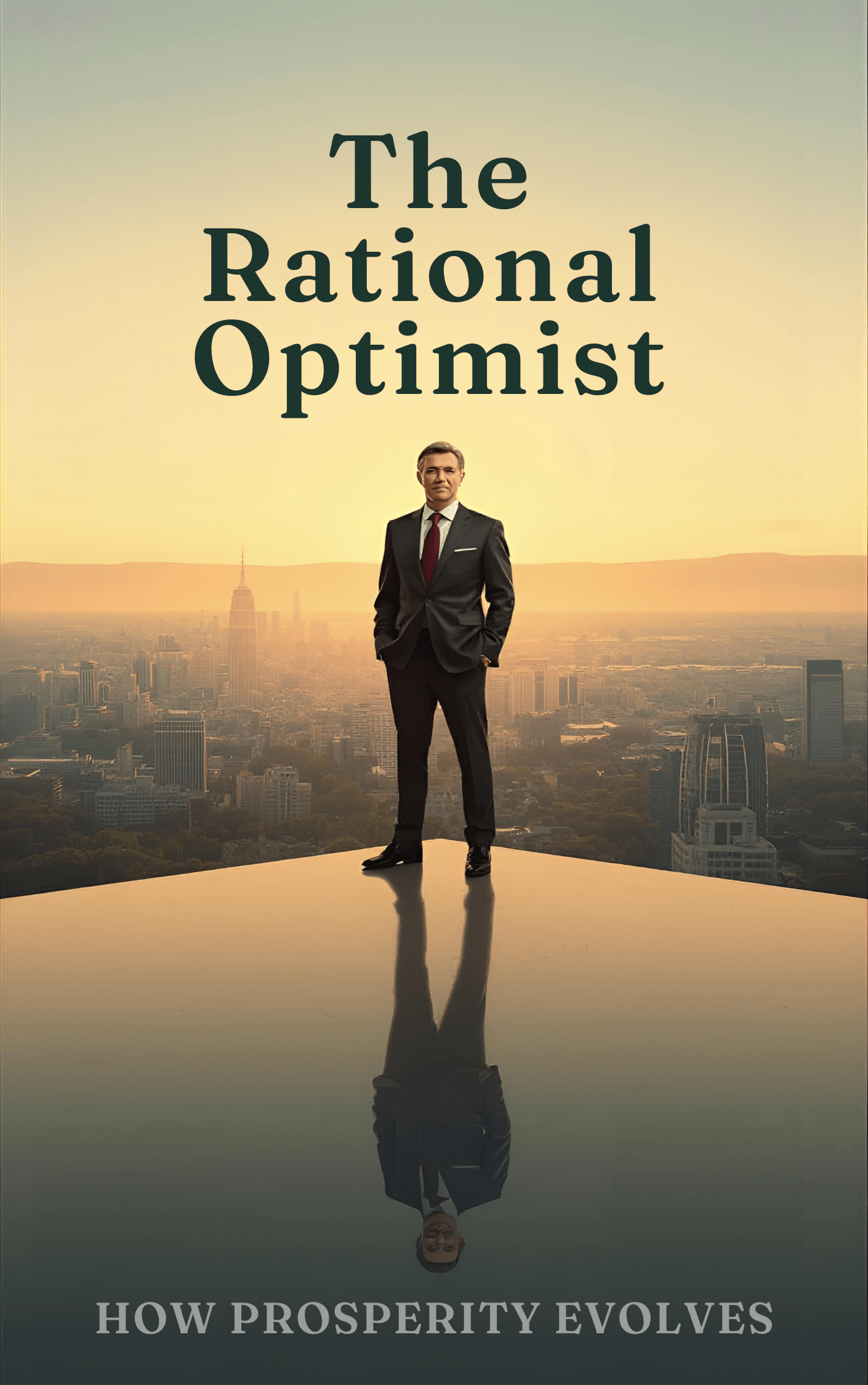
The Rational Optimist

By Matt Ridley

15 min
Audio available

Brief Summary

The core message of The Rational Optimist is that human progress emerges from cooperation, not control. Our greatest achievements are not the result of top-down design, but bottom-up exchange.

When people are free to trade goods and ideas, they innovate. When they innovate, living standards rise. When living standards rise, societies become healthier, safer, and more capable of solving new problems.

Ridley’s optimism is not naive. It acknowledges risk, failure, and uncertainty. But it insists that history provides strong evidence for confidence in humanity’s creative capacity.

The lesson is not to ignore challenges, but to approach them with trust in human ingenuity. The future is not doomed by default. It is shaped by whether we allow ideas to move, mix, and multiply.

About the Author

Matt Ridley is a British science writer and journalist known for exploring the intersection of biology, economics, and human behavior. His work frequently examines how complex systems—markets, ecosystems, and cultures—produce order without central direction.

Ridley has written extensively on evolution, innovation, and human progress, advocating for evidence-based optimism grounded in historical trends and scientific understanding. His writing combines storytelling with data, challenging popular narratives of decline and catastrophe.

Topics

The Rational Optimist Book Summary Preview

The Rational Optimist begins with a position that feels almost provocative in an era dominated by headlines of crisis and decline: humanity is not collapsing—it is improving. According to Matt Ridley, the long arc of human history bends not toward catastrophe but toward abundance, safety, and opportunity. This optimism is not sentimental or blind. It is grounded in data, history, and a specific explanation of how progress actually happens.

Ridley does not argue that the world is perfect or that suffering has disappeared. Instead, he asserts that by nearly every measurable standard—health, longevity, safety, access to goods, knowledge, and freedom—human life has improved dramatically over time. What makes this improvement possible, he argues, is not central planning, heroic leadership, or moral enlightenment, but something far more mundane and powerful: the exchange of ideas.

The book’s central claim is that human prosperity is driven by innovation—and innovation is fueled by interaction. When people trade, converse, imitate, and build on each other’s insights, progress accelerates. When societies isolate themselves or restrict exchange, stagnation follows.

Ridley’s optimism is therefore “rational” not because it ignores problems, but because it recognizes a recurring pattern: whenever humans are allowed to connect freely, solve problems collaboratively, and specialize in what they do best, living standards rise.

Humans as a Collective Intelligence

One of Ridley’s foundational arguments is that humans are unique not because of individual intelligence, but because of shared intelligence. Unlike most animals, humans do not rely solely on instinct or isolated learning. We pool knowledge across generations and geographies, allowing ideas to evolve and compound.

An innovation does not need to be rediscovered repeatedly by every individual. Once discovered, it spreads, mutates, improves, and combines with other ideas. Over time, this process produces outcomes far beyond what any single mind could achieve.

Ridley emphasizes that intelligence resides not inside brains alone, but in networks—markets, communities, cultures, and institutions that allow knowledge to circulate. Civilization itself is a vast memory system, storing and transmitting information across time.

This perspective reframes progress as emergent rather than designed. Breakthroughs rarely appear fully formed. Instead, they arise from countless small exchanges: one person improves a tool, another adapts it, a third applies it somewhere new. Progress is cumulative, decentralized, and often invisible in the moment.

Cultural Evolution: How Ideas Compete and Improve

Ridley introduces the concept of cultural evolution to explain how ideas change over time. Just as biological traits evolve through variation and selection, ideas evolve through experimentation and adoption. Better ideas spread because they work—not because they are mandated.

This process does not follow a straight line or a single direction. Some ideas flourish briefly and vanish. Others persist, adapt, and become foundational. What matters is not perfection, but openness—the freedom for ideas to be tested, shared, and refined.

Trade plays a crucial role in this process. When societies interact, their ideas collide. Agricultural methods, technologies, languages, and social norms mix and mutate. This cross-pollination generates solutions that no isolated group could have invented alone.

Ridley highlights historical examples where trade routes functioned as idea highways. Goods moved, but ...

Join over 100,000 readers!

Upgrade to Sumizeit Premium

Sign up for 3 free book summaries and upgrade for unlimited access


Get Started for Free

Save time with unlimited access to text, audio, and video summaries of the world's best-selling books.

Upgrade Now

book summary - The Rational Optimist by Matt Ridley

The Rational Optimist

Book Summary
15 min

More Like This

Paulo Coelho
Daniel Coyle
Thomas H. Davenport
Rajeev Kapur

Learn Something New Every Day with Sumizeit

Try Sumizeit to get the key ideas from thousands of bestselling nonfiction titles. Listen, read, or watch in just 15 minutes.

High-Quality Titles

Highest quality content

Our book summaries are crafted to be unbiased, concise, and comprehensive, giving you the most valuable insights in the shortest amount of time.

New book summaries added constantly

New content added constantly

We add new content each week, including New York Times bestsellers.

Learn on the go while commuting, exercising, etc

Learn on the go

Learn anytime, anywhere - read, listen or watch summaries on IOS, tablet, laptop, and Kindle!

You can cancel your subscription anytime

Cancel anytime

Changed your mind? No problem. Cancel your subscription anytime.

Collect awards while learning

Collect Achievements

Learning just got more rewarding - track your progress and earn prizes using our mobile app.

Sumizeit provides other features as well

And much more!

Improve your retention with quizzes. Enjoy PDF summaries, infographics, offline access with our app and more.

Our users love Sumizeit

Join thousands of readers who learn faster than they ever thought possible

Trustpilot reviews
4.6
out of 5
5k+ ratings
Quality

People ❤️ SumizeIt

See what our readers are saying

Olga Z.

I love this app! As a busy executive, I don't have time to read entire books, but I still want to stay informed. This app provides me with concise summaries of the latest bestsellers, so I can stay up-to-date on the latest trends and ideas without sacrificing my precious time.

Chen L.

Very good development in last months. Content updates on a regular basis and UI is getting better and better.

Erica A.

Great product. Have used them for a long time. One of my favorite things about them is that they are able to summarize a whole book into just 10 minutes.

William H.

This app has been a lifesaver for my studies. Instead of struggling to finish textbooks, I can quickly get the key points from each chapter. It's helped me improve my grades and understand the material much better.