New users get 3 free summaries! Upgrade for unlimited access to 2,500+ book summaries.

Upgrade Now

Get the Sumizeit app

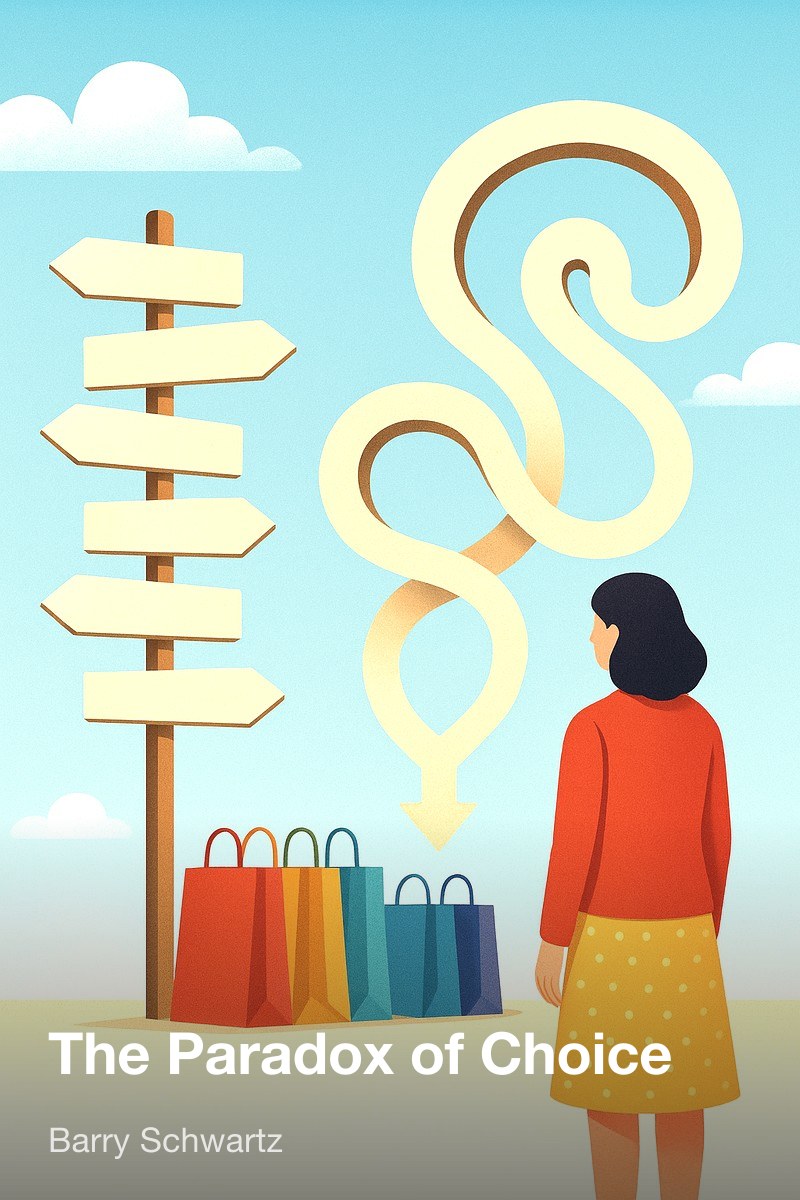
The Paradox of Choice by Barry Schwartz  book cover

As an Amazon Associate, Sumizeit earns from qualifying purchases.

Book Summary

The Paradox of Choice Book Summary

By Barry Schwartz


This The Paradox of Choice Book Summary covers the key ideas, lessons, and takeaways in about 20 minutes.

20 min read Audio available
Freedom of choice is worth having, but it isn't a free lunch. When options multiply without limit, they cost us time, calm and satisfaction, and they tempt us into perfectionism, regret, disappointment and endless comparison. You can't change how many options the world throws at you, but you can change how you meet them. Decide which choices truly matter, accept good enough for the rest, commit firmly once you choose, lean on rules and routines to spare your energy, invest in close relationships and practice gratitude. Do that and choice goes back to being a source of freedom rather than a weight on your back.

Helps with these goals

4.8

Stars

Average ratings on iOS and Google Play

100,000+

Users

On all platforms

6+

Years

Experience igniting personal growth

Want the complete 20-minute summary?

  • Full structured summary
  • Video Summary
  • Podcast Summary
  • Audio summary
  • Key takeaways
  • Exercises
  • Quiz
  • Highlights and notes
  • Ask the book with AI

Want a Free Weekly Read?

Get a free summary every week straight to your mailbox.

Preview the The Paradox of Choice book summary

Below is a preview of Sumizeit’s comprehensive human-written summary of The Paradox of Choice by Barry Schwartz . The full summary is 15-20 minutes long and covers the book’s key ideas in text, audio, visual, and video formats. Unlock the full 20 Minute Summary

The big idea

Barry Schwartz starts from a simple observation. Having options feels like freedom, and freedom is good. But somewhere along the way, the number of options we face crossed a line. Now we spend our days picking between dozens of nearly identical products, plans and paths, and it leaves us tired, anxious and unsure we chose well.

Schwartz doesn't argue against choice itself. He says plainly that a life with no choice at all makes people miserable. Autonomy matters. Being able to shape your own life matters. His point is that past a certain level, more options stop adding to your happiness and start taking it away. They crowd your day with small decisions that don't matter and drain the energy you need for the ones that do.

The book covers four things. It looks at the kinds of choices we make, how we make them, why so many choices make us suffer, and what we can do about it. His answer to the last question is not to wish choice away. It's to get better at deciding which choices deserve your attention and which ones you should settle quickly or skip.

Schwartz draws on psychology, economics and his own life. He has said that his own frustration as a shopper faced with a wall of options pushed him to write the book. The ideas leaned heavily on the work of Daniel Kahneman and Amos Tversky, the pair behind prospect theory and much of what we know about mental shortcuts and bias.

The book came out in 2004 and it has been argued over ever since. Some later researchers couldn't reproduce famous results Schwartz relied on, and critics at outlets like The Atlantic and the Financial Times said the case against too much choice wasn't backed by enough evidence. Schwartz has answered them. He admits his claim isn't universal and that more choice helps in some situations. He still holds that too much choice causes real trouble often enough to matter, and he points to a long list of studies that back him up.

Where the explosion of choice comes from

Schwartz gives two reasons why our options keep multiplying. First, market economies reward anyone who can offer one more variety, one more model, one more plan. Companies win by giving you more to pick from, so they do. Second, in the United States especially, independence and freedom are core values. Cutting back on options feels like giving up on the American way, so nobody pushes back.

The result is a world where choices have grown in number and in complexity. And we usually get little guidance on how to make them well.

He sorts the choices we face into three groups. Consumer choices are about things we buy. Complex choices are about services and systems with real consequences for our health, money and careers. Personal life choices are about how we live and who we are. Expanded choice shows up in all three.

Consumer choices

Consumer choices…

The full structured summary is available after upgrading

Want the complete 20-minute summary?

  • Full structured summary
  • Video Summary
  • Podcast Summary
  • Audio summary
  • Key takeaways
  • Exercises
  • Quiz
  • Highlights and notes
  • Ask the book with AI

Who should read The Paradox of Choice?

The Paradox of Choice is essential for anyone feeling overwhelmed by everyday decisions—from choosing groceries to picking a career or life partner. It speaks especially to people in affluent societies who notice that more options haven't made them happier, as well as those struggling with decision fatigue, perfectionism, or chronic dissatisfaction. If you find yourself second-guessing choices or spending excessive time on trivial decisions, this book offers both explanation and practical relief.

Why does The Paradox of Choice matter?

In today's world of infinite options—from streaming services to dating apps to career possibilities—Barry Schwartz's insights are more relevant than ever. We face more choices than any previous generation, yet research shows rising rates of anxiety, depression, and regret alongside unprecedented freedom. Understanding how expanded choice affects our decision-making, relationships, and well-being is crucial for reclaiming mental space and building a more satisfying life.

What are the key themes in The Paradox of Choice?

  • The difference between having freedom and being overwhelmed by too much freedom
  • How maximizing (seeking the best) differs from satisficing (accepting good enough)
  • The psychological costs of endless options: decision fatigue, regret, and disappointment
  • The role of cognitive biases in decision-making under choice overload
  • Why close relationships and community matter more than individual autonomy alone
  • The connection between expanded choice, individualism, and rising depression
  • Strategic limitation of choice through rules, standards, and routines

Want the complete 20-minute summary?

  • Full structured summary
  • Video Summary
  • Podcast Summary
  • Audio summary
  • Key takeaways
  • Exercises
  • Quiz
  • Highlights and notes
  • Ask the book with AI

How can you apply ideas from The Paradox of Choice?

  • Create rules and routines for low-stakes decisions (same breakfast, standard coffee order) to save mental energy for decisions that matter
  • Set clear standards for decisions (maximum price for jeans, minimum traits in a partner) to narrow overwhelming option sets without full deliberation
  • Practice satisficing by finding options that meet your standards and committing to them, rather than endlessly searching for the perfect choice
  • Reduce social media consumption and unfollow accounts that trigger comparison and envy, then notice your satisfaction increase
  • When facing a major decision, create a simple table listing options across the top and goals down the side to visualize tradeoffs clearly
  • Intentionally lower your expectations on frivolous matters and save peak experiences (expensive champagne, favorite restaurant) for special occasions to maintain their specialness
  • Practice gratitude daily through writing or reflection to counteract hedonic adaptation and the natural tendency to take choices for granted

What common mistakes do readers make with The Paradox of Choice?

  • Applying maximizing effort equally to all decisions, when consumer choices like breakfast cereal deserve quick satisficing while career and relationship choices deserve deliberation
  • Constantly second-guessing decisions by keeping options reversible, which prevents commitment and creates ongoing dissatisfaction by encouraging endless searching
  • Dwelling on opportunity costs and imagining how other choices would have played out, which creates regret and dissatisfaction even with excellent decisions
  • Using social comparison as the primary measure of whether your choices are good, rather than focusing on whether they align with your own values and bring you actual satisfaction

Sumizeit Exercises Apply what you've learned

Turn ideas from The Paradox of Choice into action with a short guided reflection: identify the biggest takeaway, connect it to your life, and commit to one step you can take in the next 24 hours.

Unlock book-specific exercises with a Sumizeit membership

Unlock Exercises

What is the expert analysis of The Paradox of Choice?

Overview

The Paradox of Choice, authored by Barry Schwartz, is a seminal work at the intersection of psychology, economics, and social theory. Published in 2004, the book addresses a pervasive modern dilemma: the overwhelming abundance of choices in contemporary life and its paradoxical effect on human well-being. Schwartz, a professor at Swarthmore College known for exploring how people make decisions and the consequences thereof, brings a rich interdisciplinary perspective to this topic. His work has resonated widely, influencing both academic discourse and popular understanding of choice, autonomy, and happiness.

Core Thesis

Schwartz’s central argument is that while freedom of choice is fundamentally valuable and essential for autonomy and well-being, an excess of options can lead to decision paralysis, anxiety, regret, and dissatisfaction. Beyond a certain threshold, more choices do not increase happiness but instead deplete cognitive and emotional resources, fostering perfectionism and chronic dissatisfaction. The book explores how this phenomenon manifests across consumer goods, complex services, and personal life decisions, and proposes that managing choice—by prioritizing, satisficing rather than maximizing, and structuring decisions through rules and routines—can restore choice’s liberating potential.

Strengths

  • Interdisciplinary Integration: Schwartz skillfully synthesizes insights from psychology (notably Kahneman and Tversky’s work), behavioral economics, and social theory, providing a nuanced understanding of decision-making processes and their emotional consequences.
  • Practical Framework: The book offers actionable strategies such as distinguishing between trivial and significant decisions, adopting satisficing over maximizing, and employing second-order decisions (rules, routines, standards) to reduce cognitive load.
  • Broad Applicability: By categorizing choices into consumer, complex, and personal life domains, Schwartz’s analysis captures the multifaceted nature of modern decision-making and its psychological toll.
  • Engaging Use of Examples: The vivid illustrations—from supermarket aisles to retirement plans and dating apps—ground abstract concepts in everyday experience, enhancing accessibility without sacrificing intellectual rigor.
  • Balanced Perspective: Schwartz acknowledges the value of choice and autonomy, avoiding simplistic anti-choice rhetoric, and openly engages with critiques and contradictory findings, demonstrating intellectual honesty.

Critiques & Counterarguments

  • Empirical Ambiguity: Some foundational studies Schwartz relies on, such as the jam experiment, have faced replication challenges, raising questions about the universality of the “too much choice” effect. Subsequent research has shown mixed results, with some contexts showing neutral or even positive effects of increased options.
  • Contextual Variability: The book’s thesis may oversimplify the complex interplay between individual differences, cultural factors, and situational contexts. For example, some cultures with less emphasis on individualism may experience choice overload differently, and some individuals thrive on variety and exploration rather than suffering from it.
  • Maximizer-Satisficer Nuances: Later research complicates Schwartz’s dichotomy, suggesting that maximizers may not be universally less happy and that measurement instruments conflated maximizing with other traits. This challenges the straightforward prescription to “be a satisficer.”
  • Overemphasis on Individual Responsibility: While Schwartz highlights societal values of freedom and market forces as drivers of choice proliferation, critics might argue that structural and systemic factors—such as economic inequality, marketing practices, and digital platform designs—also shape how choices impact well-being, which the book addresses less thoroughly.
  • Potential Underestimation of Adaptation: Although hedonic adaptation is discussed, some psychological research suggests people are more resilient and capable of adjusting to complex choice environments than the book implies, especially with evolving digital tools and decision aids.

Who Should Read This

This book is essential reading for scholars and practitioners in psychology, behavioral economics, and consumer research, as well as thoughtful readers interested in the psychological underpinnings of modern life’s complexity. Professionals in marketing, public policy, and organizational behavior will find valuable insights into how choice architecture affects decision quality and satisfaction. Moreover, anyone grappling with decision fatigue or the anxiety of abundance—whether in personal relationships, career choices, or consumer behavior—will benefit from Schwartz’s clear exposition and practical guidance. The book’s blend of theory, empirical evidence, and actionable advice makes it a compelling resource for those seeking to understand and navigate the paradoxes of freedom in contemporary society.

Test yourself on The Paradox of Choice 5 sample questions from the summary quiz

Try a few questions from the The Paradox of Choice quiz. Unlock the full summary for the full quiz and answers that will help the ideas stick.

Question 1 of 5

What central claim does Barry Schwartz make about too many choices?

Question 2 of 5

Which three groups of choices does Schwartz use to organize the expanded choice people face?

Question 3 of 5

What distinction does Schwartz recommend using to decide how much effort to spend when buying items?

Question 4 of 5

What did the jam study often cited by Schwartz find about consumer behavior?

Question 5 of 5

Which cognitive bias does Schwartz describe as giving extra weight to what comes to mind easily, such as vivid stories?

Frequently asked questions about the The Paradox of Choice book summary

What is The Paradox of Choice about?

The Paradox of Choice by Barry Schwartz explores how expanded options in modern life—from consumer goods to careers to relationships—paradoxically decrease happiness rather than increase it. The book argues that while some choice is essential for freedom and autonomy, excess choice creates decision fatigue, anxiety, regret, and disappointment. Schwartz provides both the psychology behind why too many options harm us and practical strategies for limiting choice to reclaim satisfaction and well-being.

Who should read The Paradox of Choice?

Anyone feeling overwhelmed by everyday decisions or chronic dissatisfaction despite abundant options would benefit from this book. It's especially relevant for people in affluent societies struggling with decision fatigue, perfectionism, or the sense that more freedom hasn't made them happier. Professionals managing teams, parents teaching children decision-making, and anyone interested in the psychology of well-being and happiness will find valuable insights.

What are the main takeaways from The Paradox of Choice?

Key takeaways include: (1) differentiate between maximizing (seeking the best) and satisficing (accepting good enough), and practice satisficing; (2) create rules and routines to remove trivial decisions from your plate; (3) invest deeply in close relationships rather than keeping all options open; (4) practice gratitude to counter hedonic adaptation and comparison; (5) make firm commitments to choices rather than endlessly reversing them; and (6) strategically limit your options through standards and routines to preserve mental energy for decisions that truly matter.

How does expanded choice affect relationships according to Schwartz?

Schwartz argues that expanded choice undermines relationships in two ways. First, the time spent on endless decisions leaves less time to build and maintain close bonds. Second, the marketplace mentality—switching when unhappy—conflicts with the commitment relationships require. Dating apps exemplify this by offering seemingly endless alternatives, which makes people less likely to invest in relationships. Yet research shows strong family and community ties predict greater happiness and longevity than wealth or freedom.

What is the difference between maximizers and satisficers?

Maximizers insist on finding the absolute best option and examine every alternative, even for trivial purchases. Satisficers set standards for what's acceptable and choose the first option that meets them. While maximizers sometimes achieve objectively better outcomes (like higher salaries), they experience more regret, buyer's remorse, and unhappiness. Satisficers feel more content with their choices. The key insight is that maximizing doesn't necessarily make people happier despite producing better results on paper.

How does The Paradox of Choice connect to depression?

Schwartz argues that expanded choice and individualism contribute to rising depression rates in affluent societies. When personal choice is emphasized, people blame themselves when decisions disappoint. Simultaneously, higher expectations created by endless options clash with reality, fueling disappointment and regret. Maximizers are particularly vulnerable, as they set impossibly high standards and experience depression when choices fail to meet them. The pressure to control every aspect of life creates stress when that control proves impossible.

What does Schwartz recommend to handle decision overload?

Schwartz recommends eleven practical strategies: be selective about which decisions deserve deep thought; deliberate on important choices and guess quickly on trivial ones; adopt satisficing as your default; ignore opportunity costs; make firm decisions without reversing; practice daily gratitude; minimize regret through satisficing and acceptance; adjust to hedonic adaptation; lower expectations intentionally; reduce social comparisons; and embrace constraints through rules, standards, and routines that spare your mental energy.

About Sumizeit

Sumizeit is a profitable Scomy LLC company based in Miami, Florida. It has been helping readers learn from nonfiction books for 7 years with expert-written summaries in text, audio, podcast, and video.

Want the complete 20-minute summary?

  • Full structured summary
  • Video Summary
  • Podcast Summary
  • Audio summary
  • Key takeaways
  • Exercises
  • Quiz
  • Highlights and notes
  • Ask the book with AI

Here's why readers love Sumizeit

Join thousands of learners getting smarter every day

"Great experience. Detailed summaries. Loved the gamification feature. Makes learning fun. Good customer service. I recommend Sumizeit to anyone. You'll learn a lot."

Chen, TrustPilot

"I always felt busy but still wanting to keep up with the book discussion in my friend group. This was a great supplement to help me keep reading the books I find fun while keeping up with important books."

Daniel, TrustPilot

"I love this website. Instead of scrolling social media, I find myself learning a lot. I use it everyday. I recommend this app for anyone who is too busy and wants to get up to speed with their favorite books."

Erica, TrustPilot

The Paradox of Choice Book Summary PDF

Looking for a The Paradox of Choice Book Summary PDF you can save and revisit offline? Our The Paradox of Choice Book Summary PDF captures the book’s core ideas in a clean, printable format — the key frameworks, takeaways, and structure without the fluff. Download the The Paradox of Choice Book Summary PDF when you want a reference you can annotate, share with your team, or review on the go. Get your The Paradox of Choice Book Summary PDF from the download page below.

Download The Paradox of Choice Book Summary PDF

People also liked these summaries

Readers who explored The Paradox of Choice often enjoyed these titles next.

Browse all books →

Want the complete 20-minute summary?

  • Full structured summary
  • Video Summary
  • Podcast Summary
  • Audio summary
  • Key takeaways
  • Exercises
  • Quiz
  • Highlights and notes
  • Ask the book with AI


View Full Summary