
Question 1 of 10


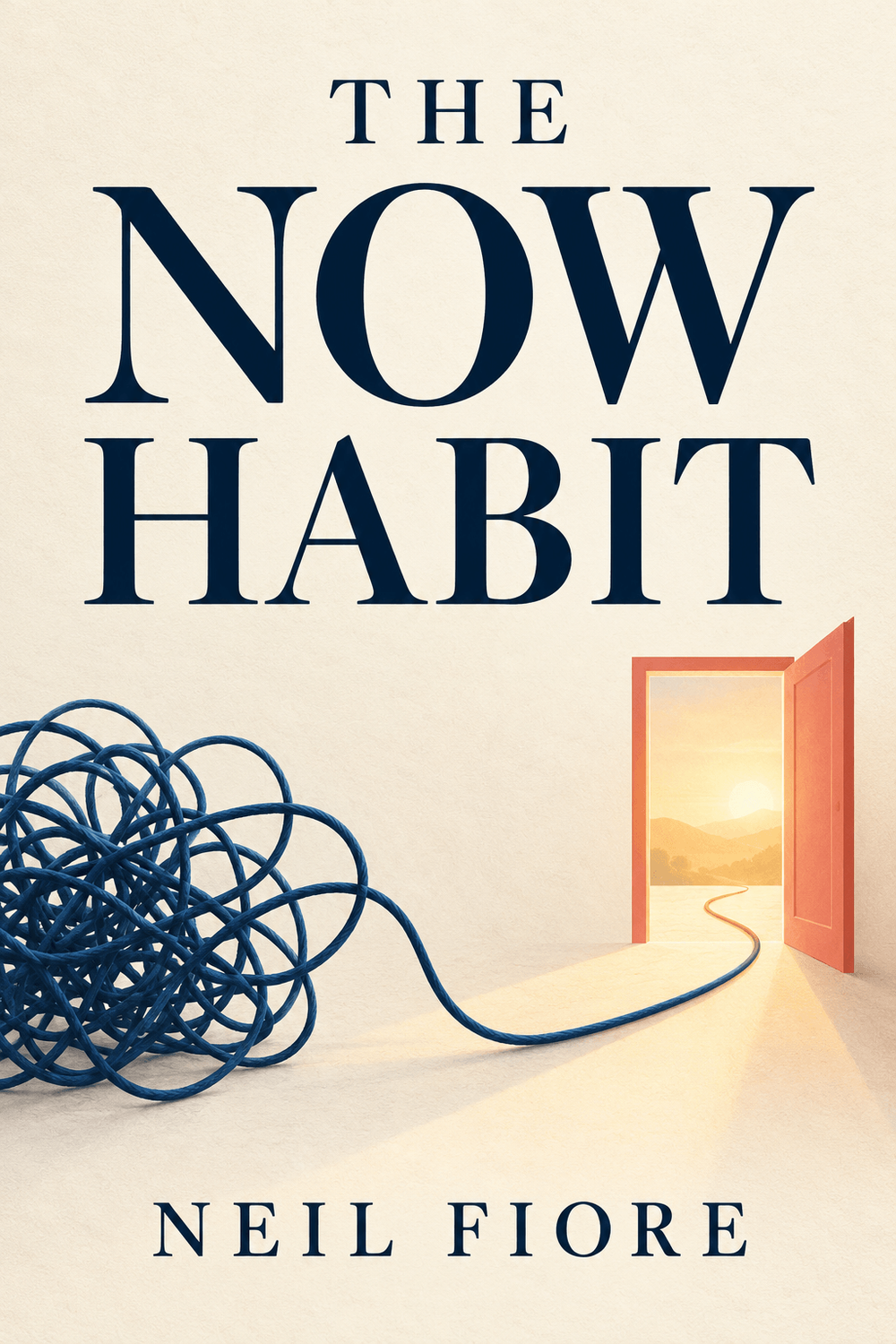
Prefer the print book? Buy on Amazon
As an Amazon Associate, Sumizeit earns from qualifying purchases.
Book Summary
The Now Habit Book Summary
This The Now Habit Book Summary covers the key ideas, lessons, and takeaways in about 20 minutes.
Short Description:
Why you procrastinate and how Neil Fiore says to stop for good
Procrastination is not a lack of discipline. It's a stress reaction, built on perfectionism, fear, and a belief that work is supposed to be painful, and you can't beat it by pushing harder. You beat it by making work feel safer and life feel fuller. Talk to yourself in terms of choice, plan your play before your work, break big projects into small starts, reward yourself for 30 minutes of honest effort, and rehearse the resistance before it shows up. When work stops threatening your sense of worth, starting gets easy, and that is the habit Fiore wants you to build.
Preview the The Now Habit book summary
Below is a preview of Sumizeit’s comprehensive human-written summary of The Now Habit by Neil Fiore. The full summary is 15-20 minutes long and covers the book’s key ideas in text, audio, visual, and video formats. Unlock the full 20 Minute Summary
Why do you put off the things that matter most to you, even when you know it makes you unhappy? Neil Fiore spends the whole book on that question. His answer surprises most people. Procrastination is not laziness, and you can't fix it by trying harder. It's a symptom. Underneath it sits fear, stress, and a pile of beliefs about work that make starting feel like walking into a storm.
So Fiore doesn't hand you a stricter schedule or a pep talk. He goes after the cause. The book first explains why we stall, then gives you a set of tools that change how you think about work, how you plan your week, how you break down big projects, and how you stay focused once you sit down. His promise is simple. Follow the program and you'll get more done, feel better about yourself, and enjoy your life more.
The book came out in 1988. A second edition in 2007 added a new introduction and some advice on internet distractions. The core program stayed the same.
Procrastination is not laziness
Most of us grew up believing procrastination means you're lazy. If you just had more discipline, you'd get on with it. Fiore says that story is backwards. Procrastination isn't the root problem. It's how you cope with the anxiety you feel about starting a task or finishing it.
That matters because the lazy story makes things worse. When you think you're lazy, you scold yourself. The scolding adds stress. The stress makes the task feel even heavier, and you dodge it again. Willpower can't break that loop, because willpower is the thing you're already straining against. Fiore wants you to stop treating yourself as a character flaw to be fixed and start treating yourself as a person who is trying to avoid something that hurts.
How we learned to hate work
Fiore blames part of the problem on what we absorbed from parents, teachers, bosses, and the culture around us. We learned that work should be hard and unpleasant. We learned that play is a waste of time, something you earn only after the work is done. But the work is never done.
Put those beliefs together and you get a trap. You dread work, so you avoid it. You feel guilty whenever you're not working, so you can't enjoy your free time either. You resent work for stealing your life, and you resent your free time for being tainted. Stress and guilt feed avoidance, and avoidance feeds more stress and guilt.
Fiore's fix starts with flipping those assumptions. Rest and fun are not rewards you have to earn. They belong in a healthy week from the start. And work doesn't have to be a grind. You can make it lighter so it carries less pressure.
What counts as work and play
Fiore uses "play" broadly. It covers exercise, hobbies, creative projects, games, time with friends, and anything you find relaxing, fun, or meaningful.
Want the complete 20-minute summary?
- Full structured summary
- Video Summary
- Podcast Summary
- Audio summary
- Key takeaways
- Exercises
- Quiz
- Highlights and notes
- Ask the book with AI
Who should read The Now Habit?
The Now Habit is for anyone who struggles with procrastination, regardless of whether it's affecting work projects, personal goals, or creative pursuits. This book is especially valuable for perfectionists, high achievers, and people who feel trapped in cycles of guilt and avoidance. If you've tried willpower and discipline without success, Fiore's approach offers a fundamentally different path.
Why does The Now Habit matter?
Understanding procrastination as a stress response rather than a character flaw changes everything about how you approach the problem. In a culture that celebrates constant productivity and perfectionism, The Now Habit by Neil Fiore provides permission to rest and practical strategies to make work feel less threatening. This reframing is essential for building sustainable productivity and actually enjoying your life alongside your accomplishments.
What are the key themes in The Now Habit?
- Procrastination as anxiety management, not laziness
- The role of perfectionism and unrealistic standards
- Cultural beliefs about work and play that fuel avoidance
- Fear of success and its hidden costs
- The power of self-talk and language choices
- Rest as essential, not earned
- Breaking psychological patterns through small, concrete steps
How can you apply ideas from The Now Habit?
- Replace 'have to' and 'should' statements with 'I choose to' and 'I want to' for one week and notice how your motivation and mood shift
- Plan your week by blocking leisure first—at least 30 minutes daily and one full day free of work—then fit work into what remains
- Pick one large project and break it into specific, dated mini-steps, then commit to starting just the first step for 30 minutes
- Track completed work sessions by logging them after you finish, not before, and celebrate your weekly total hours of quality effort
- Use the worry-to-plan technique: name the worst realistic outcome, plan how you'd handle it, then identify one concrete action to take today
- Before each work session, spend five minutes picturing the resistance you expect and mentally rehearsing how you'll handle it
- Take a break immediately after each 30-minute work block, either to rest or to switch to something enjoyable, to reward yourself for starting and staying
- Identify one perfectionist belief about work or success that you hold, challenge it with evidence, and test a new assumption for a week
What common mistakes do readers make with The Now Habit?
- Treating procrastination as laziness and responding with stricter discipline or willpower, which only increases stress and deepens the avoidance cycle
- Waiting to schedule work until you 'feel like it' or after all your other tasks are done, which means work never starts
- Focusing on finishing a project perfectly on the first try instead of breaking it into starts, which guarantees you'll feel overwhelmed before you begin
- Skipping rest and play to maximize work time, which leaves you feeling guilty about downtime and resentful of work, fueling more avoidance
- Using endless research and preparation as a substitute for starting the actual work, which feels productive but is another form of avoiding the real task
- Believing that the pressure and panic of last-minute work is proof you work best under pressure, when you've actually never given yourself the chance to work any other way
Sumizeit Exercises Apply what you've learned
Turn ideas from The Now Habit into action with a short guided reflection: identify the biggest takeaway, connect it to your life, and commit to one step you can take in the next 24 hours.
What is the expert analysis of The Now Habit?
Overview
The Now Habit is a seminal work on procrastination authored by Neil Fiore, a psychologist and productivity coach. Since its original publication in 1988, the book has become a cornerstone in understanding procrastination not as mere laziness but as a complex psychological response to stress and fear. Fiore’s expertise and clinical background lend credibility to his approach, which integrates psychological insights with practical strategies. The 2007 revised edition, which updates the text to address modern distractions such as the internet, demonstrates the enduring relevance of Fiore’s core program.
Core Thesis
Fiore’s central argument reframes procrastination as a symptom of deeper anxieties—perfectionism, fear of success, and feelings of powerlessness—rather than a character flaw or lack of discipline. He posits that procrastination arises from a toxic cycle of stress and guilt fueled by cultural conditioning that equates work with suffering and play with guilt. The antidote is a paradigm shift: by changing one’s internal dialogue, prioritizing leisure as a foundational element of the week, breaking tasks into manageable steps, and cultivating focused work sessions, individuals can dismantle the emotional barriers to productivity and reclaim a balanced, fulfilling relationship with work and life.
Strengths
- Psychological Depth: Fiore’s identification of procrastination as a stress reaction rooted in fear and perfectionism offers a nuanced understanding that transcends simplistic notions of laziness.
- Practical Strategies: The book excels in translating theory into actionable tools, such as reframing self-talk from “have to” to “choose to,” and the innovative concept of scheduling play before work, which challenges conventional productivity dogma.
- Holistic Approach: By addressing emotional, cognitive, and behavioral dimensions, Fiore provides a comprehensive program that attends to both mindset and habit formation.
- Enduring Relevance: The book’s core principles remain applicable decades after its first publication, underscoring the timeless nature of its insights.
Critiques & Counterarguments
- Limited Empirical Evidence: While Fiore’s clinical experience is evident, the book relies heavily on anecdotal evidence and lacks rigorous empirical validation through controlled studies, which may limit its acceptance in academic psychology.
- Oversimplification of Complex Causes: Procrastination can stem from diverse causes including neurobiological factors, executive dysfunction, or socioeconomic constraints, which Fiore’s framework only partially addresses.
- Potential Underestimation of Structural Barriers: The emphasis on individual mindset and scheduling might overlook external systemic issues such as workplace culture, mental health disorders, or chronic stressors that impede productivity.
- Competing Theories: Cognitive-behavioral models and Acceptance and Commitment Therapy (ACT) offer alternative approaches that emphasize acceptance of discomfort and values-driven action rather than reframing self-talk alone.
- Real-World Complexity: The recommendation to “plan your play first” may be challenging for individuals in highly demanding or inflexible work environments, limiting the universal applicability of this strategy.
Who Should Read This
The Now Habit is ideal for readers who struggle with procrastination and seek a compassionate, psychologically informed approach that moves beyond willpower and discipline. It is particularly valuable for creative professionals, students, and knowledge workers who face large, emotionally charged projects and perfectionistic tendencies. Additionally, coaches, therapists, and productivity consultants may find Fiore’s framework a useful complement to other intervention strategies. Readers looking for a balanced integration of mindset shifts and practical time-management tools will benefit most from this enduring classic.
Discussion questions for The Now Habit Short questions you can actually use in a conversation
Frequently asked questions about the The Now Habit book summary
What is The Now Habit about?
The Now Habit by Neil Fiore is a comprehensive guide to understanding and overcoming procrastination, which Fiore identifies not as laziness but as a stress response rooted in perfectionism and fear. Rather than relying on willpower and discipline, the book offers practical strategies for changing how you talk to yourself, plan your time, break down projects, and focus on work. Fiore's core approach is to make work feel safer and life feel fuller by planning leisure first, focusing on small starts rather than perfect finishes, and rewarding consistent effort over outcomes.
Who should read The Now Habit?
The Now Habit is ideal for anyone struggling with procrastination on work projects, personal goals, or creative pursuits, especially perfectionists and high-achievers who feel trapped in cycles of guilt and avoidance. If you've tried traditional productivity methods and willpower without success, or if you find yourself waiting until the last minute and then feeling rushed and resentful, this book offers a fundamentally different approach. It's also valuable for people who feel anxious or paralyzed by perfectionism and those who struggle to enjoy downtime because they feel they should always be working.
What are the main takeaways from The Now Habit?
The main takeaways are: procrastination is a stress reaction, not laziness; changing your self-talk from 'have to' and 'should' to 'I choose to' restores control; planning leisure and rest first makes work feel manageable; breaking large projects into small, specific steps removes overwhelm; focusing on 30-minute sessions of genuine effort rather than outcomes builds momentum; and worrying becomes actionable when you ask what's realistically worst, how you'd handle it, and what you can do now. The underlying insight is that you overcome procrastination not by pushing harder but by making work feel safer and giving yourself permission to rest without guilt.
How does Neil Fiore explain why procrastination happens?
Fiore identifies three main drivers of procrastination: perfectionism (setting impossibly high standards that guarantee failure), fear of success (worrying about isolation, changed relationships, or unmet expectations), and frustration or powerlessness (feeling trapped in work and using avoidance as a way to reclaim control). Underlying all three is the cultural belief that work must be painful and unpleasant, while play is only a reward you must earn after work is done. This creates a vicious cycle where dread leads to avoidance, guilt amplifies stress, and stress makes the task feel even heavier.
What is the 30-minute rule in The Now Habit?
Fiore recommends committing to just 30 minutes of uninterrupted, quality work on a single task as the basic unit of effort. You log a work block only after completing at least 30 minutes, take a break immediately afterward (either to rest or switch to something enjoyable), and record your sessions after you finish, not before. This approach lowers the barrier to starting, rewards you for beginning and persisting, and lets you celebrate the total hours accumulated over a day or week. The 30-minute focus also keeps individual sessions manageable and helps you push through initial resistance to find the work easier than you expected.
How does planning leisure first change your approach to work?
In The Now Habit, Fiore recommends building your week around rest and play first—including at least 30 minutes of recreation daily and one full day off each week—then fitting work into the remaining hours. This shift has several effects: it forces you to see how limited your work time actually is, which makes you value those hours; it guarantees guilt-free downtime you can truly enjoy; and it transforms work from an endless swamp into a bounded set of hours, which feels far less threatening. This reframing also addresses the cultural trap where guilt about not working poisons your leisure, and guilt about resting poisons your work.
Why does Fiore say language matters in overcoming procrastination?
Fiore argues that 'have to' and 'should' are poison words that strip away your sense of control and agency. 'Have to' makes you feel like a victim pushed by external forces, breeding resentment. 'Should' turns a task into a moral test, linking it to your worth as a person and creating shame. By swapping these for 'I choose to' and 'I want to,' you restore your sense of agency without lying to yourself, since you almost always do have a choice. This shift in language reduces the emotional weight of the task, lowers resentment and anxiety, and makes starting feel like a genuine choice rather than forced compliance.
What does Fiore say about perfectionism and procrastination?
Fiore identifies perfectionism as one of the primary drivers of procrastination. When you set impossibly high standards and tell yourself that failure will have terrible consequences, starting feels pointless because success feels impossible. Perfectionism also paradoxically protects procrastination: by waiting until the last minute, you can blame any flaws on time pressure rather than your ability, so you never have to discover what your best actually looks like. Breaking the procrastination habit means finally risking the discovery of what you're capable of, which is both liberating and scary. Fiore's solution is to focus on starting and improving rather than on getting it perfect the first time.
About Sumizeit
Sumizeit is a profitable Scomy LLC company based in Miami, Florida. Our founders, Clemens Raemy and Weina Scott, are successful entrepreneurs with several exits. Sumizeit is a popular book summary app / micro learning app used by busy professionals and entrepreneurs with over 2,500 non-fiction book summaries and 10,000 podcast summaries in text, audio, visual, podcast, and video format. We also have stellar retention tools to make ideas stick - such as flashcards with spaced repetition, quizzes, streaks, highlighting and notes, daily challenges, riddles, mini-courses, meditation, and more. You won't only learn the idea, but also remember it. Over 90% of our users change their habits with Sumizeit.
Upgrade Now
Here's why readers love Sumizeit
Join thousands of learners getting smarter every day
"Great experience. Detailed summaries. Loved the gamification feature. Makes learning fun. Good customer service. I recommend Sumizeit to anyone. You'll learn a lot."
"I always felt busy but still wanting to keep up with the book discussion in my friend group. This was a great supplement to help me keep reading the books I find fun while keeping up with important books."
"I love this website. Instead of scrolling social media, I find myself learning a lot. I use it everyday. I recommend this app for anyone who is too busy and wants to get up to speed with their favorite books."
The Now Habit Book Summary PDF
Looking for a The Now Habit Book Summary PDF you can save and revisit offline? Our The Now Habit Book Summary PDF captures the book’s core ideas in a clean, printable format — the key frameworks, takeaways, and structure without the fluff. Download the The Now Habit Book Summary PDF when you want a reference you can annotate, share with your team, or review on the go. Get your The Now Habit Book Summary PDF from the download page below.
Download The Now Habit Book Summary PDFPeople also liked these summaries
Readers who explored The Now Habit often enjoyed these titles next.
Ready to read the whole thing?
- Full structured summary
- Video Summary
- Podcast Summary
- Audio summary
- Key takeaways
- Exercises
- Quiz
- Highlights and notes
- Ask the book with AI
Featured Book Titles
Popular Book Summaries at sumizeit, leading book summary app
Atomic Habits Book Summary Rich Dad Poor Dad Book Summary The Four Agreements Book Summary The 48 Laws of Power Book Summary When Breath Becomes Air Book Summary Think and Grow Rich Book Summary