


Prefer the print book? Buy on Amazon
As an Amazon Associate, Sumizeit earns from qualifying purchases.
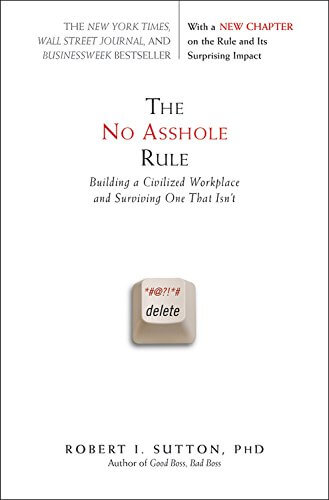
The No Asshole Rule Book Summary
This The No Asshole Rule Book Summary covers the key ideas, lessons, and takeaways in about 20 minutes.
Short Description:
Avoid assholes at work and life to stay happy and avoid bad habits.
Helps with these goals
Preview the The No Asshole Rule book summary
Below is a preview of Sumizeit’s comprehensive human-written summary of The No Asshole Rule by Robert I. Sutton. The full summary is 15-20 minutes long and covers the book’s key ideas in text, audio, visual, and video formats. Unlock the full 20 Minute Summary
It’s no secret that we can all be assholes sometimes.
But, what about those people who seem to be major jerks 24/7?
According to Robert I. Sutton, those are the real assholes of the world.
In his book, “The No Asshole Rule” Sutton shares his views on what an asshole really is, how to deal with them in the workplace, and how to successfully structure a workplace that’s “asshole-free”.
“As much as I believe in tolerance and fairness, I have never lost a wink of sleep about being unapologetically intolerant of anyone who refuses to show respect for those around them.”- Robert I. Sutton
After reading his key insights, you will be ready to take on these hostile characters with the utmost grace.
Assholes in the Workplace Don’t Lead to Success
It’s sad but true, that bad behavior or asshole behavior in the workplace is often left untouched. Management often ignores it thinking that talking about the issue will just lead to more problems. But, as a result, the morale of the employees is left bruised.
When people are not professional and respectful in the workplace, productivity slows. And, other employees start to act out. For example, if the work environment is toxic, they may call out of work more simply because they don’t want to be in that environment.
When your boss is an asshole, humiliation for their employees is common. Employers work in fear of messing up, which causes damaging effects on the person and on the team.
Hard-working and smart employees that mentally register that their workplace is toxic will leave for other positions at other companies that are asshole-free.
The No Asshole Rule
A lot of times assholes in the workplace are overlooked because they are talented and have skills. But, that doesn’t make up for the harm it causes to their team.
All assholes should be kicked out of the workplace at the first sign of disrespect.
An employee that makes others feel as if they are worthless, incompetent, or uncomfortable should not be allowed to stay in the company. Team members who get along and encourage each other get a lot more done.
This rule should also be applied to clients and customers. If they are not kind, they should not be served.
More Equality
It’s been proven that people who are the higher-ups on the ladder are more likely to be assholes. It’s an elitist mindset.
The higher-ups are often more talkative because they feel what they have to say matters more because of their position.
“Winning is a wonderful thing if you can help and respect others along the way. But if you stomp on others as you climb the ladder and treat them like losers once you reach the top, my opinion is that you debase your own humanity and undermine your team or organization.”- Robert I. Sutton
They also take things from the workplace without consideration for the other employees.
Want the complete 20-minute summary?
- Full structured summary
- Video Summary
- Podcast Summary
- Audio summary
- Key takeaways
- Exercises
- Quiz
- Highlights and notes
- Ask the book with AI
Who should read The No Asshole Rule?
The No Asshole Rule is essential reading for managers, HR professionals, and anyone working in teams who wants to create a respectful workplace culture. It's also valuable for individual employees navigating toxic work environments and seeking strategies to protect their well-being and career growth.
Why does The No Asshole Rule matter?
Toxic behavior in the workplace costs organizations billions in lost productivity, employee turnover, and damaged morale, yet many leaders overlook it because high performers are often excused. Robert I. Sutton's framework provides both organizations and individuals with practical tools to identify, address, and eliminate the corrosive effects of disrespectful behavior before it becomes normalized.
What are the key themes in The No Asshole Rule?
- Identifying and defining destructive workplace behavior
- The business case against tolerating disrespect
- Power dynamics and how hierarchies enable toxic behavior
- Building cooperative team cultures
- Personal resilience when working with difficult people
- Organizational accountability and zero-tolerance policies
How can you apply ideas from The No Asshole Rule?
- Implement a zero-tolerance policy for persistent disrespect, applied equally to all employees regardless of talent or seniority
- Reduce pay inequality and hierarchical distance through transparent salary structures and inclusive communication practices
- Design performance incentives and recognition systems that reward cooperation and team success rather than individual competition
- Use inclusive language in meetings, emails, and company communications to foster 'we' thinking and discourage individualistic win-at-all-costs attitudes
- Develop emotional resilience strategies for employees working with difficult people, including detachment techniques and perspective management
- Create exit strategies and minimal-contact protocols for employees who must work near disruptive people while protecting their own well-being
- Evaluate whether clients or customers whose behavior is consistently disrespectful are worth retaining, and establish boundaries accordingly
What common mistakes do readers make with The No Asshole Rule?
- Overlooking bad behavior from high performers because they deliver results, not recognizing that their damage to team culture often outweighs their contributions
- Assuming that tolerating toxic people is necessary to avoid conflict, when in fact ignoring the problem creates more conflict and resentment
- Adopting the behaviors and attitudes of disrespectful colleagues through prolonged exposure rather than consciously maintaining boundaries
- Using aggressive leadership style thinking it projects strength, when respectful motivation actually produces better performance and retention
Sumizeit Exercises Apply what you've learned
Turn ideas from The No Asshole Rule into action with a short guided reflection: identify the biggest takeaway, connect it to your life, and commit to one step you can take in the next 24 hours.
What is the expert analysis of The No Asshole Rule?
Overview
The No Asshole Rule: Building a Civilized Workplace and Surviving One That Isn't is authored by Robert I. Sutton, a distinguished professor of management science at Stanford University and a leading figure in evidence-based management. Sutton’s academic rigor combined with practical insights lends this book a unique position in the discourse on organizational behavior and workplace culture. The book’s significance lies in its candid confrontation of toxic interpersonal dynamics at work, a subject often glossed over or inadequately addressed in business literature. Sutton’s blend of empirical research, anecdotal evidence, and straightforward prose makes this work both accessible and impactful for leaders and employees alike.
Core Thesis
Sutton’s central argument is that organizations must adopt a zero-tolerance policy towards toxic individuals—whom he labels “assholes”—to cultivate a productive, respectful, and psychologically safe workplace. He posits that the presence of such individuals not only damages morale but also undermines team cohesion, productivity, and ultimately organizational success. Sutton insists that skill or talent does not excuse abusive behavior, and that enforcing the “No Asshole Rule” is essential for sustainable business performance and employee well-being. Furthermore, he extends this principle beyond employees to clients and customers, advocating for boundaries that preserve a healthy organizational environment.
Strengths
- Clarity and Directness: Sutton’s unvarnished language cuts through euphemisms, making the problem of workplace toxicity impossible to ignore.
- Evidence-Based Approach: Grounded in research and real-world examples, the book offers credible support for its claims, enhancing its persuasive power.
- Practical Framework: The “No Asshole Rule” serves as a memorable and actionable guideline for managers and organizations seeking to improve culture.
- Holistic Perspective: Sutton addresses not only how to identify and remove toxic individuals but also how to foster cooperation, motivation, and emotional resilience in teams.
- Applicability Across Contexts: The principles extend beyond the workplace into personal life, underscoring the universal importance of respectful interactions.
Critiques & Counterarguments
- Oversimplification of Complex Dynamics: Labeling individuals as “assholes” risks reducing nuanced behavioral issues to a binary moral judgment, potentially ignoring underlying causes such as stress, cultural differences, or mental health challenges.
- Limited Discussion of Power Structures: While Sutton acknowledges that higher-ups are often the perpetrators, the book could delve deeper into systemic factors that enable toxic behavior, such as organizational politics or lack of accountability mechanisms.
- Potential Neglect of Conflict Resolution Nuances: The emphasis on removal may overshadow opportunities for rehabilitation or mediation, which some organizational psychologists argue can be effective in certain cases.
- Competing Research on Leadership Styles: Some leadership theories, such as those emphasizing “tough love” or “constructive confrontation,” suggest that assertiveness bordering on abrasiveness can sometimes drive results, challenging Sutton’s blanket intolerance.
- Contextual Variability: Cultural and industry-specific norms influence what is considered acceptable behavior; Sutton’s rule may require adaptation to avoid cultural insensitivity or impracticality in highly competitive or hierarchical settings.
Who Should Read This
This book is essential reading for organizational leaders, HR professionals, and managers committed to fostering healthy workplace cultures. It also benefits employees seeking to understand and navigate toxic dynamics, as well as consultants and coaches specializing in organizational development. Beyond the professional realm, individuals interested in personal growth and interpersonal effectiveness will find Sutton’s insights valuable for cultivating respect and emotional resilience in all social interactions.
Frequently asked questions about the The No Asshole Rule book summary
What is The No Asshole Rule about?
The No Asshole Rule by Robert I. Sutton is about identifying and eliminating persistent disrespect and toxic behavior from workplaces and personal relationships. The book provides a framework for understanding how disrespectful people damage organizations, strategies for protecting yourself from their influence, and methods for building and maintaining cultures where civility and respect are non-negotiable.
Who should read The No Asshole Rule?
The No Asshole Rule is essential for managers, HR professionals, and organizational leaders who want to build healthy workplace cultures. It's also valuable for individual employees navigating toxic environments, and for anyone seeking to understand how disrespectful behavior spreads and how to protect their well-being and performance.
What are the main takeaways from The No Asshole Rule?
The main takeaways are that organizations should not tolerate persistent disrespect from employees or clients, regardless of their talent; that toxic behavior spreads contagiously to others; and that individuals should actively avoid and distance themselves from disrespectful people in both work and personal life. Building respectful cultures through inclusive language, cooperative incentives, and consistent enforcement protects both organizational performance and personal well-being.
How do you identify an asshole according to Sutton?
Sutton defines an asshole as someone who consistently makes others feel worthless, incompetent, or uncomfortable, and whose disrespect is habitual rather than occasional. The key distinction is between people who are sometimes jerky versus those who demonstrate persistent patterns of disrespect that damage team dynamics and individual well-being.
Why do organizations tolerate toxic behavior?
Organizations often tolerate disrespect from high performers because they assume the individual's talent outweighs the team damage, and because leaders fear that addressing the behavior will create more conflict. However, Sutton argues that this short-term avoidance leads to lost productivity, employee turnover, and normalized toxic culture that ultimately costs far more than addressing the problem early.
How does power imbalance enable asshole behavior?
People in higher positions are more likely to act disrespectfully because their status makes them feel justified, and subordinates have less power to push back. Closing hierarchical gaps through transparent pay, inclusive communication, and equal enforcement of respect standards helps prevent this dynamic from taking hold.
What should you do if you work with a toxic person you cannot avoid?
Sutton recommends building emotional distance by reminding yourself that their behavior is their problem, not yours; that they won't be in your life forever; and that their disrespect reflects their character, not your worth. Minimizing voluntary interaction, maintaining calm during necessary contact, and preparing mentally for difficult conversations all help protect your performance and well-being.
About Sumizeit
Sumizeit is a profitable Scomy LLC company based in Miami, Florida. Our founders, Clemens Raemy and Weina Scott, are successful entrepreneurs with several exits. Sumizeit is a popular book summary app / micro learning app used by busy professionals and entrepreneurs with over 2,500 non-fiction book summaries and 10,000 podcast summaries in text, audio, visual, podcast, and video format. We also have stellar retention tools to make ideas stick - such as flashcards with spaced repetition, quizzes, streaks, highlighting and notes, daily challenges, riddles, mini-courses, meditation, and more. You won't only learn the idea, but also remember it. Over 90% of our users change their habits with Sumizeit.
Upgrade Now
Here's why readers love Sumizeit
Join thousands of learners getting smarter every day
"Great experience. Detailed summaries. Loved the gamification feature. Makes learning fun. Good customer service. I recommend Sumizeit to anyone. You'll learn a lot."
"I always felt busy but still wanting to keep up with the book discussion in my friend group. This was a great supplement to help me keep reading the books I find fun while keeping up with important books."
"I love this website. Instead of scrolling social media, I find myself learning a lot. I use it everyday. I recommend this app for anyone who is too busy and wants to get up to speed with their favorite books."
The No Asshole Rule Book Summary PDF
Looking for a The No Asshole Rule Book Summary PDF you can save and revisit offline? Our The No Asshole Rule Book Summary PDF captures the book’s core ideas in a clean, printable format — the key frameworks, takeaways, and structure without the fluff. Download the The No Asshole Rule Book Summary PDF when you want a reference you can annotate, share with your team, or review on the go. Get your The No Asshole Rule Book Summary PDF from the download page below.
Download The No Asshole Rule Book Summary PDFPeople also liked these summaries
Readers who explored The No Asshole Rule often enjoyed these titles next.

Ready to read the whole thing?
- Full structured summary
- Video Summary
- Podcast Summary
- Audio summary
- Key takeaways
- Exercises
- Quiz
- Highlights and notes
- Ask the book with AI
Featured Book Titles
Popular Book Summaries at sumizeit, leading book summary app