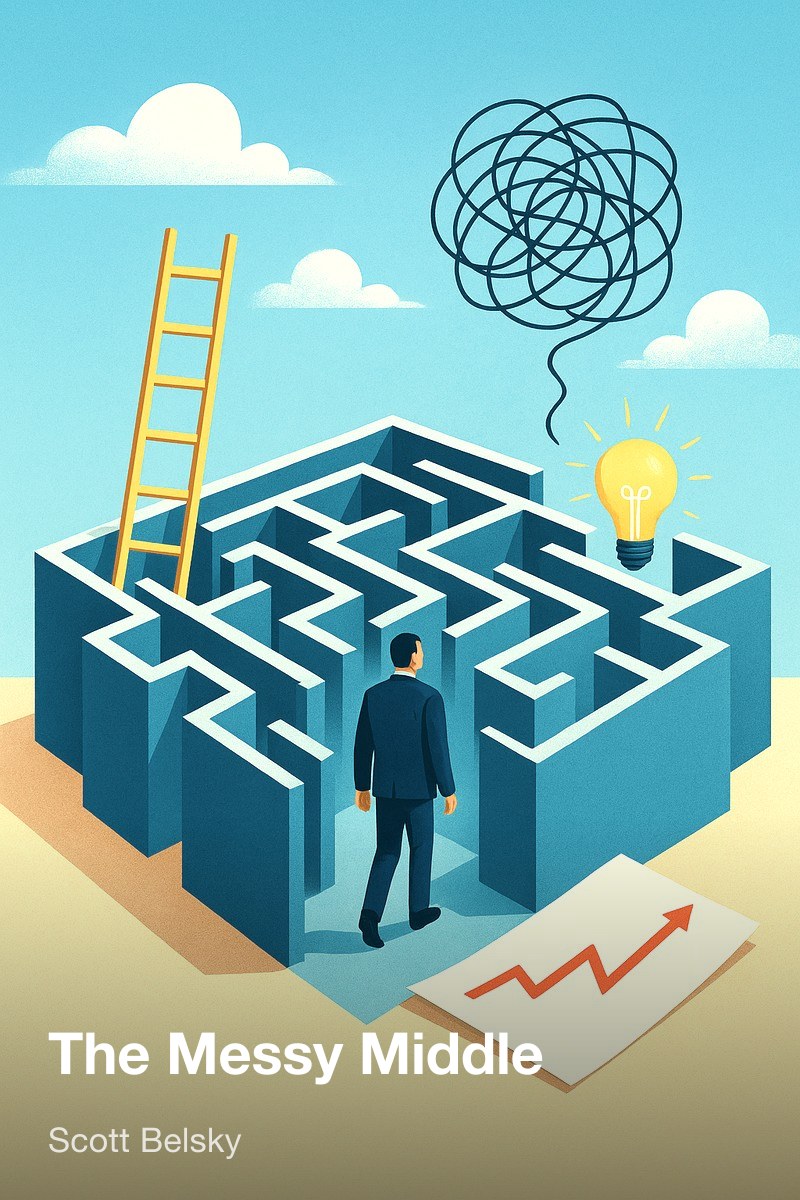
Ask a founder how their company got going and you'll hear a good story. There was a spark, a risky leap, and then a big win at the end. What you rarely hear about is everything in between. Scott Belsky says that gap is the real story, and he calls it the messy middle.
The middle is the long period after the first rush of excitement fades and before you know whether you've made it. It isn't glamorous. It's a string of ups and downs that can last years. Plenty of successful people skip over it when they tell their stories, partly because talking about it means admitting how hard it was. That leaves newcomers with a warped picture. They expect a clean climb, hit the first bump, and wonder if they're failing.
Belsky wrote The Messy Middle in 2018 to fix that picture. His argument is that the middle isn't something to get through as fast as possible. It's where you learn, where you build toughness, and where your final success gets decided. If you charge into the mess instead of dodging it, you come out with skills you couldn't have picked up any other way.
He has earned the right to say this. Belsky cofounded Behance, an online platform where creative people show off their work. Adobe bought it in 2012, and he later became Adobe's chief product officer and an executive vice president. He's also a venture partner at Benchmark, and he invested early in companies like Uber, Pinterest, and Warby Parker. His first book, Making Ideas Happen, came out in 2010 and covered how to see creative projects through to the end.
Living with uncertainty
The first big challenge in the middle is not knowing. When you start something new, you can't tell if it will work. Belsky says a good leader learns to operate without that certainty and lets the process play out.
Part of that is resisting the pull toward easy answers. When growth feels like an endless uphill walk with no clear route, it's tempting to sweep problems under the rug or settle for a quick workaround. Belsky admits he fought this urge himself. His warning is that patching a problem with a shortcut can blind you to the more original idea that would have set your business apart.
Accepting uncertainty also changes how your mind works. Belsky says that once he stopped fighting the unknown, part of his brain kept chewing on his business problems in the background, no matter what else was going on. That could be intrusive, but it fed better decisions. His tip for handling the constant hum is to focus on the single problem in front of you, like a design flaw in your product, while keeping the bigger concerns in view, like your final goal and your company's financial health.
Entrepreneurship isn't fun, and that's fine
Belsky is blunt about the second challenge. Setbacks and long stretches of hardship come with the territory.