


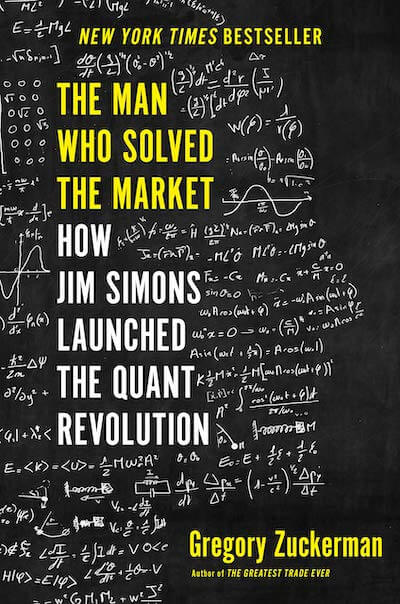
Prefer the print book? Buy on Amazon
As an Amazon Associate, Sumizeit earns from qualifying purchases.
The Man Who Solved the Market Book Summary
This The Man Who Solved the Market Book Summary covers the key ideas, lessons, and takeaways in about 20 minutes.
Short Description:
The Man Who Solved the Market tells Jim Simons’ story of quantitative investing.
Helps with these goals
Preview the The Man Who Solved the Market book summary
Below is a preview of Sumizeit’s comprehensive human-written summary of The Man Who Solved the Market by Gregory Zuckerman. The full summary is 15-20 minutes long and covers the book’s key ideas in text, audio, visual, and video formats. Unlock the full 20 Minute Summary
Jim Simons observes patterns in the financial market. And he understands behind these ups and downs is the science of mathematics.
Because of his ability to understand the market, he can predict it, which in turn, makes him a lot of money.
Simons is the most successful market investor in today’s world. But, Simons is even more than that, he is the founder of the hedge fund firm, Renaissance Technologies, a geometer, a code-breaker, and a philanthropist.
“We’re right 50.75 percent of the time . . . but we’re 100 percent right 50.75 percent of the time,” Mercer told a friend. “You can make billions that way.”- Gregory Zuckerman
In, “The Man Who Solved the Market” by Gregory Zucker you will get a good look at Simon’s life and learn some valuable information along the way.
Simons Always Loved Math
Jim Simons was born loving numbers. He was born in 1938 in Brookline, Massachusetts. Jim was an only child in his Jewish-American family. His parents were named Marcia and Matthew.
At the age of three, Simons was solving complex math equations. His parents discovered him dividing numbers by two as a toddler, all the way up to the number 1024.
Another example of Simon’s early love of math was when he was shocked, at the age of four, when his father pulled over to fill up the car with gas. Simon concluded that if the tank was half full then it would never run out, there would always be half of whatever was remaining left, no matter how small.
“Scientists and mathematicians are trained to dig below the surface of the chaotic, natural world to search for unexpected simplicity, structure, and even beauty.”- Gregory Zuckerman
Without his knowledge, four-year-old Simons had begun questioning a classic math problem. This was a problem that the Greek philosopher, Zeno, had puzzled. The question is: If you always have to travel half of the remaining distance before you get to where you want to be, how will you ever get there?
When Simons finished school he was encouraged to go into medicine by his family’s physician. However, Simons wasn’t too keen on that idea.
He decided to attend MIT to get a B.A. in mathematics. At first, he struggled and ended up failing a few tests. He decided to stop for one summer and really learn to understand the more complex mathematical theories.
“‘When I heard MIT didn’t have a football team, I knew it was the school for me,’ he says.”-Gregory Zuckerman
After that, he gained a better understanding of everything and he began to notice the universal system of math. He thought he was looking at a code that could help to explain all of life’s vast and mysterious occurrences.
Simons’ Work With Codes
Simons had many academic achievements at both MIT and Berkley. After that, he went on a lookout for a lecturing post.
Simons completed his Ph.D. at Berkeley in only two years.
Want the complete 20-minute summary?
- Full structured summary
- Video Summary
- Podcast Summary
- Audio summary
- Key takeaways
- Exercises
- Quiz
- Highlights and notes
- Ask the book with AI
Who should read The Man Who Solved the Market?
The Man Who Solved the Market is ideal for investors, finance professionals, and anyone fascinated by how mathematical genius can unlock patterns others can't see. It's also compelling for those interested in the intersection of pure mathematics, technology, and wealth creation. If you want to understand how one brilliant mind revolutionized modern finance, this biography will captivate you.
Why does The Man Who Solved the Market matter?
Jim Simons' story reveals how applying mathematical principles and algorithmic thinking to financial markets transformed not just investing but how entire industries approach problem-solving today. His legacy extends far beyond Wall Street—from sports analytics to military operations—making this a crucial case study in innovation and data-driven decision-making. Gregory Zuckerman's biography documents one of history's greatest untold business achievements with fascinating personal insights into the man behind Renaissance Technologies.
What are the key themes in The Man Who Solved the Market?
- The power of mathematics to find hidden patterns in chaotic systems
- From academia to industry: translating theoretical knowledge into practical profit
- Building genius through collaboration and recruiting brilliant minds
- Technology and computation as tools for market prediction
- The tension between financial success and personal values
- Secrecy and discretion as competitive advantages
- Giving back: using wealth for philanthropic impact
How can you apply ideas from The Man Who Solved the Market?
- Apply pattern-recognition thinking to your own industry by ignoring causal explanations and focusing purely on observable trends in your data
- Invest in technology infrastructure early, even if competitors dismiss it as wasteful, to build sustainable competitive advantages
- Build teams by identifying specific skill gaps and recruiting people whose talents complement your own rather than hiring generalists
- Use algorithmic thinking to remove emotion and bias from high-stakes decisions in your business or personal investments
- Create feedback loops where early failures force you to fundamentally rethink your approach rather than making incremental tweaks
- Maintain strategic secrecy around your proprietary methods or business insights to prevent competitors from copying your edge
- Deploy financial success toward meaningful causes aligned with your values after establishing security
What common mistakes do readers make with The Man Who Solved the Market?
- Assuming you must understand why something works before you can predict it—Simons proved prediction is possible through pattern observation alone
- Waiting for perfect causal understanding before taking action in markets or business; decisive pattern recognition beats theoretical certainty
- Spreading attention across too many problems instead of mastering core competencies and recruiting specialists for everything else
- Avoiding necessary technology investments because current methods seem sufficient; lagging competitors often realize the advantage gap too late
Sumizeit Exercises Apply what you've learned
Turn ideas from The Man Who Solved the Market into action with a short guided reflection: identify the biggest takeaway, connect it to your life, and commit to one step you can take in the next 24 hours.
What is the expert analysis of The Man Who Solved the Market?
Overview
The Man Who Solved the Market by Gregory Zuckerman offers a compelling portrait of Jim Simons, a mathematician turned hedge fund titan whose quantitative approach revolutionized financial markets. Zuckerman, a seasoned financial journalist with the Wall Street Journal, brings rigorous investigative detail and narrative flair to this biography, situating Simons not only as a market innovator but also as a code-breaker, academic, and philanthropist. The book stands out for chronicling the rise of Renaissance Technologies and its Medallion Fund, widely regarded as the most successful investment vehicle in history.
Core Thesis
Zuckerman’s central argument is that Jim Simons fundamentally transformed investing by applying advanced mathematical models and pattern recognition to financial markets, thereby “solving” aspects of market behavior previously thought inscrutable. Unlike traditional investors who rely on intuition or macroeconomic analysis, Simons and his team developed algorithms that detect subtle, repeatable patterns in market data, enabling consistent, outsized returns. The book posits that this scientific, data-driven approach not only disrupted Wall Street but also influenced broader fields reliant on predictive analytics.
Strengths
- In-depth Character Study: Zuckerman provides a nuanced portrayal of Simons’ intellectual evolution from prodigious mathematician to pioneering hedge fund manager, illuminating his motivations and challenges.
- Integration of Technical and Human Elements: The narrative balances complex mathematical concepts with accessible explanations and personal anecdotes, making sophisticated ideas comprehensible without oversimplification.
- Historical Context: The book situates Renaissance Technologies within the broader evolution of quantitative finance, including Cold War code-breaking and advances in computing, enriching the reader’s understanding of its origins.
- Insight into Hedge Fund Culture: It reveals the secretive, competitive nature of quantitative trading and the ethical and political tensions embodied by figures like Robert Mercer.
- Philanthropic Dimension: The coverage of Simons’ charitable work adds depth, portraying him as a multidimensional figure beyond financial success.
Critiques & Counterarguments
- Overemphasis on Mathematical Determinism: While the book celebrates Simons’ model-driven approach, it may understate the role of randomness and market unpredictability, potentially overstating the notion that markets can be “solved.” Behavioral economics and market anomalies challenge the idea of fully predictable patterns.
- Limited Critical Engagement with Ethical Implications: The narrative touches on controversies around Renaissance’s secrecy and Mercer’s political activities but does not deeply explore the broader societal impacts of such concentrated financial power or the ethical dilemmas posed by algorithmic trading.
- Potential Survivorship Bias: The book focuses on an extraordinary success story, which may skew perceptions of quantitative investing’s general efficacy. Many quantitative funds fail or underperform, and the text offers limited discussion of these contrasting outcomes.
- Technological and Market Evolution: Some examples and methods described reflect the technological landscape of the 1980s and 1990s; however, the book could engage more critically with how subsequent advances in AI, machine learning, and market structure might challenge or extend Simons’ original models.
- Opposing Schools of Thought: Traditional fundamental analysis and newer behavioral finance perspectives provide counterpoints to pure quantitative strategies, emphasizing qualitative factors and investor psychology that may elude algorithmic capture.
Who Should Read This
This book is ideal for readers interested in the intersection of mathematics, finance, and technology, especially those fascinated by how abstract scientific principles translate into real-world financial innovation. Academics and practitioners in quantitative finance, data science, and economics will find valuable historical and conceptual insights. Additionally, readers drawn to biographies of transformative figures who blend intellect with entrepreneurship will appreciate the detailed, engaging narrative. Finally, those curious about the ethical and political dimensions of modern finance will find thought-provoking material, albeit requiring supplementary sources for a more critical perspective.
Frequently asked questions about the The Man Who Solved the Market book summary
What is The Man Who Solved the Market about?
The Man Who Solved the Market by Gregory Zuckerman is a biography of Jim Simons, a mathematician who revolutionized finance by applying sophisticated mathematical models and algorithms to discover patterns in markets. The book traces Simons' journey from childhood prodigy through his academic career in geometry and code-breaking during the Cold War, to founding Renaissance Technologies—a hedge fund that achieved the greatest investment returns in history by treating markets as mathematical systems rather than economic phenomena.
Who should read The Man Who Solved the Market?
Anyone interested in finance, investing, mathematics, business history, or innovation will find this book compelling. It appeals equally to Wall Street professionals seeking to understand modern quantitative trading, entrepreneurs exploring how to build genius-driven organizations, and general readers fascinated by untold stories of quiet industry-transformers. You don't need financial expertise to appreciate how Simons' mathematical approach solved seemingly impossible problems.
What are the main takeaways from The Man Who Solved the Market?
Key takeaways include: mathematical thinking can unlock patterns in any domain, seemingly chaotic systems often have observable structure, strategic partnerships multiply individual genius, early technology investments create lasting competitive advantages, and observation without causal understanding can be predictively powerful. The book also illustrates how building secretive, exclusive organizations staffed with brilliant minds produces results that reshape entire industries.
How did Jim Simons apply mathematics to investing?
Simons applied mathematical models—particularly the Baum-Welch algorithm from his code-breaking days—to identify hidden market states (high variance, positive momentum, etc.) without trying to understand why markets moved. He fed massive historical data into computers and built predictive models that could anticipate market moves with only 50.75% accuracy, yet generated billions because the wins outweighed losses through careful position sizing.
What was Renaissance Technologies and why was it so successful?
Renaissance Technologies was Simons' hedge fund, particularly its flagship Medallion fund, which achieved a 66% annual return and generated over $100 billion in trading profits—the greatest investment record in history. Its success came from combining mathematical sophistication, computer power beyond what competitors possessed, secretive operations that prevented idea theft, and recruitment of the world's best mathematicians and computer scientists.
What role did Robert Mercer play at Renaissance Technologies?
Robert Mercer joined Renaissance as a brilliant computer programmer from IBM and helped identify and fix flaws in their trading systems during the 1990s. He became co-CEO alongside Simons but was eventually forced to step down after funding Donald Trump's presidential campaign, as his conservative politics clashed sharply with Simons' Democratic values and angered investors.
Did Simons try to share his trading methods or keep them secret?
Simons and Renaissance maintained extreme secrecy around their methods, deliberately avoiding media, industry conferences, and public appearances to prevent competitors from gaining any hints about their proprietary algorithms. This discretion proved to be a crucial competitive advantage that allowed Renaissance to dominate quantitative trading for decades without their edge being replicated.
What did Jim Simons do after becoming wealthy?
After achieving extraordinary financial success, Simons transitioned into philanthropy, establishing the Simons Foundation for Education and Health and the Math for America initiative. He also donated generously to Stony Brook University and Nepalese healthcare causes, demonstrating that his mathematical brilliance extended to strategically deploying wealth for social impact.
About Sumizeit
Sumizeit is a profitable Scomy LLC company based in Miami, Florida. Our founders, Clemens Raemy and Weina Scott, are successful entrepreneurs with several exits. Sumizeit is a popular book summary app / micro learning app used by busy professionals and entrepreneurs with over 2,500 non-fiction book summaries and 10,000 podcast summaries in text, audio, visual, podcast, and video format. We also have stellar retention tools to make ideas stick - such as flashcards with spaced repetition, quizzes, streaks, highlighting and notes, daily challenges, riddles, mini-courses, meditation, and more. You won't only learn the idea, but also remember it. Over 90% of our users change their habits with Sumizeit.
Upgrade Now
Here's why readers love Sumizeit
Join thousands of learners getting smarter every day
"Great experience. Detailed summaries. Loved the gamification feature. Makes learning fun. Good customer service. I recommend Sumizeit to anyone. You'll learn a lot."
"I always felt busy but still wanting to keep up with the book discussion in my friend group. This was a great supplement to help me keep reading the books I find fun while keeping up with important books."
"I love this website. Instead of scrolling social media, I find myself learning a lot. I use it everyday. I recommend this app for anyone who is too busy and wants to get up to speed with their favorite books."
The Man Who Solved the Market Book Summary PDF
Looking for a The Man Who Solved the Market Book Summary PDF you can save and revisit offline? Our The Man Who Solved the Market Book Summary PDF captures the book’s core ideas in a clean, printable format — the key frameworks, takeaways, and structure without the fluff. Download the The Man Who Solved the Market Book Summary PDF when you want a reference you can annotate, share with your team, or review on the go. Get your The Man Who Solved the Market Book Summary PDF from the download page below.
Download The Man Who Solved the Market Book Summary PDFPeople also liked these summaries
Readers who explored The Man Who Solved the Market often enjoyed these titles next.





Ready to read the whole thing?
- Full structured summary
- Video Summary
- Podcast Summary
- Audio summary
- Key takeaways
- Exercises
- Quiz
- Highlights and notes
- Ask the book with AI
Featured Book Titles
Popular Book Summaries at sumizeit, leading book summary app