


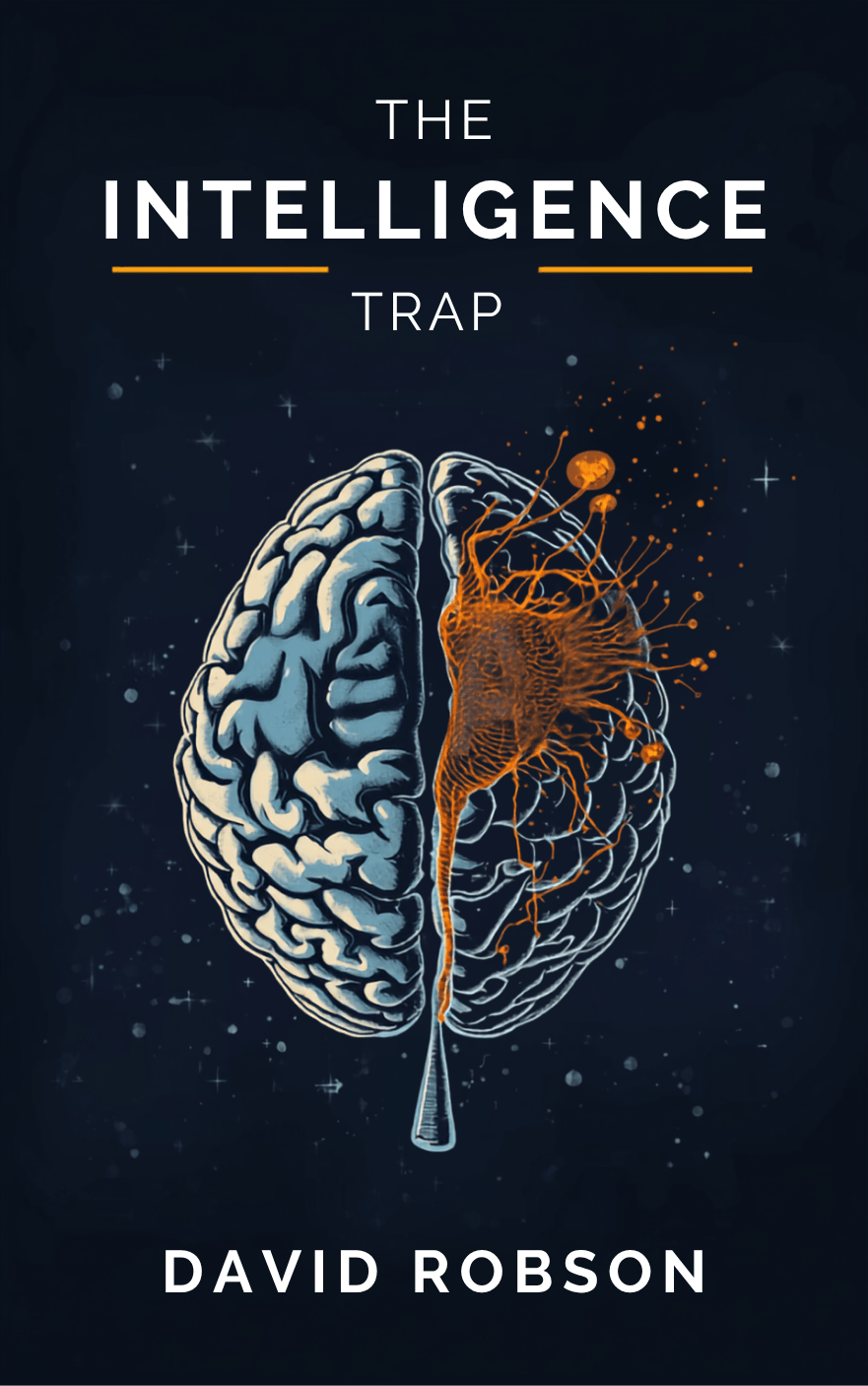
Prefer the print book? Buy on Amazon
As an Amazon Associate, Sumizeit earns from qualifying purchases.
The Intelligence Trap Book Summary
This The Intelligence Trap Book Summary covers the key ideas, lessons, and takeaways in about 20 minutes.
Short Description:
How smart people fall for bad thinking, and the habits that build real wisdom instead.
Helps with these goals
Want a Free Weekly Read?
Get a free summary every week straight to your mailbox.
Preview the The Intelligence Trap book summary
Below is a preview of Sumizeit’s comprehensive human-written summary of The Intelligence Trap by David Robson. The full summary is 15-20 minutes long and covers the book’s key ideas in text, audio, visual, and video formats. Unlock the full 20 Minute Summary
David Robson opens with a puzzle that should bother anyone who assumes book smarts and good judgment travel together: they often don't. Robson, a science journalist who has covered psychology and neuroscience for outlets like New Scientist, The Atlantic, and The Guardian, spent years digging into a strange pattern. People with high IQs, advanced degrees, and prestigious careers keep falling for scams, conspiracy theories, bad investments, and reasoning so flawed a teenager could poke holes in it. He calls this pattern the intelligence trap, and his central claim is unsettling: raw brainpower doesn't just fail to protect you from foolish thinking. In some cases, it makes the fall harder.
Consider the numbers Robson cites. Highly intelligent people show up more often in statistics around smoking, drinking, drug use, missed mortgage payments, credit card debt, and bankruptcy filings. Plenty of them also hold beliefs with zero scientific backing, from questionable health remedies to genuinely bizarre ideas about secret societies running world affairs. None of this fits the comfortable assumption that smarter people naturally make better choices. Robson pushes further and argues that intelligent people can sometimes be more susceptible to bad thinking than the average person, not less.
This matters beyond individual embarrassment. Smart people frequently end up running hospitals, banks, airlines, and governments. When their judgment fails, the damage doesn't stay contained. Robson points to medical misdiagnoses, financial meltdowns, and airline disasters as examples of what happens when brilliant people trust flawed reasoning at the worst possible moment.
The Trouble With Measuring a Mind
Before explaining why intelligence goes wrong, Robson tackles a thornier question: what does intelligence even mean? Mainstream psychology has traditionally measured it through things like memory capacity, vocabulary size, and logical reasoning ability. The assumption baked into this approach is that scoring well on these measures predicts good judgment, sound problem solving, and rational decision making across the board. Rationality, in this framework, means picking actions that actually serve your goals and forming conclusions that fit the evidence.
Robson highlights a major flaw in how this research developed. The people studied to build these definitions were overwhelmingly young men from wealthy, Western, university settings. That narrow sample became the yardstick for judging everyone else's mental capacity, and the consequences were not neutral. Robson traces how these limited definitions of intelligence got used to justify immigration quotas, racial hierarchies, segregated schooling, and forced sterilization programs. A concept meant to describe cognitive ability ended up as a tool for discrimination.
More recent researchers have tried to widen the lens, factoring in things like reading comprehension, physical coordination, pattern recognition in nature, and emotional awareness. The problem is that these broader qualities resist tidy measurement the way vocabulary tests do. Some scholars have gone even further, suggesting intelligence isn't a fixed, universal trait at all but something that depends on context. A skill considered brilliant in one setting might look useless or even foolish in another.
Want the complete 20-minute summary?
- Full structured summary
- Video Summary
- Podcast Summary
- Audio summary
- Key takeaways
- Exercises
- Quiz
- Highlights and notes
- Ask the book with AI
Who should read The Intelligence Trap?
The Intelligence Trap is for anyone who assumes that being smart automatically leads to good decisions—particularly high-achieving professionals, experts in their fields, and educated leaders who want to understand why brilliance sometimes fails them. It's equally valuable for people who want to protect themselves from their own blind spots and improve their judgment in real-world situations.
Why does The Intelligence Trap matter?
In an age of complexity, expertise, and rapid change, David Robson reveals a counterintuitive truth: intelligence alone doesn't guarantee sound judgment, and can sometimes make poor thinking harder to detect. With smart people running hospitals, banks, and governments, understanding how sharp minds talk themselves into foolish decisions has never been more urgent for individual success and institutional safety.
What are the key themes in The Intelligence Trap?
- Intelligence and wisdom are distinct—brainpower doesn't automatically produce good judgment
- Expertise can become a liability when circumstances change
- Confident people are often the worst judges of their own flaws
- Smart people can construct elaborate rationalizations for beliefs they already hold
- Cognitive biases affect everyone regardless of IQ
- Identity-driven reasoning protects beliefs rather than tests them
- Curiosity is a trainable skill that protects against overconfidence
- Wise thinking requires emotional discipline and perspective-taking
How can you apply ideas from The Intelligence Trap?
- Use Ben Franklin's moral algebra: assign numerical weights to each factor in a major decision, cross out items that balance, wait a day before deciding to avoid impulsive choices
- Build curiosity by writing down what you know and separately listing questions you can't answer, treating those gaps as mysteries your brain wants to solve
- Practice self-distancing when emotions run high by mentally observing your situation as though watching it on a screen and narrating what you see as an outside observer
- Keep an emotional journal documenting what you feel after encounters that stir reactions, using precise language to name emotions rather than generic terms
- Reframe challenging work and learning as play or puzzles worth enjoying rather than obligatory tasks to restore the natural curiosity that fades with age
- Actively hunt for information that contradicts your existing beliefs rather than reflexively dismissing it, especially in areas tied to your professional identity
- When correcting false claims, emphasize accurate information and minimize repetition of the false statement itself to avoid reinforcing the lie
- Pre-expose yourself and your team to examples of misinformation and explain why they're false to build immunity to manipulation before real-world encounters
What common mistakes do readers make with The Intelligence Trap?
- Assuming that high IQ or advanced degrees guarantee sound judgment in real-world situations and financial decisions
- Relying too heavily on expertise and failing to notice when circumstances or problems have fundamentally changed from familiar patterns
- Dismissing feedback that contradicts your conclusions rather than genuinely considering whether criticism might be valid
- Building sophisticated rationalizations for beliefs you already hold rather than objectively testing whether those beliefs are actually accurate
Sumizeit Exercises Apply what you've learned
Turn ideas from The Intelligence Trap into action with a short guided reflection: identify the biggest takeaway, connect it to your life, and commit to one step you can take in the next 24 hours.
What is the expert analysis of The Intelligence Trap?
Overview
The Intelligence Trap by David Robson is a compelling exploration of the paradox that high intelligence does not necessarily equate to sound judgment or wise decision-making. Robson, a seasoned science journalist with a focus on psychology and neuroscience, draws on extensive research and real-world examples to challenge the conventional assumption that cognitive ability alone safeguards against poor reasoning. His work is significant because it bridges the domains of intelligence research, cognitive biases, and practical wisdom, offering both diagnosis and remedy for a phenomenon that affects individuals and institutions alike.
Core Thesis
Robson’s central argument is unsettling yet illuminating: raw intelligence, measured traditionally by IQ or academic achievement, often fails to protect—and can even exacerbate—susceptibility to flawed thinking. He coins the term “intelligence trap” to describe how highly intelligent individuals can fall prey to cognitive biases, overconfidence, and motivated reasoning, leading them to defend pre-existing beliefs rather than seek truth. The book posits that intelligence divorced from wisdom, curiosity, and emotional regulation can become a liability rather than an asset. Ultimately, Robson advocates for cultivating wisdom—defined as the ability to make sound, context-sensitive decisions over time—as a crucial complement to intelligence.
Strengths
- Interdisciplinary Synthesis: Robson adeptly integrates findings from psychology, neuroscience, behavioral economics, and social science, providing a nuanced understanding of intelligence beyond narrow IQ metrics.
- Rich Examples and Case Studies: The use of real-world failures—from medical misdiagnoses to financial collapses—grounds abstract concepts in tangible consequences, enhancing the book’s urgency and relevance.
- Critical Examination of Intelligence Metrics: The historical critique of intelligence testing’s origins and its sociopolitical misuse adds depth and challenges readers to reconsider entrenched beliefs about cognitive ability.
- Practical Wisdom Framework: The book moves beyond diagnosis to offer actionable strategies—such as cultivating curiosity, weighing opposing views, emotional self-distancing, and inoculation against misinformation—that empower readers to improve their decision-making.
- Balanced Treatment of Emotions: Robson’s nuanced view on emotions as both potential pitfalls and valuable information signals enriches the discourse on rationality and human cognition.
Critiques & Counterarguments
- Potential Oversimplification of Expertise: While Robson correctly highlights the risks of schema rigidity and overconfidence, some cognitive science research suggests that expertise can also enhance adaptive flexibility and pattern recognition in novel contexts, complicating the portrayal of expertise as predominantly a liability.
- Limited Discussion of Cultural and Socioeconomic Factors: The book primarily focuses on cognitive and psychological mechanisms but could engage more deeply with how social environments, education systems, and cultural narratives shape both intelligence and wisdom.
- Evidence on Intelligence and Bias Susceptibility: Although Robson argues intelligence does not shield against biases, some studies indicate that higher cognitive ability can reduce certain biases or improve debiasing efforts, suggesting a more complex relationship than presented.
- Wisdom as a Trainable Skill: The optimistic framing of wisdom as universally trainable may underestimate the role of personality traits, life experiences, and structural constraints that influence one’s capacity for wise judgment.
- Competing Views on Rationality: Philosophers and psychologists who emphasize dual-process theories or bounded rationality might argue that Robson’s framework, while insightful, does not fully capture the interplay between intuitive and deliberative thinking in real-world decisions.
Who Should Read This
The Intelligence Trap is essential reading for anyone interested in the complexities of human cognition, particularly those who assume intelligence guarantees sound judgment. It is highly recommended for professionals in leadership roles—such as executives, policymakers, and healthcare providers—who must navigate high-stakes decisions and want to guard against cognitive pitfalls. Additionally, scholars and students of psychology, behavioral economics, and philosophy will find Robson’s synthesis and critique valuable. Finally, readers committed to personal growth and self-improvement will appreciate the book’s practical guidance on cultivating curiosity, emotional insight, and intellectual humility to complement raw intelligence with genuine wisdom.
Frequently asked questions about the The Intelligence Trap book summary
What is The Intelligence Trap about?
The Intelligence Trap by David Robson examines why highly intelligent people often make poor decisions and fall for flawed thinking, conspiracy theories, and scams despite their brainpower. Robson argues that raw intelligence doesn't protect against bad judgment and can sometimes amplify it by supplying better tools for rationalizing existing beliefs rather than testing them objectively.
Who should read The Intelligence Trap?
Anyone who wants to understand why being smart doesn't guarantee good judgment should read this book, especially high-achieving professionals, experts, and educated leaders. It's valuable for anyone seeking to improve their decision-making, protect themselves from their own blind spots, and understand how intelligence can sometimes work against sound reasoning.
What are the main takeaways from The Intelligence Trap?
The main takeaways are that intelligence and wisdom are distinct abilities, that expertise can become a liability, that cognitive biases affect everyone regardless of IQ, and that smart people often use their reasoning skills to defend existing beliefs rather than test them. Robson argues that wisdom—combining curiosity, perspective-taking, emotional discipline, and critical thinking—is trainable and more important than raw brainpower for sound judgment.
How does expertise become a liability according to Robson?
Robson explains that experts develop mental shortcuts called schemas that let them recognize familiar patterns instantly. When situations deviate from these familiar templates, however, experts may miss critical clues precisely because they're relying on learned patterns rather than examining every detail. This causes doctors to misdiagnose unusual cases and other professionals to apply outdated solutions to new problems.
What role does curiosity play in avoiding the intelligence trap?
Robson treats curiosity as one of the most valuable traits for avoiding poor thinking because curious people stay genuinely open to information that challenges what they already believe. Curiosity triggers dopamine release in the brain, which strengthens learning and memory, and it naturally protects against overconfidence and identity-driven reasoning that traps less curious thinkers.
What is the best way to correct someone's false belief?
Robson cautions against simply repeating the false claim while debunking it, since false statements are memorable and corrections fade quickly, often leaving people remembering the lie more vividly. Instead, emphasize accurate information and mention the false claim as little as possible, or use inoculation by exposing people to examples of misinformation ahead of time to build immunity to manipulation.
Can wisdom be developed or is it an inborn trait?
Robson argues that wisdom is trainable and can be systematically developed through consistent practice, unlike fixed intelligence. The components of wisdom—curiosity, fair perspective-taking, emotional regulation, and critical thinking—are all learnable skills that can be built deliberately over time.
About Sumizeit
Sumizeit is a profitable Scomy LLC company based in Miami, Florida. Our founders, Clemens Raemy and Weina Scott, are successful entrepreneurs with several exits. Sumizeit is a popular book summary app / micro learning app used by busy professionals and entrepreneurs with over 2,500 non-fiction book summaries and 10,000 podcast summaries in text, audio, visual, podcast, and video format. We also have stellar retention tools to make ideas stick - such as flashcards with spaced repetition, quizzes, streaks, highlighting and notes, daily challenges, riddles, mini-courses, meditation, and more. You won't only learn the idea, but also remember it. Over 90% of our users change their habits with Sumizeit.
Upgrade Now
Here's why readers love Sumizeit
Join thousands of learners getting smarter every day
"Great experience. Detailed summaries. Loved the gamification feature. Makes learning fun. Good customer service. I recommend Sumizeit to anyone. You'll learn a lot."
"I always felt busy but still wanting to keep up with the book discussion in my friend group. This was a great supplement to help me keep reading the books I find fun while keeping up with important books."
"I love this website. Instead of scrolling social media, I find myself learning a lot. I use it everyday. I recommend this app for anyone who is too busy and wants to get up to speed with their favorite books."
The Intelligence Trap Book Summary PDF
Looking for a The Intelligence Trap Book Summary PDF you can save and revisit offline? Our The Intelligence Trap Book Summary PDF captures the book’s core ideas in a clean, printable format — the key frameworks, takeaways, and structure without the fluff. Download the The Intelligence Trap Book Summary PDF when you want a reference you can annotate, share with your team, or review on the go. Get your The Intelligence Trap Book Summary PDF from the download page below.
Download The Intelligence Trap Book Summary PDFPeople also liked these summaries
Readers who explored The Intelligence Trap often enjoyed these titles next.


Ready to read the whole thing?
- Full structured summary
- Video Summary
- Podcast Summary
- Audio summary
- Key takeaways
- Exercises
- Quiz
- Highlights and notes
- Ask the book with AI
Featured Book Titles
Popular Book Summaries at sumizeit, leading book summary app