
Question 1 of 10


Prefer the print book? Buy on Amazon
As an Amazon Associate, Sumizeit earns from qualifying purchases.
Book Summary
The Hero with a Thousand Faces Book Summary
This The Hero with a Thousand Faces Book Summary covers the key ideas, lessons, and takeaways in about 20 minutes.
Short Description:
Campbell’s hero’s journey and the myths behind it all
The Hero with a Thousand Faces teaches that the stories humans have told for thousands of years all trace one path, and that the path is a map of your own growth. You leave what is safe, face what scares you, lose an old version of yourself, and come back changed with something worth sharing. The power that wins the journey was never handed to the hero from outside. It was inside all along, and the trial is what brings it out. When you see your own struggles as part of that ancient pattern, they stop being random pain and start to look like the middle of a story that is going somewhere.
Helps with these goals
Preview the The Hero with a Thousand Faces book summary
Below is a preview of Sumizeit’s comprehensive human-written summary of The Hero with a Thousand Faces by Joseph Campbell. The full summary is 15-20 minutes long and covers the book’s key ideas in text, audio, visual, and video formats. Unlock the full 20 Minute Summary
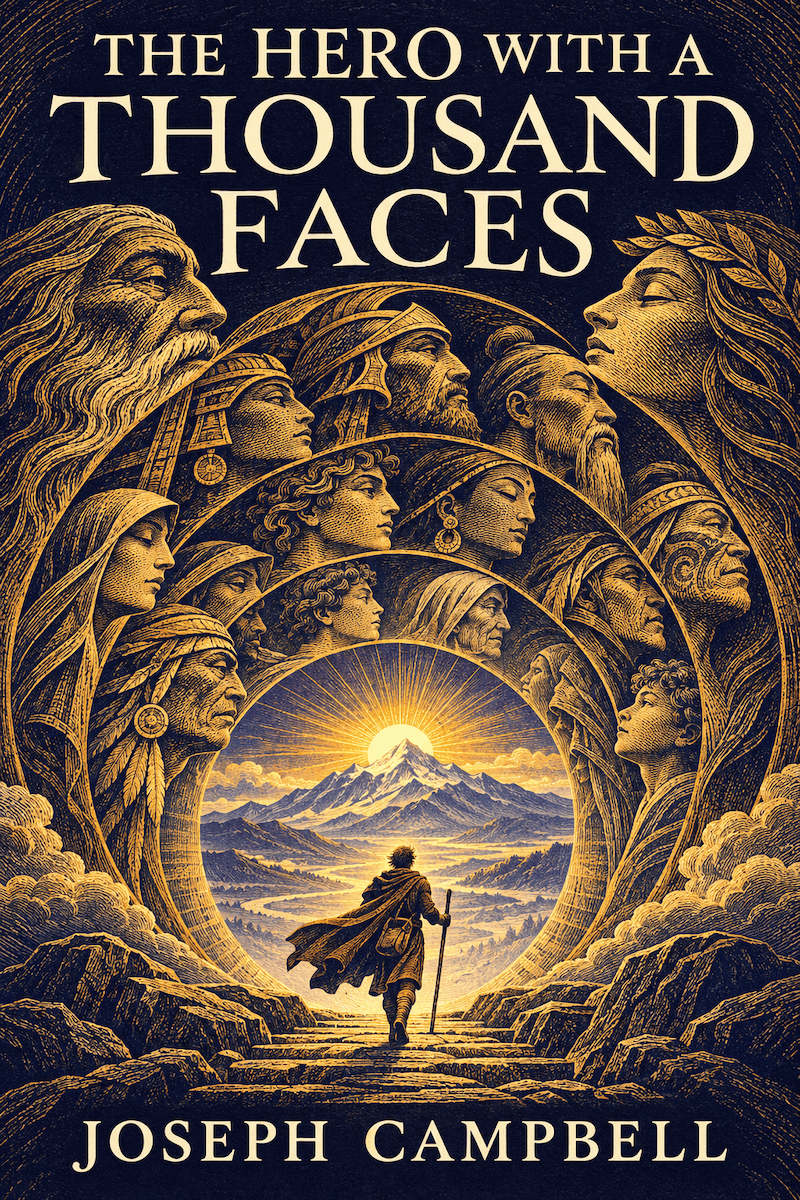
Joseph Campbell makes one big claim in this book. Myths from every corner of the world, no matter how far apart the cultures were in time or place, tell the same basic story. He calls it the monomyth, and most people know it as the hero's journey.
A hero leaves home, faces trials, goes through a kind of death and rebirth, wins a great prize, and brings it back to help everyone else. Campbell moves through Egyptian, Greek, Roman, Hindu, Buddhist, Celtic, Native American, Polynesian and Biblical tales to show the pattern again and again.
He also argues that these stories are not dusty relics. They describe what happens inside every person who grows up, faces fear, and changes. The hero is a stand in for the divine spark that sits inside all of us.
The hero and the mythological template
Heroes come in two flavors. Some are kings, warriors or scholars who already hold a high place in society. Others are nobodies from the edge of the world, often born in humble or miraculous ways. Either way, the hero sets out to fix some kind of lack. In a simple fairy tale that might mean winning a golden ring or a princess. In a story with deeper religious meaning, it means renewing the spiritual life of a whole world that is falling apart.
When the hero comes back with new powers, we learn that the spark was inside them the whole time. The journey only made it visible. That is why so many tales end with the reveal that the hero was the chosen one or the king's son. Campbell says this is the quiet point of the whole genre. The hero shows the godly potential in every one of us.
The core pattern has three rites of passage. The hero separates from the known world, goes through an initiation where they gain power, and then returns to share it. Campbell calls this the monomyth. Many myths also point to a World Navel, a sacred center where divine wisdom enters the physical world. It might be Rome for Catholics, Mecca for Muslims, or the Immovable Spot where the Buddha sat.
Two stories show the whole cycle at work. The Buddha begins as a sheltered prince who leaves his palace, cuts his hair, and lives as a harsh ascetic. That is the separation. He then sits under the Tree of Enlightenment and beats back the attacks of Mara, the god of love and death, and in the process he gains knowledge of his past lives and the chain of cause and effect. That is the initiation. At first he doubts anyone could understand his message, but the god Brahma urges him on, so he walks back into the cities to teach. That is the return.
Moses follows the same arc. He leads the Israelites out of Egypt and into the wilderness, climbs Mount Sinai to receive the Law from God, and brings it down to the people.
Campbell adds a…
Want the complete 20-minute summary?
- Full structured summary
- Video Summary
- Podcast Summary
- Audio summary
- Key takeaways
- Exercises
- Quiz
- Highlights and notes
- Ask the book with AI
Who should read The Hero with a Thousand Faces?
The Hero with a Thousand Faces is essential for anyone interested in understanding the deep patterns that connect human stories across cultures and time. Whether you're a writer, filmmaker, spiritual seeker, therapist, or simply curious about what myths reveal about the human experience, this book offers profound insights into your own journey of growth and transformation.
Why does The Hero with a Thousand Faces matter?
In an era where traditional narratives have fragmented and storytelling feels disconnected from deeper meaning, Joseph Campbell's work reminds us that the stories we tell—whether ancient myths or modern films—trace a universal pattern rooted in human psychology and spiritual development. Understanding the hero's journey helps us recognize that personal struggle and transformation are not random but part of an ancient, archetypal pattern that has guided human meaning-making for millennia.
What are the key themes in The Hero with a Thousand Faces?
- The monomyth: the universal pattern underlying myths across all cultures
- The hero's journey as a map of personal psychological and spiritual transformation
- Separation, initiation, and return as the three stages of growth
- The power of myth in binding communities and answering existential questions
- The hero's divine potential reflecting the godly spark within all humans
- Reconciling opposites and moving between material and spiritual worlds
How can you apply ideas from The Hero with a Thousand Faces?
- Recognize your personal struggles as part of a larger archetypal pattern, transforming random pain into a meaningful narrative where you are the protagonist of your own hero's journey
- Identify the 'herald' moments in your life—uncomfortable signs and calls that signal it's time to leave behind what's safe and familiar, and practice accepting rather than refusing them
- Seek out mentors and guides who appear in your life to offer protection and wisdom during transitions, and actively cultivate relationships that help you navigate the unknown
- Use myths and stories as mirrors to understand your own inner conflicts, recognizing that characters in stories—especially monsters and antagonists—often represent parts of yourself requiring integration
- Apply the three-stage structure (separation, initiation, return) to major life transitions: leaving a job, ending a relationship, moving to a new city, or undertaking any significant personal change
- Examine what 'boon' or reward you're actually seeking in major life goals; check whether you're chasing external rewards that never satisfy, or deeper self-knowledge that genuinely transforms you
- Use Campbell's framework to analyze books, films, and stories you encounter, deepening your appreciation for how storytellers tap into universal patterns that resonate across all audiences
What common mistakes do readers make with The Hero with a Thousand Faces?
- Treating myths as historical facts or primitive science rather than psychological and spiritual maps, missing their deeper meaning by focusing on literal truth claims
- Expecting the hero's reward to be external wealth, status, or immortality, rather than recognizing that lasting fulfillment comes from internal transformation and self-understanding
- Refusing the call to adventure and new growth because safety feels more comfortable, not realizing that this refusal carries its own heavy costs in stagnation and regret
- Believing you must make the hero's journey alone, overlooking the crucial role of helpers, mentors, and guides who appear to support transformation at key moments
- Failing to recognize that you are the hero of your own story, instead waiting passively for life to happen rather than consciously engaging with its challenges as opportunities for growth
Sumizeit Exercises Apply what you've learned
Turn ideas from The Hero with a Thousand Faces into action with a short guided reflection: identify the biggest takeaway, connect it to your life, and commit to one step you can take in the next 24 hours.
What is the expert analysis of The Hero with a Thousand Faces?
Overview
The Hero with a Thousand Faces is a seminal work in comparative mythology authored by Joseph Campbell, a distinguished scholar whose influence spans literature, psychology, and cultural studies. Published in 1949, the book remains a cornerstone for understanding the universal structures underlying myths across diverse cultures. Campbell’s synthesis of global mythologies into the concept of the "monomyth" or "hero’s journey" has profoundly shaped storytelling in modern media, notably impacting filmmakers and writers worldwide.
Core Thesis
At the heart of Campbell’s work lies the assertion that myths from disparate cultures share a fundamental narrative structure: the hero’s journey. This monomyth comprises three key stages—separation, initiation, and return—through which the protagonist undergoes transformation by confronting trials, death, and rebirth, ultimately bringing back a boon to their community. Campbell argues that these myths are not mere stories but symbolic representations of the psychological and spiritual growth inherent in human experience, reflecting the universal quest for self-realization and the divine potential within every individual.
Strengths
- Comprehensive Cross-Cultural Analysis: Campbell’s erudition shines in his ability to weave together myths from Egyptian, Greek, Hindu, Native American, and many other traditions, revealing striking parallels that transcend geography and epoch.
- Psychological and Spiritual Insight: By linking mythic motifs to inner psychological processes and rites of passage, Campbell provides a framework that resonates deeply with readers seeking meaning beyond literal interpretation.
- Enduring Influence on Storytelling: The articulation of the hero’s journey has become a foundational template for narrative construction in literature, film, and psychology, demonstrating the book’s lasting relevance.
- Integration of Myth and Modernity: Campbell’s recognition of psychoanalysis as a contemporary analogue to ancient mythic interpretation bridges traditional wisdom with modern thought.
Critiques & Counterarguments
- Overgeneralization and Reductionism: Critics argue that Campbell’s monomyth can oversimplify the rich diversity of myths by forcing them into a single narrative mold, potentially erasing cultural specificity and nuance.
- Selective Evidence: The book’s sweeping claims occasionally rest on selective readings of myths, privileging those that fit the pattern while marginalizing contradictory or atypical stories.
- Psychological Interpretations Debated: While Campbell’s Jungian-influenced approach is compelling, alternative psychological frameworks (e.g., cognitive or evolutionary psychology) offer differing explanations for mythic patterns, challenging the universality of the monomyth.
- Historical and Cultural Contexts Underemphasized: Some scholars highlight that Campbell’s focus on archetypal themes downplays the socio-political and historical conditions that shape myth-making, which can be critical for a full understanding.
- Modern Mythology and Variations: The book’s framework struggles to accommodate contemporary narratives that subvert or reject traditional heroic structures, such as postmodern or non-linear storytelling.
Who Should Read This
The Hero with a Thousand Faces is essential reading for scholars and enthusiasts of mythology, literature, psychology, and philosophy, as well as creative professionals in storytelling and media. It offers profound insights for those interested in the universal patterns of human experience and the symbolic language of transformation. Readers seeking a deep, archetypal understanding of narrative and personal growth will find Campbell’s work both inspiring and foundational, though it should be engaged with critically and supplemented by culturally specific studies and contemporary theoretical perspectives.
Discussion questions for The Hero with a Thousand Faces Short questions you can actually use in a conversation
Frequently asked questions about the The Hero with a Thousand Faces book summary
What is The Hero with a Thousand Faces about?
The Hero with a Thousand Faces by Joseph Campbell argues that myths from cultures around the world—Egyptian, Hindu, Buddhist, Celtic, Native American, and many others—all follow the same underlying pattern, which Campbell calls the monomyth or hero's journey. He shows that this universal pattern reflects the psychological and spiritual transformation every human undergoes when facing fear, growing up, and changing, revealing that the divine potential mythologists attribute to heroes actually exists within all of us.
Who should read The Hero with a Thousand Faces?
Anyone seeking to understand the deeper meaning in stories, whether as a writer, filmmaker, student of culture, therapist, or person navigating major life changes, will find value in this book. It appeals to those interested in comparative mythology, psychology, spiritual development, and the universal patterns that connect human experience across time and cultures. Even casual readers who want to recognize themselves in the stories they encounter will gain profound insights.
What are the main takeaways from The Hero with a Thousand Faces?
The main takeaway is that your personal journey of growth follows the same ancient pattern as myths told across millennia: you leave what is safe, face what scares you, lose your old self, and return changed with something worth sharing. Campbell teaches that the power to transform was never handed to you from outside—it was always inside, and trials simply bring it out. Understanding your struggles as part of this archetypal pattern transforms them from random suffering into the meaningful middle of a story going somewhere.
How does the hero's journey structure work?
The hero's journey unfolds in three major stages: separation (the hero leaves home after receiving a call to adventure, often with help from supernatural guides and after facing threshold guardians), initiation (the hero faces trials, descends into underworlds, meets inner demons and goddesses, and achieves enlightenment or a transcendent realization), and return (the hero brings the prize or wisdom back to their community, often facing obstacles in reintegrating the two worlds). This three-part structure appears across myths from every culture.
What is the monomyth?
The monomyth, also called the hero's journey, is Joseph Campbell's term for the universal narrative pattern underlying myths worldwide. It describes how a hero leaves home, faces trials and transformations, and returns with new power or wisdom to benefit their community. Campbell demonstrates that whether examining Babylonian, Egyptian, Greek, Hindu, Buddhist, Christian, or Native American stories, the basic pattern remains remarkably consistent, suggesting it reflects something fundamental about human psychology and spiritual growth.
How does Campbell connect myths to modern psychology?
Campbell argues that ancient myths served as psychological and spiritual guidance that storytellers and mystics provided for their communities, helping people understand and navigate fear and change. Today, psychoanalysts fill much of that role by interpreting dreams and exploring the unconscious mind. When you work with a therapist to understand your own psychology and inner struggles, Campbell suggests, you are essentially taking your own version of the hero's journey into the depths of the self.
Does the hero's journey apply to real life?
Yes, Campbell argues that the monomyth is not just a literary pattern but a description of what happens inside every person who grows up, faces fear, and changes. Major life transitions—leaving home, ending relationships, changing careers, recovering from illness—follow the hero's journey structure of separation, initiation, and integration. Recognizing your personal struggles within this archetypal pattern transforms suffering from meaningless pain into the meaningful middle of your own transformative story.
About Sumizeit
Sumizeit is a profitable Scomy LLC company based in Miami, Florida. Our founders, Clemens Raemy and Weina Scott, are successful entrepreneurs with several exits. Sumizeit is a popular book summary app / micro learning app used by busy professionals and entrepreneurs with over 2,500 non-fiction book summaries and 10,000 podcast summaries in text, audio, visual, podcast, and video format. We also have stellar retention tools to make ideas stick - such as flashcards with spaced repetition, quizzes, streaks, highlighting and notes, daily challenges, riddles, mini-courses, meditation, and more. You won't only learn the idea, but also remember it. Over 90% of our users change their habits with Sumizeit.
Upgrade Now
Here's why readers love Sumizeit
Join thousands of learners getting smarter every day
"Great experience. Detailed summaries. Loved the gamification feature. Makes learning fun. Good customer service. I recommend Sumizeit to anyone. You'll learn a lot."
"I always felt busy but still wanting to keep up with the book discussion in my friend group. This was a great supplement to help me keep reading the books I find fun while keeping up with important books."
"I love this website. Instead of scrolling social media, I find myself learning a lot. I use it everyday. I recommend this app for anyone who is too busy and wants to get up to speed with their favorite books."
The Hero with a Thousand Faces Book Summary PDF
Looking for a The Hero with a Thousand Faces Book Summary PDF you can save and revisit offline? Our The Hero with a Thousand Faces Book Summary PDF captures the book’s core ideas in a clean, printable format — the key frameworks, takeaways, and structure without the fluff. Download the The Hero with a Thousand Faces Book Summary PDF when you want a reference you can annotate, share with your team, or review on the go. Get your The Hero with a Thousand Faces Book Summary PDF from the download page below.
Download The Hero with a Thousand Faces Book Summary PDFPeople also liked these summaries
Readers who explored The Hero with a Thousand Faces often enjoyed these titles next.





Ready to read the whole thing?
- Full structured summary
- Video Summary
- Podcast Summary
- Audio summary
- Key takeaways
- Exercises
- Quiz
- Highlights and notes
- Ask the book with AI
Featured Book Titles
Popular Book Summaries at sumizeit, leading book summary app
Atomic Habits Book Summary Rich Dad Poor Dad Book Summary The Four Agreements Book Summary The 48 Laws of Power Book Summary When Breath Becomes Air Book Summary Think and Grow Rich Book Summary