


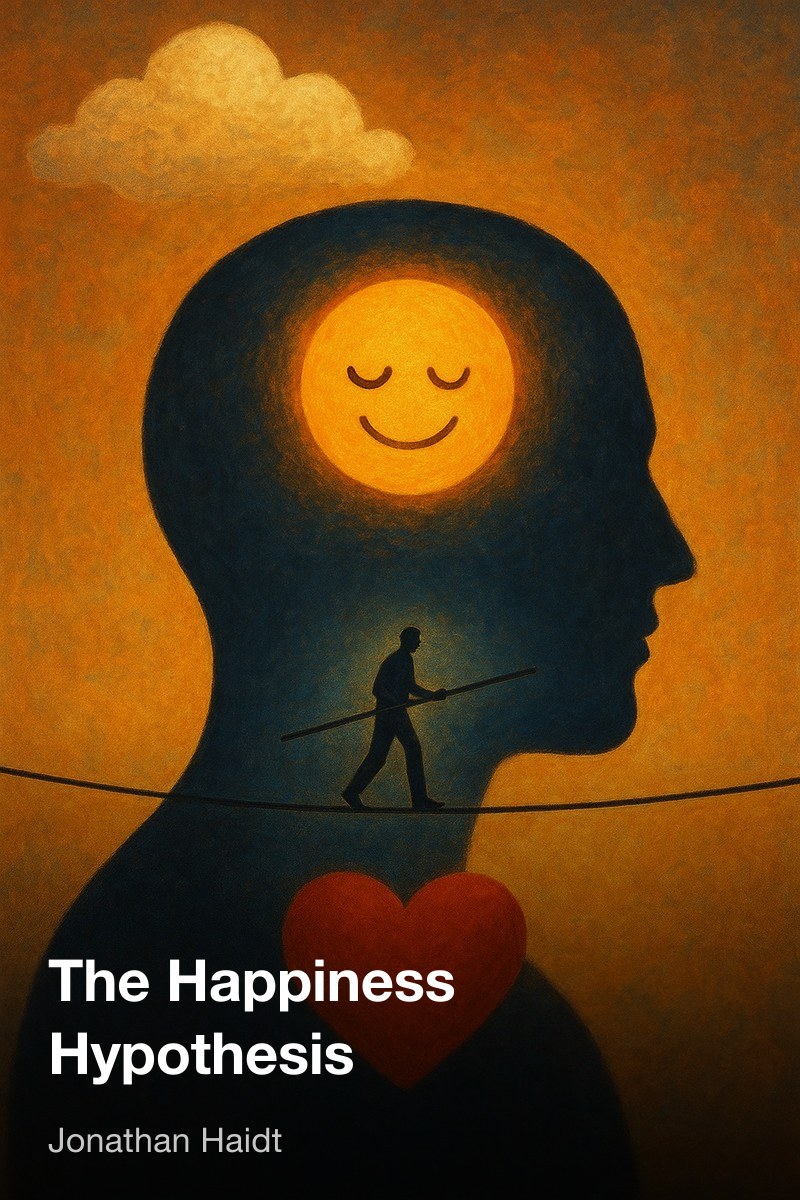
Prefer the print book? Buy on Amazon
As an Amazon Associate, Sumizeit earns from qualifying purchases.
The Happiness Hypothesis Book Summary
This The Happiness Hypothesis Book Summary covers the key ideas, lessons, and takeaways in about 20 minutes.
Want the complete 20-minute summary?
- Full structured summary
- Video Summary
- Podcast Summary
- Audio summary
- Key takeaways
- Exercises
- Quiz
- Highlights and notes
- Ask the book with AI
Want a Free Weekly Read?
Get a free summary every week straight to your mailbox.
What is in the The Happiness Hypothesis book summary?
Below is a preview of Sumizeit’s expert-written summary of The Happiness Hypothesis by Jonathan Haidt. The full summary covers the book’s key ideas in text, audio, and video.
Everybody wants to be happy. That part is easy. The hard part is figuring out how, and people have been arguing about it for thousands of years.
Jonathan Haidt takes a smart approach. He goes back to the big ideas from Buddha, Confucius, the Greek philosophers, the Bible, the Hindu scriptures, and even Freud. Then he checks each one against what modern psychology has actually found. Some of the old wisdom holds up really well. Some of it gets things badly wrong. Most of it lands somewhere in between.
His core point is simple. How satisfied you feel with life comes down to your emotions. And your emotions come from the way your mind filters and reads what happens to you. The events matter less than your interpretation of them.
The trouble is that your mind isn't one unified thing. It's split. One part feels and wants. The other part thinks and plans. They pull against each other all day long, and feeling usually wins.
So what's the answer? Haidt says the West got it half right and the East got it half right. Western thinking tells you to chase goals and win. Eastern thinking tells you to drop your desires and let go. Neither works on its own. The real move is to use your thinking mind to steer away from wants that only give you a quick hit, and to lean into the wants that actually leave you fulfilled.
The rider and the elephant
Haidt's big image for the mind is a person riding an elephant. Once you get this picture, the rest of the book falls into place.
The rider is your reasoning mind. It's the voice in your head that plans, weighs options, and explains things. The elephant is everything else. Your gut reactions, your emotions, your instincts, your automatic habits. The elephant is huge and strong and has a mind of its own.
The rider can suggest a direction. The rider can nudge. But if the elephant really wants to go somewhere else, the elephant goes. In a straight fight, emotion beats reason almost every time.
That explains a lot. It's why you eat the cake you swore you'd skip. It's why you snap at someone you love even while part of you knows you'll regret it. It's why a random, inappropriate thought pops into your head at a funeral.
Haidt is careful here, though. This isn't a war with a winner and a loser. Reason and emotion work as partners, even if emotion is usually the senior one. Good reasoning makes you emotionally smarter. Good emotional sense makes your reasoning sharper. The goal is to get them working together.
Four ways your mind is divided
The rider and elephant picture covers a lot, but Haidt shows the split runs through the brain in four specific ways.
The first split is between your head and your gut. Your autonomic nervous system handles a bunch of body functions on its own.
Want the complete 20-minute summary?
- Full structured summary
- Video Summary
- Podcast Summary
- Audio summary
- Key takeaways
- Exercises
- Quiz
- Highlights and notes
- Ask the book with AI
Who should read The Happiness Hypothesis?
The Happiness Hypothesis is for anyone seeking to understand why they feel the way they do and how to build a more satisfying life. Whether you're struggling with motivation, relationships, or simply want to know what psychology and ancient wisdom say about contentment, this book offers practical insights. It's especially valuable for people willing to examine their own thinking patterns and open to perspectives from both modern science and centuries-old traditions.
Why does The Happiness Hypothesis matter?
In a world where self-help advice is everywhere, Jonathan Haidt grounds his recommendations in actual research and ancient wisdom, showing which traditional ideas about happiness hold up and which don't. Understanding how your mind divides between reason and emotion can explain why you struggle with willpower and why your goals so often feel hollow once achieved. This book helps you see yourself clearly and gives you concrete, evidence-based ways to reshape your life for lasting contentment rather than fleeting pleasure.
What are the key themes in The Happiness Hypothesis?
- The mind as a rider (reason) and elephant (emotion), where emotion usually wins
- Negativity bias and how bad things affect us more than good things
- Adaptation and the hedonic treadmill—why winning feels temporary
- Reciprocity and social connection as central to happiness
- Virtue and character development as a path to fulfillment
- The importance of meaningful work and purpose
- Love and attachment across the lifespan
- The role of shared sacred experiences in human communities
Want the complete 20-minute summary?
- Full structured summary
- Video Summary
- Podcast Summary
- Audio summary
- Key takeaways
- Exercises
- Quiz
- Highlights and notes
- Ask the book with AI
How can you apply ideas from The Happiness Hypothesis?
- Shape your environment to make good choices easy—stock fruit instead of junk food, put your gym clothes out the night before, arrange your space so healthy habits require less willpower
- When stuck in a painful thought loop, catch the thought, name it, and replace it with something more realistic rather than fighting it directly
- Practice writing about difficult experiences for 15 minutes to process them and fit them into your life story, which improves health and reduces doctor visits
- Deliberately spend money on experiences and time with people rather than status goods, since experiences create lasting memories and deepen relationships
- Seek work that uses your strengths and connects to a larger purpose, even if that means reframing a current job to see its bigger meaning
- Apologize genuinely when you're wrong without defending yourself, which triggers reciprocity and often leads the other person to own their part too
- Identify your character strengths and actively practice developing them through daily choices, building virtue as you would build muscle
What common mistakes do readers make with The Happiness Hypothesis?
- Relying only on willpower to resist impulses, when reshaping your environment would be far more effective
- Believing that once you reach a goal, you'll feel happy forever—the adaptation principle means you'll likely drift back to your baseline quickly
- Assuming that pursuing money, status, and possessions will significantly increase happiness, when research shows connection and purpose matter far more
- Treating your emotions as something to conquer rather than as a crucial part of yourself that deserves understanding and partnership
Sumizeit Exercises Apply what you've learned
Turn ideas from The Happiness Hypothesis into action with a short guided reflection: identify the biggest takeaway, connect it to your life, and commit to one step you can take in the next 24 hours.
What is the expert analysis of The Happiness Hypothesis?
Overview
The Happiness Hypothesis, authored by Jonathan Haidt, stands as a landmark work at the intersection of psychology, philosophy, and self-improvement literature. Haidt, a respected social psychologist with a distinguished academic career, synthesizes ancient wisdom from diverse traditions—Buddhism, Confucianism, Greek philosophy, and religious texts—with contemporary scientific research. Published in 2006, this book bridges millennia of human thought on happiness with the rigor of modern empirical findings, making it significant not only for scholars but also for a broad readership seeking a nuanced understanding of well-being.
Core Thesis
At its core, The Happiness Hypothesis argues that happiness arises from the complex interplay between our emotional and rational minds—metaphorically depicted as the "elephant" and the "rider," respectively. Haidt posits that while emotions (the elephant) often dominate our behavior, reason (the rider) can guide and shape these impulses toward lasting fulfillment. He critiques simplistic Western or Eastern prescriptions for happiness—whether relentless goal pursuit or total desire renunciation—and instead advocates a balanced approach: harnessing reason to steer emotional drives toward meaningful, enduring wants rather than fleeting pleasures. Happiness, therefore, is less about external events and more about how our divided minds interpret and respond to those events.
Strengths
- Interdisciplinary Synthesis: Haidt masterfully weaves together philosophy, religion, neuroscience, and psychology, offering readers a panoramic view of happiness that respects both ancient insights and modern data.
- Accessible Metaphors: The rider-elephant analogy elegantly captures the tension between reason and emotion, making complex psychological concepts intuitively graspable without oversimplification.
- Balanced Perspective: By acknowledging the limitations of both Western and Eastern approaches, Haidt avoids ideological extremes and promotes a pragmatic middle path that resonates across cultures.
- Practical Application: The book provides actionable strategies—such as meditation, cognitive therapy, and shaping one’s environment—to cultivate happiness, grounded in empirical evidence.
- Rich Exploration of Morality and Social Connection: Haidt’s treatment of reciprocity, attachment theory, and virtue ethics situates happiness within the social and moral fabric of human life, emphasizing relational and communal dimensions often neglected in self-help literature.
Critiques & Counterarguments
- Potential Overreliance on Metaphor: While the rider-elephant model is compelling, it risks oversimplifying the nuanced and dynamic interactions within the brain’s emotional and cognitive systems, which contemporary neuroscience reveals as more integrated and less hierarchical than the metaphor suggests.
- Selective Use of Evidence: Haidt’s synthesis occasionally leans on studies that support his thesis while giving less attention to conflicting research, such as critiques of the universality of attachment styles or the variability of affective set points across cultures.
- Underestimation of Structural Factors: The book’s emphasis on individual agency and internal mental states may underplay the role of socioeconomic conditions, systemic inequality, and cultural context in shaping happiness, areas where external realities can limit personal control.
- Philosophical Debates on Desire: Haidt’s rejection of total desire renunciation aligns with a pragmatic view but contrasts with deep philosophical traditions (e.g., Stoicism, certain Buddhist schools) that argue for radical detachment as a path to tranquility, suggesting a richer engagement with these perspectives might nuance his argument.
- Complexity of Moral Reasoning: Haidt critiques Kantian and utilitarian ethics as overly rationalistic, yet these frameworks continue to offer robust models for ethical decision-making. Emerging research in moral psychology also highlights the interplay of intuition and reasoning in ways that complicate a simple rider-elephant dichotomy.
Who Should Read This
The Happiness Hypothesis is ideally suited for readers who seek a sophisticated, well-rounded exploration of happiness beyond superficial self-help platitudes. It appeals to intellectually curious individuals interested in psychology, philosophy, and spirituality who appreciate evidence-based insights blended with historical and cultural depth. Scholars and practitioners in psychology and related fields will find Haidt’s integration of diverse disciplines stimulating, while general readers will benefit from its clear prose and practical guidance. Those grappling with the complexities of human motivation, morality, and emotional life will find this book a valuable companion in their quest for a meaningful and balanced life.
Frequently asked questions about the The Happiness Hypothesis book summary
What is The Happiness Hypothesis about?
The Happiness Hypothesis by Jonathan Haidt examines ancient wisdom about happiness against modern psychology research to reveal what actually works. The core insight is that your happiness depends less on what happens to you than on how your mind interprets events, and that your mind is split between reason (the rider) and emotion (the elephant), with emotion usually winning. Haidt shows how to align these parts and build a life around relationships, meaningful work, and purpose.
Who should read The Happiness Hypothesis?
This book is for anyone curious about why they feel the way they do and how to build lasting contentment. It appeals to people interested in psychology, philosophy, and self-improvement who want evidence-based rather than trendy advice. Whether you're struggling with relationships, career satisfaction, or simply wondering what happiness actually is, Haidt offers insights that bridge ancient traditions and modern science in practical ways.
What are the main takeaways from The Happiness Hypothesis?
The main takeaways are that happiness comes from relationships, meaningful work, and connection to something bigger than yourself—not from money or achievement alone. Your mind is divided between reason and emotion, so you can't force happiness through willpower. Instead, you reshape your environment and practice good habits until your emotional side wants the right things. Finally, the best life involves balancing personal freedom with shared values and community, and seeing adversity as a chance for growth rather than defeat.
How does the rider and elephant metaphor explain human behavior?
The rider represents your conscious, reasoning mind that plans and explains. The elephant represents your automatic emotions, instincts, and habits. The elephant is huge and powerful, so when it wants something, the rider usually can't stop it—which is why you eat cake despite promising yourself you wouldn't. The goal isn't to fight the elephant but to train it by shaping what it sees and rewarding what you want it to want.
Why do we feel worse about losses than we feel good about gains?
Humans have a built-in negativity bias because our ancestors survived by being extra alert to threats. Missing an opportunity usually wasn't fatal, but misjudging a danger could kill you instantly. So evolution wired us to feel losses more intensely than equivalent gains, which is why losing $100 feels worse than gaining $100 feels good.
Does The Happiness Hypothesis recommend meditation, therapy, or medication?
Haidt shows all three work for moving your baseline happiness upward. Meditation loosens your grip on attachments that fuel negative thinking. Cognitive therapy breaks painful thought loops by teaching you to catch and replace distorted thoughts. Medication like SSRIs addresses chemical imbalances that keep you stuck. He rejects the idea that medication is cheating—fixing your brain's wiring is as legitimate as fixing any physical problem.
Does money make you happy according to this book?
Money makes a significant difference when you're poor and struggling to meet basic needs like food and safety. Once you have enough, each additional dollar adds surprisingly little to happiness. What matters far more is meaningful work, strong relationships, and a sense of purpose. Research shows wealthy people aren't much happier than poor people, despite their financial advantages.
How does The Happiness Hypothesis explain why helping others makes us happy?
Haidt shows that acts of kindness genuinely raise happiness across all groups, with especially strong effects in older adults who gain purpose and wider social circles through volunteering. This happens because humans are wired for reciprocity—the urge to help those who help us. Helping others satisfies this deep social need and creates the kind of gratification that keeps paying off long after the moment ends.
About Sumizeit
Sumizeit is a profitable Scomy LLC company based in Miami, Florida. It has been helping readers learn from nonfiction books for 7 years with expert-written summaries in text, audio, podcast, and video.
Want the complete 20-minute summary?
- Full structured summary
- Video Summary
- Podcast Summary
- Audio summary
- Key takeaways
- Exercises
- Quiz
- Highlights and notes
- Ask the book with AI
Here's why readers love Sumizeit
Join thousands of learners getting smarter every day
"Great experience. Detailed summaries. Loved the gamification feature. Makes learning fun. Good customer service. I recommend Sumizeit to anyone. You'll learn a lot."
"I always felt busy but still wanting to keep up with the book discussion in my friend group. This was a great supplement to help me keep reading the books I find fun while keeping up with important books."
"I love this website. Instead of scrolling social media, I find myself learning a lot. I use it everyday. I recommend this app for anyone who is too busy and wants to get up to speed with their favorite books."
The Happiness Hypothesis Book Summary PDF
Looking for a The Happiness Hypothesis Book Summary PDF you can save and revisit offline? Our The Happiness Hypothesis Book Summary PDF captures the book’s core ideas in a clean, printable format — the key frameworks, takeaways, and structure without the fluff. Download the The Happiness Hypothesis Book Summary PDF when you want a reference you can annotate, share with your team, or review on the go. Get your The Happiness Hypothesis Book Summary PDF from the download page below.
Download The Happiness Hypothesis Book Summary PDFPeople also liked these summaries
Readers who explored The Happiness Hypothesis often enjoyed these titles next.




Want the complete 20-minute summary?
- Full structured summary
- Video Summary
- Podcast Summary
- Audio summary
- Key takeaways
- Exercises
- Quiz
- Highlights and notes
- Ask the book with AI
Featured Book Titles
Popular Book Summaries at sumizeit, leading book summary app