


Prefer the print book? Buy on Amazon
As an Amazon Associate, Sumizeit earns from qualifying purchases.
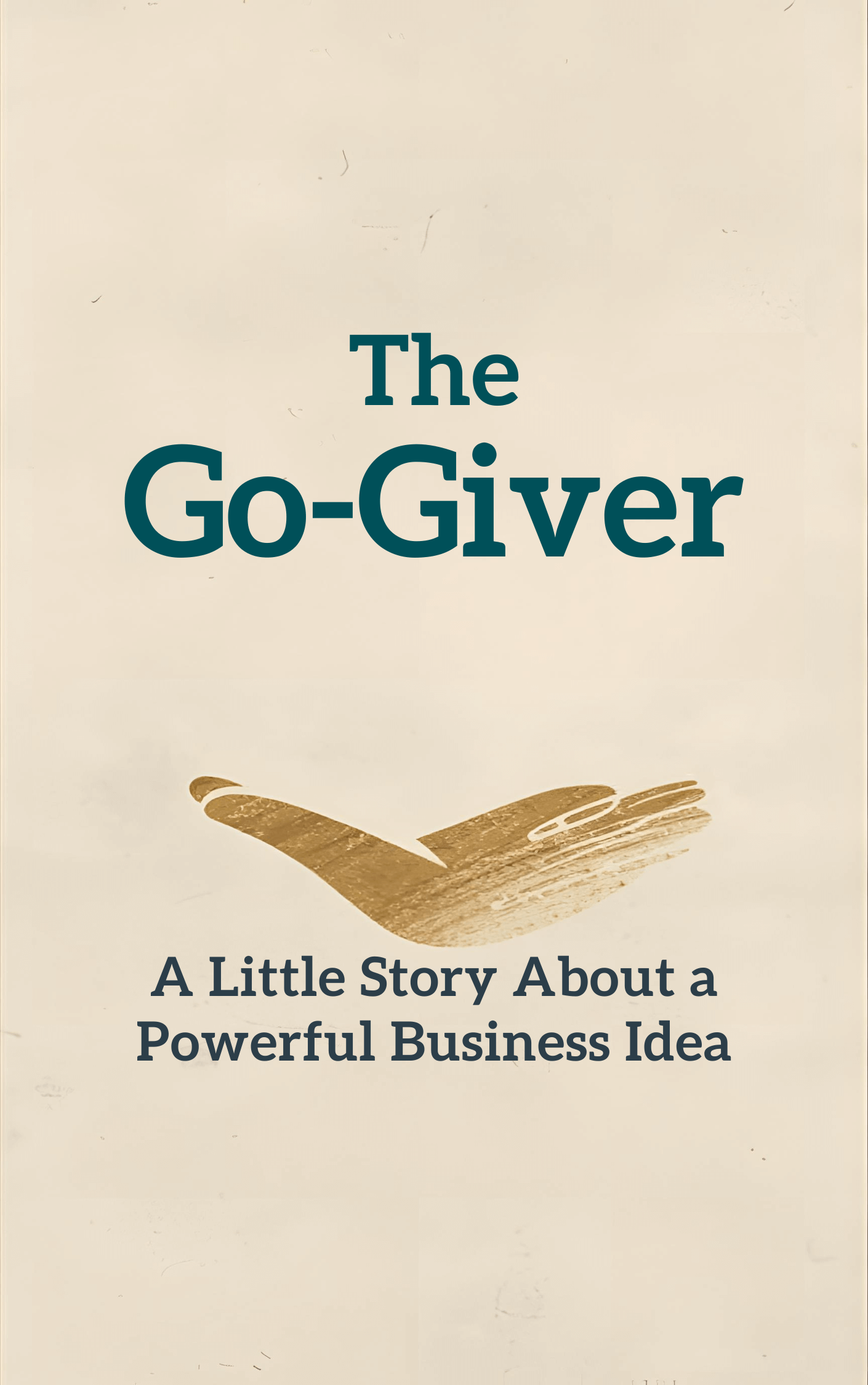
The Go-Giver Book Summary
This The Go-Giver Book Summary covers the key ideas, lessons, and takeaways in about 20 minutes.
Short Description:
The Go-Giver teaches success comes from making others’ lives better.
Money, influence, and recognition are not goals to chase, but outcomes to allow. When value creation becomes the priority, rewards follow naturally—often in ways that cannot be engineered.
The five principles work together as a system:
Value without expectation
Service without limits
Influence without manipulation
Authenticity without performance
Receptivity without guilt
This framework does not promise ease. Giving requires courage, patience, and trust. But the book argues that it is the only path that leads to both achievement and fulfillment.
Helps with these goals
Want the complete 20-minute summary?
- Full structured summary
- Video Summary
- Podcast Summary
- Audio summary
- Key takeaways
- Exercises
- Quiz
- Highlights and notes
- Ask the book with AI
Want a Free Weekly Read?
Get a free summary every week straight to your mailbox.
Preview the The Go-Giver book summary
Below is a preview of Sumizeit’s comprehensive human-written summary of The Go-Giver by Bob Burg,John D. Mann. The full summary is 15-20 minutes long and covers the book’s key ideas in text, audio, visual, and video formats. Unlock the full 20 Minute Summary
At the heart of The Go-Giver is a challenge to one of the most deeply ingrained beliefs in modern business culture: the idea that success comes from relentless pursuit, aggressive competition, and personal gain. The book rejects the conventional wisdom that you must chase results, close harder, and outmaneuver others to win. Instead, it introduces a radically different operating system for achievement—one built on contribution, service, and trust.
Rather than presenting this philosophy as a dry manifesto or instructional guide, the authors choose a narrative format. Through a short but carefully structured parable, readers follow the journey of a driven professional whose familiar tactics stop working. As his usual methods fail, he is forced to confront an uncomfortable possibility: what if the very mindset he believes will make him successful is the thing holding him back?
The story unfolds over a single week, during which the protagonist is introduced to five principles that redefine what value, influence, income, authenticity, and success truly mean. Each principle is revealed through lived experience rather than abstract theory. By the end, the reader sees not just what the ideas are, but how they operate in real relationships, businesses, and lives.
Joe’s Crisis: When Hustle Stops Paying Off
Joe is portrayed as a classic high performer—ambitious, intelligent, disciplined, and deeply committed to his career. He measures progress by quarterly targets, client wins, and upward mobility. On paper, he is doing everything right.
Yet at the moment the story begins, Joe is losing ground.
A key client leaves. A major opportunity slips through his fingers. His confidence is shaken, not because he lacks ability, but because effort is no longer translating into results. The harder he pushes, the more resistance he encounters. What frustrates him most is that he believes he deserves better outcomes—he has followed the rules as he understands them.
In desperation, Joe seeks advice from a legendary business figure known for extraordinary success and influence. He expects tactics, leverage, or insider access. What he receives instead is something profoundly unsettling: a claim that Joe’s entire approach to success is backward.
This moment sets the tone for the book. Joe is not failing because he lacks skill or ambition. He is failing because his orientation is inward rather than outward. He is focused on extracting value instead of creating it.
The Mentor Who Refuses to Teach Tactics
Joe’s guide through this transformation is an enigmatic, quietly powerful man who does not position himself as a guru or savior. He does not lecture. He does not provide shortcuts. Instead, he issues a challenge.
Over five days, Joe will be introduced to five individuals. Each person embodies a distinct principle. Joe must apply each lesson immediately in his own life, without delay or negotiation. No theoretical agreement is enough. Only action counts.
This structure matters. The book insists that generosity is not an idea to admire but a discipline to practice. Each principle must be lived before it can be understood.
What makes the mentor compelling…
Want the complete 20-minute summary?
- Full structured summary
- Video Summary
- Podcast Summary
- Audio summary
- Key takeaways
- Exercises
- Quiz
- Highlights and notes
- Ask the book with AI
Who should read The Go-Giver?
The Go-Giver is ideal for professionals, entrepreneurs, and leaders who feel stuck despite effort and want to understand why traditional competitive approaches are failing them. It's also valuable for anyone seeking to align personal success with authentic values and meaningful relationships. Whether you're in sales, management, or any field where influence matters, this book challenges you to reconsider what drives real achievement.
Why does The Go-Giver matter?
In an era of burnout, transactional relationships, and zero-sum thinking, The Go-Giver by Bob Burg and John D. Mann offers a counterintuitive operating system for sustainable success. It directly challenges the hustle-harder mentality that dominates modern business culture and demonstrates that generosity, authenticity, and service create stronger outcomes than aggression or self-protection. This philosophy matters today because it reconnects ambition with meaning, showing that you don't have to compromise integrity to achieve remarkable results.
What are the key themes in The Go-Giver?
- Contribution creates success more reliably than competition
- Value is measured by benefit delivered, not price charged
- Generosity is strategic, not sacrificial
- Authenticity builds influence more powerfully than performance
- Giving and receiving are interdependent, not opposed
- Trust compounds over time and multiplies opportunities
Want the complete 20-minute summary?
- Full structured summary
- Video Summary
- Podcast Summary
- Audio summary
- Key takeaways
- Exercises
- Quiz
- Highlights and notes
- Ask the book with AI
How can you apply ideas from The Go-Giver?
- Identify one client or colleague you're struggling with and focus on solving their problem better than before, even if it benefits a competitor
- Reframe your role description from defending territory to solving problems, and notice how your daily decisions shift
- Practice saying 'I don't know' or 'I was wrong' in professional settings to build authenticity and invite deeper connection
- Create a habit of asking 'How can I make this person's situation better?' before pursuing your own gain in a transaction
- Expand your definition of success from quarterly targets to meaningful relationships built over time, and measure your progress accordingly
- Spend one week prioritizing listening and presence in conversations instead of efficiency, and observe how trust changes
- Help someone achieve their goal without expectation of direct return, and track how opportunities emerge over the following months
What common mistakes do readers make with The Go-Giver?
- Assuming that generosity means underpricing or self-sacrifice rather than strategic contribution that respects your own worth
- Giving with hidden expectations of immediate reciprocity, which defeats the purpose and creates transactional relationships
- Confusing authenticity with oversharing; vulnerability is powerful but must be appropriate to context and relationship
- Treating the five principles as techniques to manipulate others rather than as a genuine reorientation of values and behavior
Sumizeit Exercises Apply what you've learned
Turn ideas from The Go-Giver into action with a short guided reflection: identify the biggest takeaway, connect it to your life, and commit to one step you can take in the next 24 hours.
What is the expert analysis of The Go-Giver?
Overview
The Go-Giver, authored by Bob Burg and John D. Mann, stands as a significant contribution to contemporary business and self-improvement literature. By weaving philosophical insights into a narrative parable, the book challenges the dominant paradigms of success rooted in competition and self-interest. Burg, a seasoned speaker on ethical leadership, and Mann, a skilled storyteller and business writer, combine their expertise to craft a work that transcends typical business manuals. Their collaboration offers a fresh lens on achievement, emphasizing generosity, authenticity, and relational trust as foundational to lasting success.
Core Thesis
The central argument of The Go-Giver is that true success is not the product of aggressive self-promotion or relentless pursuit of personal gain, but rather the natural consequence of creating genuine value for others. The authors propose a paradigm shift from an inward, transactional mindset to an outward, contribution-focused orientation. Through five interrelated laws—value defined by others’ benefit, income as a function of impact, influence through prioritizing others, authenticity as a differentiator, and the necessity of receiving—the book articulates a holistic framework where generosity and trust catalyze both professional achievement and personal fulfillment.
Strengths
- Innovative Narrative Structure: The use of a parable to communicate complex business and ethical principles makes the material accessible and engaging, allowing readers to internalize lessons experientially rather than abstractly.
- Integration of Personal and Professional Domains: By demonstrating that the same principles apply in relationships beyond business, the book bridges the often artificial divide between work and life, underscoring the universality of its message.
- Emphasis on Authenticity and Vulnerability: The focus on genuine presence and humility counters prevalent notions of performative professionalism, offering a refreshing and psychologically astute perspective.
- Practical Application: The insistence on immediate action and lived experience of each principle encourages readers to move beyond intellectual assent to behavioral change.
- Ethical Reorientation: The book situates generosity and service not as altruistic ideals detached from business realities but as strategic imperatives that yield sustainable success.
Critiques & Counterarguments
- Potential Oversimplification: The parable format, while engaging, risks glossing over the complexities and systemic barriers present in real-world business environments, such as power dynamics, structural inequalities, and competitive market forces.
- Limited Empirical Evidence: The book’s claims rely heavily on anecdotal narrative rather than rigorous data or case studies, which may challenge its applicability across diverse industries and cultural contexts.
- Idealism vs. Pragmatism: Critics might argue that the emphasis on generosity and trust underestimates the necessity of strategic self-interest and negotiation in certain competitive sectors, where zero-sum dynamics prevail.
- Competing Schools of Thought: Traditional economic theories emphasizing rational self-interest and game theory suggest that cooperation must be balanced with competitive tactics; The Go-Giver may understate these tensions.
- Reception and Reciprocity Complexities: The final law on receiving acknowledges the paradox of generosity but may not fully address psychological or cultural factors that inhibit receptivity, such as pride, mistrust, or social conditioning.
Who Should Read This
The Go-Giver is ideally suited for professionals, entrepreneurs, and leaders seeking to recalibrate their approach to success by integrating ethical considerations and relational depth into their work. It appeals to readers interested in personal development that transcends mere technique, especially those open to exploring the interplay between mindset, behavior, and long-term influence. Additionally, individuals grappling with burnout or disillusionment in highly competitive environments may find the book’s reframing of achievement both inspiring and practical. Finally, its accessible narrative makes it a valuable resource for educators and coaches aiming to foster values-driven leadership.
Frequently asked questions about the The Go-Giver book summary
What is The Go-Giver about?
The Go-Giver by Bob Burg and John D. Mann is a business parable that challenges conventional success wisdom by arguing that sustainable achievement comes from contribution and service rather than competition and self-interest. Through the story of a struggling professional who learns five key principles from a mentor, the book demonstrates how generosity, authenticity, and trust create more reliable success than hustle or manipulation.
Who should read The Go-Giver?
The Go-Giver is essential for professionals, entrepreneurs, and leaders whose traditional competitive approaches are failing them or who feel disconnected from their work. It's also valuable for anyone in sales, management, or influence-based roles who wants to succeed without compromising integrity. The book appeals to readers seeking to align ambition with authentic values and meaningful relationships.
What are the main takeaways from The Go-Giver?
The five main principles are: value is defined by benefit delivered, not price; income is a function of impact and reach; influence grows when you prioritize others' interests; authenticity is your ultimate differentiator; and receiving completes the giving cycle. Collectively, these principles teach that success is a consequence of making other people's lives better, not a direct target to chase.
Is The Go-Giver just about business?
No. While The Go-Giver uses business scenarios, its principles apply equally to personal relationships, family dynamics, and any context involving influence or connection. The book explicitly demonstrates that authenticity, generosity, and trust strengthen both professional and personal integrity without separation.
Does The Go-Giver suggest giving away your work for free?
No. The Go-Giver does not advocate underpricing or self-sacrifice. Instead, it distinguishes between the price you charge and the value you create. The goal is to deliver benefit that exceeds expectations while respecting your own worth and maintaining healthy boundaries.
How does The Go-Giver explain why generosity works?
The Go-Giver explains that generosity works because it builds trust, which compounds into opportunities and relationships over time. When you consistently prioritize others' interests without scorekeeping, people naturally reciprocate—not from obligation but from goodwill. This creates networks where value flows back indirectly and often unexpectedly.
Can The Go-Giver's principles work in competitive industries?
Yes. The Go-Giver actually argues that contribution-based approaches work better in competitive industries than traditional aggressive tactics. By focusing on solving client problems exceptionally well and building genuine relationships, you create differentiation and loyalty that competitors cannot easily replicate.
About Sumizeit
Sumizeit is a profitable Scomy LLC company based in Miami, Florida. Our founders, Clemens Raemy and Weina Scott, are successful entrepreneurs with several exits. Sumizeit is a popular book summary app / micro learning app used by busy professionals and entrepreneurs with over 2,500 non-fiction book summaries and 10,000 podcast summaries in text, audio, visual, podcast, and video format. We also have stellar retention tools to make ideas stick - such as flashcards with spaced repetition, quizzes, streaks, highlighting and notes, daily challenges, riddles, mini-courses, meditation, and more. You won't only learn the idea, but also remember it. Over 90% of our users change their habits with Sumizeit.
Upgrade Now
Want the complete 20-minute summary?
- Full structured summary
- Video Summary
- Podcast Summary
- Audio summary
- Key takeaways
- Exercises
- Quiz
- Highlights and notes
- Ask the book with AI
Here's why readers love Sumizeit
Join thousands of learners getting smarter every day
"Great experience. Detailed summaries. Loved the gamification feature. Makes learning fun. Good customer service. I recommend Sumizeit to anyone. You'll learn a lot."
"I always felt busy but still wanting to keep up with the book discussion in my friend group. This was a great supplement to help me keep reading the books I find fun while keeping up with important books."
"I love this website. Instead of scrolling social media, I find myself learning a lot. I use it everyday. I recommend this app for anyone who is too busy and wants to get up to speed with their favorite books."
The Go-Giver Book Summary PDF
Looking for a The Go-Giver Book Summary PDF you can save and revisit offline? Our The Go-Giver Book Summary PDF captures the book’s core ideas in a clean, printable format — the key frameworks, takeaways, and structure without the fluff. Download the The Go-Giver Book Summary PDF when you want a reference you can annotate, share with your team, or review on the go. Get your The Go-Giver Book Summary PDF from the download page below.
Download The Go-Giver Book Summary PDFPeople also liked these summaries
Readers who explored The Go-Giver often enjoyed these titles next.



Want the complete 20-minute summary?
- Full structured summary
- Video Summary
- Podcast Summary
- Audio summary
- Key takeaways
- Exercises
- Quiz
- Highlights and notes
- Ask the book with AI
Featured Book Titles
Popular Book Summaries at sumizeit, leading book summary app