Question 1 of 5
Which four chemical units make up DNA, as described in the summary?
The summary states DNA is built from four nucleotides: adenine, cytosine, guanine, and thymine (A, C, G, and T).


Prefer the print book? Buy on Amazon
As an Amazon Associate, Sumizeit earns from qualifying purchases.
This The Gene Book Summary covers the key ideas, lessons, and takeaways in about 20 minutes.
Helps with these goals
Want a Free Weekly Read?
Get a free summary every week straight to your mailbox.
Below is a preview of Sumizeit’s comprehensive human-written summary of The Gene by Siddhartha Mukherjee. The full summary is 15-20 minutes long and covers the book’s key ideas in text, audio, visual, and video formats. Unlock the full 20 Minute Summary
Everything about your body, from your toenails to your brain, follows instructions written in your genes. That is the starting point for Siddhartha Mukherjee's book The Gene. He wrote it for ordinary readers who want to know what genes are, how scientists found them, and where the science is headed.
The book runs from Charles Darwin to modern gene editing, and it spends as much time on the people as on the biology. Mukherjee is a cancer doctor, and cancer is at heart a disease of damaged genes, so the subject sits close to his own work. The book came out in 2016, and I'll point out a few things that have changed since.
Mukherjee opens in 1859, when Darwin published On the Origin of Species. Darwin had studied finches in the Galapagos Islands and noticed that birds on different islands had different beaks. One kind was built for cracking nuts. Another was good at digging insects out of bark.
His explanation was simple. Traits that help an animal survive and reproduce get passed on, while less useful traits get crowded out. Each island had slightly different conditions, so over time the finches split into distinct types. Other ideas were around, like creationism and catastrophism, but neither explained how species change.
Darwin could describe what evolution produced. He couldn't say how it worked. His guess was that cells shed tiny particles he called gemmules, which traveled through the blood and blended from both parents in their child. He named the idea pangenesis. It also meant an injury or a lifetime of building muscle could get inherited. That is wrong in most of its details, though a few modern researchers think it wasn't entirely off. Some studies suggest traumatic experiences leave chemical marks that pass to offspring. Most scientists remain unconvinced.
In 1864, an Augustinian friar named Gregor Mendel made the next leap. He bred pea plants that differed in height, flower color, and other obvious ways, and he tracked what happened over generations.
His big finding was that traits get passed on whole. Cross a purple flowered plant with a white flowered one and the offspring come out purple. They aren't pale purple, and they aren't a mix. That went against the popular belief that traits blend. If traits stay intact, Mendel reasoned, heredity must run on separate units. He called them factors.
He also laid down two rules. The first is segregation. Every organism carries two copies of each gene, one from each parent, and passes on just one copy of each pair at random. The second is independent assortment. Genes travel separately, so blond hair doesn't have to come with blue eyes.
In the 1890s the Dutch botanist Hugo de Vries saw how the pieces fit. Mendel's units of heredity explained what Darwin had observed. The two men had been describing one theory from different ends.
De Vries added a…
The Gene is for anyone curious about how heredity works and why it matters to medicine and identity. Whether you're a student seeking foundational knowledge, a patient with a genetic condition, or simply someone wondering how DNA shapes who you are, Mukherjee's narrative style makes complex biology accessible. The book appeals equally to those interested in the ethical dilemmas surrounding gene editing and those wanting to understand the history behind today's genetic breakthroughs.
Gene editing, personalized medicine, and genetic testing are reshaping healthcare and raising urgent ethical questions about who decides which traits to eliminate or enhance. Siddhartha Mukherjee's The Gene provides essential context for understanding these debates by tracing how we discovered genes, decoded them, and learned to manipulate them—while showing why the eugenics era remains a crucial warning. As genetic technologies become more powerful and accessible, the moral choices Mukherjee explores will increasingly affect our health, our rights, and our society.
Turn ideas from The Gene into action with a short guided reflection: identify the biggest takeaway, connect it to your life, and commit to one step you can take in the next 24 hours.
The Gene by Siddhartha Mukherjee stands as a landmark work that bridges the complex science of genetics with the broader human narrative. Mukherjee, an accomplished immunologist, geneticist, and cancer physician, leverages his dual expertise as a scientist and storyteller to craft a comprehensive history and exploration of genetics. Published in 2016, this book follows his Pulitzer Prize-winning The Emperor of All Maladies, continuing his mission to make intricate biomedical topics accessible and deeply relevant to a general audience. Its significance lies not only in elucidating the biological mechanisms of heredity and mutation but also in confronting the ethical and societal implications of genetic knowledge and technology.
Mukherjee’s central argument is that genes are fundamental blueprints shaping our bodies, health, and identities, yet they never act in isolation. The interplay between genes and environment—through mechanisms such as gene regulation, epigenetic modifications, and environmental triggers—creates the dynamic complexity of life. The book traces the scientific journey from Darwin’s observations and Mendel’s laws through to modern genomics and gene editing technologies like CRISPR. Mukherjee underscores that while genetic science empowers us to treat diseases and potentially redesign ourselves, it also imposes profound ethical responsibilities, especially in light of historical abuses like eugenics and the contemporary dilemmas posed by germline editing.
The Gene is essential reading for anyone seeking a profound yet accessible understanding of genetics’ past, present, and future. It is particularly valuable for:
Ultimately, Mukherjee’s work invites a sophisticated audience to reflect on the power and limits of genetic science, urging a responsible stewardship of this transformative knowledge.
Try a few questions from the The Gene quiz. Unlock the full summary for the full quiz and answers that will help the ideas stick.
Question 1 of 5
The summary states DNA is built from four nucleotides: adenine, cytosine, guanine, and thymine (A, C, G, and T).
Question 2 of 5
The summary explains segregation: every organism carries two copies of each gene and passes on just one copy of each pair at random.
Question 3 of 5
The summary says Avery, MacLeod, and McCarty showed that DNA, not protein, carries genetic information.
Question 4 of 5
The summary credits Thomas Morgan with breeding fruit flies and finding linkage; his student Sturtevant then used this to map gene positions.
Question 5 of 5
The summary states Sanger sequenced a full genome in 1977: the virus Phi X174, about 5,400 base pairs.
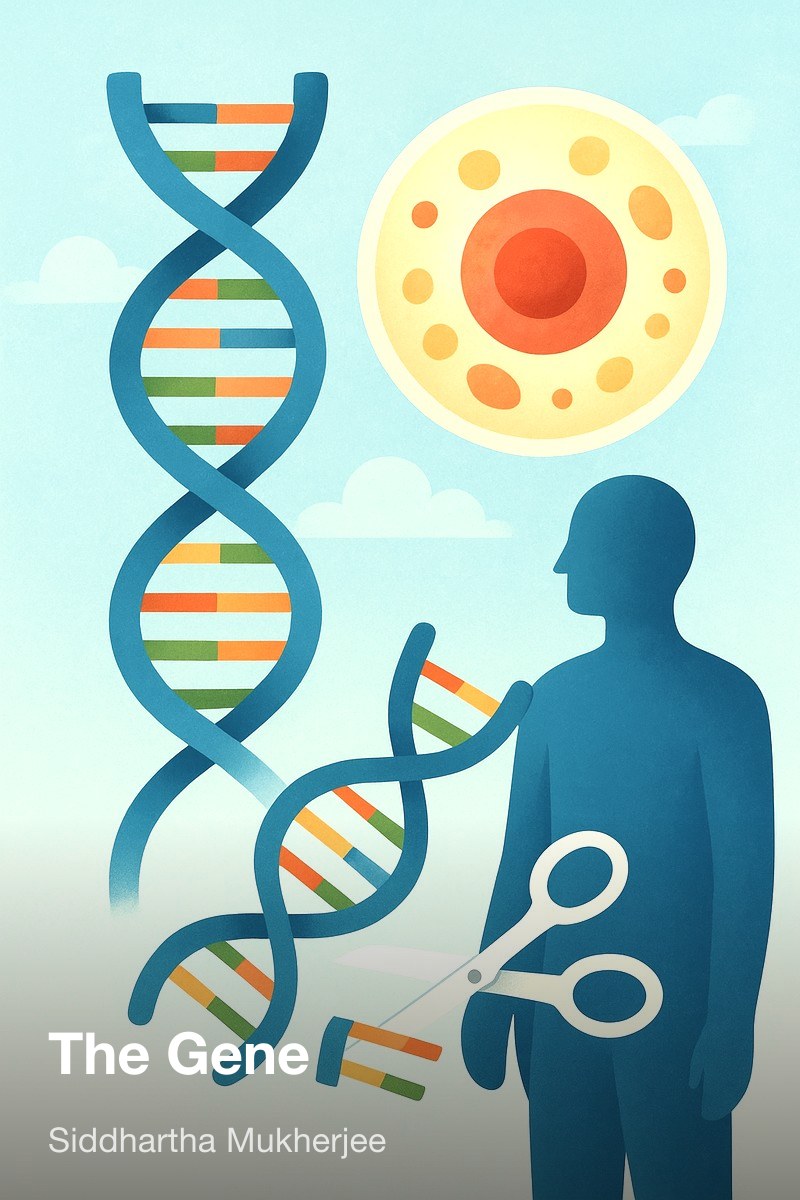
The Gene by Siddhartha Mukherjee is a history of genetics that traces how scientists discovered genes, decoded DNA, and learned to edit them. The book spans from Darwin's observations of evolution to modern CRISPR technology, explaining the science while emphasizing that genes shape us but never work alone—environment matters just as much. Mukherjee also explores the ethical implications of gene editing, drawing on the dark history of eugenics to show why these new powers demand careful moral consideration.
The Gene is ideal for anyone wanting to understand how heredity works and why genetic science matters today. This includes students seeking foundational knowledge, patients or families affected by genetic conditions, healthcare professionals broadening their perspective, and engaged citizens facing ethical debates about gene editing and genetic testing. Mukherjee writes for general readers without assuming scientific background, making complex biology accessible to anyone curious about genes and identity.
The central message is that genes shape our bodies and health but never determine our fate alone—environment constantly switches genes on and off and leaves marks on them. Key takeaways include understanding that human genetic variation is too small to support racial categories, that gene therapy offers real medical hope but faces practical limits, and that germline editing raises profound ethical questions we must answer before proceeding. Mukherjee emphasizes that the eugenics era remains a crucial lesson: partial genetic knowledge in the wrong hands leads to horror, so we must approach gene editing with humility and moral seriousness.
Mukherjee traces genetics from Darwin's observations of finches through Mendel's experiments with peas, then Morgan's fruit flies, and finally to the discovery that DNA carries genetic information. He shows how each scientist built on predecessors, revealing genes as discrete units that travel on chromosomes and are made of DNA. The narrative culminates in the Human Genome Project and modern gene editing, emphasizing how understanding the science requires knowing the people who made the discoveries and the debates that shaped the field.
Mukherjee argues that the nature-versus-nurture debate is fundamentally misframed—genes and environment are inseparable. Genes set up tendencies and potentials, but environment determines whether those tendencies activate. Identical twins prove this: they share all genes but diverge if their life circumstances differ. He also explains that environment leaves chemical marks on genes themselves, affecting which genes turn on or off throughout life. This integrated view shows why genetic knowledge alone can't predict who someone will become.
CRISPR is a genetic tool that uses an enzyme to cut DNA at a precise location, allowing scientists to remove or insert genetic sequences. Mukherjee explains that CRISPR offers potential to fix harmful mutations and treat genetic diseases, but it has real limits: it's difficult to apply across all cells in the body, it doesn't always work as intended, and it can sometimes edit the wrong location, potentially causing new mutations. These technical challenges, combined with ethical concerns, mean CRISPR is powerful but not a simple cure-all.
Mukherjee treats eugenics as an essential warning because it shows what happens when partial genetic knowledge meets the desire to control human reproduction. He argues the idea was immoral from the start under Francis Galton, not just in its Nazi applications, because it violates reproductive freedom and human dignity. By reviewing this history, Mukherjee reminds readers that as we gain power to edit genes, we must remember that earlier generations used incomplete science to justify horrific decisions. The eugenics era teaches humility about the limits of our knowledge and the dangers of playing god.
Mukherjee explains that genetic testing can now identify inherited diseases before birth or early in life, offering hope for intervention. However, he notes that diseases come in different forms: single-gene disorders like sickle cell anemia are straightforward, chromosomal problems like Down syndrome involve whole chromosomes, and complex diseases like heart disease involve many genes plus environment. Understanding which type of disease someone carries helps doctors and patients make informed decisions about treatment and lifestyle, but genetic information doesn't guarantee outcomes—environment remains crucial.
Sumizeit is a profitable Scomy LLC company based in Miami, Florida. It has been helping readers learn from nonfiction books for 7 years with expert-written summaries in text, audio, podcast, and video.
Join thousands of learners getting smarter every day
"Great experience. Detailed summaries. Loved the gamification feature. Makes learning fun. Good customer service. I recommend Sumizeit to anyone. You'll learn a lot."
"I always felt busy but still wanting to keep up with the book discussion in my friend group. This was a great supplement to help me keep reading the books I find fun while keeping up with important books."
"I love this website. Instead of scrolling social media, I find myself learning a lot. I use it everyday. I recommend this app for anyone who is too busy and wants to get up to speed with their favorite books."
Looking for a The Gene Book Summary PDF you can save and revisit offline? Our The Gene Book Summary PDF captures the book’s core ideas in a clean, printable format — the key frameworks, takeaways, and structure without the fluff. Download the The Gene Book Summary PDF when you want a reference you can annotate, share with your team, or review on the go. Get your The Gene Book Summary PDF from the download page below.
Download The Gene Book Summary PDFReaders who explored The Gene often enjoyed these titles next.
Popular Book Summaries at sumizeit, leading book summary app